What Is an AI Audit? Four Types Every Business Should Know
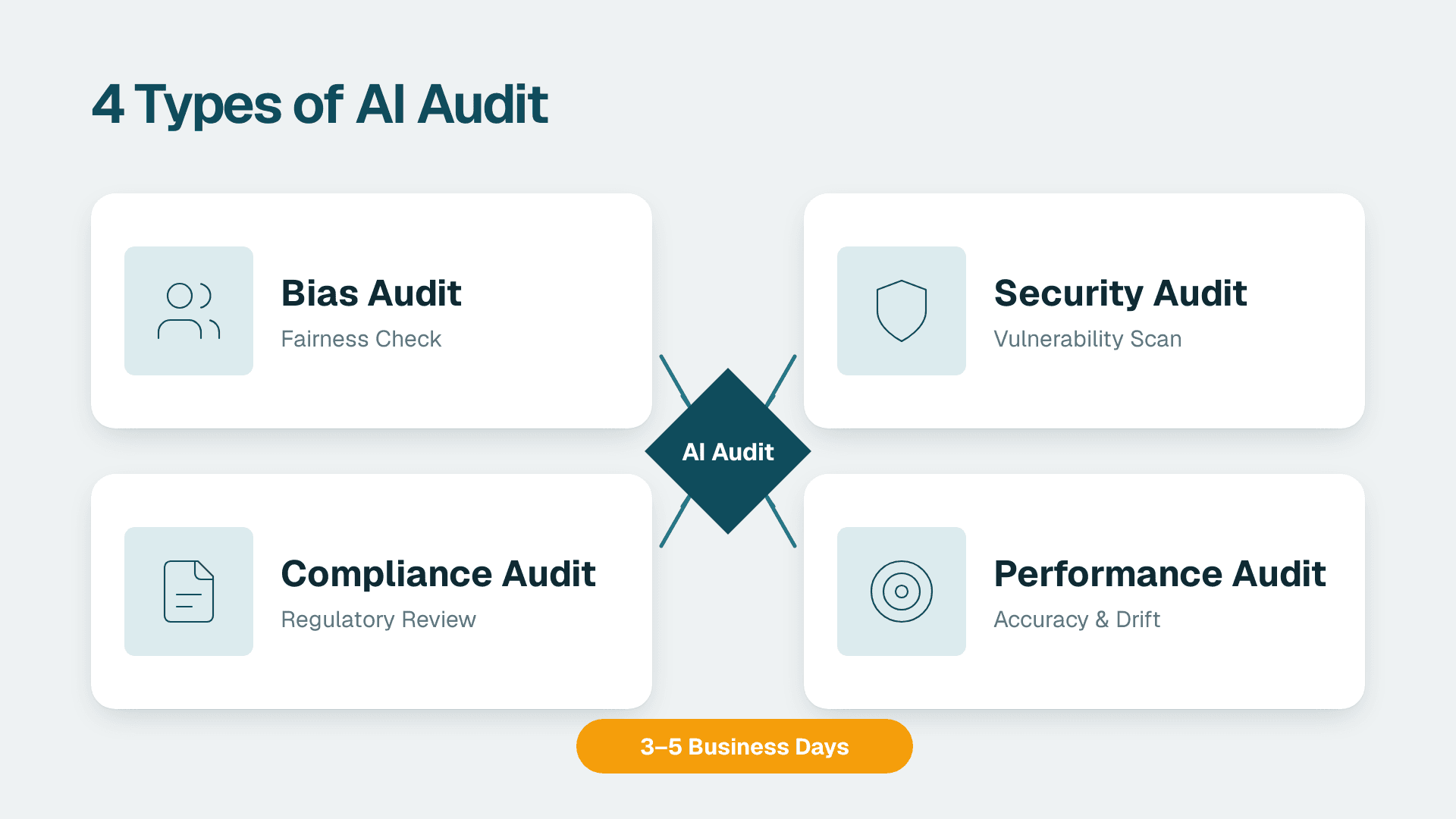
An AI audit is a structured review that examines whether the AI tools and automated processes inside a business are operating correctly, fairly, and safely. It covers four distinct areas - bias, security, compliance, and performance - and typically takes three to five business days to complete. The goal is not to evaluate whether AI is a good idea, but to verify that the AI already in use is doing what you think it is.
Key Takeaways
An AI audit covers four distinct types - bias, security, compliance, and performance - each designed to catch a different category of failure
Any business running AI-assisted pricing, routing, customer service, or financial reporting is a candidate for an audit, regardless of company size
Data quality problems are the most common finding in performance audits at small and mid-size businesses
Compliance obligations vary by geography: SOC 2 in the US, GDPR in the UK and EU, and PIPEDA in Canada each carry different requirements for AI systems
Preparing a vendor and data inventory before the audit begins reduces engagement time and produces higher-quality findings
What Is an AI Audit, and Why Does It Matter to Operations Teams?
An AI audit is an independent, evidence-based assessment of an AI system's inputs, logic, outputs, and internal controls. Unlike a general technology review, it focuses on the places where automation fails silently - producing skewed recommendations, exposing sensitive data, breaching a regulation, or reporting metrics that look correct but are not.
The term is sometimes used interchangeably with AI readiness assessment, but the two serve different purposes. A readiness assessment asks whether a business is positioned to deploy AI effectively. An audit asks whether AI already in production is performing as intended. Lets Viz's AI readiness assessment (fixed price, 5 days) combines both in a structured engagement that examines current tool performance alongside future investment priorities.
For operations leaders at growing companies in wholesale distribution, logistics, manufacturing, professional services, or ecommerce, the case for an audit is direct: it tells you whether the automation driving your pricing, routing, or revenue reporting is actually working.
What Are the Four Types of AI Audit?
The field has converged on four audit types, each targeting a different failure mode. A full AI audit examines all four; a scoped engagement may focus on the one or two types most relevant to a specific system or business function.
| Audit Type | Core Question | Most Common Finding |
|---|---|---|
| Bias | Are outputs systematically skewed toward or against certain inputs? | Training data that reflects outdated conditions or narrow historical segments |
| Security | Is sensitive data protected throughout the AI pipeline? | PII flowing unencrypted through third-party model APIs |
| Compliance | Does the system meet applicable legal obligations? | Missing data residency controls for GDPR or PIPEDA |
| Performance | Is the tool delivering what it was deployed to deliver? | Metric definitions that miscount outcomes and inflate reported results |
Bias Audit
A bias audit examines whether an AI system's outputs systematically favor or disadvantage certain inputs in ways that were not intended - and are usually not noticed.
In healthcare, the problem is well-documented: clinical decision tools trained on data from one patient population underperform for patients from other demographic groups. In financial services, credit-scoring models trained on historical approval patterns can embed past lending behavior into future decisions regardless of design intent.
For a wholesale distributor, the analogous failure mode is subtler. A demand-forecasting model trained predominantly on pre-2020 purchasing data will systematically underforecast for product lines whose seasonality shifted during supply-chain disruptions. The model is not biased in any social sense - it is biased toward obsolete patterns - and inventory accumulates in the wrong places while dashboards show no alert.
A bias audit maps the training data, tests outputs across meaningful segments, and identifies where the model's embedded assumptions no longer match current conditions. Open-source toolkits such as IBM AI Fairness 360 (ibm.github.io/AIF360) provide structured testing methods that auditors adapt to business contexts.
Security Audit
A security audit traces how data moves into, through, and out of an AI system - and identifies where that movement creates exposure.
The most common risk for small businesses is inadvertent data leakage. When a customer-service chatbot is fed raw CRM records to answer queries, and those records contain names, addresses, or purchase histories, the audit must establish whether data is encrypted in transit, whether the model provider retains inputs, and whether sensitive information can appear in responses to other users.
For a UK logistics firm operating under GDPR, the question is where model inference happens. Sending employee schedule data or customer shipment data to a US-based model API requires a valid transfer mechanism under GDPR Chapter V - Standard Contractual Clauses are the most common route. For a Canadian ecommerce company subject to PIPEDA, equivalent consent and accountability obligations apply under PIPEDA's Principle 4.1.
A security audit traces the full data flow, reviews data processing agreements with each AI vendor, and checks encryption standards at every handoff point.
Compliance Audit
A compliance audit examines whether an AI system meets the legal and regulatory obligations that apply to the specific business operating it.
Those obligations differ significantly by geography. US businesses that use AI in financial reporting or customer data processing may carry SOC 2 requirements around automated controls, as defined under the AICPA Trust Services Criteria. Under GDPR Article 22, individuals have enforceable rights when AI makes decisions that significantly affect them - rights that apply to any UK or EU organization, not only regulated industries. Canadian businesses handling personal data through AI must satisfy PIPEDA's openness, accountability, and safeguard principles.
The key point for non-regulated sectors: compliance exposure does not belong only to healthcare or finance. A 50-person professional services firm using AI to screen incoming contracts, or an ecommerce operation using a pricing algorithm, can carry material compliance risk without realizing it. A compliance audit surfaces those obligations in a prioritized list before a regulatory inquiry does.
Performance Audit
A performance audit asks a single direct question: is this AI tool delivering the outcomes it was deployed to produce?
This is where the most expensive failures hide. A tool can produce output that looks plausible, passes visual inspection, and satisfies routine reporting - while systematically misrepresenting the metric that informs real business decisions.
For finance teams auditing AI-generated reports, 10 AI-Generated Reports Audit Questions for Finance Teams 2026 covers the performance testing questions most directly applicable.
Who Needs an AI Audit?
Any organization running AI-assisted processes is a candidate, but the case is most immediate when one or more of the following applies:
AI tools were adopted reactively - bought because vendors offered them, not because a documented process requirement drove the decision
No one has formally recorded what data the tools consume, where it goes, or who can access model outputs
Business decisions about pricing, inventory, routing, or customer response are made from AI-generated outputs that no one has independently validated
The company has changed markets, added product lines, or changed suppliers since the AI tool was first configured
These conditions describe the majority of growing operators in wholesale distribution, third-party logistics, non-defense manufacturing, professional services, and ecommerce. These businesses run real AI workloads - demand forecasting, route optimization, dynamic pricing, churn scoring - but without the formal governance programs that regulated industries are required to maintain.
A US ecommerce company running AI-based dynamic pricing should audit both performance (is the algorithm meeting margin targets?) and compliance (does the pricing logic meet FTC guidance on algorithmic transparency?). A UK 3PL firm using AI for route allocation should audit bias (is the model underserving certain lanes?) and security (is shipment data handled under GDPR?). A Canadian manufacturer using AI for predictive maintenance should audit performance (is the model still calibrated to current equipment data?) and compliance (does it meet PIPEDA obligations for any employee data it uses?).
For logistics and distribution operations, Power BI Consulting for Logistics Companies covers the data infrastructure considerations that directly affect AI audit scope.
How Much Does an AI Audit Cost for Small Business?
AI audit costs for small businesses vary by scope. Most engagements at the 20-to-200-person scale fall into three tiers:
| Scope | Coverage | Typical Duration |
|---|---|---|
| Single-system audit | One AI tool, one or two audit types | 1-3 days |
| Departmental audit | All AI tools in one function (e.g., operations or sales) | 3-5 days |
| Full organizational audit | All AI systems company-wide, all four audit types | 2-4 weeks |
For most small businesses, a departmental audit is the right starting point - it covers the highest-risk area without requiring a full organizational survey. An AI readiness assessment for small business structured as a five-day departmental engagement covers this ground efficiently.
The cost of not auditing is less visible but rarely smaller. An incorrectly calibrated forecasting model that triggers one unnecessary purchasing cycle, or a reporting error that misrepresents gross margin for a quarter, typically exceeds the cost of the audit that would have caught it. For operators evaluating the return on process automation more broadly, Order Entry Automation ROI: The Formula That Shows Payback covers the payback calculation that applies here as well.
How Do You Prepare for an AI Audit? An AI Vendor Due Diligence Checklist
Preparation determines the quality of audit findings. A company with no documentation of its AI tools will spend the first day of an engagement building an inventory from scratch - time better spent on analysis.
An AI vendor due diligence checklist for small business should assemble the following before the audit starts:
AI tool inventory
Every AI tool currently in use, including AI features embedded in CRM, ERP, logistics, or finance platforms
What each tool does, who owns it operationally, and which business decisions it informs
Data map
What data each tool consumes and from which source systems
Whether any of that data includes personal information about customers, employees, or suppliers
Vendor contracts
The data processing agreement for each AI vendor
Whether the vendor retains input data and under which jurisdiction
Access controls
Who holds administrator access to each AI system
Whether audit logs exist for model outputs or configuration changes
Performance baselines
The KPIs or metrics each tool is meant to improve
Who reviews those metrics, how often, and what actions those reviews have triggered
For businesses approaching this from a BI readiness angle, the free BI readiness self-assessment covers complementary ground and is a useful starting point before the audit engagement begins.
---
Ready to verify that your AI tools are performing as intended? Lets Viz's AI readiness assessment (fixed price, 5 days) examines current tool performance alongside future investment priorities in a structured five-day engagement, with a written findings report and a prioritized remediation plan. Scope depends on the systems involved, so confirm which audit types are included when you book.
---
About Lets Viz: Lets Viz specializes in finding the AI and data failures that look fine on the surface but cost real money over time.