Best Automated Reporting Tools for Professional Services Firms
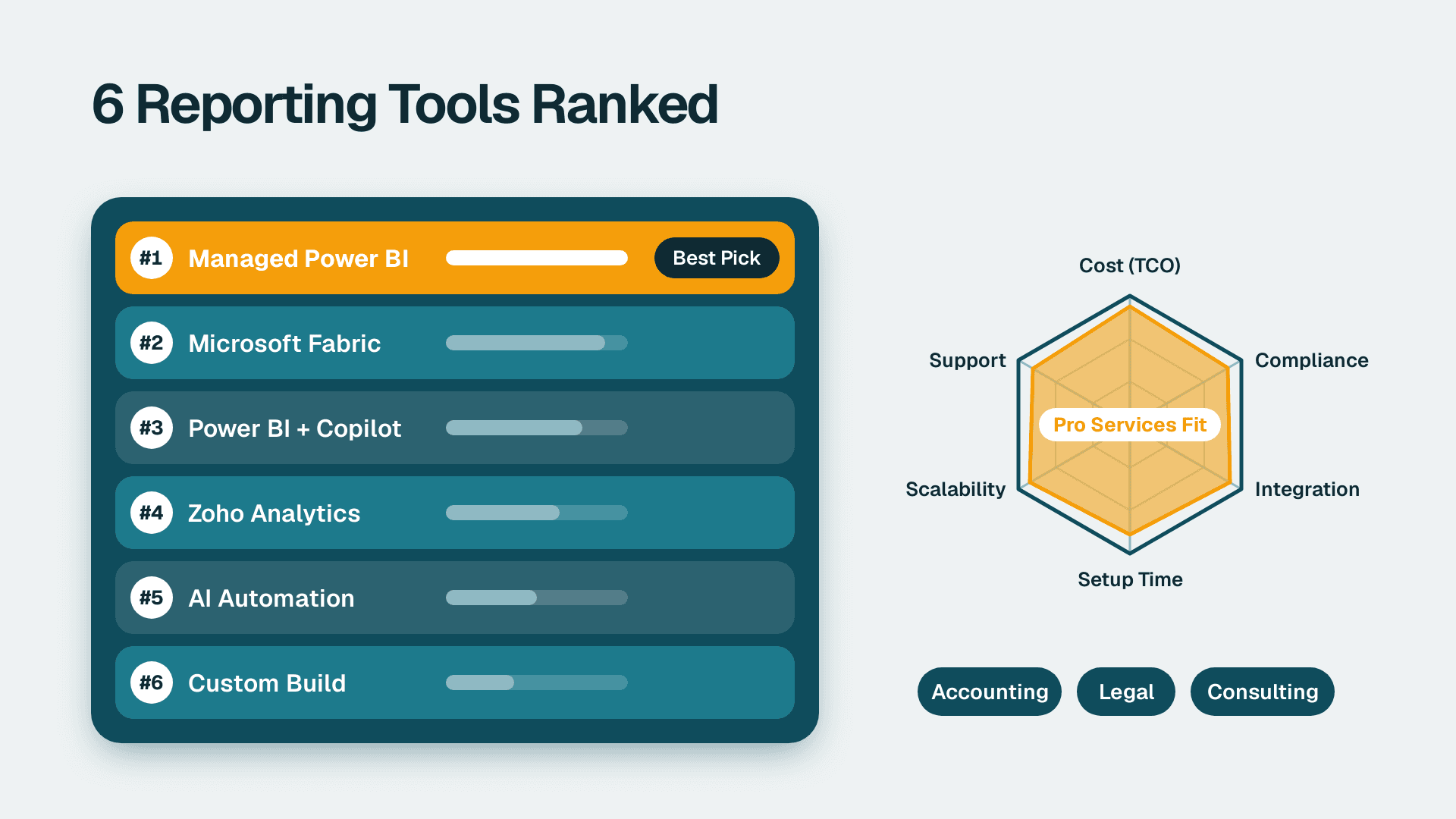
For accounting, legal, and consulting firms evaluating automated reporting in 2026, managed Power BI is the top pick. It delivers enterprise dashboards without in-house data engineering and meets GDPR and PIPEDA data-residency obligations through Microsoft's Data Processing Addendum. If you are already inside Microsoft 365, the integration advantage is decisive.
Our Ranking Criteria
Every tool below was assessed against six criteria that matter to professional services leaders:
Total cost of ownership (TCO): Licensing fees plus setup, ongoing maintenance, and internal labor. A low sticker price masks high hidden costs when training drags on for months.
GDPR and PIPEDA data-residency compliance: Can the vendor contractually commit to keeping client data in your required jurisdiction? Financial and healthcare firms with EU or Canadian clients cannot compromise here.
Integration depth with professional services data sources: Does the tool connect natively to your practice management software, billing system, ERP, or CRM without brittle custom ETL?
AI and automation capabilities: Does the tool move beyond static reports to scheduled refreshes, anomaly alerts, or natural-language query?
Time-to-value: How quickly can a non-engineer configure a meaningful dashboard? Weeks, not months, is the professional services standard.
Scalability: Can the same tool serve a 25-person boutique and a 500-person regional firm without a platform migration?
1. Managed Power BI: Best Automated Reporting Tool for Professional Services Firms
Managed Power BI services is a fully outsourced model where a specialist partner builds, maintains, and governs your Power BI environment on your behalf. You own the data and the workspace; the partner handles data modeling, dashboard development, scheduled refreshes, and ongoing support.
Best for: Accounting, legal, and consulting firms of 20-500 employees who want board-ready dashboards without hiring a data engineer.
Why it wins on compliance: Microsoft's Data Processing Addendum covers GDPR Article 28 processor requirements and supports Canadian data residency through dedicated Azure regions (Canada Central and Canada East). This is the lowest-friction path to satisfying PIPEDA obligations for Canadian professional services clients. For firms handling EU client data, Microsoft's Standard Contractual Clauses are pre-negotiated, removing legal overhead from your implementation.
Why it wins on time-to-value: A well-scoped Power BI star schema data model can go live in 3-6 weeks with experienced partners - typically a fraction of the timeline required for an in-house build. Before committing, use the free BI readiness self-assessment to inventory your data sources and identify gaps that would inflate implementation cost on any platform.
Pros:
Fastest time-to-value of all options: live dashboards in weeks, not months
Compliance documentation (DPA, SOC 2 reports) pre-exists - you receive it rather than building it
Scales from a single revenue dashboard to a full multi-source CFO reporting suite without a platform change
Cons:
You depend on a vendor for changes; ad-hoc requests carry SLA delays
Requires disciplined data governance on your end - accurate source data is a prerequisite, not a given
2. Microsoft Fabric: Best for Enterprise Data Infrastructure
Our guide to Microsoft Fabric architecture covers the full picture, but in brief: Fabric is Microsoft's unified analytics platform combining data engineering, data warehousing, real-time analytics, and Power BI into a single SaaS service. OneLake provides a single logical data lake at the tenant level, which simplifies governance considerably for multi-practice firms.
Best for: Professional services firms with 500+ employees, multiple business units, or complex data estates that require a proper warehouse layer beneath their dashboards.
Pros:
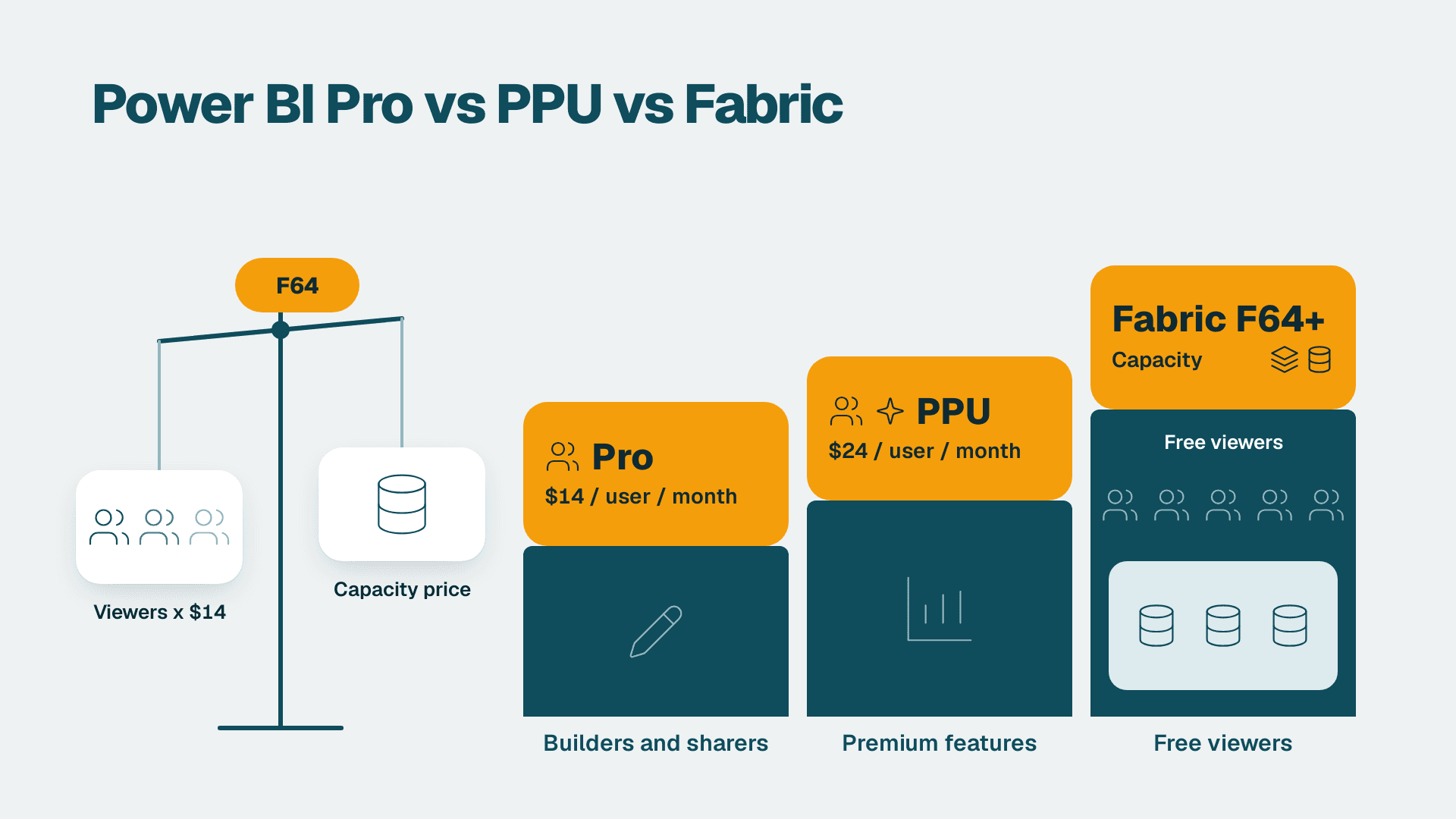
Single licensing model covers data engineering, warehouse, and BI - eliminates tool sprawl
OneLake tenant-level data residency controls map cleanly to GDPR and PIPEDA jurisdiction requirements
Native integration with Microsoft 365 Copilot enables AI-driven report generation for qualified workspaces
Cons:
Full Fabric architecture requires data engineering expertise; it is overkill for a firm under 200 employees
Cost scales with compute usage - without proper capacity governance, monthly spend can spike unexpectedly
3. Power BI with Copilot (Self-Managed): Best for Teams with Internal BI Skills
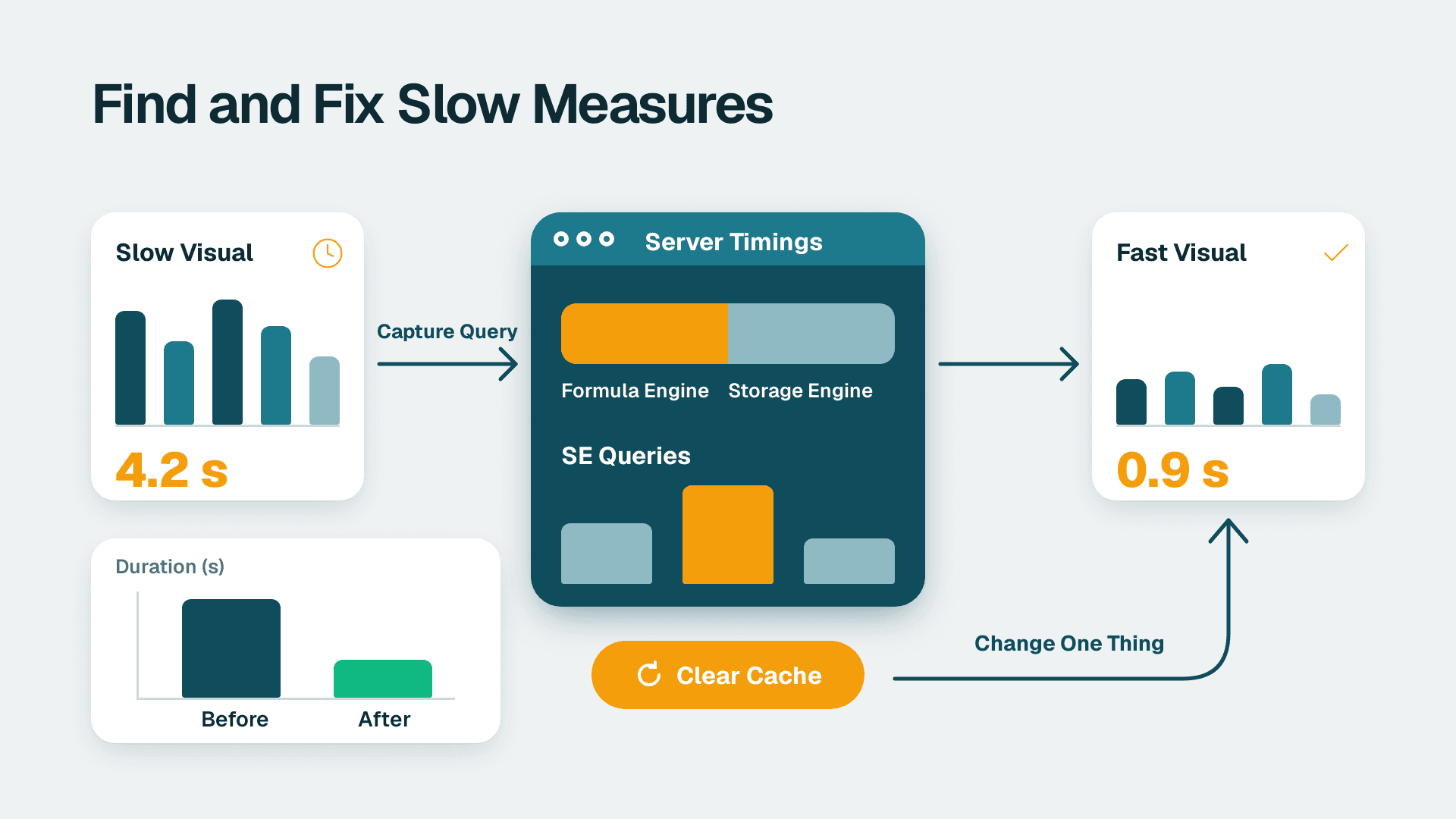
Self-managed Power BI with Copilot is the right call when your firm has an analyst comfortable with DAX and wants AI-assisted reporting without full outsourcing. Copilot can generate DAX measures, write report summaries, and answer natural-language questions against your dataset - provided your semantic model is clean and your workspace meets the Copilot readiness conditions.
Best for: Professional services firms of 50-300 employees with a technically capable internal champion who wants to build BI competency in-house rather than outsource it permanently.
Pros:
Lower ongoing cost than managed if your internal team has genuine spare capacity
AI Copilot features accelerate report creation for analysts who already understand the underlying data
Full control over the semantic model, security roles, and refresh schedules
Cons:
Meeting Copilot readiness conditions (verified semantic model, sensitivity labels, correct licensing tier) takes meaningful setup effort before any AI feature works reliably
Quality degrades quickly without a disciplined star schema - the AI surface is only as reliable as the data layer beneath it
4. Zoho Analytics: Best for Zoho-Integrated Professional Services Firms
Zoho Analytics is a cloud BI platform with native connectors across the Zoho ecosystem - CRM, Books, Desk, and Projects. For professional services firms already running Zoho One, it eliminates a separate ETL layer between operational data and management reporting, which is its primary competitive advantage.
Best for: Boutique accounting, legal, or consulting firms of 10-150 employees operating on Zoho One who need consolidated cross-functional reporting without a data engineer.
Pros:
Native Zoho connectors mean reporting can go live in days, not months
Zia AI provides natural-language query without requiring enterprise-tier licensing
EU and Australia data center options address GDPR-adjacent compliance needs for smaller firms
Cons:
Less mature for complex financial data models compared to Power BI's semantic layer
Ecosystem lock-in: migrating away from Zoho Analytics means rebuilding reports from scratch on a new platform
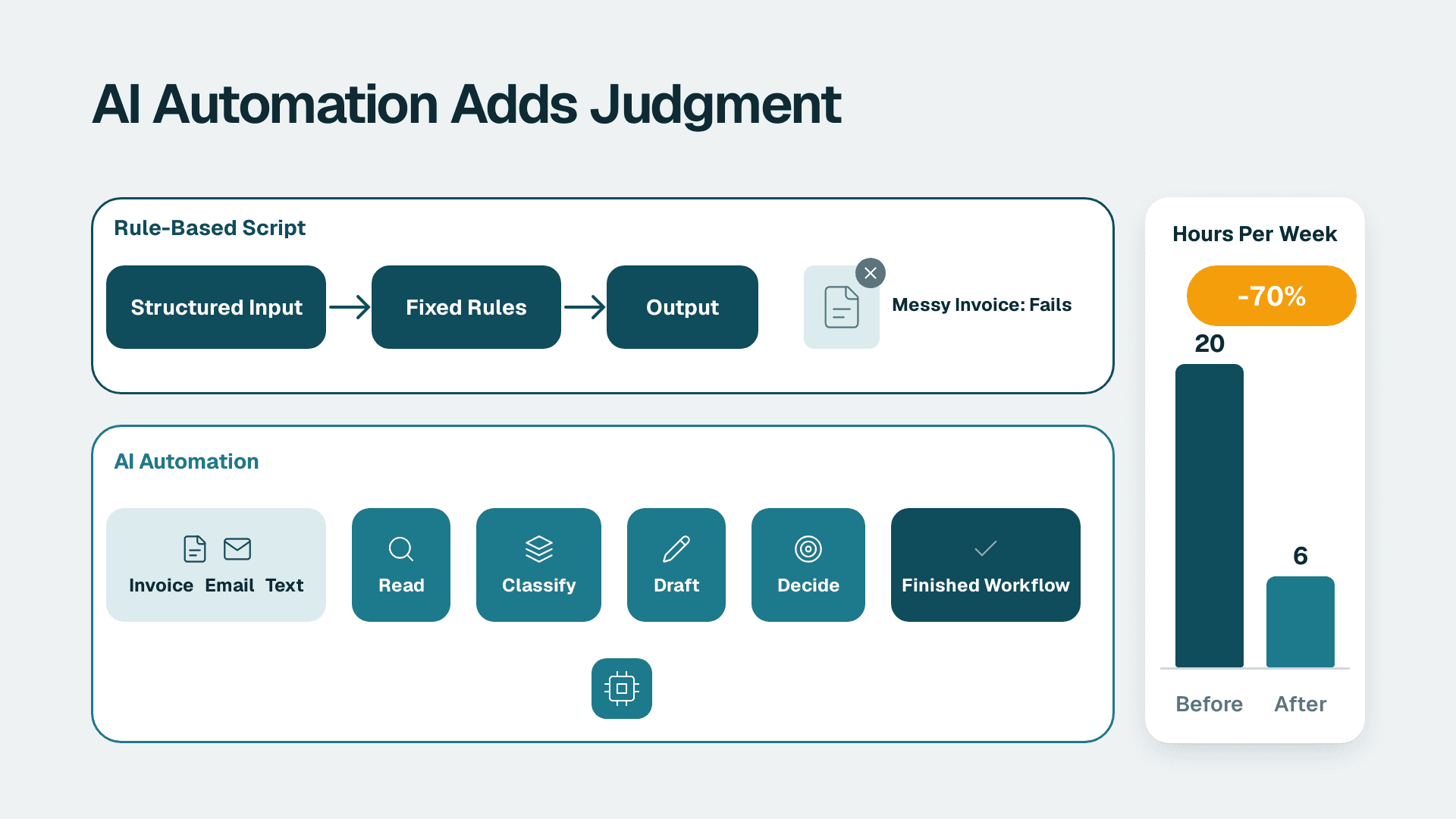
5. AI Automation Workflows: Best for Custom Data Pipelines
Some professional services firms have data that no packaged BI tool handles cleanly - proprietary billing logic, custom practice management systems, or multi-entity consolidations across jurisdictions. AI-augmented automation workflows built on Python with an orchestration layer address these scenarios directly. Before choosing this path, treat the scoping exercise as an informal ai readiness assessment for your technical team: do you have the Python depth, DevOps capacity, and security posture to run production pipelines in a regulated environment?
Best for: Technology-forward professional services firms with at least one dedicated developer and data logic that exceeds what packaged tools handle natively.
Pros:
No vendor lock-in; complete control over data flow, transformation logic, and output format
Integrates with any source including legacy or proprietary systems that packaged tools cannot reach
Cost-effective at scale once the upfront engineering investment is amortized across a large report volume
Cons:
High upfront engineering cost; not viable without dedicated technical resources
GDPR and PIPEDA compliance becomes your engineering problem entirely - data handling, audit logs, and retention policies must be coded explicitly, and any AI models embedded in the pipeline require a full ai vendor due diligence checklist review before deployment in a regulated environment
6. In-House Custom Build: Best for Large Firms with Dedicated Data Teams
An in-house build - a custom data warehouse, transformation layer, and BI front-end entirely owned by your firm - is the right choice only for large professional services organizations with a permanent data engineering function. The build cost is front-loaded, and three-year total cost of ownership is typically the highest of any option on this list.
Best for: Professional services firms with 1,000+ employees, a standing data team, and proprietary reporting requirements too sensitive to trust to any third-party platform.
Pros:
Complete control over architecture, security model, and data residency implementation
No vendor dependency risk and no per-user licensing cost at scale
Cons:
Highest TCO when engineering salaries, infrastructure, and ongoing maintenance are fully loaded
GDPR Article 30 records, PIPEDA accountability obligations, and breach notification procedures must all be designed and maintained internally with no vendor support
Quick Comparison Table
| Tool / Approach | TCO (3-Year) | GDPR/PIPEDA Ready | Time-to-Value | Best Firm Size | AI Capabilities |
|---|---|---|---|---|---|
| Managed Power BI | Medium | Yes (via DPA) | 3-6 weeks | 20-500 employees | High (Copilot-ready) |
| Microsoft Fabric | Medium-High | Yes (OneLake residency) | 2-4 months | 500+ employees | High (native Copilot) |
| Power BI Self-Managed | Low-Medium | Yes (via DPA) | 1-3 months | 50-300 employees | Medium (Copilot optional) |
| Zoho Analytics | Low | Partial (EU/AU servers) | 1-4 weeks | 10-150 employees | Medium (Zia AI) |
| AI Automation Workflows | High upfront | DIY required | 3-6 months | Tech-capable firms | High (custom) |
| In-House Custom Build | Highest | DIY required | 6-18 months | 1,000+ employees | Custom |
How to Choose the Right Automated Reporting Tool for Your Firm
If you are under 500 employees and inside Microsoft 365, managed Power BI is almost always the answer. The compliance documentation is pre-built, integration is native, and you carry no hiring risk. Use the free BI readiness self-assessment to scope what your first dashboard sprint should cover before speaking to any vendor.
If you are on Zoho One and under 150 employees, Zoho Analytics removes an entire data connection layer and gets you to useful reports faster than any alternative. The trade-off is ceiling: as your firm grows or data complexity increases, you will likely need to migrate to a more capable platform.
If you have an internal analyst but no data engineer, self-managed Power BI with Copilot is the productive middle ground - provided your team invests in a clean star schema before chasing AI features. Work through the 10 audit questions for AI-generated finance reports as a pre-launch checklist to pressure-test data quality before any AI-generated output reaches a decision-maker.
If GDPR or PIPEDA is your primary gating criterion, shortlist only platforms with a signed DPA and documented data-residency controls. Both Microsoft and Zoho provide these; a custom build requires you to generate equivalent documentation internally - a significant legal and engineering cost most professional services firms systematically underestimate until they face their first client audit.
Ready to Choose the Right Platform for Your Firm?
Selecting an automated reporting tool is a strategic decision, not a procurement exercise. The wrong choice costs more in re-implementation fees two years later than the right choice costs today. Our AI automation consulting engagement covers a full data readiness review, TCO modeling across your shortlisted platforms, and a compliance gap assessment against GDPR and PIPEDA obligations - before you sign a single vendor contract.
---
About Lets Viz: Lets Viz has delivered data analytics and BI solutions to financial services, healthcare, legal, and consulting clients since 2020. Our engagements span managed Power BI programs, Microsoft Fabric implementations, Zoho Analytics deployments, and AI automation workflows across Canada, the US, and the UK. We hold a 5.0 rating on Clutch and specialize in regulated industries where data accuracy, compliance documentation, and audit-ready reporting are non-negotiable.