Power BI Managed Service for Finance Teams: What to Expect
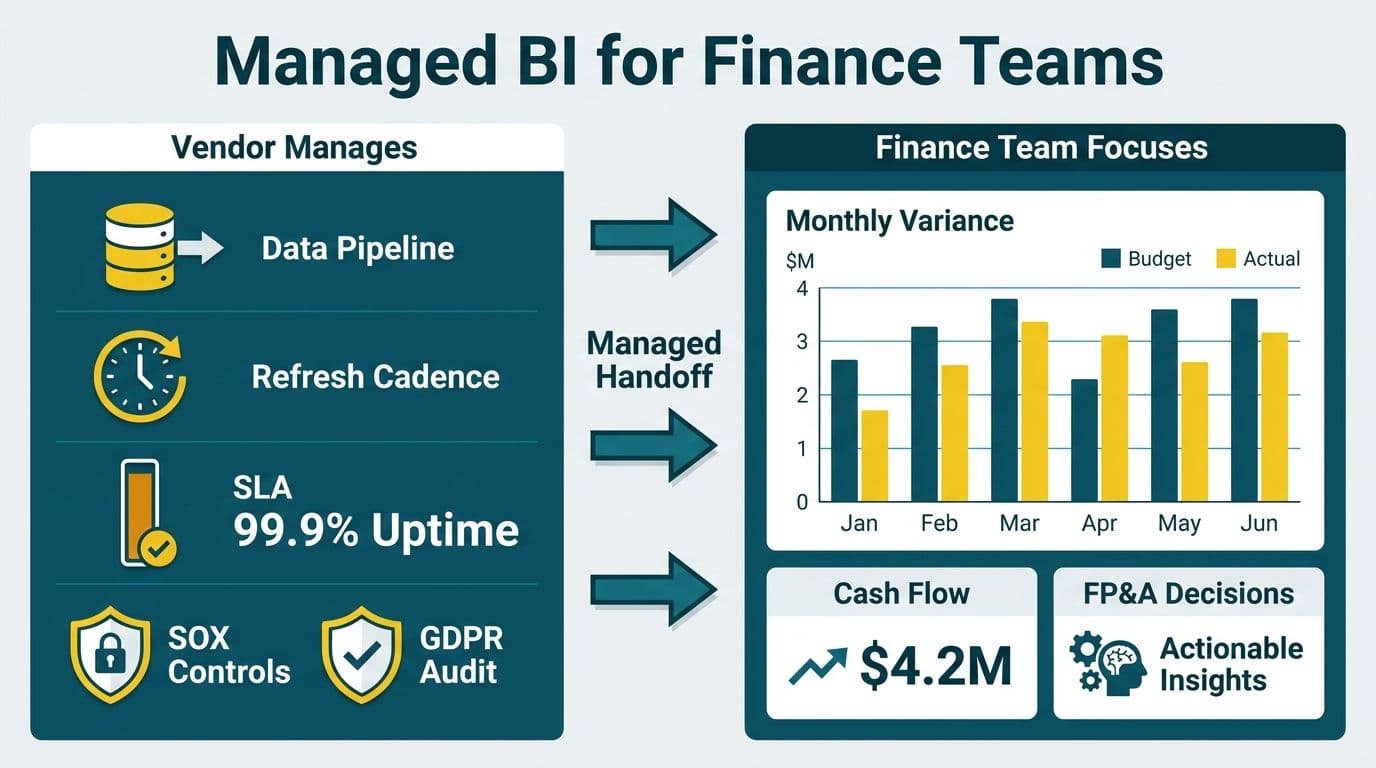
A managed Power BI service for finance teams is a retainer arrangement in which a vendor takes ownership of your report catalog, data pipeline uptime, and SLA commitments - freeing FP&A analysts to focus on decision support rather than dashboard maintenance. Evaluating one correctly requires scrutinizing refresh cadence guarantees, SOX and GDPR control documentation, escalation contacts, and report catalog handoff terms before the contract is signed.
Key Takeaways
Define refresh cadence SLAs (hourly, daily, or near-real-time) in writing before contract signature
SOX compliance requires documented data lineage; GDPR and PIPEDA require explicit data residency clauses
Escalation paths must name individual contacts with response-time commitments, not just "the support team"
Report catalog ownership - including .pbix source files - must contractually remain with you, not the vendor
A structured procurement checklist prevents scope creep and protects both parties from misaligned expectations
What Does a Managed Power BI Service for Finance Teams Actually Include?
A managed Power BI engagement covers four core workstreams: data pipeline management, report and dashboard development, governance and compliance controls, and ongoing optimization. The vendor monitors pipeline health, handles semantic model updates, and responds to refresh failures - while your team consumes finished reports.
For finance, the critical differentiator from a generic BI retainer is domain awareness. Finance-grade managed services handle multi-entity consolidations, intercompany eliminations, and rolling budget-versus-actuals models. A vendor who understands that the DAX `CALCULATE` function rewrites filter context for a variance analysis report - and that `SUMX` iterating over transaction rows produces a different result than a column-level aggregate - can catch model defects before they surface in a board pack. Equally, a vendor comfortable with the `EARLIER` function for row-context calculations in ranked or iterative measures will build time-intelligence logic that holds up across fiscal calendars. That finance fluency, not certification count alone, determines whether the resulting reports earn FP&A trust.
Typical deliverables in a finance-focused managed engagement include:
Star-schema semantic models aligned to your chart of accounts
Row-level security (RLS) mapped to cost center, entity, or region hierarchies
Time-intelligence measures using DAX period-comparison and row-context functions
Scheduled refreshes tied to ERP close signals, not arbitrary cron schedules
Change log documentation for every model update - mandatory for SOX audit trails
Our Managed Power BI services page outlines the full scope of what a retainer engagement covers, from model architecture through to month-end support windows.
If you are still deciding whether to outsource at all, the CFO guide to outsourcing finance analytics covers the build-versus-buy calculus in depth before you reach the vendor evaluation stage.
Power BI Desktop vs Power BI Service: Where Does Each Tool Fit in the FP&A Workflow?
A question that surfaces in almost every managed service evaluation is which tool does what, and which part does the vendor actually manage. Understanding the distinction between Power BI Desktop and Power BI Service for finance teams clarifies scope before the contract is drafted - and prevents disagreements about who owns what during the engagement.
Power BI Desktop is the authoring environment - a locally installed application where analysts build semantic models, write DAX measures, and design report layouts. For FP&A, Desktop is the right tool for model development work: defining relationships between your chart-of-accounts dimension and your fact tables, writing complex variance measures using `CALCULATE` and `SUMX`, iterating on rolling 13-month comparisons, and validating row-context logic before the model reaches a board pack. Desktop files (.pbix) are the source of truth for your report catalog - the equivalent of source code in a software project. They belong in version control from day one.
Power BI Service is the cloud platform where finished models are published, scheduled, and consumed. This is where scheduled refresh runs against your ERP or data warehouse, where row-level security roles are assigned to users by cost center or entity, and where finance teams collaborate on a shared workspace without everyone needing a local copy of the .pbix file. Service is also where a managed vendor does most of its operational work - monitoring refresh logs, responding to gateway failures, and managing workspace access.
The practical division for FP&A teams:
| Stage | Tool | Typical Owner |
|---|---|---|
| Model development and DAX authoring | Desktop | Vendor (or internal analyst with vendor review) |
| Data validation and UAT | Desktop | Finance team lead |
| Scheduled refresh and monitoring | Service | Vendor |
| Row-level security assignment | Service | Vendor, with client approval |
| Report sharing and collaboration | Service | Shared (vendor workspace, client users) |
| .pbix source file management | Desktop files in version control | Client-owned repository |
One friction point to anticipate: changes made directly in Power BI Service - renamed measures, adjusted visuals - do not automatically sync back to the Desktop source file. In a managed engagement, require the vendor to make all substantive model changes in Desktop, publish to Service, and commit the updated .pbix to the client repository. This prevents the source file from drifting out of sync with the live report, which becomes a genuine problem when you need to audit a measure definition for a SOX review or reconstruct logic after staff turnover. Any vendor who cannot articulate a clear answer to the power bi desktop vs power bi service ownership question during procurement is a governance risk before the engagement even begins.
What SLAs Should CFOs and FP&A Directors Demand?
SLAs define accountability. Without them, "we'll fix it quickly" means nothing at month-end when your board pack refresh has failed overnight and the CFO presentation is at 09:00.
At minimum, your contract should specify:
| SLA Category | Minimum Acceptable Standard |
|---|---|
| Refresh failure acknowledgement | Within 1 hour, 24x7 during financial close windows |
| Critical report restoration | Within 2 hours during close periods |
| Standard support response | Within 4 business hours outside close windows |
| Proactive monitoring | Automated pipeline alerts before users notice failures |
| Scheduled maintenance notice | 72-hour advance notice; windows must avoid close periods |
| SLA performance reporting | Monthly report with uptime metrics and full incident log |
Financial close protection clauses deserve particular attention. A US SaaS finance team running a monthly close cycle needs guaranteed vendor availability from the 28th through the 3rd of the following month. Those dates should appear explicitly in the contract as protected windows with elevated response commitments and, ideally, a named on-call contact rather than a generic support queue.
A UK fintech firm operating under FCA reporting deadlines faces an equivalent constraint - regulatory submission dates must appear in the SLA as named events. A generic "business-critical" clause does not hold up when a regulator asks why consolidated figures were late.
Beyond uptime, SLAs should also address report accuracy validation. Finance teams have been burned by dashboards that looked correct but were silently wrong - a metric that appeared healthy because the underlying data model treated missing values as zero rather than null, causing every unresolved record to count as instantly resolved. Requiring the vendor to document metric definitions and provide a validation log for any new measure protects against that class of failure.
How Do SOX, GDPR, and PIPEDA Controls Apply to a Managed Power BI Engagement?
Compliance controls are not optional add-ons - they are procurement requirements. The specific framework depends on your jurisdiction and sector, but the documentation checklist overlaps significantly across markets.
SOX (US public companies): Section 404 requires documented internal controls over financial reporting. In a managed Power BI context, that means data lineage documentation showing where every figure in a financial report originates, change control logs for every semantic model update, and segregation of duties evidence showing the vendor cannot both create and approve a report change without a client-side review step. Request the vendor's SOX control matrix before contract signature and verify it maps to your external auditor's expectations.
GDPR (UK and EU): Any managed service that processes personal data of EU or UK data subjects must operate under a signed Data Processing Agreement (DPA). In finance, this matters for payroll analytics, expense reporting by employee, and any dashboard pulling HR or customer PII. Verify that the vendor can demonstrate data residency in compliant regions and maintains a record of processing activities as required by GDPR Article 30. Post-Brexit UK GDPR adds a parallel requirement for UK data subjects; if your organization spans both UK and EU, you need DPA coverage under both frameworks.
PIPEDA (Canada): Canadian mid-market companies handling employee or customer financial data must ensure vendor data-handling practices align with PIPEDA's accountability and consent principles. A Canadian manufacturing company moving its FP&A dashboards to a managed Power BI platform should require a written privacy impact assessment covering cross-border data transfers if the vendor's infrastructure sits outside Canada. The forthcoming federal Consumer Privacy Protection Act (Bill C-27) is likely to raise these requirements further; build flexibility into the contract now.
The AI compliance requirements map for financial services (2026) covers the broader regulatory landscape if your team also operates AI-assisted analytics alongside Power BI. For US healthcare organizations adding financial dashboards alongside clinical data, the AI automation compliance checklist for finance teams is a practical companion document.
What Refresh Cadence and Data Pipeline Ownership Should the Contract Specify?
Refresh cadence is one of the most commonly under-specified terms in managed Power BI contracts. "Daily refresh" can mean anything from midnight to 11:59 PM unless the contract names an exact completion window and specifies vendor behavior on failure.
For FP&A use cases, distinguish between three cadence tiers:
Near-real-time dashboards (cash position, AR aging, treasury) - DirectQuery or Microsoft Fabric semantic models with sub-hourly latency
Daily operational reports (cost center spend, headcount analytics) - scheduled refresh with a "data current as of 06:00 local time" completion guarantee
Period-end reports (monthly P&L, board pack, management accounts) - vendor-managed refresh triggered by your ERP close signal, with a four-hour SLA from trigger to delivery
Each tier should be specified per report in the contract, not applied as a single blanket schedule across the catalog.
Data pipeline ownership is a separate and equally important question. Who owns the dataflows, Power Query transformations, and gateway credentials? Best practice is for the client to hold all credentials and for the vendor to operate under delegated access - revocable at contract end without disrupting live reports. Many vendors default to keeping credentials under their own service accounts; require client ownership explicitly.
Volume matters more than most finance teams anticipate. A book distributor we worked with could not export their own billing data through Power BI's visual export cap, which limits CSV output to 30,000 rows. We bypassed the front end entirely, connected directly to the Analysis Services engine underneath, and streamed all 5,042,721 billing rows at roughly a million rows per minute. If your finance team runs high-volume transaction reporting - AP ledgers, billing reconciliations, intercompany journals - confirm whether the managed service plan includes direct model access or is constrained to front-end visual exports.
How Should Report Catalog Ownership and Escalation Paths Be Structured?
Report catalog ownership determines what you retain if you end the engagement. CFOs regularly discover too late that their entire report library lives in the vendor's Power BI workspace under the vendor's service account - meaning termination equals data loss unless the contract says otherwise.
Require the following in writing:
1. All `.pbix` source files are stored in a client-owned repository (Azure DevOps, GitHub, or equivalent) from day one
2. The client's Power BI tenant hosts all published reports; vendor access is via guest accounts, not workspace ownership
3. At contract end, the vendor delivers a full report inventory with data source documentation within 30 days
4. Version history is maintained throughout the engagement, with tagged releases aligned to reporting periods
Escalation paths must be structured as a named ladder, not a generic inbox:
Level 1 - self-service: vendor knowledge base and ticket portal; acknowledgement within 2 hours
Level 2 - assigned analyst: named individual contact, response within 4 business hours
Level 3 - senior consultant: named individual, triggered by SLA breach or close-period failure, response within 2 hours
Level 4 - executive sponsor: vendor account lead, for contractual disputes or repeated SLA failures, response within one business day
"The support team will handle it" is not an escalation path. Without names and response-time commitments at each level, accountability dissolves at exactly the moments it matters most.
For organizations that track operational issues inside an IT service management platform, integrating managed BI escalation tickets into those workflows can reduce resolution time. The ServiceNow and Power BI integration guide covers how ITSM ticket data can feed directly into operational dashboards - relevant if your finance operations team monitors SLA performance inside a platform like ServiceNow.
The Procurement Checklist: What to Verify Before You Sign
Every unanswered item below is a negotiation point.
Scope and deliverables
[ ] Written report catalog (named dashboards, owners, refresh schedule, data sources)
[ ] Semantic model architecture document and naming-convention standards
[ ] Change request process with version-controlled .pbix files and client approval workflow
SLA and availability
[ ] Response and resolution times for refresh failures, documented by severity tier
[ ] Named protected windows for financial close, audit, and regulatory submission dates
[ ] Monthly SLA performance report with uptime evidence and full incident log
Compliance and governance
[ ] SOX control matrix with data lineage documentation (US public companies)
[ ] GDPR Data Processing Agreement covering all EU and UK data subjects
[ ] PIPEDA privacy impact assessment covering cross-border data transfers (Canadian organizations)
[ ] Row-level security documentation mapping roles to data access permissions
[ ] Audit log retention policy (Power BI activity logs, minimum 90 days)
Data pipeline and refresh
[ ] Refresh schedule documented per report with completion-by-time guarantees
[ ] Failure notification policy: who is alerted, by what channel, within what timeframe
[ ] Gateway and credential ownership confirmed as client-held
[ ] Documented fallback procedure for upstream ERP or data warehouse outages
Ownership and exit
[ ] Client-owned Power BI workspace confirmed in writing before engagement starts
[ ] Source file repository established on day one, with vendor holding commit access only
[ ] Offboarding runbook included in the contract
[ ] Knowledge transfer hours specified for transition to internal team or successor vendor
Team and escalation
[ ] Named contacts at each escalation level with individual response-time commitments
[ ] Vendor finance-domain credentials: certifications and reference clients in your sector
[ ] Coverage model clearly stated: business hours only vs. extended coverage for close periods
Ready to evaluate a managed Power BI engagement with full SLA transparency and clear ownership terms? Review what Lets Viz delivers in our Managed Power BI services retainer.
---
About Lets Viz: Lets Viz has delivered data analytics and managed BI engagements since 2020, serving US healthcare systems, UK fintech firms, Canadian manufacturing companies, and global SaaS organizations. Our team holds a 5.0 Clutch rating and brings deep finance-domain Power BI expertise - from SOX-compliant semantic model governance to GDPR-aligned and PIPEDA-compliant reporting infrastructure across multiple jurisdictions.