AI Compliance Requirements for Financial Services: 2026 Regulatory Map
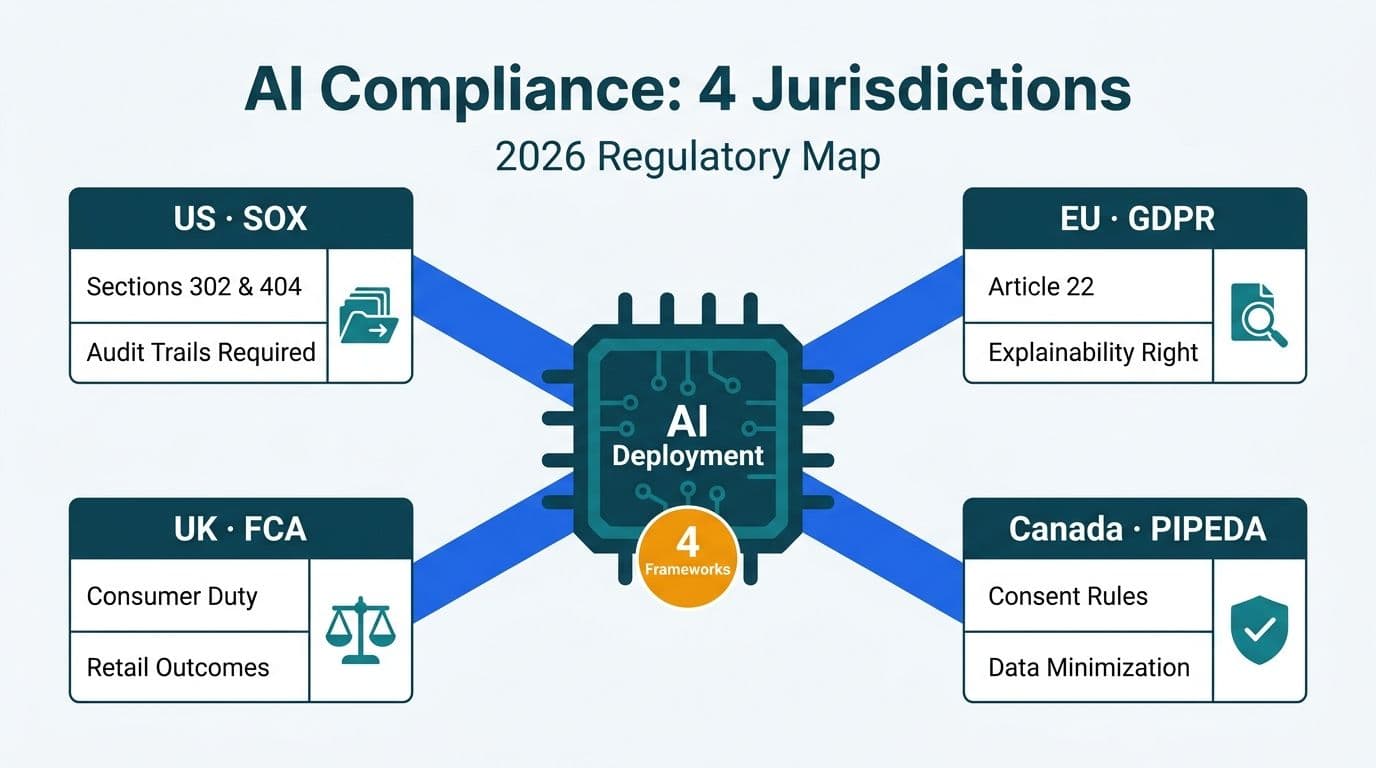
The AI compliance requirements for financial services span four frameworks: SOX audit trails for US financial reporting, GDPR explainability for EU and UK automated decisions, FCA Consumer Duty for UK retail outcomes, and PIPEDA consent rules for Canadian data. Mapping which obligations apply before deployment is far less costly than remediating after a regulatory review.
Key Takeaways
SOX Sections 302 and 404 require AI-generated outputs that affect financial statements to be covered by documented internal controls and retrievable audit trails.
GDPR Article 22 gives EU and UK data subjects the right to a meaningful explanation when AI makes decisions with "significant effects," including credit or insurance outcomes.
The FCA Consumer Duty (effective July 2023) requires UK firms to ensure AI-driven recommendations and pricing deliver "good outcomes" for retail customers.
PIPEDA requires meaningful consent before personal data is used to train or run AI models affecting financial decisions in Canada.
A robust AI governance framework for finance teams maps each AI tool to its regulatory regime before deployment, not after.
What Are the Core AI Compliance Requirements for Financial Services?
Financial services firms face a multi-jurisdictional compliance challenge when deploying AI. Unlike a single piece of software, an AI model simultaneously touches data privacy law, financial regulation, and sector-specific conduct rules.
The four frameworks that govern AI in financial services most broadly are:
SOX (Sarbanes-Oxley Act, US): Governs internal controls over financial reporting. Any AI that influences a number appearing in an SEC filing falls under this umbrella.
GDPR (EU and UK): Governs automated decision-making and requires explainability when AI decisions significantly affect individuals.
FCA Consumer Duty (UK): Requires AI-driven customer interactions to deliver "good outcomes" and to be fair, transparent, and understandable.
PIPEDA (Canada): Requires meaningful consent before personal data is used in AI systems that affect consumers.
Each of these frameworks was written before large-scale AI deployment became routine in financial services. Regulators are actively issuing guidance to close that gap, which means the specific obligations continue to evolve. Building your AI compliance program on a framework that anticipates regulatory direction, rather than reacting to published rules alone, is the more defensible approach for both compliance teams and technology leaders.
How Does SOX Apply to AI Tools Used in Finance?
SOX applies to any AI-generated output that influences a financial statement, a material disclosure, or the internal controls environment around either. Sections 302 and 404 require management to evaluate and certify the effectiveness of internal controls over financial reporting. If an AI model automates a control, such as flagging journal entry anomalies or generating variance explanations for management accounts, that model becomes part of the controls framework subject to certification.
The practical implications for a US financial services firm include the following:
Audit trails are non-negotiable. When AI agents in finance automate month-end close tasks, including reconciliations, accrual calculations, and intercompany eliminations, every input, transformation, and output must be logged and retrievable. External auditors need to understand what the model did and verify it independently. A black-box AI in the audit trail does not satisfy Section 404 requirements.
Change management applies to model updates. If you retrain or update an AI model that touches financial reporting controls, that update is a change to an internal control. It needs the same change-management documentation, testing, and sign-off as any other control change. Many finance teams learning how to automate month-end financial close with AI discover this requirement only at year-end audit, which is the wrong time to discover it.
Model risk management documentation is required. The US Office of the Comptroller of the Currency Bulletin 2011-12 on model risk management remains foundational US guidance for banks, requiring models affecting financial decisions to be validated, documented, and periodically reviewed. The Federal Reserve SR 11-7 guidance extends the same framework. In subsequent FAQ updates (OCC, 2023), regulators confirmed that both apply to AI and machine learning tools used in financial decision-making.
A practical example: a mid-market US bank deploying an AI forecasting tool to project loan loss provisions must maintain model inventory records, conduct independent validation before production deployment, and document model limitations, because the provision figure feeds a SOX-covered balance sheet line.
What Does GDPR Require for AI Model Explainability?
GDPR Article 22 prohibits solely automated decisions that have "legal or similarly significant effects" on individuals, unless specific conditions are met. Where such decisions are permitted, the regulation requires meaningful explanation of each outcome. For a financial services firm operating in the EU or the UK (which retains UK GDPR post-Brexit), this is the primary AI constraint on credit decisions, insurance pricing, and fraud flagging.
The three lawful bases that permit automated decisions under Article 22 are: explicit consent, contractual necessity, or EU or member-state law. Most financial services firms rely on contractual necessity: a credit application implies acceptance of automated credit assessment. But even then, the firm must:
Inform the individual that automated processing is occurring and describe the logic involved.
Provide a right to object and to obtain human review of any decision.
Explain the outcome in terms a non-technical person can understand, not the model weights, but the factors that drove the result. For example: the application was declined because the debt-to-income ratio exceeded the underwriting threshold.
This is where model explainability becomes a technical requirement, not a design preference. SHAP values, LIME explanations, or rule-based decision summaries are among the approaches firms use to generate per-decision rationale that satisfies Article 22.
For UK firms specifically, the FCA's AI explainability guidance (2024, with supervisory updates issued in 2026) aligns with UK GDPR but adds a supervisory expectation that firms can demonstrate explainability to regulators on request, not just to the customer. The FCA's 2026 thematic review of AI in consumer credit found that over half of sampled firms could not reproduce a decision-level explanation on demand — a gap the regulator has identified as a near-term enforcement priority. This raises the bar well beyond what many firms anticipate when designing their AI architecture.
A UK fintech providing instant personal loans must log each decision's input features, store the explanation generated at the time of decision, and reproduce that explanation if the customer requests review or if the FCA raises it during a thematic review. Our GDPR-compliant financial reporting checklist covers the data pipeline requirements that support an audit-ready architecture for EU and UK firms.
How Do FCA Consumer Duty Rules Govern AI Tools?
The FCA Consumer Duty, which took effect in July 2023, requires UK financial services firms to demonstrate that their products and services deliver "good outcomes" for retail customers, including outcomes generated or influenced by AI. It is not an AI-specific regulation, but it applies directly to every AI-driven customer interaction a regulated firm conducts.
The four Consumer Duty outcome areas that intersect with AI deployments are:
| Outcome Area | What It Means for AI |
|---|---|
| Products and Services | AI-recommended products must be genuinely suitable for the customer, not just compliant on paper |
| Price and Value | AI-driven dynamic pricing must not exploit customer vulnerability or systematically deliver poor value |
| Consumer Understanding | AI chatbots and automated communications must use plain language; hidden complexity is not a defence |
| Consumer Support | Firms cannot use AI to reduce support quality or make it harder for customers to exercise their rights |
The FCA has stated clearly in Policy Statement PS23/16 and subsequent Dear CEO letters that governance over AI tools is a board-level responsibility under Consumer Duty. Senior managers who approve AI tools that later cause consumer harm face personal accountability under the Senior Managers and Certification Regime.
A UK wealth management firm using AI to generate portfolio recommendations must be able to demonstrate at the level of an individual client file that the recommendation was appropriate, understandable, and delivered value. This requires model logging, output archiving, and a governance layer that connects each AI decision to the firm's Consumer Duty assessment framework.
What Does PIPEDA Require for AI Consent in Canadian Financial Services?
Under PIPEDA, Canadian financial services firms must obtain meaningful consent before collecting, using, or disclosing personal information in AI systems. Consent given for one purpose does not automatically extend to a new AI application using the same data. The Office of the Privacy Commissioner of Canada confirmed this position in guidance most recently updated in 2026, including joint recommendations with provincial privacy commissioners on AI use in financial services.
The PIPEDA principles most relevant to financial services AI deployments are:
Accountability: The firm is responsible for personal information under its control, including data processed by third-party AI vendors. Vendor contracts must require PIPEDA-equivalent protections; the firm cannot transfer responsibility by outsourcing the AI function.
Limiting Collection and Use: Data collected for mortgage origination cannot be used to train a credit-scoring AI without additional consent unless the new use is reasonably expected by the individual at the time of original collection.
Accuracy: AI outputs that affect individuals, including credit decisions, insurance premiums, and investment recommendations, must be based on accurate data. Individuals have the right to challenge and correct inputs used in AI systems that affect their financial outcomes.
Openness: Firms must be able to explain, in general terms, how AI is used in decisions that affect customers.
Canada's proposed Bill C-27, which includes the Consumer Privacy Protection Act and the Artificial Intelligence and Data Act, would introduce additional requirements specific to "high-impact AI systems" in financial services, including mandatory transparency disclosures and algorithmic impact assessments. While not yet in force as of August 2026, firms building AI governance frameworks now should design for these requirements as a forward-looking control.
A Canadian credit union deploying an AI loan adjudication system must document its consent basis for using member data, conduct a Privacy Impact Assessment, and verify that the adjudication model does not use sensitive personal characteristics as inputs. This is a PIPEDA obligation that also intersects with human rights requirements under provincial law.
How Do You Build an AI Governance Framework for Finance Teams?
An AI governance framework for finance teams is a structured set of policies, controls, and processes that maps each AI tool to its regulatory obligations, assigns ownership, and creates the documentation trail regulators expect to see. Without this framework, compliance becomes reactive, discovered at audit rather than designed in.
AI Inventory and Risk Classification
Before you can govern AI tools, you need a complete picture of what is deployed. An AI inventory registers every model, tool, and automated process, including AI features embedded in existing platforms, cloud analytics tools, and SaaS applications. Each entry should capture: the regulatory regimes that apply, the personal data it processes, the decisions it influences, and the named business owner.
Risk classification determines the depth of controls applied. An AI that generates internal management dashboards carries lower regulatory risk than one that drives credit decisions or produces customer-facing disclosures. High-risk tools require full model risk management; lower-risk tools need proportionate oversight.
Pre-Deployment Review Gate
A pre-deployment review gate requires documented sign-off on compliance, legal, and technology risk before any AI tool goes live in a regulated context. The gate should cover: regulatory mapping, explainability capability verification, audit trail design, bias and fairness testing, and data lineage documentation.
Skipping this gate is among the most common AI workflow automation mistakes that finance teams make. Remediating a live AI deployment is substantially more expensive in time, cost, and regulatory exposure than addressing gaps at the design stage.
Ongoing Model Monitoring and Third-Party Controls
AI models drift over time. A credit model trained on 2021–2022 economic data can show Gini coefficient degradation of 5–8 percentage points when applied to 2025–2026 portfolios shaped by sustained rate-cycle volatility — a gap material enough to affect capital model outputs and trigger SOX remediation obligations. Governance frameworks must include a regular cadence for monitoring model performance, tracking output distributions against expected behaviour, and triggering revalidation when drift is detected. This discipline applies to AI forecasting for finance teams as much as to customer-facing decisioning models.
Many financial services firms access AI through third-party platforms, including embedded AI in ERPs, AI features in cloud analytics, and AI forecasting capabilities delivered via SaaS subscriptions. The regulatory obligations do not transfer to the vendor. The firm remains responsible, and third-party AI must be subject to the same inventory, risk classification, and pre-deployment review as internally developed models. Reviewing the leading AI automation tools for business is useful for understanding available capabilities, but capability evaluation must be paired with compliance mapping before any tool is deployed in a regulated context.
AI Compliance Requirements by Jurisdiction: Quick Reference
| Regulation | Jurisdiction | Core AI Obligation | Who It Applies To |
|---|---|---|---|
| SOX Sections 302 and 404 | US | Audit trail and ICFR documentation for AI-influenced financials | SEC-reporting firms and their subsidiaries |
| OCC Bulletin 2011-12 / SR 11-7 | US banking | Model validation, documentation, and ongoing inventory | US banks and bank holding companies |
| GDPR Article 22 | EU and UK | Explainability and right to human review for automated decisions | Any firm processing EU or UK resident data |
| FCA Consumer Duty | UK | Good outcomes, fair pricing, plain-language AI communications | FCA-regulated retail financial services firms |
| PIPEDA (Bill C-27 pending) | Canada | Consent, accountability, and accuracy for personal data in AI | Any firm processing Canadian personal information |
What Should Finance Leaders Do Next?
Regulatory compliance is not a reason to avoid AI. It is a design constraint that shapes how you deploy it responsibly. Firms that integrate compliance into their AI governance framework from the outset can build faster than those who retrofit controls after a deployment is live and regulators come asking.
The practical sequence is: inventory first, risk-classify second, apply jurisdictionally appropriate controls third, and monitor continuously. Multi-jurisdictional firms operating across the US, UK, and Canada must satisfy the highest applicable bar in each dimension: GDPR's explainability standard for EU and UK customer data, PIPEDA's consent standard for Canadian data, and SOX's audit trail standard for any data that touches financial reporting.
If your organisation is ready to map its AI tools to regulatory obligations and build a governance framework that holds up under scrutiny, AI automation consulting from Lets Viz includes regulatory mapping and pre-deployment review design as part of every engagement.
---
*Written by [Author Name], AI Governance Analyst at Lets Viz. [Author] has advised US, UK, and Canadian financial services firms on regulatory AI frameworks since [year] and holds [relevant qualification].*
About Lets Viz: Lets Viz has delivered analytics and AI automation engagements for US healthcare providers, UK fintech firms, Canadian manufacturing companies, and global SaaS businesses since 2020. With a 5.0 rating on Clutch, our team specialises in building compliant, audit-ready AI workflows that meet the regulatory requirements of each jurisdiction we serve.