When to Outsource Finance Analytics Consulting: CFO Guide
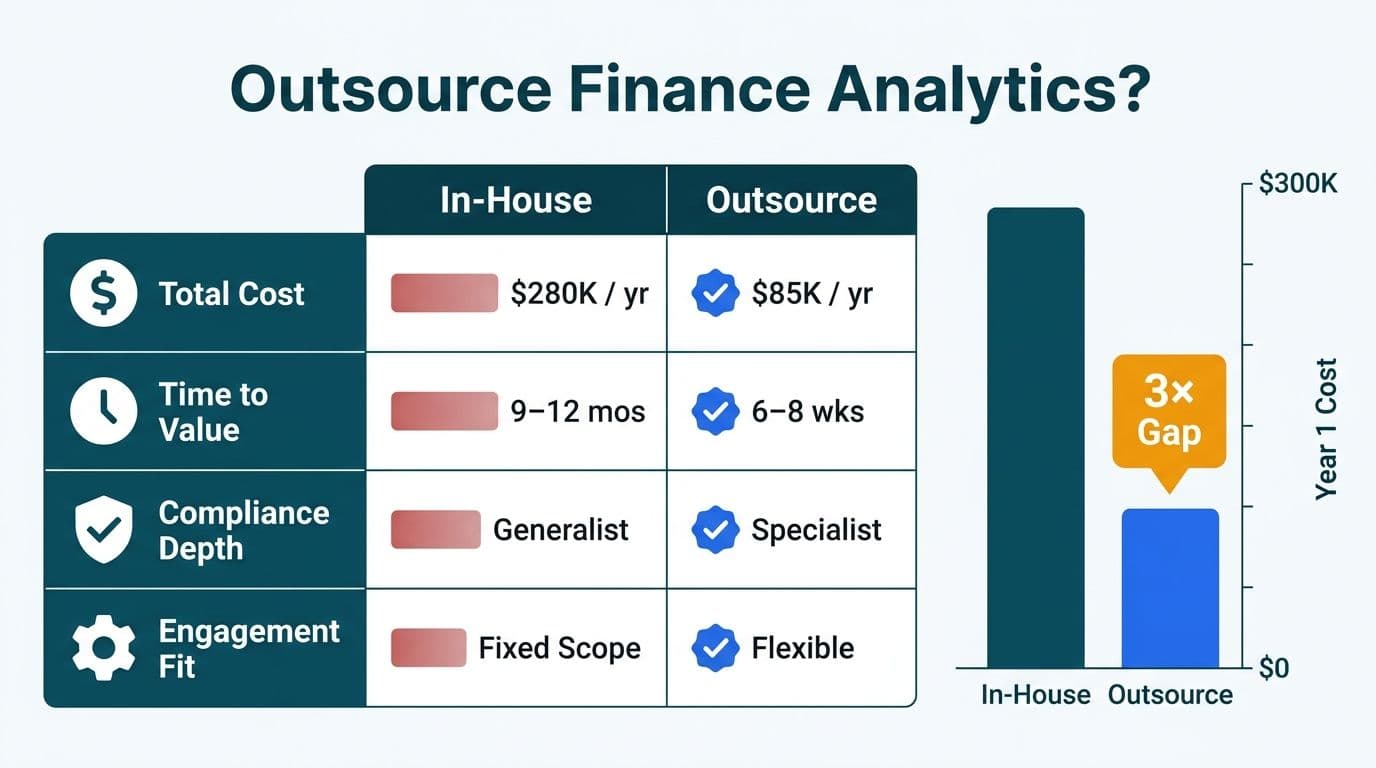
Mid-market CFOs should consider outsourcing finance analytics consulting when the cost of building specialized BI capability in-house outweighs the strategic return, when regulatory complexity - GDPR, HIPAA, or PIPEDA - demands depth that generalist analysts rarely carry, or when speed to insight is a competitive requirement. The decision comes down to four variables: total cost of ownership, time-to-value, compliance depth, and engagement structure.
Key Takeaways
Internal BI headcount carries fully-loaded costs well above base salary once benefits, tooling, onboarding, and ongoing training are factored in.
External consulting typically delivers production-grade finance dashboards faster because teams arrive with frameworks already calibrated for SaaS metrics like ARR, NRR, and CAC payback.
Compliance depth - particularly for GDPR (UK/EU), HIPAA (US healthcare SaaS), and PIPEDA (Canada) - is frequently the deciding factor that tips the analysis toward external specialists.
Retainer engagements suit teams with recurring reporting needs; project engagements suit one-time migrations or buildouts.
A five-stage finance analytics maturity model helps CFOs move beyond gut feel: it pinpoints which capability gap is the binding constraint before any outsourcing budget is committed.
The strategic question is not whether to outsource entirely, but which combination of internal ownership and external expertise best matches your current reporting maturity.
When Should You Outsource Finance Analytics Consulting?
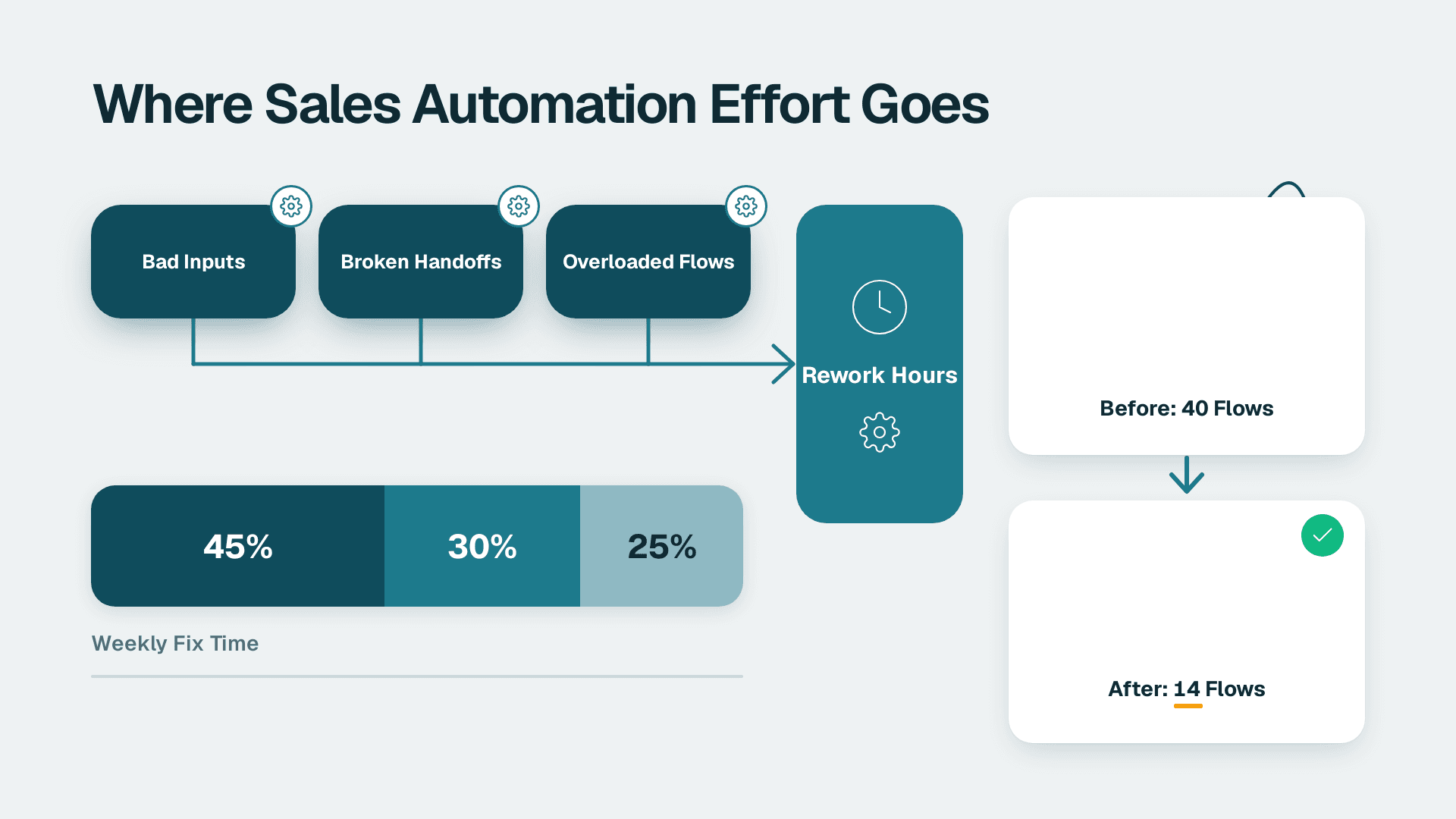
The clearest case for outsourcing arises when your finance team is spending analyst time on report maintenance rather than forward-looking analysis - or when a single internal BI hire cannot simultaneously cover data modeling, dashboard development, compliance configuration, and stakeholder enablement across a growing SaaS operation.
Three trigger points signal that outsourcing deserves a serious answer:
Trigger 1 - Headcount lag. Finance BI hiring cycles typically run 90-120 days from job post to productivity for a senior analyst. If your board is requesting SaaS unit-economics visibility - ARR waterfall, cohort retention, CAC payback period - before the next quarterly review, a consulting engagement reaches production faster than recruiting.
Trigger 2 - Compliance exposure. A US SaaS company serving healthcare clients must manage financial data under HIPAA-adjacent controls even when the product itself is not a covered entity. A UK or EU business processing subscriber billing data falls under GDPR Article 25, which mandates data protection by design. A Canadian B2B SaaS company handling customer financial records operates under PIPEDA's fair information principles. Each framework requires specific data residency, access audit, and retention configurations that a specialist consultant - already credentialed in these frameworks - can implement in days rather than months.
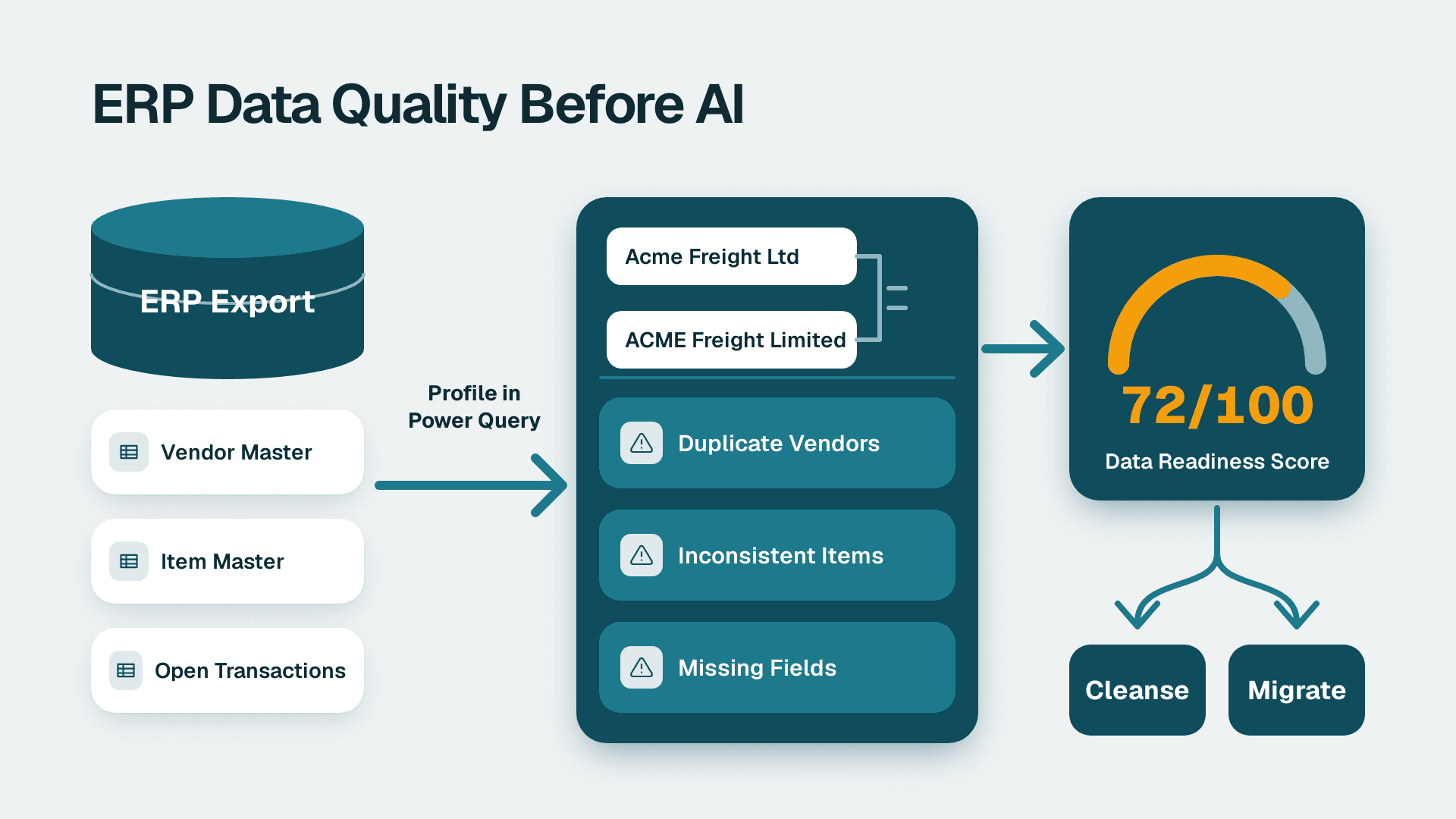
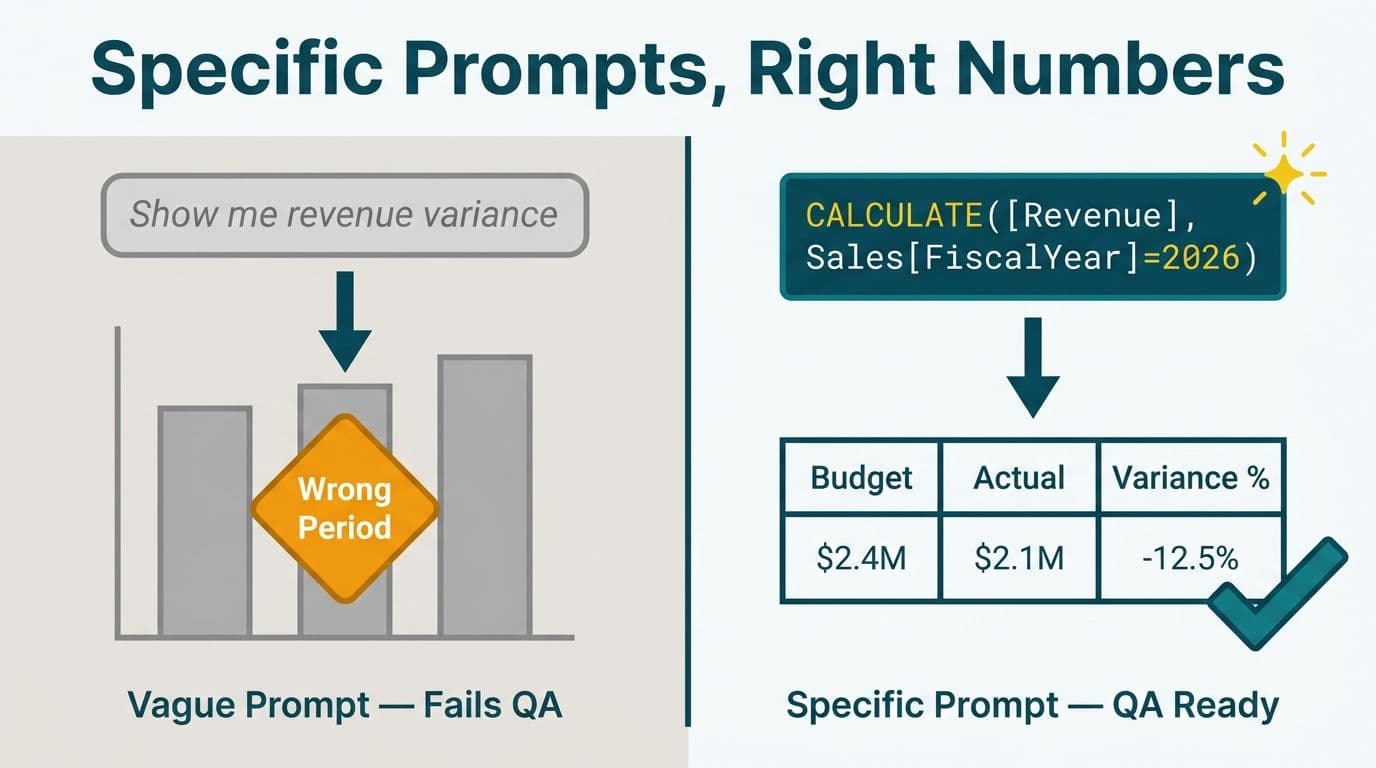
Trigger 3 - Tooling maturity gap. If your team is implementing Power BI for SaaS finance for the first time, the learning curve for DAX modeling, row-level security, and incremental refresh is steep. One early architectural decision that carries outsized downstream risk is storage mode: choosing between Import, DirectQuery, and Composite mode for your finance data sources affects query performance, RLS enforcement behavior, and gateway dependency in ways that are difficult to reverse once a report layer is built on top. An Import model sized for today's row counts becomes a refresh-time liability as the business scales; a DirectQuery model chosen for real-time visibility breaks DAX measures written assuming materialized row context. Bringing in external expertise to architect the semantic layer correctly from the start prevents this category of rework at scale.
What Is the True Total Cost: Internal BI Headcount vs External Consulting?
The assumption that building in-house is cheaper long term rarely survives a rigorous fully-loaded cost model.
A mid-market SaaS company in the US hiring a senior BI or finance analytics analyst pays a base salary commensurate with local market rates - but the total employer cost is substantially higher once you add payroll taxes, health benefits, 401(k) matching, software seat licenses, professional development, and a recruiting fee (typically 15-20% of base salary for a specialist role). UK employers add employer National Insurance contributions and auto-enrollment pension obligations. Canadian companies carry CPP and EI contributions on top of provincial payroll requirements.
External consulting fees look higher per hour in isolation, but they are scoped to deliverables, carry no benefits overhead, and require no onboarding runway.
| Cost Factor | Internal Hire (US, Annual Est.) | Consulting Retainer (Monthly) | Project Engagement |
|---|---|---|---|
| Base salary / fee | $130,000-$180,000 | $8,000-$20,000/month | $25,000-$80,000 fixed |
| Benefits and payroll taxes | 30-40% uplift on salary | Not applicable | Not applicable |
| Tooling and licenses | $2,000-$10,000 per seat/year | Typically included | Often included |
| Ramp to productivity | 60-90 days | 5-10 business days | Same |
| Compliance configuration | Additional specialist cost | Included with specialist | Included |
| Turnover and rehire risk | High (~50% of salary to replace) | Low | None |
*Ranges are illustrative for US mid-market. UK and Canadian cost structures differ by local employment law, but the structural gap between fully-loaded headcount and a scoped consulting engagement holds consistently across markets.*
The FP&A Dashboard in Power BI build guide illustrates how much surface area a well-scoped finance BI engagement covers - waterfall charts, rolling forecasts, variance analysis, and executive drill-through. That scope is difficult for a single internal hire, still ramping, to complete within a first quarter.
How Does Compliance Depth Differ Between Internal Teams and External Consultants?
Compliance is the dimension where the internal-versus-external calculus most consistently favors outsourcing for finance teams operating across multiple jurisdictions.
GDPR (UK and EU). GDPR Article 25 requires data protection by design and by default - meaning your Power BI semantic layer must enforce row-level security, apply field-level masking on PII-adjacent fields, and generate audit logs before any data reaches a dashboard. In Power BI, this also includes configuring Microsoft Purview sensitivity labels at the dataset level, so that downstream exports, Teams shares, and email subscriptions automatically inherit the correct classification tier - a control that is frequently omitted on a first build and cannot be cleanly retrofitted once stakeholders are embedded in a live reporting environment. The GDPR compliant SaaS financial reporting checklist covers the specific BI layer controls required to satisfy Article 25 in a Power BI environment. A UK fintech firm building its first consolidated P&L dashboard across EU and UK entities needs these controls in place before the first stakeholder review, not retrofitted afterward.
HIPAA (US healthcare SaaS). SaaS companies providing billing analytics or financial reporting to covered entities often fall under Business Associate Agreement obligations. Finance dashboards surfacing payment data, claim adjudication records, or provider compensation must enforce minimum-necessary access, maintain audit trails, and prevent BI exports from inadvertently exposing PHI. Building a gdpr hipaa pipeda compliant analytics architecture requires purpose-built access control design that generalist internal analysts frequently misconfigure under time pressure.
PIPEDA (Canada). Canadian organizations processing financial records of individuals must comply with PIPEDA's accountability and purpose limitation principles. For a US SaaS company expanding into Canada - a common growth trajectory for mid-market B2B software - adding PIPEDA compliance to an existing GDPR and HIPAA-governed data model without introducing redundant pipelines is specialist work that crosses data engineering, legal interpretation, and BI architecture simultaneously.
Compliance in a BI environment also intersects with the entire data stack. If your team is addressing zoho crm gdpr hipaa pipeda compliance configuration for its CRM layer alongside the finance reporting layer, the same data residency and row-level security principles apply across both systems. An external consultant handling both layers in the same engagement produces a more coherent compliance posture than two internal teams working independently.
Retainer vs Project: Which Engagement Model Fits Your Finance Team?
Neither model is universally correct. The right choice depends on how frequently your data model changes, how mature your internal team is, and how often finance stakeholders need new analyses outside the standard reporting cycle.
When a project engagement is the right choice:
One-time migrations from spreadsheet-based FP&A models to a governed Power BI semantic layer
Initial buildout of a SaaS metrics suite covering ARR, MRR, gross retention, net retention, CAC, and LTV
A targeted compliance remediation - for example, implementing GDPR-compliant RLS and field masking on an existing dataset
A structured proof-of-concept before committing to a BI platform or data warehouse architecture
Project engagements carry defined scope and fixed deliverables. The primary risk is scope creep when finance stakeholders add requirements mid-engagement. Well-governed consulting firms manage this through a formal change-order process with written sign-off before any scope expansion begins.
When a retainer is the right choice:
Ongoing reporting cadences where dashboards update monthly with new actuals from your ERP or billing system
Finance teams without dedicated internal BI capacity who need on-call analytical support between reporting cycles
Environments where the data model evolves alongside the business - new product lines, new geographies, new compliance requirements
Post-implementation governance, where the ongoing support and maintenance costs of a complex analytics environment make retained specialist access more cost-effective than break-fix contracting
A retainer also preserves institutional knowledge through internal personnel changes. When a key internal BI analyst leaves, a retainer arrangement backed by documented models and governance standards keeps the finance reporting function running without a gap - a resilience benefit that is difficult to quantify until it is absent.
Managed Power BI services operate on this retained-expert model, combining ongoing delivery with documentation and governance that survive team transitions.
What Is Your Finance Analytics Maturity Stage - and What Does It Tell You to Outsource?
A finance analytics maturity model gives CFOs a structured framework for assessing their team's current reporting capability, identifying gaps against a defined endpoint, and sequencing investment in the right order. Rather than making an outsourcing decision based on acute pain points alone, a maturity assessment anchors the conversation in where you are on a known progression and what reaching the next stage actually requires.
The five-stage model below draws on patterns observed across mid-market SaaS, fintech, and manufacturing finance functions. Most teams already have a rough sense of which stage they inhabit; the value of a scoring rubric is precision - pinpointing which dimension is the binding constraint before committing budget to either hiring or consulting.
| Stage | Name | Primary Signal |
|---|---|---|
| 1 | Spreadsheet Chaos | Finance runs on shared workbooks; no single source of truth; reconciliation is manual |
| 2 | Structured Reporting | Standardized close pack; ERP or billing exports feed consistent templates |
| 3 | Self-Service BI | Power BI or equivalent deployed; semantic layer partially defined; some stakeholder self-service |
| 4 | Integrated Analytics | Finance, CRM, and operational data unified; FP&A is forward-looking; variance alerts automated |
| 5 | Predictive Analytics | Scenario modeling, automated rolling forecasts, and AI-assisted planning in production |
Scoring rubric - answer each question and assign a stage score of 1-5:
| Diagnostic Question | Stage 1 | Stage 2 | Stage 3 | Stage 4 | Stage 5 |
|---|---|---|---|---|---|
| How is your monthly close pack produced? | All manual, Excel | Templated Excel with ERP export | BI dashboard, manually refreshed | BI with scheduled refresh and variance alerts | Real-time with automated commentary |
| Where does ARR/MRR truth live? | Multiple conflicting spreadsheets | Single master spreadsheet | BI report connected to billing system | Governed semantic layer with RLS enforced | Predictive model with scenario overlays |
| Can a finance stakeholder answer an ad hoc question without IT or analyst support? | Never | Rarely | Sometimes | Usually | Consistently |
| Is compliance (GDPR, HIPAA, or PIPEDA) enforced at the data layer, not just the report layer? | Not in scope or unknown | Manual process documented | Partially implemented | Fully implemented | Audited and continuously monitored |
| How is analytical output connected to business decisions? | It is not tracked | Report volume counted | Dashboard adoption tracked | Decisions tied to specific analyses | Revenue or cost outcomes attributed to analytics |
Sum your five scores. A total of 5-9 places most teams at Stages 1-2. A total of 10-14 indicates Stage 3. Scores of 15-19 indicate Stage 4. A score of 20-25 is Stage 5.
What each range signals for your outsourcing strategy:
- Stages 1-2: The constraint is foundational. A project engagement to build a governed semantic layer - with source system integration, RLS, and a standard SaaS metrics suite - delivers the highest return on consulting spend. Internal teams at this stage benefit most from knowledge transfer built explicitly into the engagement structure.
- Stage 3: The constraint is typically architectural depth or compliance configuration. Targeted retainer or project work to close governance gaps is usually more cost-effective than adding internal headcount with overlapping skills.
- Stages 4-5: Outsourcing scope narrows to specialist work - advanced DAX optimization, cross-jurisdictional compliance architecture, or ML-based forecasting model design. A retained specialist relationship rather than broad outsourcing is the appropriate model.
The finance analytics maturity model also functions as a shared vocabulary between CFO and prospective consulting partner. It converts a subjective assessment ("our reporting feels immature") into a scoped brief with defined deliverables, making proposals easier to compare and engagements easier to govern once underway.
The Finance Analytics Outsourcing Decision Matrix
Use this matrix to score your organization across six dimensions. A majority of responses in the "External Favored" column is a strong signal to outsource, at minimum for an initial scoped engagement.
| Dimension | Internal Favored | External Favored |
|---|---|---|
| **Total Cost (Year 1)** | Existing team has spare analytical capacity | Fully-loaded hire exceeds retainer or project cost |
| **Speed to Insight** | 90+ day runway is acceptable | Board visibility needed within 30-60 days |
| **Compliance Depth** | Single jurisdiction, controls already established | Multi-jurisdiction: GDPR, HIPAA, or PIPEDA in scope |
| **Engagement Type** | Stable model with minimal ongoing change | Active buildout, migration, or compliance remediation |
| **BI Team Maturity** | Senior analyst already owns data model | Team is spreadsheet-native; BI architecture is new |
| **Tooling Stack** | Established Power BI governance in place | Greenfield environment or fragmented legacy tools |
The BI Team Maturity row is easier to score precisely after completing the five-stage maturity assessment above - a Stage 1 or 2 score maps directly to "External Favored" regardless of how capable individual analysts are.
A US healthcare SaaS company expanding into the Canadian market would score in the External Favored column on compliance, tooling, and speed in nearly every scenario. A mature UK fintech firm with an established data engineering function and a stable reporting model might score Internal Favored on cost and maturity - in which case a targeted consulting engagement for a specific compliance gap, rather than full outsourcing, is the appropriate scope.
The matrix does not replace judgment. It ensures the right variables are on the table before a hiring decision becomes a long-term cost assumption.
How Do You Evaluate Speed to Insight When Comparing Internal vs External Options?
Speed to insight is not measured by when the first dashboard goes live. It is measured by how quickly the finance team can answer a question it has not yet asked.
An internal hire, however capable, spends the first 60-90 days learning the business: which metrics the CFO actually relies on, where revenue data lives in the ERP, how billing system events map to financial periods, and which edge cases break simple aggregations. External consultants who specialize in SaaS finance analytics arrive with that framework pre-built. They have modeled ARR waterfall charts across dozens of companies and know the edge cases - mid-month upgrades, prorated credits, multi-currency consolidation, deferred revenue schedules - before the first discovery call.
For a UK fintech firm approaching its Series B close and facing a first formal audit committee review, the difference between a 30-day delivery and a 90-day one carries material board-level consequences. For a Canadian SaaS company building an FP&A function ahead of a US market entry, a consulting team's template library and compliance pattern library compress months of institutional learning into weeks.
The technical complexity of a well-structured finance model reinforces this point. Knowing when to push transformations into Power Query versus DAX calculations - as covered in the Power Query vs DAX guide for Power BI - determines whether a model performs under cross-filter pressure or collapses at board-level data volumes. Consulting teams calibrate these architectural decisions daily; internal analysts building their first production model learn them under live pressure.
Speed to insight compounds over time: a finance team with trusted dashboards in month two makes better operating decisions in months three through twelve than one still validating source data in month four.
---
About Lets Viz: Lets Viz is a data analytics consultancy serving US healthcare, UK fintech, Canadian manufacturing, and global SaaS clients since 2020, with a 5.0 Clutch rating across finance BI, compliance architecture, and FP&A enablement engagements. Our team specializes in Power BI governance and compliance-aware analytics design for organizations navigating GDPR, HIPAA, and PIPEDA simultaneously.
For finance teams ready to scope their next engagement - whether a dashboard buildout, a compliance remediation, or an ongoing retainer - Power BI for SaaS finance teams outlines how we structure analytics engagements for SaaS companies at every stage of reporting maturity.