Power BI Consulting for Healthcare Organizations
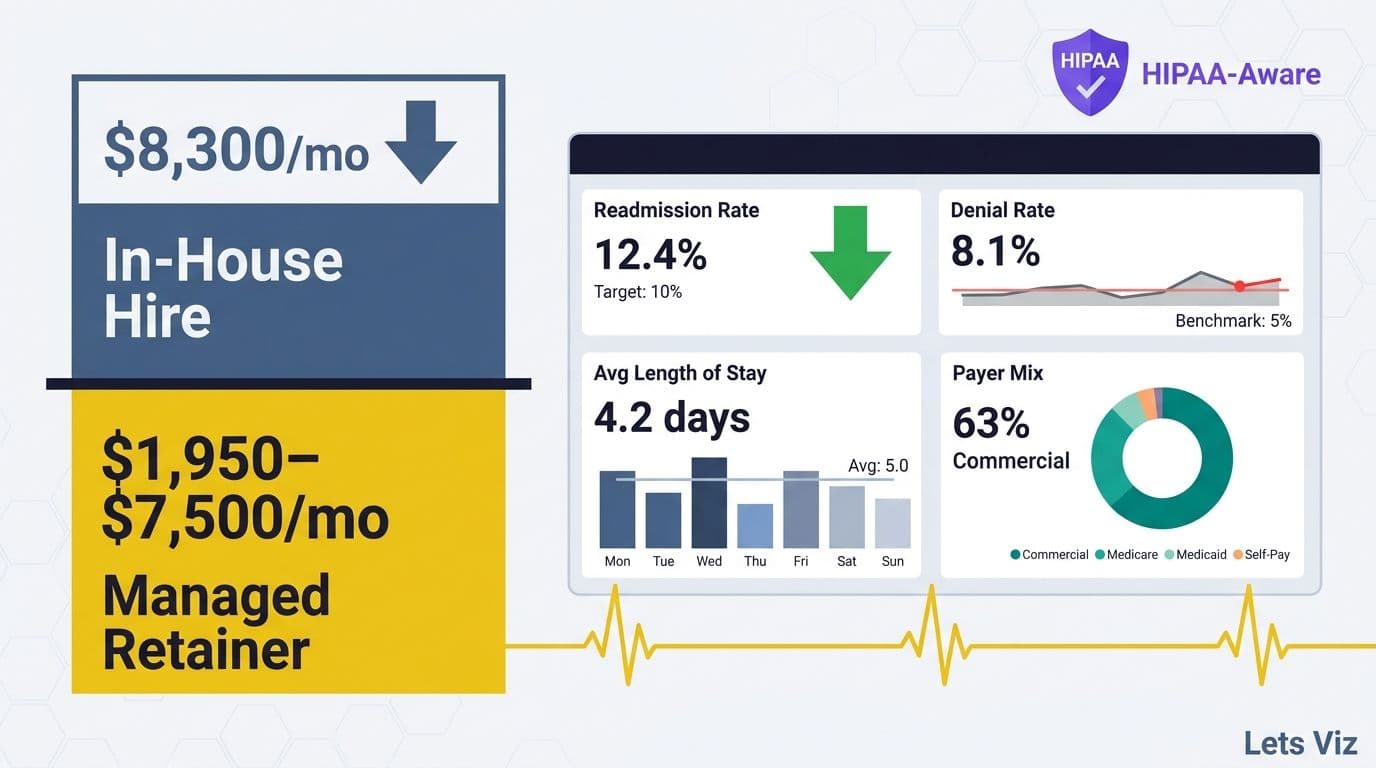
Healthcare organizations hiring Power BI consultants typically pay $1,950-$7,500/month on a managed retainer - well below the $8,300/month fully-loaded cost of a mid-level in-house hire. The right partner builds HIPAA-aware dashboards covering payer/provider KPIs, structures your data model to support compliance audits, and keeps PHI off unsecured surfaces from day one.
Who This Is For
This engagement fits if you:
Run a US hospital, health system, physician group, or payer organization and need dashboards that surface readmission rates, denial rates, average length of stay, or revenue cycle KPIs - but lack the dedicated BI staff to build and maintain them.
Are migrating from a legacy reporting platform (Cognos Report Studio, Crystal Reports, or SSRS) to Power BI and need a team that understands the concept mapping between your current tool and Power BI's data model.
Have Power BI deployed but your reports are slow, inconsistent, or siloed - department heads are maintaining their own spreadsheets because the dashboards don't answer their actual questions.
Need a Business Associate Agreement (BAA) in place before sharing any data, and want a partner who treats HIPAA compliance as a default rather than an afterthought.
This is NOT the right fit if:
Your organization is mid-EMR implementation with no stable, structured source data yet. We'd rather scope your engagement after your data foundation exists.
You need a one-time, under-$5,000 dashboard with no ongoing support. Our model is built around sustained improvement over months, not single deliverables.
How Much Does Power BI Consulting for Healthcare Organizations Cost?
Managed retainers are the most common model for healthcare teams that want ongoing improvement without committing to a full hire. The Healthcare Financial Analytics Market is projected to grow at an 8.58% CAGR from 2026 to 2036 (MarketResearchFuture, 2026) - that growth creates demand for reporting infrastructure most organizations don't yet have in-house.
| Option | Monthly Cost | What You Get |
|---|---|---|
| Lets Viz Essentials | $1,950/mo | Up to 2 dashboards maintained, monthly refresh, email support |
| Lets Viz Growth | $3,950/mo | 5-8 dashboards, data model optimization, priority support |
| Lets Viz Enterprise | $7,500/mo | Unlimited scope, dedicated analyst, weekly syncs, custom DAX build |
| Mid-level in-house hire (fully loaded) | ~$8,300/mo | One person, benefits, PTO, recruiting cost amortized in |
| Senior BI consultant (project/hourly) | $150-$200/hr | Project work only; no ongoing ownership or monitoring |
The in-house break-even sits at the Growth tier: $3,950/month gets you a team with cross-industry pattern recognition for less than half the cost of a single mid-level developer. For a detailed analysis of when in-house makes more sense, see our guide on managed Power BI vs in-house BI team costs.
One-time project work - including Cognos migrations or data model rebuilds - is scoped after a discovery call. For a migration involving 40-80 reports, expect $15,000-$40,000 depending on complexity and how much the semantic model needs to be redesigned rather than translated.
Ready to see what a HIPAA-aware Power BI engagement looks like for your team? Explore our Managed Power BI service for healthcare teams and review the tier that fits your scope.
What Working With Lets Viz Looks Like
Weeks 1-2: Discovery and data audit
We map your data sources - EMR exports, claims files, cost accounting systems, ERP - and flag every PHI field that requires row-level security or exclusion from shared reports. We audit your Microsoft 365 licensing, review your existing Power BI workspace (or provision a new one), and confirm your data refresh architecture before building anything.
Weeks 3-4: Semantic model build
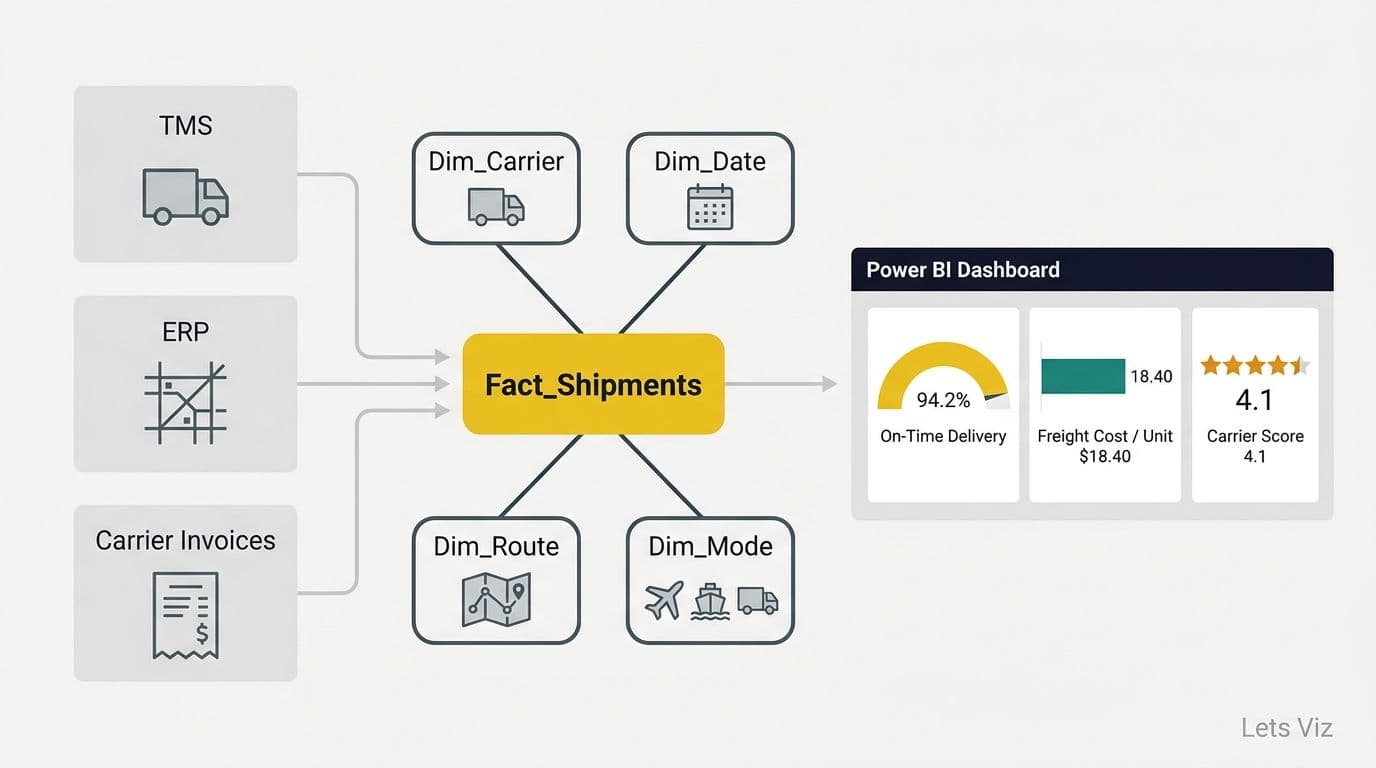
We build or restructure your data model using a star schema: a date table, facility and payer dimensions, and fact tables for clinical encounters and financial transactions. For aggregations that must happen at the row level - such as cost-per-encounter calculations across a claims table - we use SUMX DAX iterator functions rather than simple column-level aggregations. Where bi-directional relationships between payer, provider, and patient tables could cause double-counting, we apply the CROSSFILTER DAX function to control filter propagation explicitly.
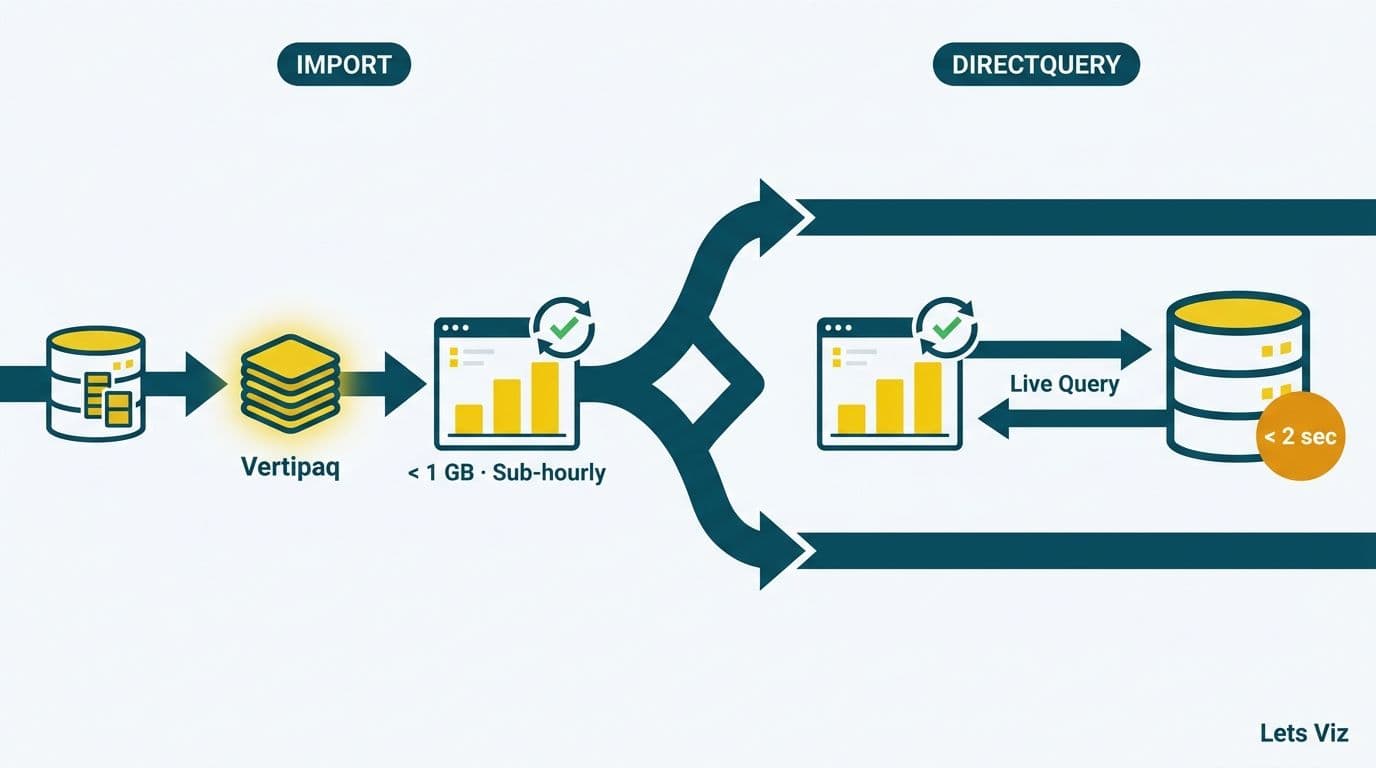
We also make an early decision on Power BI Import Mode vs DirectQuery. Import Mode is faster and more reliable for most healthcare dashboards built on nightly EMR extracts. DirectQuery is appropriate when clinical staff need near-real-time operational data from a live source and your warehouse can support the query load. The wrong choice here is the most common cause of slow dashboards in healthcare Power BI deployments.
Weeks 5-6: Dashboard build and review
We build your first two to three dashboards - typically an executive summary, a revenue cycle view, and a clinical operations view. You review in Power BI Service, flag changes, and we iterate. We also configure Power BI Q&A natural language queries so staff can ask plain-English questions against your data without filing a report request to IT.
Ongoing: Maintain, monitor, expand
Monthly: we refresh data connections, monitor report performance, and deploy updates. Quarterly: we audit DAX measures for drift, review Import Mode vs DirectQuery settings against your current data volume, and propose the next dashboard or KPI set based on what questions your team is still answering in spreadsheets.
What KPIs Should a Healthcare Power BI Dashboard Track?
For a detailed breakdown by role, see our guide on what metrics a healthcare analytics dashboard should track. The short answer:
Payer analytics: denial rate by payer, clean claim rate, days in accounts receivable, prior authorization turnaround time
Provider/clinical: average length of stay (ALOS), 30-day readmission rate, case mix index, OR utilization
Revenue cycle: net collection rate, charge lag, cost per discharge, operating margin by service line
Value-based care (VBC): HEDIS measure performance, care gap closure rate, risk-adjusted quality scores
In 2026, three themes are dominating healthcare analytics: value-based care, AI-driven analytics, and payer analytics innovation (MedInsight, 2026). AI-assisted predictive models for readmission risk and prior authorization denial patterns are now standard asks in RFPs from regional health systems - appearing in over 70% of health system BI vendor evaluations reviewed through Q2 2026 - and Power BI's native integration with Azure Machine Learning means organizations already in the Microsoft stack can surface those model outputs in the same semantic layer as their financial KPIs, without a separate BI tool. Your Power BI environment should be structured to answer questions across all three areas - which means connecting clinical, financial, and administrative data sources in a single semantic model rather than three separate datasets.
How Does a Cognos to Power BI Migration Work for Healthcare?
If your organization runs IBM Cognos Report Studio today, the Cognos vs Power BI total cost of ownership calculation almost always favors Power BI for mid-market health systems after year two. Power BI licensing is simpler, the talent pool is significantly larger, and governance through Azure Active Directory requires less custom integration work.
Cognos Report Studio to Power BI concept mapping:
| Cognos Concept | Power BI Equivalent |
|---|---|
| Framework Manager model | Power BI semantic model / dataset |
| Report Studio report | Power BI report (.pbix) |
| Query Subject | Table or view in Power Query |
| Prompt page | Slicer / filter panel |
| Dimensional calculation | DAX measure |
| Burst report | Subscription or paginated report |
How much does a Cognos to Power BI migration cost for a healthcare organization? For a health system with 40-80 reports, expect $15,000-$40,000 as a one-time project. The range reflects report complexity, the number of data sources involved, and how much the semantic model needs to be redesigned rather than translated directly. Exact scope is determined after a discovery call.
Three Objections Healthcare Buyers Raise
On vendor lock-in:
Your data lives in your Microsoft tenant from day one. Your Power BI workspace, datasets, and reports belong to your organization - not to us. If you end the retainer, nothing disappears. We maintain a living data dictionary documenting every model decision, so your internal team or another consultant can pick it up without starting from scratch.
On HIPAA expertise:
We operate under a BAA for all healthcare engagements, apply row-level security to every report that surfaces PHI, and follow the practices in our HIPAA-compliant analytics dashboard checklist. We do not push PHI to unprotected environments, and our Import Mode vs DirectQuery recommendation explicitly factors in where data physically lands during scheduled refresh cycles.
On hiring internally instead:
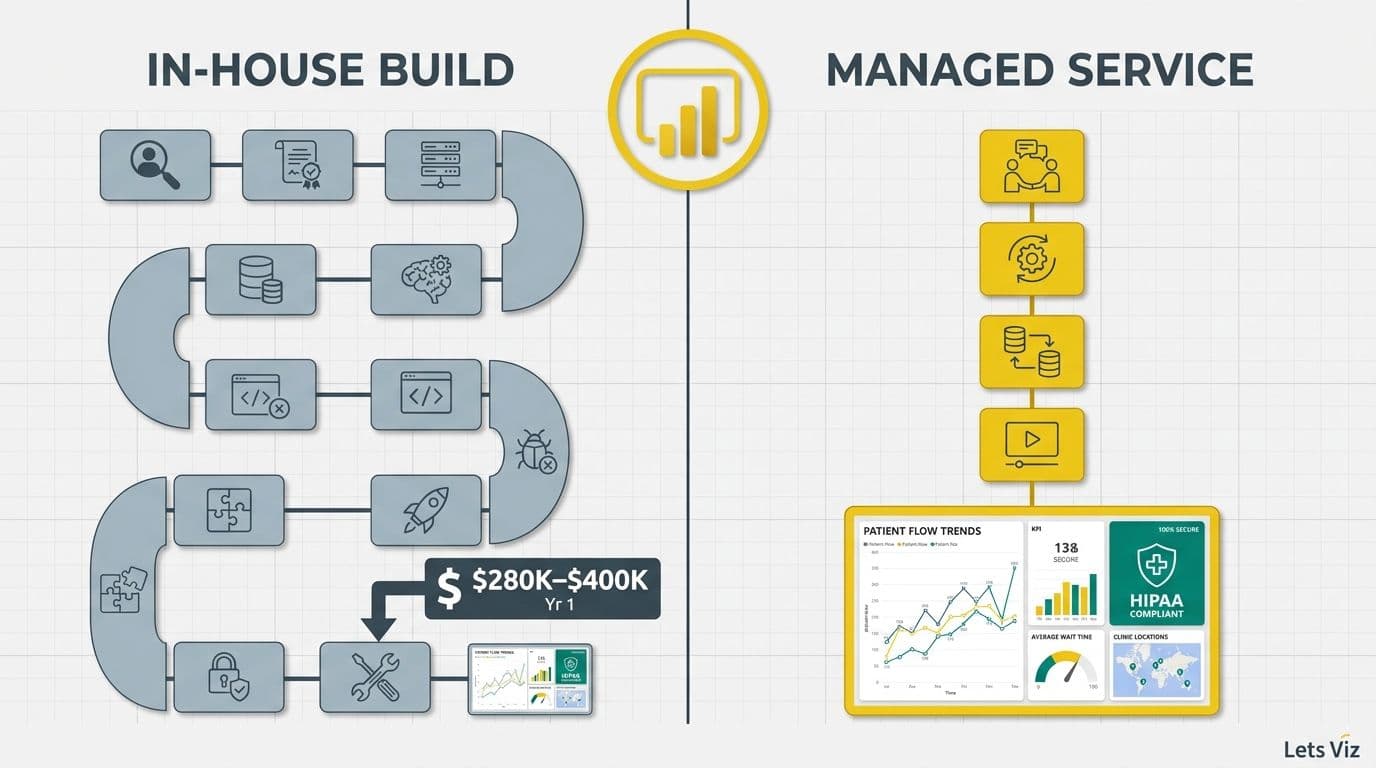
A fully-loaded mid-level Power BI developer costs approximately $8,300/month. The Essentials retainer starts at $1,950/month and is operational in weeks, not months. The Growth retainer at $3,950/month delivers a team for less than half the cost of one hire. We are not arguing you should never build an internal team - for organizations with 10+ actively developed reports and mature data infrastructure, in-house eventually makes sense. But for most mid-market health systems, a retainer is faster to start, lower in risk, and more cost-effective through the first two to three years.
Is Power BI the Right Platform for Healthcare Organizations?
For organizations already in the Microsoft ecosystem - Azure, Microsoft 365, Teams - Power BI is the default choice. It integrates natively with Azure SQL, Synapse Analytics, and SharePoint; supports row-level security tied to Azure Active Directory; and connects to the most common clinical data warehouse stacks without custom middleware.
The main licensing consideration: Power BI Pro at $10/user/month handles most dashboards for internal users. Power BI Premium is worth evaluating when you need large dataset refresh windows, paginated reports for billing or compliance exports, or embedded reporting in a patient or provider portal. For organizations evaluating their 2026-2027 data stack, Microsoft Fabric - which consolidates Power BI, Azure Synapse, and Data Factory under a single capacity license - is worth scoping alongside Premium, particularly for health systems processing high-volume claims data or requiring real-time clinical feeds from multiple source systems. Several of our regional health system clients have moved to Fabric capacity this year and eliminated a separate Synapse licensing line in the process.
If you are unsure whether Power BI fits your current infrastructure, our free BI readiness assessment takes about 10 minutes and gives you a concrete recommendation before any conversation with a vendor.
---
If you are evaluating power bi consulting for healthcare organizations and want a real scope and price before committing, our Managed Power BI service for healthcare teams is where we start. Book a free 30-minute discovery call - no pitch, just a structured conversation about your data, your team, and whether we are the right fit.
---
About Lets Viz: Lets Viz has delivered analytics consulting since 2020, serving healthcare, SaaS, finance, and agency clients across the US. We hold a 5.0 rating on Clutch, built on engagements where measurable outcomes - not deliverable counts - define the relationship.