Managed Power BI Service for Healthcare: Build vs. Buy Guide
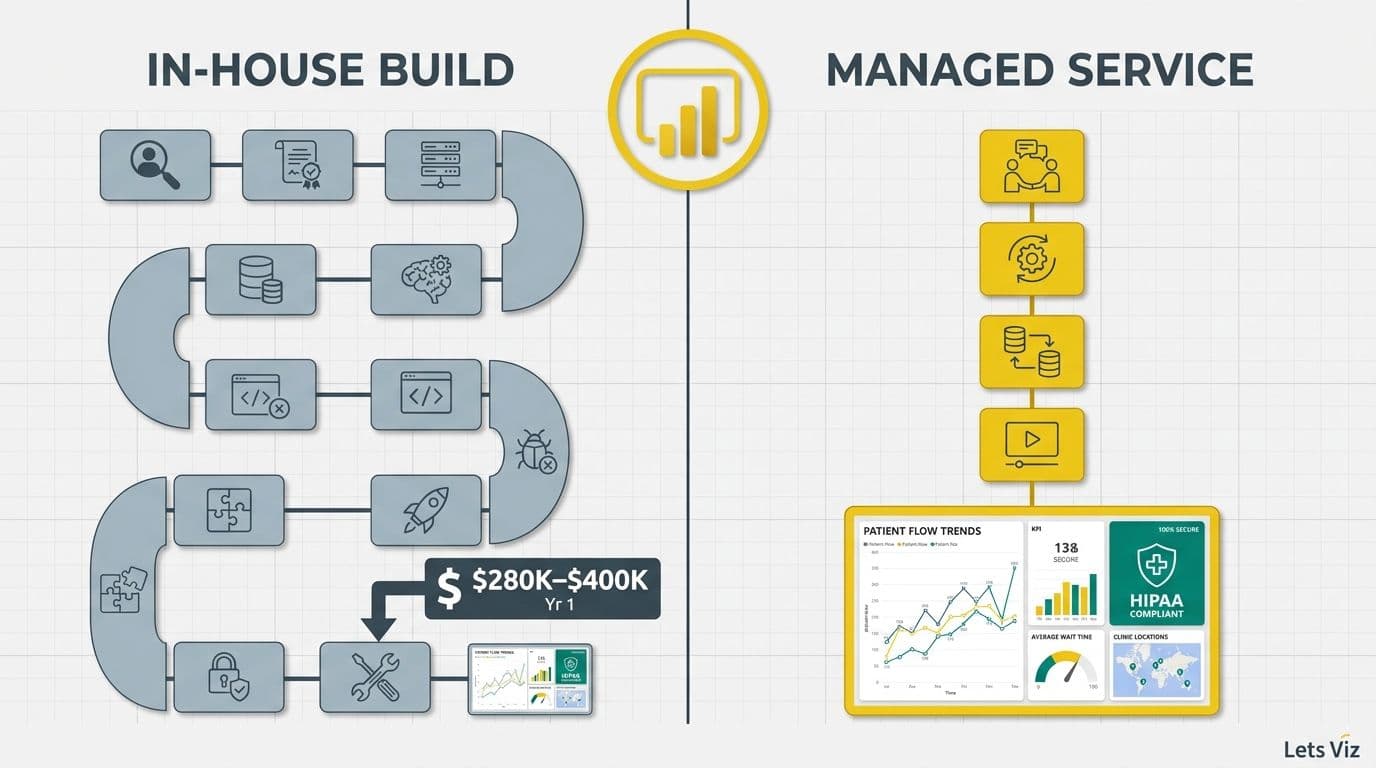
For mid-market hospitals and clinic networks, choosing between building an in-house Power BI team and a managed Power BI service for healthcare analytics comes down to total cost of ownership, time-to-insight, and HIPAA compliance overhead. Most organizations with under 500 beds reach a first working dashboard in 4-8 weeks under a managed model compared to 6-12 months in-house - a gap that directly affects clinical and financial decision speed.
Key Takeaways
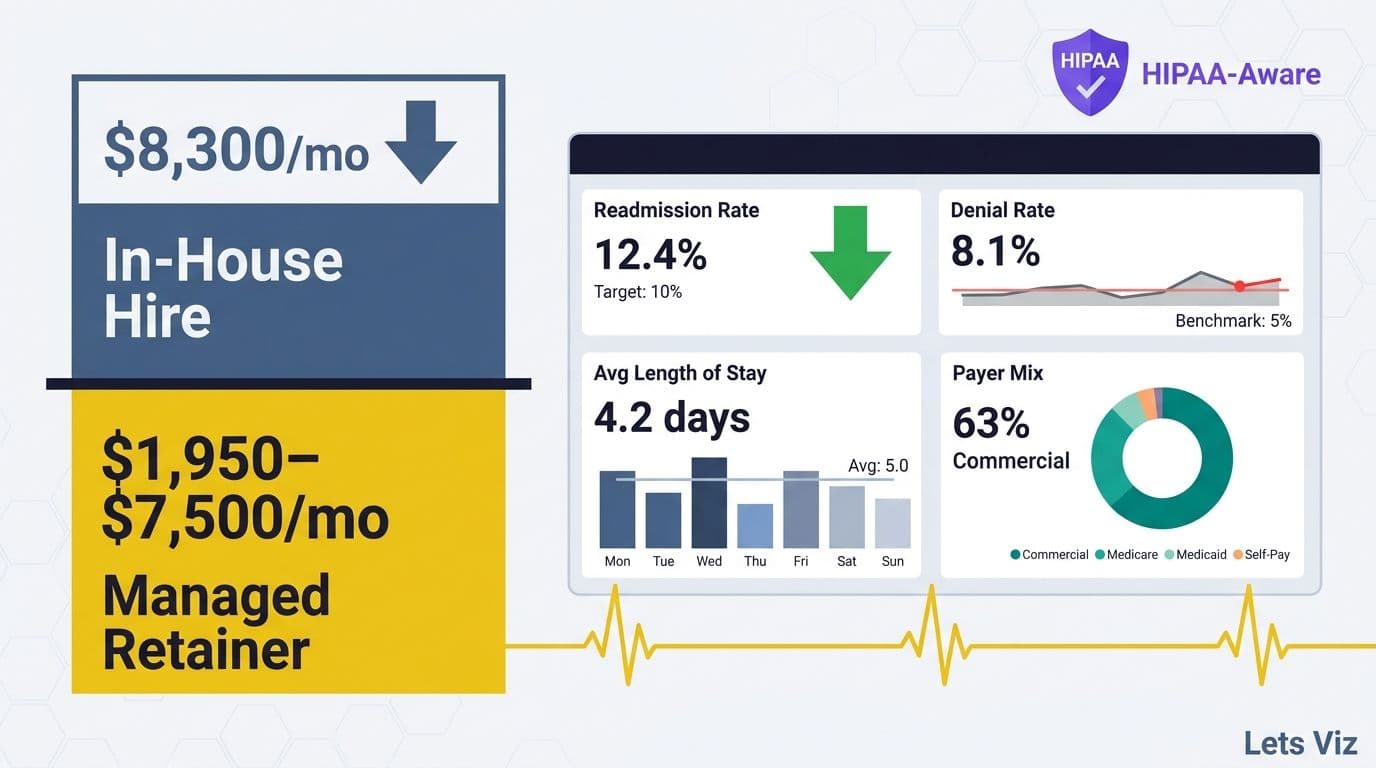
Building an in-house BI team for a mid-market hospital typically carries $280K-$400K or more in year-one costs when salaries, licensing, infrastructure, and training are combined
Managed Power BI services reduce time-to-first-dashboard from 6-12 months to 4-8 weeks in most healthcare implementations
HIPAA compliance is structurally simpler under a managed model where the vendor signs a BAA and maintains ongoing audit configurations
The Healthcare Financial Analytics Market is projected to grow at 8.58% CAGR from 2025 to 2035 (as of 2026), making durable analytics infrastructure a strategic priority for every hospital system
For mid-market teams evaluating Microsoft Fabric vs. Power BI, a managed partner absorbs platform evolution so internal teams stay focused on clinical and operational decisions
Lets Viz delivers Managed Power BI services for healthcare and finance teams -- fully managed analytics, from data model to decision-ready dashboard.
What Is the Real TCO of Building an In-House BI Team for a Mid-Market Hospital?
Building a BI capability in-house at a 150-400 bed hospital is a multi-year financial commitment - and the full cost rarely fits into a single budget line. A realistic year-one total cost of ownership includes several overlapping expenses that surface gradually:
Senior BI developer salary: $135K-$175K annually at US median rates in 2026, as healthcare data roles increasingly compete with AI and data engineering positions for the same candidate pool
Power BI Pro or Premium Per User licensing: $10-$20 per user/month across clinical, financial, and administrative staff
Data engineering support for ETL pipelines, EHR connectors, and security review: $80K-$120K in contract labor or a second FTE
Microsoft Azure or Microsoft Fabric infrastructure for Premium workloads and gateway hosting: $15K-$40K per year
Onboarding, training, and change management: $20K-$40K in year one before the first report reaches production
Before the first dashboard reaches a department head, a typical mid-market hospital commits $280K-$400K in hard spend. Add the structural risk of BI talent attrition - healthcare data roles command a premium and turnover runs high - and the three-year total often exceeds $1M for organizations that need coverage across finance, clinical quality, and operations.
The comparison is commonly framed as Power BI licensing cost versus a managed service retainer, but that framing misses the full picture. For a complete breakdown of these trade-offs across multiple organization sizes, see the Managed Power BI vs In-House BI Team: Mid-Market Cost Guide.
How Does a Managed Power BI Service for Healthcare Analytics Compress Time-to-Insight?
A managed Power BI service for healthcare analytics delivers a working, HIPAA-governed dashboard environment in weeks rather than quarters. Managed providers arrive with pre-built EHR data connectors, validated semantic models for common schemas (Epic Clarity, Oracle Health CDR, eClinicalWorks), and design libraries calibrated to clinical and financial reporting standards.
According to Market Research Future (2026), the Healthcare Financial Analytics Market is projected to grow at an 8.58% CAGR from 2025 to 2035, driven by regulatory pressure, value-based care adoption, and demand for real-time payer analytics. Organizations that delay building analytics capability lose ground as peers move faster on contract negotiation, cost reduction, and quality metric reporting.
Three structural factors explain the managed model's speed advantage:
1. No hiring lag. The average healthcare BI hire takes 60-90 days to recruit and another 60-90 days to reach full productivity — and in 2026 that window is increasingly optimistic, as healthcare data roles now compete directly with AI and data engineering positions for the same scarce talent pool. For a 200-bed hospital that needs revenue cycle and clinical quality dashboards by Q4, a 5-7 month hiring gap translates directly into one operating quarter without the analytics needed to catch payer underpayments, readmission trends, or cost variances before they compound. A managed team starts at contract signature with no recruiting queue.
2. Reused architecture. Managed providers apply data models refined across dozens of similar engagements. A hospital's finance team is not the first to need a patient revenue waterfall, a payer-mix breakdown, or a cost-per-discharge dashboard — a mature provider typically arrives with 35-50 validated measures covering clinical quality, payer mix, and operational efficiency, compressing what would otherwise be a 3-6 month measurement design phase into the first two weeks of engagement.
3. Embedded governance. Role-level security, row-level filters for protected health information (PHI), and audit logging are configured at deployment - not retrofitted after a compliance review flags the gap.
For hospitals pursuing AI-driven analytics as the next step, this governed foundation is prerequisite. As of 2026, three themes continue to define healthcare analytics strategy: value-based care, AI-driven analytics, and payer analytics innovation - all require clean, governed data before any AI layer can operate reliably. The AI Analytics for Healthcare Finance Teams: 2026 Guide walks through how to sequence that build-out.
Build vs. Managed Power BI for Healthcare: A Side-by-Side Comparison
The table below compares the two models across the dimensions that matter most to hospital CIOs and CFOs evaluating a multi-year BI strategy.
| Dimension | In-House Build | Managed Power BI Service |
|---|---|---|
| Year-one cost (150-400 bed hospital) | $280K-$400K+ | $60K-$120K |
| Time to first production dashboard | 6-12 months | 4-8 weeks |
| HIPAA BAA coverage | Self-managed | Included via vendor BAA |
| EHR connector readiness | Built from scratch | Pre-built connectors available |
| DAX and data model expertise | Depends on hire quality | Senior-level, consistent team |
| Scalability | Requires additional headcount | On-demand capacity adjustment |
| Microsoft Fabric migration | Internal project to plan and resource | Managed partner handles evolution |
| Attrition risk | High - BI talent is mobile | Low - vendor provides team continuity |
| Row-level security for PHI | Manual configuration required | Embedded in standard deployment |
| Continuous optimization | Requires internal bandwidth | Included in service scope |
One dimension the table highlights deserves closer attention: Microsoft Fabric vs. Power BI is an active platform question for mid-market teams in 2026. Microsoft is consolidating its data platform under Fabric - bringing together Power BI, data engineering, warehousing, and real-time analytics - and organizations are asking how Fabric compares to Azure Synapse and to independent platforms on cost and governance terms. A managed partner tracks and absorbs these platform shifts; an internal team must redirect project capacity to evaluate, test, and migrate independently.
For structured guidance on the outsourcing decision itself, When to Outsource Power BI Management: A Decision Framework offers a practical scoring model for operations, finance, and IT leaders.
When Does Building an In-House BI Team Make Sense for Hospitals?
The managed model is not the right answer for every organization. In-house builds make sense under four conditions:
Scale justifies a dedicated team. A health system with 1,500-plus beds, multiple hospitals, and 75 or more regular reporting users often has enough complexity and volume to justify three or more dedicated BI FTEs. At that scale, the managed service model may represent a cost floor rather than a cost advantage.
Proprietary models are a competitive asset. Some organizations have built unique predictive models - readmission risk scoring, length-of-stay prediction, surgical scheduling optimization - that represent genuine institutional intellectual property. These models benefit from tight internal control over logic and training data.
Existing data engineering depth is available. If a hospital already operates a mature data warehouse team experienced with platforms like Snowflake, Databricks, or Microsoft Fabric - and is actively evaluating their relative cost and governance performance for mid-market analytics workloads - adding Power BI developers to an established platform carries lower implementation risk than starting from scratch.
Board policy restricts third-party PHI access. Certain health systems have governance policies requiring full internal control over PHI-adjacent systems, even under BAA. In these cases, a managed engagement requires careful scoping to restrict vendor access to aggregated or de-identified data layers only.
For most clinic networks under 100 providers and community hospitals under 300 beds, the managed model wins consistently on cost and speed. The key is selecting a vendor with ambulatory and multi-site experience rather than one optimized for large enterprise inpatient environments.
Before committing to either path, the Free BI Readiness Assessment helps clinical and operational leaders identify capability gaps and infrastructure constraints that determine which model is viable.
How Does HIPAA Compliance Work Under a Managed Power BI Service?
HIPAA compliance is frequently cited as a reason to keep BI capability in-house - but this logic often reverses under scrutiny. A Business Associate Agreement (BAA) covers the managed vendor's access to PHI at the data layer. Microsoft signs BAAs for Power BI Premium, Microsoft Fabric, and Azure workloads. A reputable managed BI partner also signs a BAA and operates within those contractual and regulatory boundaries.
Under a well-structured managed engagement, the vendor's compliance responsibilities include:
Configuring row-level security (RLS) so clinicians see only their own patient panels and administrators see only their assigned cost centers
Maintaining audit logs for all dataset refreshes, user access events, and export actions in line with HIPAA access control requirements
Applying Microsoft Purview sensitivity labels to flag and restrict PHI-containing datasets from unauthorized sharing or export
Conducting periodic access reviews to ensure departing employees and role changes are reflected in Power BI permissions promptly
The real risk in an in-house model is not that HIPAA compliance cannot be achieved - it is that compliance in Power BI is a configuration discipline requiring ongoing attention. A single misconfigured RLS filter can expose patient-level data to the wrong role or department. Managed providers with healthcare specialization embed these checks in their standard QA and release process rather than treating them as a one-time setup task.
The HIPAA-Compliant Analytics Dashboard: Best Practices Checklist provides a comprehensive control-by-control reference for healthcare organizations validating their dashboard governance posture, whether managed or in-house.
What Should Healthcare CIOs Look for in a Managed Power BI Partner?
Not all managed BI vendors understand healthcare's reporting requirements. The following criteria separate specialized healthcare analytics partners from general-purpose BI shops:
EHR integration experience. Ask whether the vendor has built Power BI connectors for your specific EHR platform. Epic's Clarity and Caboodle databases, Oracle Health's CDR, and eClinicalWorks each require different extraction patterns and incremental refresh strategies. Generic SQL competence is not sufficient.
Healthcare-specific semantic models. A qualified partner arrives with pre-built measures for common healthcare KPIs: case mix index, average length of stay, 30-day readmission rate, claim denial rate by payer, and cost per discharged case. Building these from scratch adds months and introduces measurement risk.
Paginated reporting capability. Healthcare organizations frequently need pixel-perfect paginated reports for CMS quality submissions, payer remittance reconciliation, and billing documentation - output that Power BI Report Builder handles through paginated report format, distinct from the interactive dashboards authored in Power BI Desktop. A managed partner with healthcare experience should be proficient in both tools and know when each is appropriate.
Advanced DAX capability. Complex healthcare metrics frequently require advanced DAX patterns. The `ALLSELECTED` function, for instance, is essential for correctly cross-filtering aggregate measures across patient cohorts or time-period selections without breaking filter context. Time-intelligence patterns handle period-over-period claim volume comparisons and budget variance calculations. Assess whether the vendor's team writes and reviews DAX at this level, or relies on generated code that regularly produces incorrect results in healthcare data models.
Platform roadmap alignment. The BI landscape is evolving quickly. Microsoft Fabric is consolidating capabilities across data engineering, warehousing, real-time analytics, and Power BI visualization under a unified capacity model. Mid-market teams are evaluating how Fabric compares to standalone alternatives - including independent data warehousing and analytics platforms - across cost, governance, and workload compatibility. A managed partner needs a clear position on platform direction and a documented migration process for moving client workloads without disrupting production reporting.
References in comparable organizations. A vendor optimized for large enterprise health systems may have limited experience with the budget constraints, lean IT staffing, and multi-site complexity of a 12-clinic network or 200-bed community hospital. Ask for references in organizations of similar size and operational structure.
According to Future Market Insights (as of 2026), the AI consulting services market is projected to grow from USD 11.07 billion in 2025 to USD 90.99 billion by 2035 at a 26.2% CAGR - reflecting the broader shift toward outsourced specialized technical expertise across regulated industries. Healthcare organizations that select the right managed BI partner today are building the governed data foundation that will support AI-driven clinical decision support, automated payer analytics, and cost benchmarking tools over the next decade. For a broader view of how healthcare organizations are making this evaluation, the AI Consulting for Healthcare Data Analytics: 2026 Guide covers the full framework.
---
If your hospital or clinic network is ready to move from manual reporting to a governed, HIPAA-compliant Power BI environment - and wants it running in weeks rather than quarters - explore Managed Power BI for healthcare teams to see how Lets Viz approaches mid-market healthcare deployments.
---
About Lets Viz: Lets Viz is a data analytics consulting firm serving healthcare, finance, and operations clients since 2020. The team specializes in Power BI implementation, managed analytics services, and AI-driven reporting for mid-market organizations, with deep experience navigating HIPAA compliance requirements, EHR data integrations, and the Microsoft Fabric platform transition. Clients include hospital networks, clinic groups, and payer organizations across the United States.