Power Automate vs n8n: Enterprise Automation Compared
Power Automate and n8n solve similar workflow automation problems through fundamentally different architectures. Power Automate is a Microsoft-native, cloud-first service that deploys fastest inside Microsoft 365 environments. n8n is an open-source, self-hostable workflow engine that gives IT and compliance teams full control over where data lives and processes. The right choice turns on your cloud posture, compliance obligations, and long-term vendor dependency tolerance.
Key Takeaways
- Power Automate integrates natively with Microsoft 365 but creates platform dependency that raises switching costs over time
- n8n's self-hosting model keeps workflow data on your own infrastructure, satisfying HIPAA, GDPR, and PIPEDA data-residency requirements
- Power Automate pricing scales per user and per premium flow; n8n's self-hosted Community Edition carries only infrastructure costs
- Finance and healthcare teams automating invoice extraction, account reconciliation, or month-end close should assess data-residency obligations before choosing a platform
- Both tools support AI-assisted workflow steps, but neither replaces the need for a clear integration strategy
Power Automate vs n8n for Enterprise Automation: What Are You Actually Choosing Between?
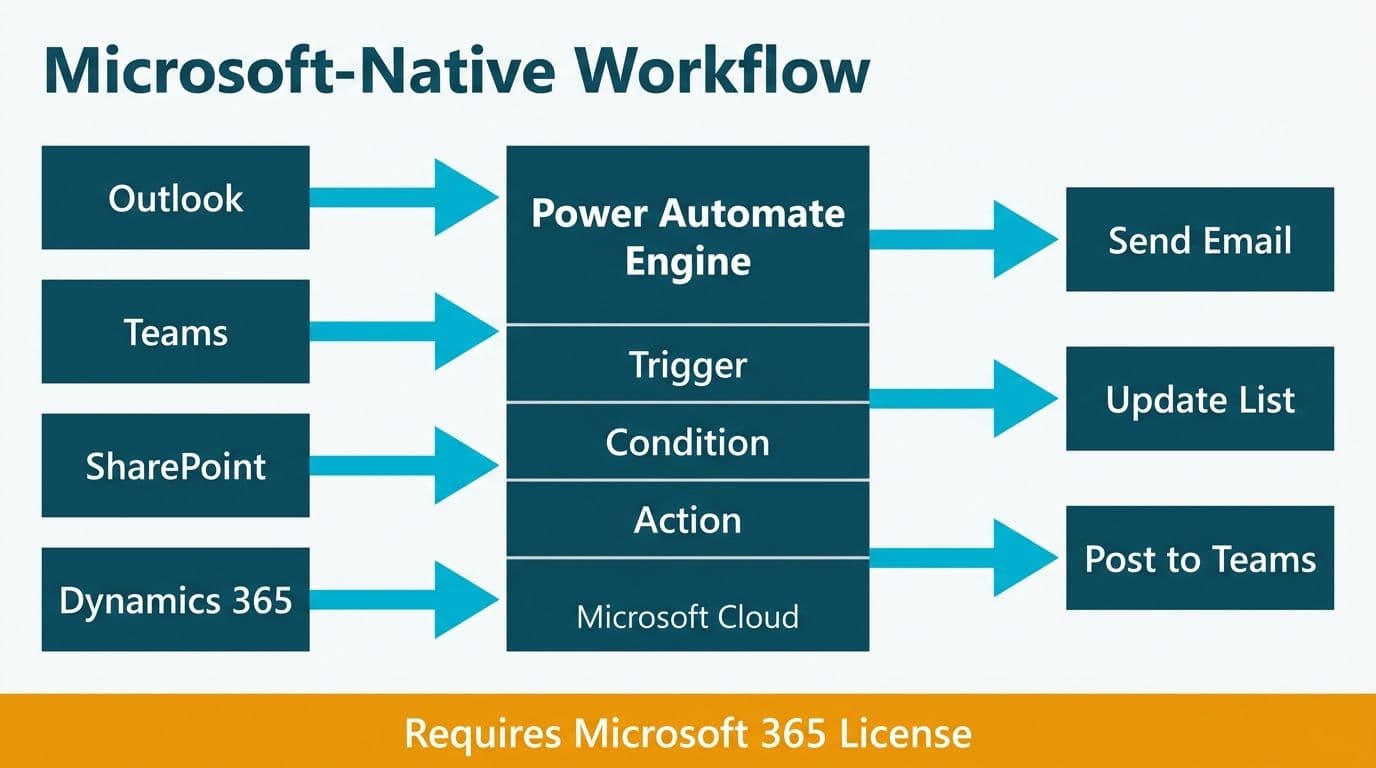
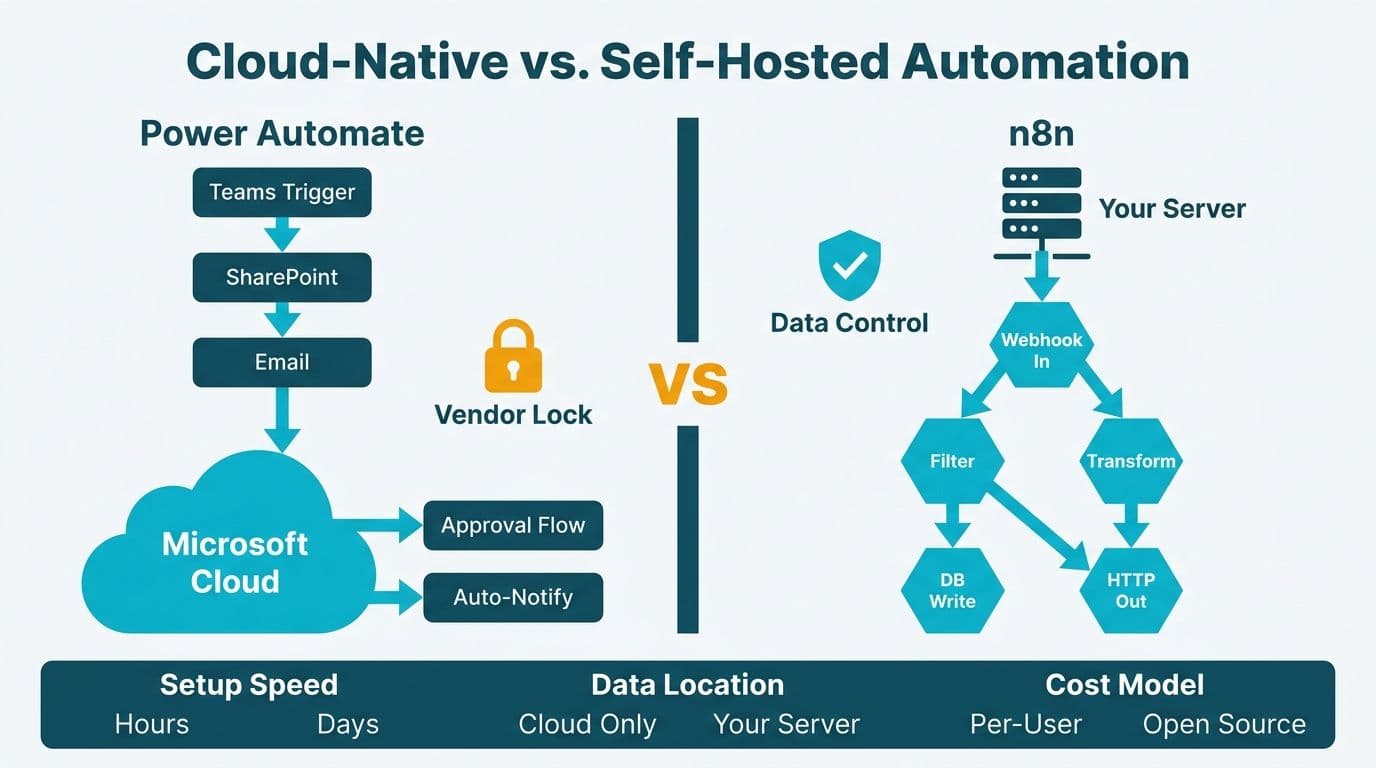
Power Automate is Microsoft's cloud automation service, tightly woven into the Microsoft 365 fabric. It connects Teams, SharePoint, Outlook, Dynamics 365, and hundreds of third-party services through a low-code canvas. n8n (pronounced "n-eight-n") is an open-source workflow automation tool that can run entirely on your own infrastructure - a virtual machine, a Kubernetes cluster, or an on-premises server - with no data leaving your environment unless you explicitly route it out.
The architectural gap matters most for regulated industries. A US healthcare system automating patient-intake workflows needs workflow data to stay within HIPAA-compliant boundaries. A Canadian insurer processing claims under PIPEDA cannot rely on a vendor's cloud compliance terms alone to satisfy its data-residency obligations. An EU-facing fintech under GDPR must document exactly where personal data flows and is processed.
Our team at Lets Viz works through these trade-offs as part of our AI automation consulting practice. The platform decision is rarely about features in isolation - it is about which compliance envelope the automation must live inside, and what the organization's true cost of vendor lock-in looks like over a three-to-five-year horizon.
The Fundamental Architecture Difference
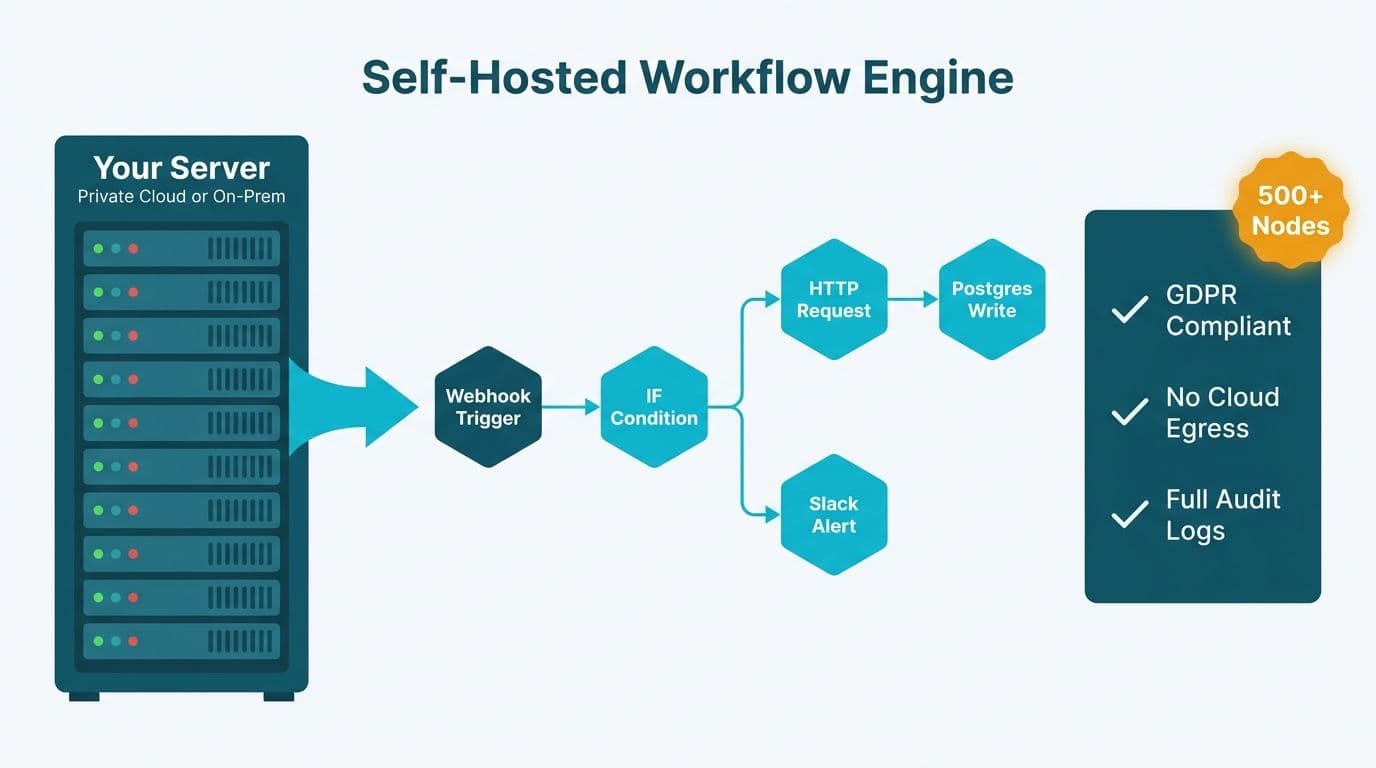
Power Automate runs in Microsoft's cloud. Flows execute on Microsoft's servers, and all trigger events, action payloads, and authentication tokens pass through Microsoft's infrastructure. n8n, when self-hosted, runs entirely within your perimeter. Credentials, patient health information, financial records, and API keys stay on hardware you control. This is not just a security posture - it is a compliance architecture.
For mid-market organizations that have not yet invested heavily in cloud security tooling, Power Automate's managed-service model removes operational burden. For organizations where data residency is a non-negotiable requirement, n8n's self-hosting makes compliance demonstrable rather than contractual.
How Does Microsoft 365 Ecosystem Lock-In Affect Your Choice?
Power Automate's greatest strength is also its tightest constraint: it is purpose-built for organizations already running Microsoft 365. Connectors to SharePoint, Teams, Azure Active Directory, and Dynamics share the same identity layer, require minimal configuration, and behave predictably. For a mid-market organization where 80 to 90 percent of workflows touch Microsoft services, that cohesion is a genuine productivity advantage in the first six months.
The risk is compounding dependency. Over 18 to 24 months, teams build dozens of flows that reference Microsoft-specific constructs - SharePoint list schemas, Teams channel webhooks, Dataverse tables, Adaptive Cards. Those references are not portable. Moving off Power Automate later means rebuilding workflows from scratch, not migrating them. IT leads should treat Power Automate adoption as an infrastructure commitment, not a software subscription.
For organizations with heterogeneous stacks - Salesforce plus NetSuite plus a custom ERP, or Zoho CRM plus a homegrown billing system - n8n often provides cleaner integration without the Microsoft scaffolding assumption. n8n's node library covers over 400 services as of 2025 (per n8n documentation), and because workflow definitions export as JSON, they can be version-controlled in Git and reviewed like any other code artifact.
Key question for IT leads: What percentage of your intended workflows stay entirely within Microsoft 365? If the honest answer is below 60 percent, the long-term lock-in cost of Power Automate may outweigh its early deployment speed advantage.
Which Platform Wins on Data Sovereignty for Healthcare and Finance?
Self-hosting is n8n's strongest differentiator for regulated industries, and it is the decisive factor for many healthcare and finance teams. When n8n runs on your own server - whether in an AWS us-east-1 region, a UK-based Azure data centre, or a Canadian cloud provider operating under Canadian data-protection requirements - workflow data never touches n8n's infrastructure.
Power Automate is a cloud-hosted service. Microsoft's compliance certifications are extensive - HIPAA Business Associate Agreements are available per Microsoft's 2025 compliance documentation - but workflow data still traverses Microsoft's cloud. For some regulated organizations that is acceptable. For others, particularly those handling sensitive health data or operating under strict national data-residency rules, self-hosting eliminates rather than merely mitigates the compliance concern.
Specific scenarios where n8n's self-hosting wins on compliance:
- US healthcare (HIPAA): A hospital system automating prior-authorization status checks or discharge summary routing needs PHI to stay within a HIPAA-compliant boundary. Self-hosted n8n with appropriate access controls and audit logging satisfies this requirement without routing PHI through a third-party cloud. Our dedicated guide on n8n HIPAA compliant workflow automation covers the configuration specifics.
- UK and EU organizations (GDPR): A UK fintech routing customer financial data through a US-hosted SaaS platform must document cross-border transfer mechanisms under GDPR Chapter V. Self-hosted n8n in a UK or EU data centre eliminates the cross-border transfer obligation entirely.
- Canadian healthcare and finance (PIPEDA): PIPEDA requires organizations to ensure personal information is protected even when processed by a third party. A Canadian insurer or bank self-hosting n8n on a Canadian cloud provider can satisfy this obligation architecturally rather than relying solely on contractual safeguards.
The broader compliance landscape for US and Canadian financial services is mapped in the AI compliance requirements for financial services: 2026 regulatory map, which is worth reviewing before committing to either platform.
How Do Power Automate and n8n Costs Compare at Enterprise Scale?
Pricing models diverge sharply, and the gap widens as execution volume and team size grow.
Power Automate uses a per-user and per-flow model. Microsoft's 2025 pricing includes a Power Automate Premium licence per user per month, plus additional costs for premium connectors, AI Builder credits, and Dataverse storage. Flows that use premium connectors require a Power Automate Premium or Process licence for each user who triggers them - the base Microsoft 365 licence does not cover premium flow execution. In a 200-person finance department, that per-seat cost compounds quickly against the baseline Microsoft 365 spend already in place.
n8n offers a self-hosted Community Edition at no licence cost (open-source, Apache 2.0 licence, per n8n documentation 2025). The n8n Cloud option is priced per execution and per active workflow, but most enterprise deployments with data-sovereignty requirements choose the self-hosted path. Infrastructure costs - a managed container environment or a dedicated virtual machine - are typically far below the per-seat licensing premium at mid-market scale.
| Factor | Power Automate | n8n (Self-Hosted) |
|---|---|---|
| Licence model | Per user + per premium connector flow | Open-source; infrastructure cost only |
| Microsoft 365 integration | Native, minimal setup | Via REST API or webhook nodes |
| Data residency | Microsoft cloud (BAAs available) | Your own infrastructure |
| HIPAA / GDPR / PIPEDA fit | Cloud BAA required | Self-hosted keeps data on-premises |
| Workflow portability | Microsoft-proprietary format | JSON; version-controllable in Git |
| AI and ML steps | Native AI Builder (credit-based) | Via API nodes (any LLM or AI service) |
| Setup complexity | Low for Microsoft 365 environments | Medium; requires DevOps capability |
| Best fit | M365-native organizations | Regulated industries; heterogeneous stacks |
One important nuance: Power Automate's per-flow Process licence can be cost-effective for high-volume, unattended automation where a single flow runs thousands of times per day. Organizations should model both per-user and per-process pricing scenarios against their specific execution profile before drawing a cost conclusion.
What Finance Workflows Should Teams Automate First - and Which Tool Fits?
Finance operations offer some of the clearest automation ROI because the underlying work is rules-based, high-volume, and disproportionately error-prone when done manually. The sequencing question - what to automate first - matters as much as the platform choice.
Invoice extraction and accounts payable: Understanding how AI extracts data from invoices and financial documents is the entry point for most finance automation projects. AI reads PDF layouts, extracts line items, and routes payables for approval without manual rekeying. Both Power Automate (via AI Builder's prebuilt invoice model) and n8n (via API calls to document AI services) can handle this. The platform choice often comes down to where invoices arrive and where they need to land.
A logistics company we worked with suspected carrier overcharges - but every carrier invoiced in a different PDF layout. We parsed 6 sample invoices across 5 partners and found a 2.86x surcharge overcharge, enough to justify automating the full freight-invoice reconciliation process. The analysis phase alone, before any workflow was built, returned its cost.
Month-end close and account reconciliation: AI automation for month-end financial close typically involves pulling trial balance data, matching transactions against bank statements, flagging exceptions, and routing them for human review. AI automation for account reconciliation follows the same pattern. Both platforms can orchestrate these steps; the determining factor is usually whether source systems have pre-built connectors (Power Automate) or accessible REST APIs (n8n).
Expense management: AI expense management automation for finance teams - capturing receipts, parsing against expense policy, and routing for manager approval - works well in Power Automate when the expense system is Microsoft-adjacent. n8n handles the same workflow through API nodes but requires more initial configuration investment.
For a broader view of where AI is reshaping finance operations, our guide on generative AI use cases in finance covers ten production-ready applications. For n8n-specific build patterns, n8n finance workflow automation: 5 real examples walks through real implementations for finance teams.
RPA vs AI Automation for Finance Teams: Where Do Power Automate and n8n Fit?
The RPA vs AI automation question for finance teams deserves a direct answer because both Power Automate and n8n occupy a middle ground between classical robotic process automation and pure AI decision systems.
Classical RPA mimics human mouse-and-keyboard interaction with applications that have no API. It is brittle - a UI change breaks the bot. Both Power Automate and n8n are API-first: they call services through documented endpoints, which is more stable and easier to audit. The AI layer in modern workflow automation refers to document understanding (parsing unstructured PDFs), classification (routing invoices by type), and natural-language steps (drafting exception notifications for review).
Power Automate's AI Builder adds a no-code layer for form processing, receipt analysis, and object detection. n8n integrates AI through API nodes - you can call any large language model directly from within a workflow to classify a document, extract specific fields, or summarize an exception for human review.
For finance teams, the practical guidance is: start with structured, rule-based tasks before adding AI steps. Use AI where inputs are unstructured - scanned invoices, free-text emails, multi-layout PDFs - and rule-based logic where inputs are already structured data. Both platforms support this hybrid pattern, and the choice between them does not change this sequencing; it only determines where the workflow runs and who controls the data.
---
About Lets Viz: Lets Viz has delivered data and automation consulting since 2020 across US healthcare systems, UK fintech firms, Canadian manufacturing companies, and global SaaS businesses. We hold a 5.0 Clutch rating and specialise in helping mid-market teams design automation strategies that satisfy compliance requirements without sacrificing operational velocity.
Ready to map out the right automation platform for your organization? Explore what structured, compliance-aware workflow design looks like in practice through our AI automation consulting service page.