n8n HIPAA Compliant Workflow Automation: The Complete Guide
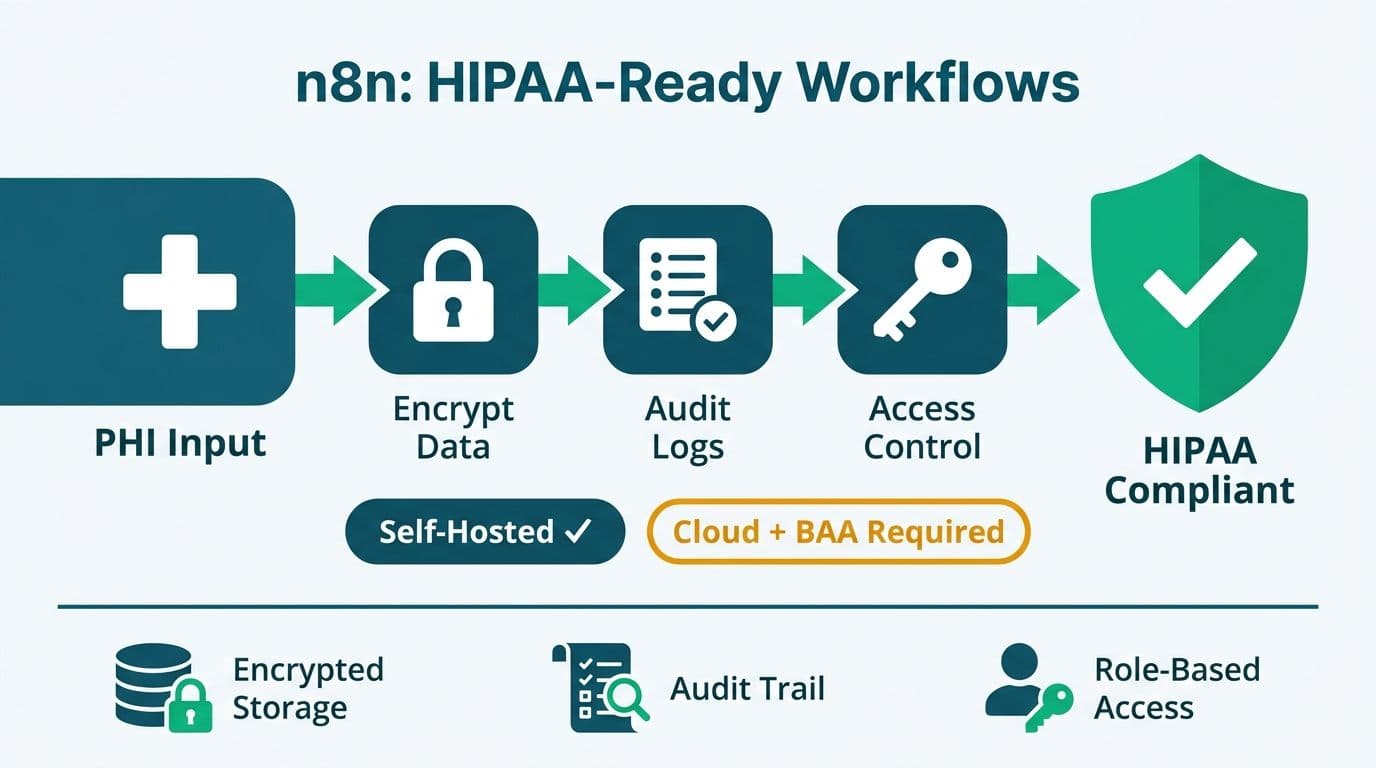
n8n can be configured for HIPAA compliant workflow automation when self-hosted on infrastructure you control, with encrypted storage, audit logging, and access controls in place. For NHS/GDPR compliance in the UK and PIPEDA compliance in Canada, the same self-hosted architecture applies with additional data residency requirements. Cloud-hosted n8n requires a signed Business Associate Agreement (BAA) and careful PHI scope limitation before routing patient data.
Key Takeaways
n8n is HIPAA compliant when self-hosted with encrypted storage, audit logs, and proper access controls - cloud deployments require a signed BAA with n8n before PHI can route through the platform
Patient intake routing, referral tracking, and EHR data pipelines are three high-ROI use cases for n8n in regulated healthcare environments
GDPR and UK NHS data requirements, as well as Canadian PIPEDA and provincial health privacy laws, impose data residency and consent obligations beyond HIPAA
Self-hosting n8n on your own VPS or private cloud gives you the infrastructure control regulators require - cloud tiers restrict the PHI you can route
A compliant n8n architecture combines workflow-level encryption, role-based access control, and SIEM-integrated audit logging
Is n8n HIPAA Compliant for Healthcare Workflow Automation?
n8n can be HIPAA compliant, but compliance is determined by your deployment configuration - not by the software itself. The U.S. Department of Health and Human Services (HHS) holds covered entities and their business associates accountable for the security of Protected Health Information (PHI) at the infrastructure level, not the application layer.
Self-hosted n8n gives you full control over where PHI is stored, how it is encrypted, and who can access workflow execution logs. A mid-market US hospital network can deploy n8n on a HIPAA-eligible cloud environment - such as AWS GovCloud or Azure's HIPAA-eligible service tiers - with the following controls in place:
Encryption at rest (AES-256) and in transit (TLS 1.2 or higher)
Role-based access control (RBAC) limiting who can view or edit workflows that handle PHI
Audit logging of every execution that touches patient data
Automated data retention and purge schedules aligned with your Notice of Privacy Practices
n8n Cloud (the managed SaaS offering) requires a signed BAA before any PHI routes through it. As of 2026, n8n Cloud Enterprise supports BAA execution for qualifying accounts. For organizations that cannot reliably scope PHI away from cloud-hosted workflows, self-hosting remains the lower-risk path.
Regulated workflow architecture sits at the core of what our AI automation consulting practice builds for healthcare and finance clients across North America and the UK.
How Do You Build a Patient Intake Routing Workflow in n8n?
Patient intake routing is one of the clearest wins for n8n in regulated healthcare. The workflow connects three systems: your intake form or scheduling portal, your internal routing rules engine (department, acuity level, insurance type), and your communication layer (secure SMS, messaging platform, or care coordinator notification).
A production n8n patient intake workflow follows this sequence:
1. Trigger - A Webhook node receives a form submission from the patient intake portal
2. Triage logic - An IF node evaluates the acuity flag, insurance type, or appointment category
3. PHI isolation - A Function node strips non-essential identifiers before the workflow branches downstream
4. Routing - A Switch node routes the record to the correct department queue via HTTP Request to the EHR's FHIR R4 API
5. Notification - An email or Twilio SMS node alerts the care coordinator, with PHI limited to what the coordinator needs for the handoff
6. Audit log - An HTTP Request node writes the execution record to your SIEM, capturing execution ID, timestamp, and data category - not the PHI content itself
Compliance Callouts for Patient Intake
HIPAA (US): Every node that processes PHI must run within your BAA-covered infrastructure boundary. Log execution metadata rather than PHI content to satisfy the HIPAA Security Rule's audit control requirement (45 CFR §164.312(b)). Use n8n's built-in credential encryption for all API keys and connection credentials.
NHS/GDPR (UK): NHS organizations must ensure patient data does not leave UK or EU data centers without a Transfer Impact Assessment. Self-hosting n8n on UK-region cloud infrastructure satisfies data residency. Document the legal basis for processing under UK GDPR Article 9 (special category health data) before the workflow goes live, and retain that documentation for your Information Governance toolkit submission.
PIPEDA (Canada): Canadian healthcare organizations subject to PIPEDA - and provincial laws such as PHIPA in Ontario or HIA in Alberta - must obtain express consent before automating the transfer of personal health information between systems. Build a consent-status check into your n8n trigger logic: if active consent is not recorded in the EHR, the workflow should halt and route the record to a manual review queue.
For a broader view of automation patterns in regulated healthcare settings, our guide to AI workflow automation for healthcare operations covers implementation approaches beyond n8n.
How Does n8n Automate Referral Tracking in Regulated Environments?
Referral leakage - patients referred to specialists who never complete the visit - costs health systems revenue and worsens clinical outcomes. Industry analyses estimate that 25-40% of specialist referrals across US ambulatory networks are never completed, representing billions in lost downstream revenue and contributing directly to avoidable readmissions. n8n can close the referral loop by automating the status check cycle between the referring provider's EHR and the specialist's scheduling system, without a custom point-to-point integration build.
Referral Identification
A Schedule Trigger runs nightly and queries the referring EHR via the FHIR R4 API for open referrals older than a configurable threshold - commonly 48 to 72 hours - with no confirmed appointment. n8n's HTTP Request node handles OAuth 2.0 authentication with EHR platforms that expose FHIR endpoints.
Status Reconciliation
An HTTP Request node queries the specialist practice management system for appointment status. A Merge node combines the two datasets. An IF node flags referrals where status remains "pending" past the follow-up window and routes those records to the outreach branch.
Outreach and Escalation
A Wait node introduces a configurable delay before the next outreach attempt, keeping the workflow within the referring organization's communication protocol. Outreach messages - sent via a Twilio or SendGrid node - are limited to appointment confirmation details only, not clinical information.
HIPAA note: Referral workflows that touch appointment status fall under HIPAA's Treatment, Payment, and Operations (TPO) exception, so patient authorization is not required for the automated status check itself. Any direct patient communication must use a HIPAA-compliant channel - encrypted email or secure SMS, not plain-text standard email.
How Do You Build Compliant EHR Data Pipelines in n8n?
EHR data pipelines built in n8n bridge clinical systems and analytics or reporting layers without expensive native integration modules. n8n's HTTP Request node supports FHIR R4, vendor-specific REST APIs, and HL7 v2 messages when combined with an integration middleware layer such as Mirth Connect.
A production-grade n8n EHR pipeline covers five stages:
| Pipeline Stage | n8n Node | Compliance Control |
|---|---|---|
| Extract | HTTP Request (FHIR R4 API) | OAuth 2.0 scoped to minimum necessary data fields |
| Transform | Function or Code node | PHI masking applied before writing to any destination |
| Load | HTTP Request or database node | TLS 1.2+ in transit; encryption at rest in destination |
| Audit | HTTP Request to SIEM | Execution ID, timestamp, and data category logged - not PHI |
| Error handling | Error Trigger node | Failed PHI transfers alert on-call; no PHI in plaintext error payloads |
The Code node - n8n's JavaScript execution environment - is where most PHI transformation and masking logic lives. Keep these scripts version-controlled in your source repository and require peer review for any change that touches PHI handling.
EHR to Data Lake to BI Layer
The most common n8n healthcare data workflow automation pattern in mid-market health systems moves clinical and claims data through three layers: the EHR as source, a cloud data lake for de-identified long-term storage, and a BI layer - Power BI or Looker - for operational reporting. n8n orchestrates every handoff across this stack.
The EHR-to-lake leg extracts FHIR R4 bundles on a nightly Schedule Trigger, applies Safe Harbor de-identification in a Code node, then writes to the lake landing zone via an S3 or Azure Blob Storage node. The lake-to-BI leg reads curated, non-PHI aggregates and pushes them to your reporting layer through a native connector or HTTP Request node.
Audit logging must cover all three transitions - not just the EHR extract. Write a SIEM log entry after de-identification, after the lake write, and after the BI push. This three-point trail satisfies HIPAA's audit control requirement (45 CFR §164.312(b)) and gives compliance teams a complete data lineage record for any regulatory review.
Data residency: Canadian organizations under PIPEDA and provincial health privacy laws must host the data lake on Canadian-region infrastructure - AWS ca-central-1 or Azure Canada Central. For HIPAA and GDPR readers, the same principle applies: the lake region must sit within your compliance boundary. GDPR-covered organizations must keep all three layers within EU or UK-region infrastructure, or complete a Transfer Impact Assessment before any cross-border data movement occurs.
Self-hosted vs cloud for EHR pipelines: Self-hosted n8n on HIPAA-eligible infrastructure is the standard recommendation for pipelines that process raw clinical data. If your pipeline operates exclusively on de-identified data - produced via HIPAA's Safe Harbor or Expert Determination method - n8n Cloud is acceptable without a BAA. Document your de-identification method and retain it in your compliance file.
Our AI workflow automation pre-launch checklist covers the most frequent oversights teams make before pushing regulated automation into production.
n8n Self-Hosted vs Cloud: Which Deployment Is Right for Regulated Industries?
The choice between self-hosted and cloud n8n is the foundational compliance decision for healthcare and finance teams. The deployment model determines your infrastructure liability, data residency options, and audit trail ownership.
| Dimension | n8n Self-Hosted | n8n Cloud Enterprise |
|---|---|---|
| HIPAA BAA | BAA with your cloud infrastructure provider | Signed BAA with n8n required before routing PHI |
| GDPR / UK GDPR | Data stays in your chosen region by default | Residency depends on n8n Cloud region selection |
| PIPEDA | PHI stays in Canadian infrastructure if CA-hosted | Verify residency; confirm n8n's subprocessor list |
| Audit logging | Full control; pipe directly to your SIEM | Platform logs available; external SIEM integration varies by plan |
| Maintenance | DevOps team manages updates and patching | n8n manages infrastructure |
| Cost model | Infrastructure cost plus internal engineering | Per-workflow or seat-based subscription |
| Best suited for | PHI-heavy pipelines; regulated financial data | De-identified analytics; low-sensitivity automation |
US finance use case: A US asset management firm automating client onboarding - pulling KYC documents, running AML screening API calls, and routing compliance approvals - should self-host n8n within its existing SOC 2 Type II infrastructure boundary. The automation layer inherits the infrastructure's compliance posture.
UK fintech use case: A UK fintech firm automating FCA regulatory reporting workflows should self-host n8n in a UK-region cloud environment and confirm that any AI inference API calls made within n8n workflows are covered by appropriate UK GDPR data processing agreements with the relevant providers.
Canadian healthcare use case: A Canadian hospital operating under Ontario's PHIPA and federal PIPEDA should self-host n8n on Canadian-region cloud infrastructure - AWS ca-central-1 or Azure Canada Central. The hospital remains the health information custodian; n8n is the processing tool operating under that custodian's governance framework.
Research coordinated by the World Economic Forum, drawing on input from over 50 financial services organizations, identifies AI and automation governance frameworks - not just technical controls - as the primary differentiator between regulated firms that deploy automation at scale and those that stall at the pilot stage. Specifically, firms with documented human-in-the-loop approval chains and automated audit trails were three times more likely to achieve regulatory sign-off on production automation deployments than those relying on ad hoc oversight processes.
How Do You Build AI Agents with n8n in Healthcare and Finance?
AI agents in n8n combine the platform's workflow orchestration with LLM inference via the AI Agent node. For regulated industries, agents introduce additional oversight requirements beyond deterministic workflow automation, because LLM outputs are probabilistic and may vary across identical inputs.
A compliant healthcare AI agent in n8n follows a human-in-the-loop architecture:
1. The AI Agent node receives a structured prompt containing de-identified or consent-cleared patient context
2. The LLM returns a recommendation - a triage category, document classification, or next best action
3. n8n routes the recommendation to a human reviewer queue before any action is taken on the EHR
4. The human approver's decision - not the LLM output - triggers the downstream EHR write or care coordination action
This architecture aligns with FDA guidance on Software as a Medical Device (SaMD) and prevents the workflow from constituting unauthorized clinical decision support software. It also satisfies NHS AI governance principles for clinical-facing automation deployed across UK trusts.
In financial services, the same pattern governs AI agents that flag AML alerts, score loan applications, or summarize regulatory filings. Human sign-off before any consequential action is the baseline expectation from regulators on both sides of the Atlantic.
The global AI consulting and support services market is forecast to expand at a CAGR of 31.6% through 2030 (Yahoo Finance, as of 2026), reflecting the scale of organizational investment in governed AI automation. Getting the governance architecture right from the start determines whether that investment delivers measurable value or stalls at the compliance review stage.
For a comparative view of n8n within the broader automation platform landscape, our roundup of best AI automation tools for business in 2026 covers how n8n's AI Agent node compares to native agent frameworks across enterprise platforms.
Summary: Four Layers of a Compliance-Ready n8n Deployment
A production n8n deployment for HIPAA, GDPR, or PIPEDA compliance requires intentional decisions at four layers:
1. Infrastructure - Self-host on HIPAA-eligible or region-specific cloud infrastructure; execute your BAA before any PHI routes through the system
2. Workflow design - Apply PHI minimization at every node; use Function or Code nodes to mask or strip identifiers before data reaches downstream systems
3. Access control - Enforce RBAC; restrict workflow editing rights to named, authorized personnel and document the approval chain for compliance audits
4. Audit and monitoring - Pipe n8n execution logs to your SIEM; establish retention schedules that meet your regulatory minimum and automate purge cycles
The first three layers are design-time decisions your engineering and compliance teams make before go-live. The fourth is operational: someone owns the SIEM alerts, reviews audit logs on cadence, and responds when the Error Trigger node fires on a PHI-handling workflow. Compliance is not a feature you build once - it is a practice you operate continuously.
For data governance controls that sit above the automation layer, our GDPR compliant financial reporting checklist covers the broader BI and reporting governance requirements relevant to regulated finance teams in the UK, EU, and Canada.
---
About Lets Viz: Lets Viz has delivered data and automation consulting since 2020, serving US healthcare networks, UK fintech firms, Canadian manufacturing operations, and global SaaS companies. With a 5.0 Clutch rating, our team brings hands-on expertise in regulated workflow design, EHR system integration, and compliant AI deployment across HIPAA, GDPR, and PIPEDA environments.
Ready to build a compliant n8n automation environment for your organization? Our AI automation consulting team works with mid-market healthcare and finance organizations across the US, UK, and Canada to design, deploy, and audit n8n architectures that meet HIPAA, GDPR, and PIPEDA requirements from day one.