Generative AI Use Cases in Finance: 10 Real Applications
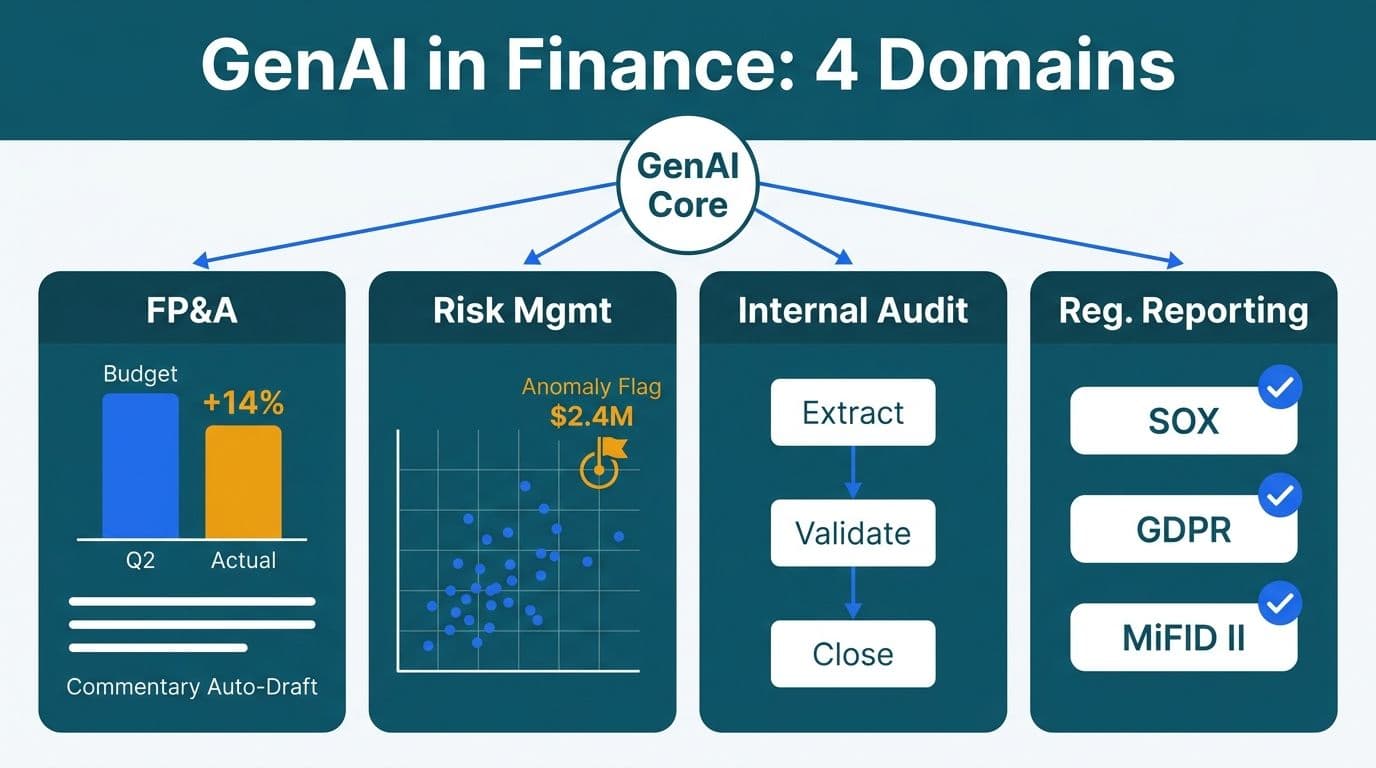
Generative AI is now deployed across finance in four core domains: FP&A, risk management, internal audit, and regulatory reporting. These systems draft narratives, flag anomalies, run variance analysis, and automate month-end close workflows - within compliance guardrails including GDPR, SOX, MiFID II, and PIPEDA. Finance teams across the US, UK, EU, and Canada are advancing from pilot to production in 2026.
Key Takeaways
GenAI has more than 10 proven deployment patterns across FP&A, risk, audit, and reporting - far beyond chatbots.
Month-end close and variance commentary automation are the fastest wins; most teams deploy a working pilot within 90 days.
Compliance architecture differs by region: SOX governs US public company AI audit trails; MiFID II shapes explainability requirements for UK/EU trading firms; PIPEDA governs Canadian financial data.
AI forecasting tools range from embedded copilots to purpose-built FP&A platforms, with meaningfully different TCO and integration depth.
A structured AI governance framework for finance is not optional - regulators in all three jurisdictions are actively scrutinising model risk management in 2026.
What Are the Real Generative AI Use Cases in Finance?
Generative AI in finance extends well beyond question-and-answer interfaces. The clearest practitioner-level view organises use cases by function.
FP&A
The most widely adopted application is variance commentary automation. Every month, FP&A analysts spend hours writing budget-versus-actual narratives. A GenAI layer connected to your ERP or data warehouse generates a first draft in seconds - pulling actuals, prior-period comparisons, and the specific accounts that drove variances. A US-based SaaS finance team, for example, can feed their BI dataset into a prompt layer and receive a board-ready narrative that an analyst reviews and approves rather than writes from scratch. For the underlying data architecture, the FP&A Dashboard in Power BI build guide covers how to structure the foundational dataset layer.
The second FP&A use case is rolling forecast generation. AI models trained on historic revenue patterns, CRM pipeline data, and macro signals produce probabilistic 13-week cash flow or 12-month revenue forecasts - flagging confidence bands automatically.
Risk Management
Third: credit risk re-scoring at scale. Lenders - from US regional banks to UK fintech firms - are deploying GenAI to ingest unstructured data (management accounts as PDFs, news feeds, company filings) and re-score counterparty risk in near-real time, supplementing traditional scorecard models.
Fourth: fraud pattern detection and alert triage. Large language models augment rule-based fraud systems by clustering transaction anomalies and drafting human-readable alert summaries for investigators. Production deployments reported in 2026 show analyst alert triage time reduced by 40–60%, allowing investigators to concentrate review on flagged clusters that exceed defined risk thresholds rather than processing raw rule hits individually.
Fifth: regulatory change impact assessment. A Canadian financial institution subject to PIPEDA and OSFI guidelines can prompt an AI system to ingest a new regulatory consultation paper and surface a gap analysis against current controls - a process that previously took a compliance team several weeks.
Internal Audit
Sixth: continuous controls testing. Internal audit teams are using AI agents to sample 100% of transactions rather than statistical 5-10% samples. The agent flags exceptions, drafts the finding narrative, and maps it to the relevant control objective - directly applicable in SOX 302/404 control environments for US-listed companies.
Seventh: audit evidence summarisation. Across a typical SOX audit cycle, an AI layer ingests hundreds of evidence documents and produces a structured cross-reference against the control matrix, compressing fieldwork time materially.
Regulatory Reporting
Eighth: MD&A drafting. Management Discussion and Analysis sections involve significant manual narrative work each quarter. GenAI drafts from structured financial data; legal and finance review and edit. This applies equally to UK-listed companies under FCA reporting obligations and US issuers under SEC requirements.
Ninth: ESG and sustainability reporting narratives. With CSRD now in mandatory reporting for large EU companies - Phase 1 organisations filed their first full-year disclosures in early 2026 - alongside SEC climate disclosure rules (US) and Canadian disclosure requirements, finance teams are using AI to draft disclosure narratives from raw emissions and supply chain data. The volume and granularity of CSRD data requirements in particular make AI-assisted drafting a practical necessity rather than an efficiency option.
Tenth: accounts payable and receivable automation. AI agents classify incoming invoices, flag discrepancies, draft remittance advice, and escalate disputes - removing manual touchpoints from the procure-to-pay cycle.
Eleventh: investor relations Q&A preparation. Before earnings calls, IR teams prompt AI with likely analyst questions drawn from prior transcripts and receive draft responses grounded in the latest financial data.
For teams evaluating where to begin, the AI automation consulting practice at Lets Viz covers the scoping methodology applied across these finance functions.
How Do AI Agents in Finance Actually Work?
AI agents in finance are not single-prompt chatbots. They are orchestrated workflows - sequences of steps where AI retrieves data, reasons over it, takes an action, and hands off to a human for review before anything is published or submitted.
A practical example: a month-end variance agent might (1) query the ERP for actuals versus budget by cost centre, (2) retrieve prior-period commentary from a document store, (3) generate a draft narrative using an LLM, and (4) route the draft to the FP&A analyst via email or Teams for approval before it enters the CFO deck. No step publishes anything without a named human sign-off.
The key architectural decision is where the AI reasoning layer sits relative to your data: embedded within a tool like Microsoft Copilot for Finance, connected via API to an existing BI layer, or built as a standalone orchestration pipeline. Each carries different cost, integration depth, and governance implications. The AI workflow automation examples guide walks through the architecture patterns most relevant to finance teams.
How Do You Automate Month-End Financial Close with AI?
Month-end close is the highest-impact, fastest-to-deliver GenAI application in finance. A typical close cycle has three phases where AI adds immediate value: journal entry preparation, reconciliation review, and commentary generation.
For journal entry preparation, AI agents ingest sub-ledger data, match it against account rules, and flag anomalies - replacing spreadsheet-driven checklists that break when a team member is absent.
For reconciliation review, the agent compares source system balances against the general ledger, highlights unreconciled items above a materiality threshold, and drafts a resolution memo. In a SOX-compliant US public company environment, this output becomes part of the evidence package with a clear AI-generated / human-reviewed audit trail.
For commentary, the agent produces the management pack narrative from reconciled numbers - ready for CFO review before the board presentation.
A UK fintech team running MiFID II transaction reporting alongside standard close can apply the same pipeline to produce compliance summary files simultaneously, using a single structured data layer. The GDPR Compliant SaaS Financial Reporting checklist outlines the data residency and access control requirements relevant to any UK or EU finance AI deployment.
What AI Forecasting Tools for Finance Teams Are Worth Evaluating?
AI forecasting for finance teams now spans four categories. The table below provides a practitioner-level comparison:
| Category | Examples | Best For | Key Limitation |
|---|---|---|---|
| Embedded copilots | Microsoft Copilot for Finance | Teams already on M365; ERP-connected close workflows | Requires clean, structured data within the Microsoft ecosystem |
| Purpose-built FP&A AI platforms | Anaplan, Pigment, Jedox (AI modules) | Mid-to-large finance teams needing driver-based models | Higher TCO; significant integration lift |
| Open API / custom builds | Azure OpenAI + Power BI, Databricks AI | Teams with data engineering capacity; multi-entity complexity | Requires in-house or consultant-led build |
| BI-native AI features | Power BI Copilot, Looker AI | Reporting-focused teams; narrative generation from dashboards | Less suited to write-back or scenario planning |
The selection decision hinges on three factors: ERP compatibility, data residency requirements (critical for GDPR jurisdictions), and whether your team needs write-back capability for scenario planning or read-only narrative generation. A Canadian manufacturing company under PIPEDA will face different data residency constraints than a US SaaS firm, affecting which cloud-hosted forecasting tools are viable without additional contractual safeguards.
What Is Microsoft Copilot for Finance?
Microsoft Copilot for Finance is a purpose-built AI assistant embedded within Microsoft 365 that connects to ERP data - initially Dynamics 365 and SAP, with expanding connectors - to help finance teams with reconciliation, variance analysis, and reporting workflows.
In practice, it surfaces inside Excel and Outlook. An analyst can highlight a variance table, ask a plain-language question, and Copilot retrieves the relevant transaction detail and drafts an explanation. For month-end close workflows, it can surface unreconciled items and propose journal entries for analyst review.
The key governance nuance: Copilot for Finance inherits the Microsoft 365 data residency and compliance boundary settings of the tenant. UK and EU organisations using the EU Data Boundary setting can satisfy GDPR requirements. US public companies should ensure AI-assisted outputs are retained as SOX control evidence - Copilot activity logs in the Microsoft Purview audit trail support this use case.
What Copilot for Finance does not handle well: complex multi-entity consolidations across non-Microsoft systems, probabilistic scenario modelling, or bespoke regulatory report generation. MiFID II transaction reports, for example, require structured data pipelines rather than copilot-style narrative tooling.
How Do You Build an AI Governance Framework for Finance?
An AI governance framework for finance is the policy and technical architecture that ensures AI outputs are accurate, auditable, explainable, and compliant across the full model lifecycle. Four domains are essential.
1. Model risk management. Every AI model used in a material financial process - forecasting, credit scoring, fraud detection - should have a model card documenting training data, known limitations, and validation results. US bank regulators (OCC, Federal Reserve) and the UK's FCA have published formal model risk management expectations that explicitly extend to AI and machine learning models, not just traditional statistical models - with supervisory focus on these areas intensifying through 2026.
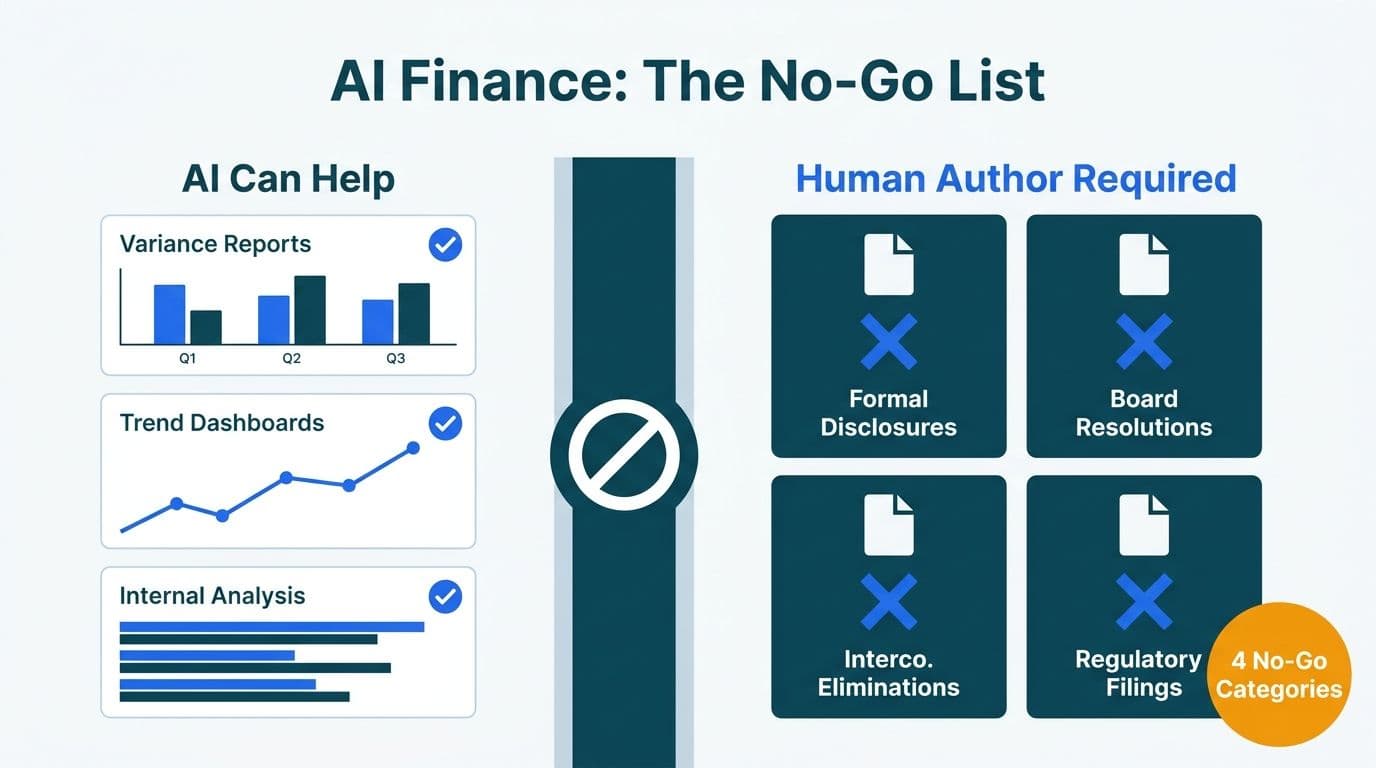
2. Human-in-the-loop controls. No AI agent should publish financials, submit regulatory reports, or execute transactions without a named human approver. The approval must be logged and auditable - not just a cultural norm.
3. Data lineage and explainability. MiFID II's best execution and suitability requirements already demand explainability for algorithmic decisions. For GenAI, this means the system must show which source data drove a specific output, not simply assert that the model produced it.
4. Regional data handling. GDPR (UK/EU) restricts personal data used in AI training and inference. PIPEDA (Canada) has equivalent requirements for financial data involving individuals. SOX (US public companies) requires internal control documentation for any system that touches financial reporting. Map all four compliance regimes to specific AI system controls before deployment.
What Does AI Consulting for Finance Cost?
AI consulting for finance spans a wide range depending on scope. A discovery and roadmap engagement - scoping use cases, assessing data readiness, and producing a 90-day implementation plan - typically runs three to six weeks. A pilot implementation covering one use case, such as variance commentary automation or month-end close, runs six to twelve weeks. A full FP&A AI transformation across forecasting, close automation, and regulatory reporting can span six to eighteen months.
The variables that most influence cost: data readiness (a team with a clean, centralised data warehouse moves faster than one relying on dispersed spreadsheets), ERP complexity, number of legal entities, and compliance jurisdiction. A SOX-compliant US public company has more governance deliverables than a private firm; a Canadian organisation under PIPEDA may face data residency requirements that add infrastructure cost. Use the instant project cost calculator to get an indicative range for your specific scope.
Ready to move from a use-case list to a working system? AI automation consulting at Lets Viz covers the full journey - from data readiness assessment through governed production deployment - for finance teams across the US, UK/EU, and Canada.
---
About Lets Viz: Lets Viz has delivered data analytics and AI automation engagements for US healthcare providers, UK fintech firms, Canadian manufacturers, and global SaaS companies since 2020, holding a 5.0 rating on Clutch. Our finance-focused work spans FP&A automation, SOX-compliant reporting infrastructure, and cross-jurisdictional compliance architecture for clients operating under GDPR, PIPEDA, and SEC/FCA regulatory frameworks.