Outsource Healthcare Analytics vs Build In-House: Decision Guide
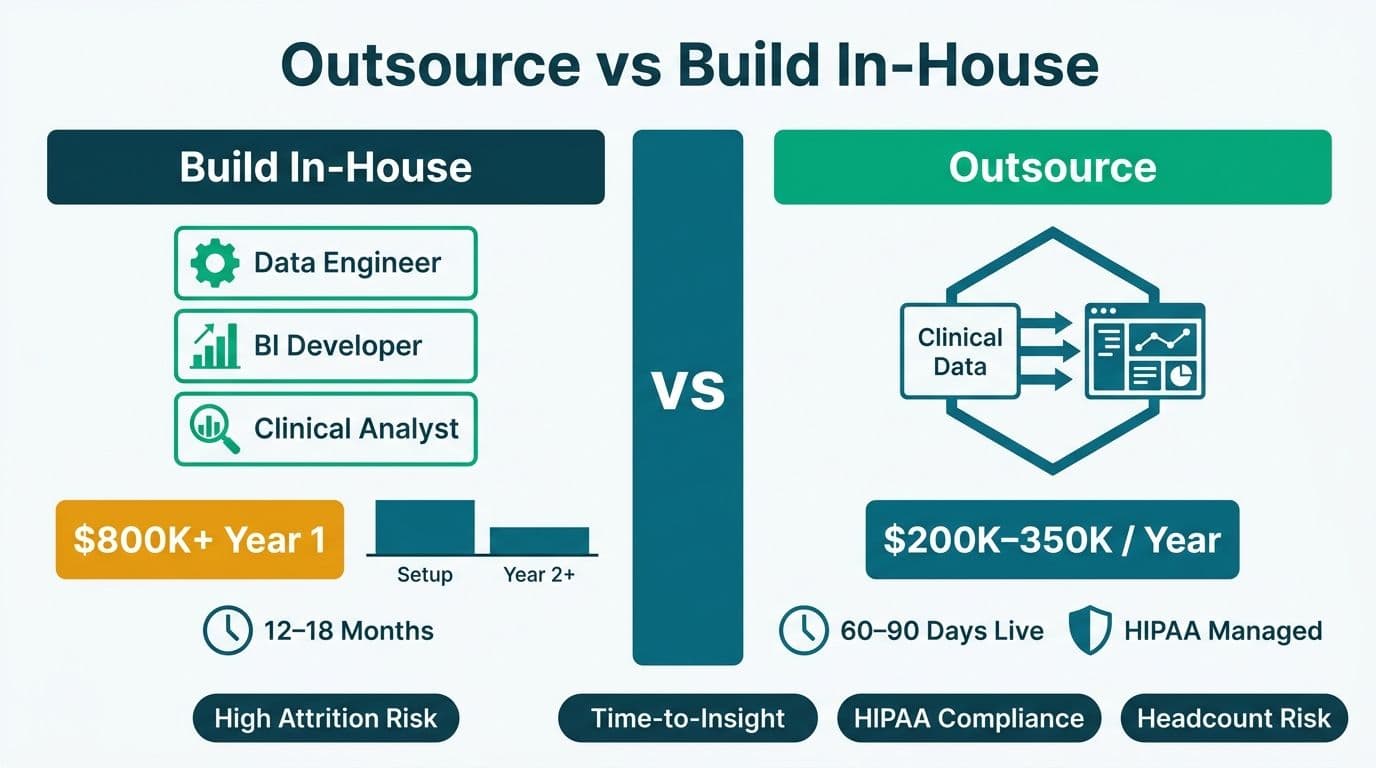
For most US hospitals and health systems, outsourcing healthcare analytics to a managed partner costs less and carries lower ongoing risk than building in-house once talent acquisition, licensing, governance infrastructure, and attrition are factored in. CIO and CFO decisions hinge on three variables: time-to-insight requirements, HIPAA compliance obligations, and whether your organization can sustain specialist headcount over a multi-year horizon.
Key Takeaways
- Building in-house requires at minimum three specialist roles - data engineer, BI developer, and clinical analyst - plus licensing, governance tooling, and attrition replacement budgets
- Healthcare compliance (HIPAA in the US, GDPR in the UK and EU, PIPEDA in Canada) adds significant governance overhead to both paths, but outsourcing to a credentialed partner typically accelerates compliance setup
- The TCO gap between build and outsource widens in years two and three as attrition replacement and licensing costs compound
- Governance provisions in the managed-service contract - data ownership, audit log access, and exit terms - determine whether outsourcing is safe long-term
- A managed analytics partner can typically deploy production-grade healthcare dashboards in four to eight weeks; an in-house build runs six to eighteen months
Lets Viz delivers Managed Power BI services for healthcare and finance teams -- fully managed analytics, from data model to decision-ready dashboard.
What Does Building an In-House Healthcare Analytics Team Actually Cost?
Building from scratch means more than hiring one generalist data analyst. A functional hospital analytics capability requires at minimum three specialist roles: a data engineer to manage pipelines from EHR, claims, and HR source systems; a BI developer to model, build, and publish reports; and a clinical data analyst who can translate metric definitions between IT and the clinical operations team. Each of these roles commands top-quartile compensation in most US markets, and all three are in acute short supply nationally.
The talent scarcity problem is particularly acute in healthcare. EHR-connected data pipelines require engineers who understand HL7 FHIR standards, ADT feeds, and clinical coding schemes - a skill set at the intersection of health informatics and modern data engineering. Organizations in secondary markets outside major metro areas often face searches running five to seven months with no guarantee of a qualified hire (Burtch Works Healthcare Analytics Hiring Report, 2025).
Licensing is the second cost that surprises finance committees. A production-grade Power BI healthcare reporting implementation covering clinical, operational, and financial dashboards requires Pro licenses for every report consumer, Premium capacity for row-level security and paginated reports, and Azure infrastructure for the data pipelines feeding those reports. Licensing alone can reach five figures per month before a single dashboard is published (based on Microsoft list pricing, 2025).
Then there is governance infrastructure. HIPAA-regulated environments require audit logging, role-based access controls, and data classification at the column level - not optional enhancements. A Power BI governance framework rigorous enough to withstand a HIPAA audit takes weeks to configure correctly and must be maintained continuously as new datasets, data sources, and report consumers are added.
Finally, attrition. When a BI developer or data engineer leaves, institutional knowledge of the data model, source system quirks, and custom calculation logic leaves with them. The replacement cycle for a senior BI developer in healthcare typically runs four to six months, during which reporting capability is effectively frozen (per healthcare IT recruiting data, 2025). A managed analytics partner that absorbs attrition risk and maintains portable documentation provides structural protection against this brittleness. Understanding how to evaluate a Power BI managed service provider is a useful step before deciding whether outsourcing addresses these constraints for your organization.
How Do Outsource Healthcare Analytics vs Build In-House Compare on Total Risk?
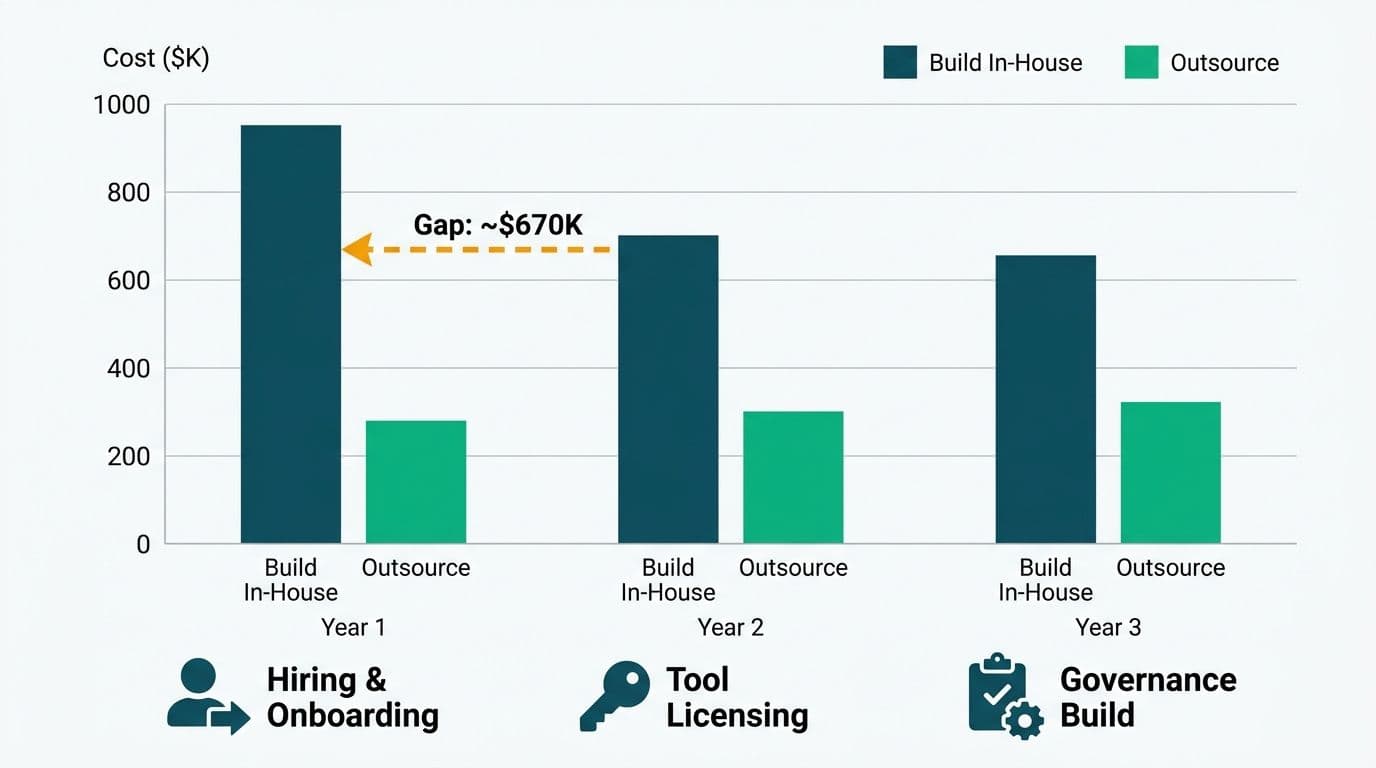
The risk profiles of the two paths diverge most sharply in years two and three, not at launch.
In-house risk concentrates in people and compliance drift. A team that owns its own data models is exposed to key-person dependency - the entire semantic model may effectively live in one engineer's head. A governance framework correctly configured at go-live can drift out of compliance as new datasets are added without proper classification review.
Outsourcing risk is primarily contractual. If the service agreement does not include explicit data ownership clauses, audit log access rights, and exit provisions, a health system can find itself in a vendor dependency relationship with limited portability. This risk is manageable - but it must be negotiated at contract stage, not after go-live.
| Risk Dimension | In-House Build | Managed Analytics Partner |
|---|---|---|
| Talent attrition | High - knowledge concentrated in 2-3 people | Low - absorbed by service provider |
| Compliance drift | High - requires continuous internal oversight | Moderate - SLA-driven; verify contract terms |
| Time-to-first dashboard | Slow - typically 6 to 18 months | Fast - typically 4 to 8 weeks |
| Licensing cost exposure | High - price changes hit your budget directly | Shared - provider manages licensing complexity |
| Data portability | High - you own the models from day one | Variable - depends on contract terms |
| Governance maintenance | Borne entirely by your internal team | Shared per the service level agreement |
Neither option is risk-free. The in-house path concentrates risk in people and operational continuity; the managed path concentrates risk in contract terms and vendor selection. A CIO who has evaluated a managed partner's governance approach before signing is in a structurally lower-risk position than one who has not.
How Do HIPAA, GDPR, and PIPEDA Shape the Build-vs-Outsource Decision?
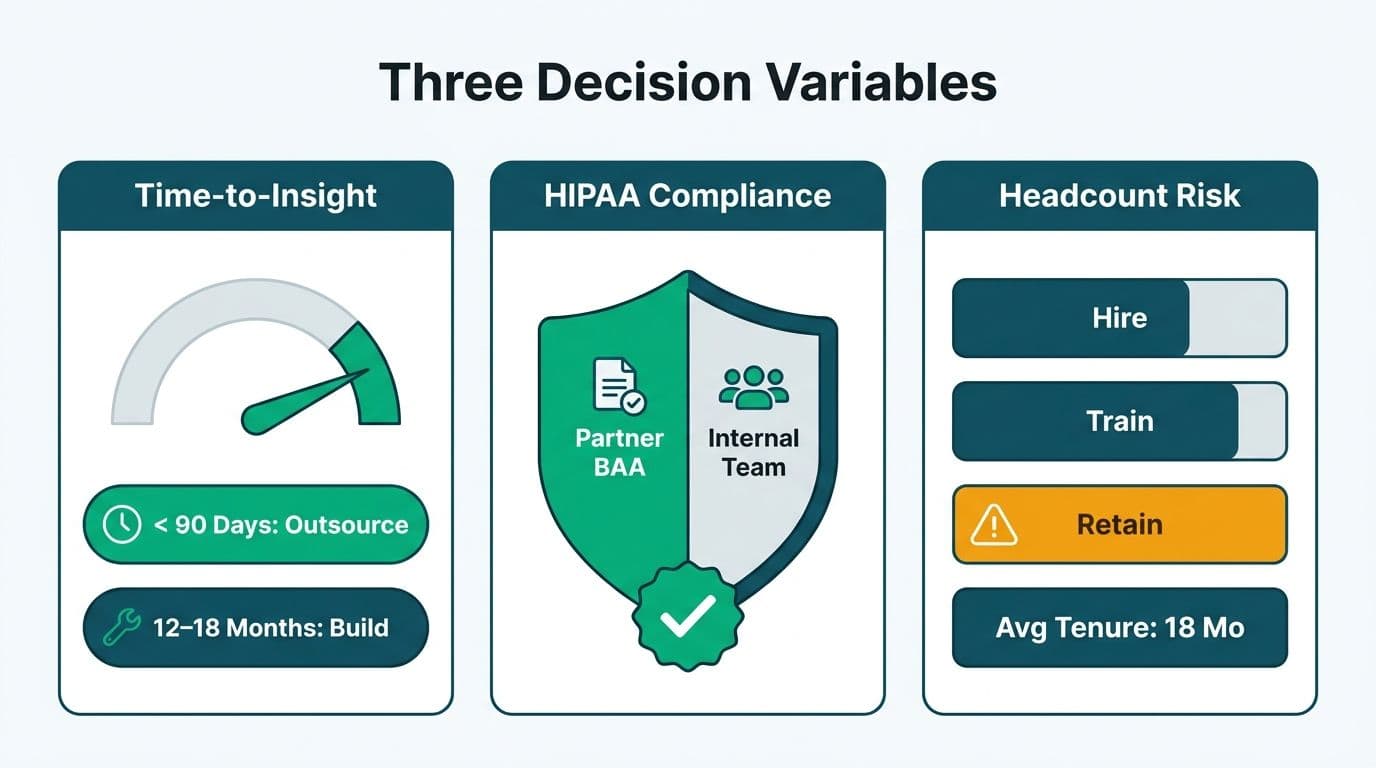
Compliance obligations impose different procedural requirements depending on which path you choose.
In a US hospital or integrated delivery network, HIPAA requires a signed Business Associate Agreement (BAA) with every vendor that touches Protected Health Information. A managed analytics partner must execute a BAA and demonstrate that their environment meets OCR's technical safeguards: encryption at rest and in transit, access controls, audit log retention, and breach notification procedures. A reputable partner will have a BAA template ready before the first data connection is made.
UK and EU health organisations operate under GDPR, which adds data subject rights - access, erasure, portability - and mandatory breach notification within 72 hours. Any outsourcing arrangement must designate the managed partner as a data processor under a Data Processing Agreement that explicitly restricts use of data to contracted purposes. GDPR also restricts transfers of personal data outside the European Economic Area, making cloud region selection a contractual matter.
Canadian health organisations covered by PIPEDA - or provincial equivalents such as PHIPA in Ontario and HIA in Alberta - face comparable data residency expectations. A managed partner processing patient-linked data must demonstrate Canadian data residency or an equivalent protection framework.
For IT teams where analytics and operations converge on shared infrastructure, our guide on ServiceNow ITSM for healthcare IT teams covering HIPAA, GDPR, and PIPEDA covers the platform-specific compliance overlay in detail.
The practical implication: outsourcing to a credentialed partner with pre-built BAA and DPA templates often accelerates compliance setup relative to a from-scratch in-house architecture. The health system retains full compliance ownership; the managed partner compresses the configuration timeline.
When Should a Hospital CIO Choose a Managed Analytics Partner?
The managed-partner path performs best when three conditions are present simultaneously: the organization needs production-grade reporting within a 90-day window, the IT team lacks dedicated BI headcount, and the analytics surface area spans multiple regulated data types - clinical, financial, and HR.
Suppose a 300-bed regional hospital system is preparing for a value-based care contract requiring monthly quality metric submissions beginning in six months. Building from scratch - hiring, licensing, and governance configuration - will not produce validated dashboards within that window. A managed partner with a healthcare reporting template library and a structured onboarding process typically can. In that scenario, the choice is not between build and outsource; it is between outsource and missing the contract deadline.
Further scenarios where managed delivery wins on both cost and speed:
- Post-merger integration. A US health system absorbing a smaller clinic network needs consolidated dashboards across two EHR environments before the next board cycle. Recruiting an in-house team while integration is live compounds the risk.
- CFO operating dashboard mandate. When a CFO needs a live operating margin view linking clinical volume, staffing costs, and revenue cycle data within a quarter, the build-from-scratch path rarely fits the timeline.
- Performance analytics platform transition. Organizations evaluating IT and operational visibility dashboard options often find that a managed Power BI layer delivers deeper cross-system insight at lower total cost than extending a single-platform reporting module.
The in-house build path makes more strategic sense when the organization has long-horizon reasons to own the data model deeply: a large IDN building a proprietary AI pipeline on its analytics layer, or a health system with sufficient scale to justify a fully-staffed dedicated team of five or more BI professionals.
What Should a CFO Include in the Analytics TCO Model?
A clean three-year TCO model covers five categories:
1. Personnel costs. Salary, benefits, recruiting fees, and attrition replacement. Recruiting fees for a senior BI developer in healthcare typically run 15 to 20 percent of first-year salary (Robert Half 2026 Salary Guide). Modeling two replacement cycles over three years produces a more realistic budget than assuming zero turnover.
2. Licensing and infrastructure. BI platform licenses, cloud compute, data pipeline tooling, and security and governance software. License pricing changes year-on-year; budgeting at current list price consistently underestimates actual cost over a three-year horizon.
3. Governance and compliance overhead. HIPAA audit preparation, BAA management, annual access review cycles, and remediation triggered by any compliance gap. This line item is frequently omitted from initial in-house build budgets and in practice represents a material fraction of total program cost in regulated environments.
4. Opportunity cost of delayed insight. Every month without production reporting is a month where clinical and operational decisions run on lagging data. A one-quarter delay in a revenue cycle dashboard is not a neutral outcome.
5. Exit costs. For managed services: contract exit, data migration, and re-platforming. For in-house: the cost of dismantling a half-built infrastructure if leadership changes direction. The managed-service exit cost is more visible and therefore more frequently negotiated into the contract at the outset.
How Do You Maintain Data Governance and Ownership When You Outsource?
Data governance is not something you hand off - it is something you co-own. The governance structures that protect data integrity shift from execution to oversight, but they do not disappear.
A well-structured outsourcing arrangement preserves governance through three contractual mechanisms:
Defined data ownership clauses. The contract should state explicitly that the health system owns all data, all semantic models, and all report artifacts. The partner holds a license to process and build; ownership never transfers.
Audit log access. HIPAA requires maintaining access logs for PHI-touching systems for six years. The contract must guarantee that the health system can extract audit logs independently - not merely request them from the vendor - so that access cannot be conditioned on continuation of the contract.
Governance co-design at engagement start. A mature managed partner runs a governance design session before any data connection is established, defining data classification tiers, approving the row-level security model, and documenting lineage for every regulated dataset. This mirrors the structured approach in a Power BI governance best-practices framework applied at the program level.
Data integrity is a governance matter, not only a technical one. Analytics environments that silently drop records from reporting joins - due to a date-filter mismatch, a pipeline failure, or a schema change in the source EHR - produce confident-looking dashboards that misrepresent financial or clinical reality. Building routine reconciliation checks into the managed service SLA catches these gaps before they compound into material reporting errors.
Managed Power BI for healthcare teams outlines what a structured managed analytics engagement looks like in practice - including governance setup, BAA provisions, and typical time-to-insight benchmarks for hospital and health system environments.
---
About Lets Viz: Written by Rohit Singhal, Principal Consultant at Lets Viz - delivering governed Power BI environments for US hospital systems since 2020. Lets Viz serves US healthcare organizations, UK fintech firms, Canadian manufacturing companies, and global SaaS businesses. With a 5.0 Clutch rating, the firm specializes in governed Power BI environments for regulated industries, analytics program design, and build-versus-outsource advisory for CIOs and CFOs navigating complex sourcing decisions.