Microsoft Fabric vs Synapse vs Databricks: TCO Cost Breakdown
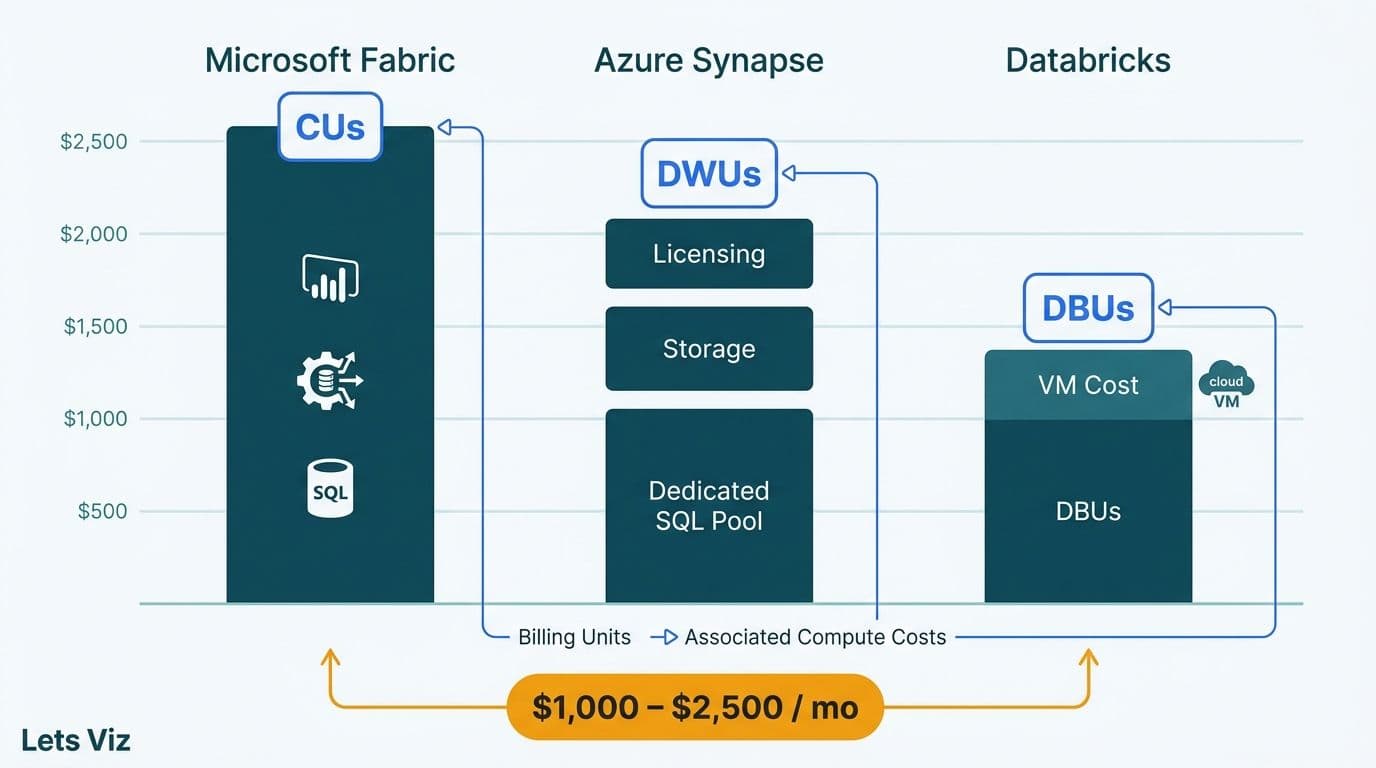
Microsoft Fabric bills by Capacity Units (CUs) at an hourly rate, Azure Synapse Analytics by Data Warehouse Units (DWUs) for dedicated SQL pools, and Databricks by Databricks Units (DBUs) layered on top of cloud VM costs. For a mid-market team running 8 hours of active compute per day across 50 analyst seats, monthly TCO ranges from roughly $1,000 to $2,500 - a gap driven almost entirely by how BI licensing, governance tooling, and storage are bundled or billed separately on each platform.
Key Takeaways
Microsoft Fabric bundles Power BI Premium, data engineering, and SQL warehousing under a single CU meter, reducing per-tool licensing overhead for Microsoft-centric teams.
Azure Synapse DWU pricing scales predictably but carries separate charges for Spark, pipeline runs, and BI licensing that inflate headline costs by 40-80%.
Databricks DBU rates look low in isolation but compound with VM costs, Unity Catalog fees, and a separate BI layer to rival or exceed Fabric TCO for SQL-heavy reporting workloads.
For HIPAA-covered US healthcare systems and GDPR-regulated UK fintechs, Fabric's native Microsoft compliance posture typically reduces security engineering overhead versus point solutions.
A serious build vs buy AI data capability analysis almost always favors a managed platform at mid-market scale - hidden engineering costs outpace compute savings within 12-18 months.
What Do Capacity Units, DWUs, and DBUs Actually Measure?
Understanding each platform's compute meter is the foundation of any accurate TCO model - and where most evaluations break down.
Capacity Units (CUs) are Microsoft Fabric's universal compute currency. One CU represents a fixed allocation of CPU, memory, and throughput shared across all Fabric workloads: Spark data engineering, SQL analytics, real-time intelligence, and Power BI report rendering. According to Microsoft's 2026 Azure pricing documentation, Fabric CU rates in US East regions range from $0.36/hour for the F2 SKU to $11.52/hour for F64. CUs are pooled across workloads, so a pipeline burst and a dashboard load compete for the same resource budget rather than spinning up independent billable resources.
Data Warehouse Units (DWUs) are Synapse Analytics' dedicated SQL pool meter. A DWU maps to a fixed bundle of CPU cores, memory, and I/O bandwidth for columnar analytical SQL. DW100c costs approximately $1.20/hour; DW1000c costs approximately $12.00/hour. The complication: Synapse Spark pools, serverless SQL queries (billed at $5.00 per TB scanned), and pipeline activity runs each carry separate meters. Teams estimating from the DWU headline alone routinely undershoot total cost by 60-70%.
Databricks Units (DBUs) measure compute intensity per hour across Databricks' runtime tiers. Standard job clusters cost approximately $0.07/DBU on Azure; Premium all-purpose clusters cost $0.15/DBU. DBUs do not include the underlying cloud VM cost, which runs at standard on-demand rates and typically adds 40-60% to the visible DBU line. This is the most common estimation error in first-time Databricks evaluations.
When our Power BI and Fabric consulting team runs a platform evaluation, the first step is always mapping each team's workload mix to the dominant meter - a team whose workload is 70% SQL reporting prices very differently from one running 70% Python ML pipelines. Our Microsoft Fabric vs Power BI: What's Actually Different primer explains how Fabric's pooled compute model differs from legacy Power BI Premium before you size a capacity purchase.
How Does Microsoft Fabric vs Synapse vs Databricks Cost Compare in a Real Scenario?
The most useful comparison is a like-for-like scenario: 50 analyst seats, 200GB of data moved daily, 8 hours of active compute per day, 22 business days per month, US East Azure region.
| Cost Component | Microsoft Fabric (F32) | Azure Synapse (DW500c + Spark) | Databricks Premium (Azure) |
|---|---|---|---|
| Core compute (8h x 22d) | $1,014/mo | $1,056/mo | $510/mo (DBU only) |
| Underlying VM cost | Included | Included | ~$620/mo |
| Power BI licensing (50 users) | Included at F32+ | ~$1,000/mo (PPU) | ~$1,000/mo (PPU) |
| Serverless / ad hoc queries | Included | ~$200-$400/mo | N/A |
| Data governance tooling | Included (Purview) | Included | ~$200-$400/mo |
| **Estimated monthly TCO** | **$1,014-$1,200** | **$2,300-$2,500** | **$2,350-$2,550** |
*Assumptions: F32 paused overnight; Synapse DW500c deallocated when idle; Databricks Standard_DS3_v2 x 5 nodes on job clusters. Power BI Premium Per User (PPU) at $20/user/month applied where not bundled. Storage excluded (~$20-$40/month at this volume).*
Fabric's bundled architecture delivers a decisive cost advantage for Microsoft-centric organizations in this scenario. The gap narrows significantly for teams with ML-heavy workloads or multi-cloud data estates, where Databricks' architecture is better aligned to the workload.
Our Medallion Architecture in Microsoft Fabric: Build Bronze to Gold guide shows how layered storage design (Bronze, Silver, Gold) affects active compute hours - a variable that changes the numbers above substantially for teams with complex ELT pipelines.
When Does Databricks Offer Better Value Than Fabric or Synapse?
Databricks is not always the expensive option. It wins on TCO in three well-defined scenarios.
ML-intensive workloads: Teams running frequent model training, hyperparameter tuning, or LLM fine-tuning will find Databricks' GPU cluster management and MLflow tracking cheaper per completed job than equivalent Fabric Spark notebooks. Databricks job clusters auto-terminate within seconds of completion; Synapse dedicated pools continue billing until explicitly deallocated - a structural advantage that compounds across hundreds of daily training runs.
Multi-cloud data estates: A Canadian manufacturing firm distributing production workloads across AWS and Azure faces material egress charges funneling everything into Fabric or Synapse. Azure charges $0.02/GB for inter-region data transfer and $0.087/GB for internet egress; at 1TB of daily cross-region movement, that translates to $600-$2,600/month in pure network cost before any compute is considered. Databricks' multi-cloud architecture - Delta Sharing and Unity Catalog workspace federation - avoids double-ingestion by federating queries at the metadata layer, keeping data in place and eliminating the egress line entirely for teams with AWS-resident source data.
AI data governance at scale: Organizations building an AI data governance framework across multiple product domains often prefer Databricks Unity Catalog's fine-grained attribute-based access control. Unity Catalog scales cleanly to 50+ data domain owners; Synapse ACLs become operationally unwieldy past 15-20.
Databricks' strength in data engineering is not a license to assume it is cheaper for SQL-heavy finance reporting. A UK fintech firm running high-volume regulatory reports switched from Databricks to Fabric F64 specifically because Databricks SQL Serverless pricing at 10TB/month query volume exceeded Fabric's flat CU rate by 38%.
Mid-market organizations are consolidating onto managed platforms rather than maintaining bespoke infrastructure stacks at an accelerating rate — a shift that makes platform selection more consequential than in prior budget cycles.
Which Platform Is Better for Healthcare and Finance Compliance?
Healthcare and financial services organizations in the US, UK, and Canada face a compliance filter that rules out certain configurations before cost enters the equation.
HIPAA (US Healthcare)
All three platforms are HIPAA-eligible when configured correctly on Azure. Fabric's Business Associate Agreement (BAA) coverage is bundled at the Microsoft Azure tenant level with no additional SKU or separate request required. Databricks requires a separate BAA request through Azure Marketplace; Synapse inherits Azure's BAA but configuration audits across linked services add engineering overhead. For teams building value-based care analytics or payer reporting workflows, Fabric's Microsoft Compliance Manager integration provides pre-built HIPAA control assessments mapped directly to OneLake and Warehouse configurations — reducing the audit preparation cycle versus assembling equivalent documentation from scratch on Databricks or Synapse.
GDPR (UK and EU Fintechs)
Fabric's OneLake supports EU data residency natively from F2 upward. Databricks supports regional workspace isolation but multi-workspace governance adds operational overhead at the platform level. For a UK fintech firm preparing for a GDPR audit, Fabric's native Microsoft Purview integration typically saves 2-4 weeks of compliance engineering compared to building equivalent data lineage on Databricks or Synapse.
PIPEDA and Quebec Law 25 (Canadian Organizations)
Canadian data residency requirements under PIPEDA and Quebec's Law 25 map cleanly to Azure Canada Central regions. All three platforms support Canadian regional deployment. Fabric's Purview data classification provides richer lineage reporting out of the box - a practical advantage for organizations subject to Quebec Law 25 documentation requirements.
Healthcare analytics demand continues to grow, driven by regulatory mandates that now require data lineage, audit trails, and anomaly detection at the infrastructure level. Platform choice determines how much custom security engineering is required to satisfy these mandates without building from scratch.
Our AI Analytics Data Privacy Risks: Healthcare Audit Guide covers the specific configuration checkpoints for HIPAA technical safeguard requirements across all three platforms.
How Should a Mid-Market Team Model TCO Before Committing to a Platform?
Completing an AI data maturity assessment before platform selection is the prerequisite. Reliable TCO modeling requires five concrete inputs.
1. Daily data volume: Determines storage costs and whether serverless query charges will be material. Teams below 100GB/day rarely stress compute tier choices; teams above 500GB/day need to model storage egress actively.
2. Active compute hours per day: The single largest cost lever. Fabric and Synapse allow capacity pausing; Databricks job clusters auto-terminate. Build your model on actual business hours. A US SaaS finance team limiting active compute to 8 hours per day rather than running 24x7 reduces the compute component of platform cost by approximately 67%.
3. Ratio of BI consumers to data engineers: Fabric's CU model subsidizes the BI layer. If your ratio of report consumers to pipeline engineers exceeds 5:1, Fabric's bundled Power BI Premium typically saves $600-$1,200/month for a 50-seat team versus purchasing PPU licenses separately on Databricks or Synapse.
4. Workload type mix: SQL-heavy reporting favors Fabric Warehouse or Synapse dedicated pools. ML and AI model development favors Databricks by a significant margin. Mixed workloads require scenario-level modeling, not a single platform benchmark.
5. Reserved capacity discounts: Fabric annual reservations reduce CU rates by up to 40% versus pay-as-you-go, per Microsoft's 2026 Azure pricing documentation. Synapse reserved DWUs save 30-35%. Databricks Committed Use pricing on Azure saves up to 45% on DBU rates. Omitting reserved pricing from a multi-year TCO model systematically overstates total cost.
The build vs buy AI data capability question applies here directly. Building raw pipelines on open-source tooling (Kafka, dbt, Airflow) can look cheaper at 10TB/month, but the engineering hours to maintain production-grade orchestration routinely exceed the platform cost delta within 12-18 months. Our Open Source AI Workflow Automation Tools: Build vs Buy Guide quantifies this tradeoff across common mid-market team configurations.
What Hidden Costs Blow Up Platform TCO Estimates?
Every platform carries cost multipliers absent from the headline pricing page.
Microsoft Fabric Hidden Costs
CU bursting: Fabric allows short-window bursting above purchased capacity. Teams without Microsoft Fabric Capacity Metrics alerts accumulate unexpected charges in the first billing cycle. Set consumption thresholds from day one.
OneLake egress: Moving data from OneLake to external systems carries standard Azure egress at $0.087/GB for the first 10TB/month from US East regions, per Microsoft's 2026 Azure pricing documentation.
Feature tier requirements: Deployment pipelines, XMLA endpoints, and Copilot features require F64 or higher. Teams purchasing F32 expecting full AI feature access will need to upgrade SKU to unlock them.
Azure Synapse Hidden Costs
Idle dedicated pool billing: Unlike Fabric, Synapse dedicated pools continue billing when paused unless explicitly deallocated. Months of idle DWU charges are among the most common Azure cost management surprises for Synapse teams.
Pipeline activity run billing: Each pipeline run, including retries, is billed at $0.001 per activity. High-frequency pipelines at hourly intervals generate $300-$800/month in activity charges that rarely appear in initial estimates.
Data integration unit (DIU) charges: Copy activities in Synapse Pipelines are billed per DIU-hour at $0.25. Lift-and-shift migrations routinely generate $500-$1,000 in DIU charges in month one alone.
Databricks Hidden Costs
All-purpose versus job clusters: Interactive all-purpose clusters cost 2-3x more per DBU than job clusters, per Databricks' 2026 pricing guide. Teams that leave notebooks running interactively for hours treat expensive compute like a free development sandbox.
Delta Live Tables (DLT) premium: DLT streaming pipelines consume DBUs at a premium rate. Factor in 20-30% additional DBU consumption versus equivalent batch jobs when DLT is in the data engineering roadmap.
Enhanced Support tier cost: Databricks Enhanced Support, required for SLA-backed enterprise agreements, adds 12-15% to the monthly bill and is non-optional for production workloads with formal uptime commitments.
Our How to Measure ROI of AI Analytics Tools: A CFO's Framework provides a structured template for surfacing these second-order costs in a format ready for board-level review.
---
If your team is building a TCO model for Microsoft Fabric, Azure Synapse, or Databricks before committing to a multi-year architecture, our Power BI and Fabric consulting practice has run this analysis for US healthcare systems, UK fintech firms, and Canadian manufacturing organizations - stress-testing compute assumptions and compliance posture before platform selection.
---
About Lets Viz: Lets Viz has delivered data analytics and BI consulting since 2020, serving US healthcare organizations, UK fintech firms, Canadian manufacturing companies, and global SaaS businesses. The firm holds a 5.0 Clutch rating and specializes in Microsoft Fabric, Power BI, and modern data stack implementations across heavily regulated industries.