When to Outsource Power BI Management: A Decision Framework
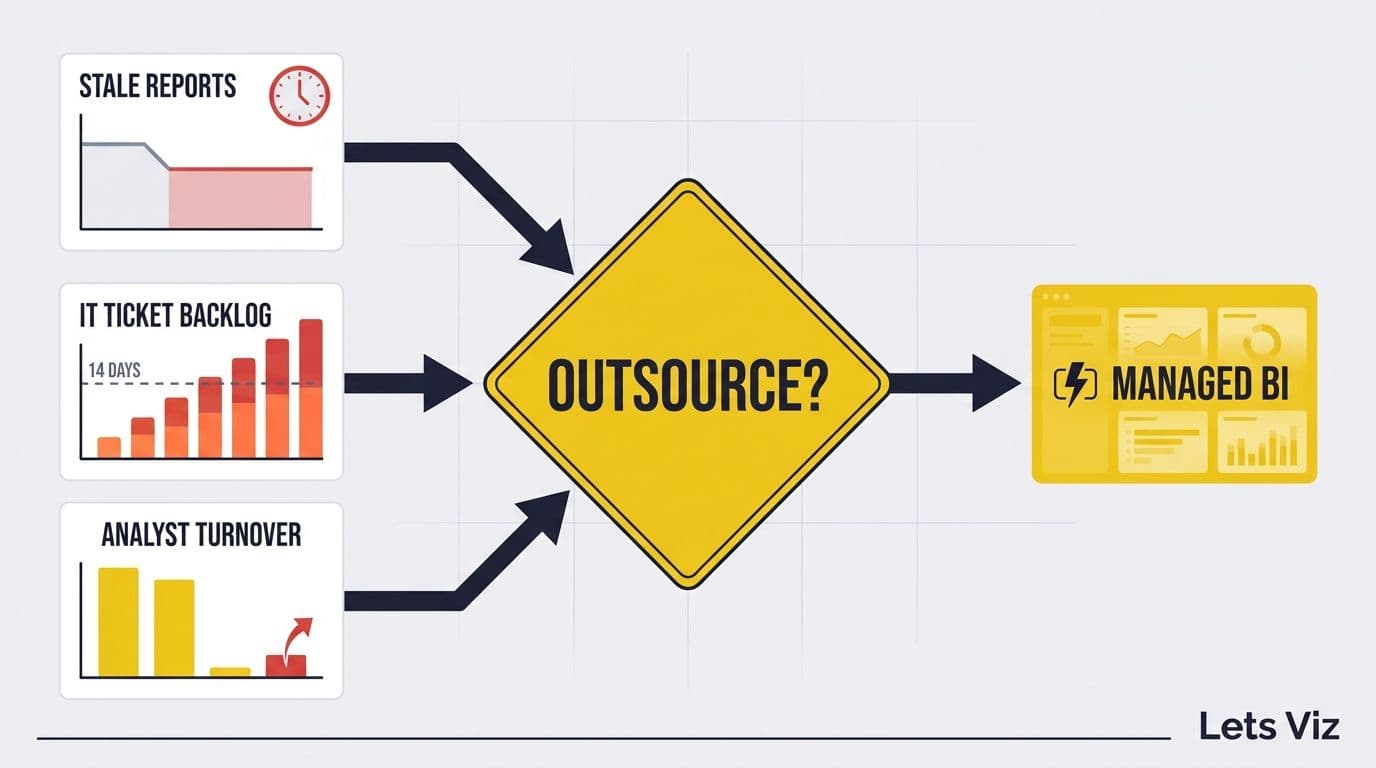
The right moment to outsource Power BI management is when three capacity signals converge: reports are consistently stale, IT ticket queues for BI issues exceed two weeks' resolution time, and analyst turnover has made institutional data knowledge a flight risk. For mid-market healthcare and finance organizations, these signals typically appear 12 to 18 months after a Power BI deployment outgrows its original scope.
Key Takeaways
Stale reports, swelling ticket backlogs, and analyst turnover are the three measurable signals that an internal BI setup has outgrown itself
Healthcare and finance organizations face compounding regulatory reporting requirements that accelerate these signals faster than most other industries
A three-phase decision framework - signal audit, cost-capacity analysis, vendor fit assessment - produces better outsourcing decisions than reactive crisis responses
Modern Power BI environments increasingly involve Microsoft Fabric, medallion architecture, and OneLake integration - capabilities that are expensive to maintain on a small internal team
Managed Power BI services shift fixed headcount costs to variable service contracts, improving BI unit economics at mid-market scale
What Capacity Signals Tell You It's Time to Outsource Power BI Management?
The three capacity signals that matter most are report staleness, ticket backlog depth, and analyst turnover rate. Each one is measurable. Each one compounds the others.
Report staleness is the most visible signal. When business users begin questioning whether a dashboard reflects last week's data or last month's, trust in the BI platform erodes - and decisions migrate back to spreadsheets. In healthcare settings, stale cost-per-case or denial-rate dashboards can delay revenue cycle decisions by weeks. In finance and insurance, outdated cash flow or AR aging reports create blind spots for treasury and FP&A teams that no operating environment can sustain.
Ticket backlog depth is a lagging indicator of capacity strain. When BI-related tickets - report fixes, data model changes, new dashboard requests - consistently queue for more than ten business days, the organization has implicitly accepted a two-week latency on its own intelligence. A healthy internal BI team closes routine requests within two to three business days. A team tracking longer than ten days is maintenance-bound, not insight-generating.
Analyst turnover is the most dangerous signal because it rarely surfaces on any management dashboard until it is already too late. When a senior Power BI developer who built your healthcare cost model or your financial consolidation logic leaves, that institutional knowledge leaves with them. Replacing a senior BI developer typically costs 1.5x to 2x their annual salary in recruiting, onboarding, and productivity loss during the six-to-nine-month ramp period — at 2026 US market rates of $135,000 to $170,000 base for a senior Power BI developer, that translates to a $202,000 to $340,000 replacement event, a compounding cost most mid-market CFOs do not model when assessing internal team stability. The Healthcare Financial Analytics Market is projected to grow at an 8.58% CAGR through 2035 (Market Research Future, as of 2026), creating sustained demand for experienced BI professionals that mid-market firms struggle to satisfy in competition with larger health systems and regional financial institutions. The accelerating enterprise shift to Microsoft Fabric in 2026 has sharpened this competition further: Fabric-certified BI professionals command a 15% to 20% salary premium over Power BI-only peers — placing effective total compensation in the $155,000 to $200,000 base range — a level that falls outside most mid-market salary bands and narrows the realistic hiring pool to candidates already embedded in enterprise or consulting environments.
If your organization can check two of these three boxes today, the outsourcing conversation is overdue. For a practical reference on what a well-structured healthcare BI environment looks like from the start, how to build a Power BI financial dashboard for healthcare is a useful benchmark.
How Does a Growing IT Ticket Backlog Signal BI Infrastructure Strain?
A BI ticket backlog is not just a workload problem - it is a structural signal about model architecture. When BI support tickets represent more than 20% of an IT team's sprint capacity, the organization is spending engineering cycles on maintenance rather than capability-building.
The root cause is almost always model debt: a Power BI semantic layer built for one use case and progressively stretched to serve many. In healthcare organizations running concurrent clinical operations, finance, and quality reporting from a single data model, this debt accumulates faster than in other industries. Regulatory requirements - HIPAA-compliant data handling, CMS quality reporting, MACRA performance data - add complexity layers that turn routine model updates into multi-day engineering projects.
Modern Power BI environments are increasingly migrating toward Microsoft Fabric, Microsoft's unified analytics platform. This migration introduces concepts that most mid-market IT teams encounter for the first time: medallion architecture (a layered data design with bronze, silver, and gold processing zones), Microsoft Fabric OneLake (a single logical data lake across the entire organization's tenant), and decisions between a Fabric lakehouse vs. a data warehouse as the primary analytical store. Each architectural layer requires specialized skills that a team of two or three internal analysts cannot realistically maintain alongside production support.
For mid-market healthcare organizations specifically, this often means a clinical data analyst who originally built a 15-table patient throughput model is now expected to integrate Azure Data Factory pipelines, configure OneLake shortcuts, and manage a medallion architecture refactor - while simultaneously answering the CFO's questions about why the monthly close report broke. That is an architectural problem that adding headcount alone will not resolve.
For a detailed look at what BI infrastructure investment looks like across a multi-year horizon, outsourced financial analytics services breaks down the build-vs-buy calculus in full.
When to Outsource Power BI Management: The Three-Phase Decision Framework
A structured decision framework prevents the most common mistake organizations make: outsourcing reactively, after a visible crisis, rather than proactively when there is still time to set a managed partner up for success.
Phase 1: Signal Audit (Weeks 1-2)
Quantify your current state against each capacity signal:
What percentage of production reports contain data older than three business days?
What is the median ticket resolution time for BI-related requests over the past 90 days?
How many BI or data analyst roles have turned over in the last 18 months, and what was the average knowledge transfer period before each departure?
If two or more signals fall outside acceptable ranges, proceed to Phase 2.
Phase 2: Cost-Capacity Analysis (Weeks 3-4)
Calculate the true internal BI cost - most organizations undercount by a significant margin. The fully loaded cost of a mid-market BI team includes salaries, benefits, software licensing, onboarding, training, and the productivity drag from context-switching between maintenance and development work. Compare this against the total cost of a managed service contract covering the same scope.
The AI consulting services market is projected to grow from an estimated USD 13.97 billion in 2026 to USD 90.99 billion by 2035, at a 26.2% compound annual growth rate (Future Market Insights, as of 2026). Much of that growth reflects mid-market organizations shifting from fixed internal analytics headcount to flexible managed analytics engagements - because the unit economics favor it once scale and complexity cross a critical threshold.
Phase 3: Vendor Fit Assessment (Weeks 5-6)
Evaluate potential partners on three dimensions: healthcare or finance domain expertise; engineering depth, including the ability to write production-grade Power BI DAX functions for healthcare reporting or multi-entity financial consolidation models; and governance posture, covering SOC 2 Type II certification, HIPAA BAA coverage, and data residency controls for Canadian operations where applicable.
| Phase | Key Question | Decision Gate |
|---|---|---|
| Signal Audit | Are 2 of 3 capacity signals active? | Yes - proceed to Phase 2 |
| Cost-Capacity | Does external cost plus transition risk outperform internal cost plus attrition risk? | Yes - proceed to Phase 3 |
| Vendor Fit | Does the provider meet domain, engineering, and compliance requirements? | Yes - proceed with engagement |
For finance directors building the internal business case, the 5 Key Financial KPIs every CFO should track framework provides a useful baseline for establishing pre- and post-outsourcing performance comparisons.
Power BI vs Tableau for Healthcare Analytics: Does Platform Choice Affect the Outsourcing Decision?
For organizations still evaluating Power BI vs Tableau for healthcare analytics - or managing both platforms in parallel - the choice does affect the outsourcing calculus, primarily through licensing economics and ecosystem integration depth.
Power BI vs Tableau cost for healthcare organizations is a consistent decision point at the mid-market level: Power BI Premium Per User licensing runs significantly lower than comparable Tableau Creator seat counts at mid-market volumes. The Microsoft 365 ecosystem integration reduces friction for healthcare IT environments already standardized on Azure Active Directory and Microsoft Teams. For hospital finance teams choosing between Power BI and Tableau, the native compatibility between Power BI and Microsoft Fabric - particularly for organizations building toward a medallion architecture or lakehouse-based analytical layer - creates an integration advantage that compounds over time in ways a parallel Tableau deployment cannot replicate.
| Criterion | Power BI | Tableau |
|---|---|---|
| Healthcare EHR integration | Native Azure and FHIR API connectors | Third-party connectors required |
| Licensing cost (mid-market, 2026) | Lower per-user, volume discounts available | Higher per-creator seat cost |
| DAX and calculated fields | DAX (steep learning curve, high analytical power) | Calculated fields (approachable, less flexible at scale) |
| Microsoft Fabric compatibility | Native - OneLake, lakehouse, Dataflows Gen2 | Limited - separate data pipeline required |
| Managed service market depth | Wide - most BI MSPs specialize in Power BI | Narrower managed service ecosystem |
| Regulatory reporting (CMS, HIPAA) | Growing curated template and accelerator library | Broader third-party template ecosystem |
The practical outsourcing implication: if your organization is Power BI-native, a specialized managed Power BI provider will deliver faster time-to-value than a platform-agnostic firm. If you are genuinely evaluating platforms, resolve that decision before selecting a managed service partner - a provider optimized for one platform cannot serve both at equal depth. For broader context on the analytics landscape serving healthcare and finance leaders, AI services and consulting for finance and healthcare leaders covers the current partner and tooling ecosystem.
How Do Mid-Market Healthcare and Finance Teams Measure Outsourcing ROI?
The ROI calculation for outsourced Power BI management has three components: direct cost savings, risk reduction, and capability acceleration.
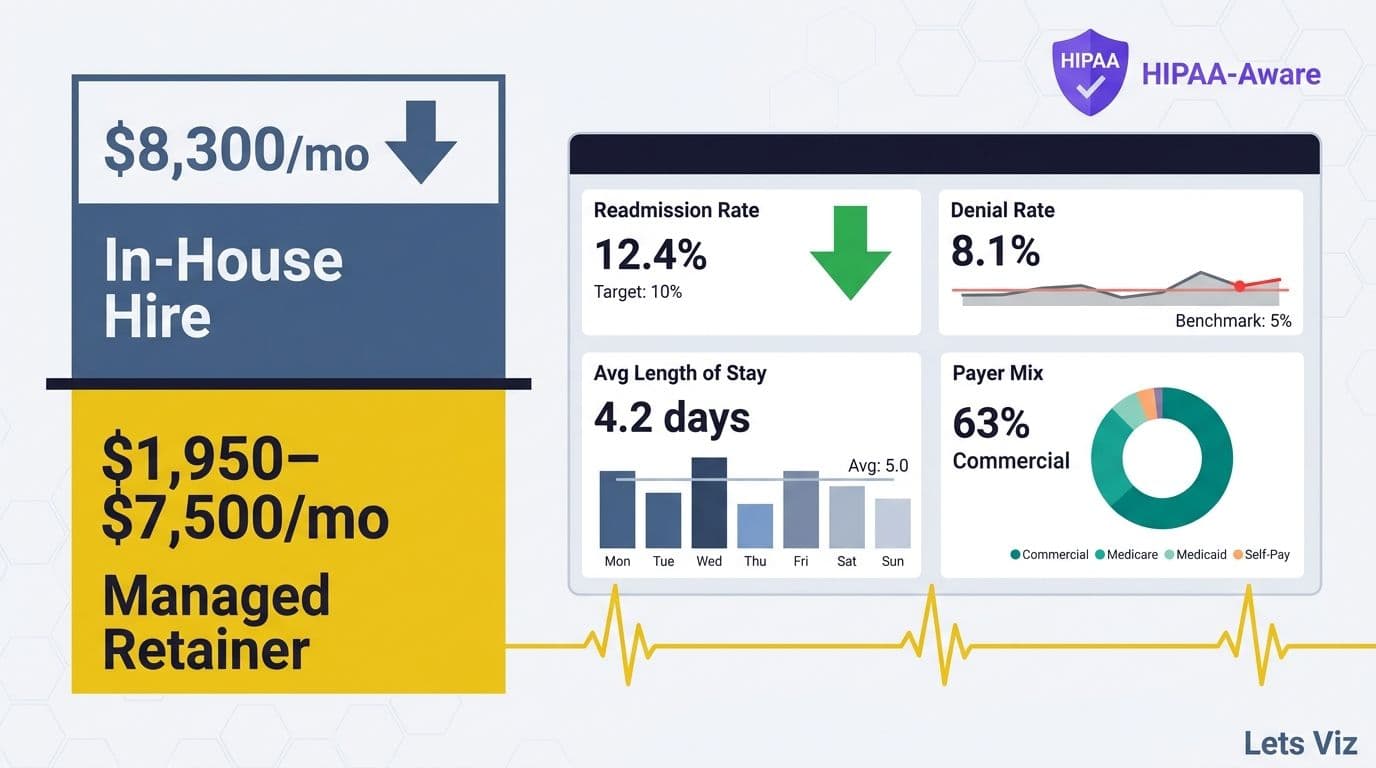
Direct cost savings are the most tangible starting point. A typical mid-market BI team of two to three analysts carries fully loaded annual costs of $295,000 to $445,000 in the US market (2026 compensation benchmarks). A managed Power BI service contract covering comparable scope runs $60,000 to $150,000 annually depending on complexity and service level - a net cost difference of 40% to 75% before accounting for recurring recruitment, onboarding, and replacement costs each time an analyst departs.
Risk reduction is harder to quantify but often more compelling for CIOs evaluating the decision at a strategic level. As of 2026, three themes have solidified as imperatives across healthcare analytics: value-based care performance tracking, AI-driven clinical and financial reporting, and payer analytics innovation (MedInsight, 2026). AI-driven clinical reporting in particular now encompasses LLM-based prior authorization intelligence, real-time denial prediction models, and automated quality metric alerting — capabilities that require continuous Fabric pipeline updates, model recalibration on a quarterly basis, and engineers who hold both BI and ML integration skills simultaneously. Each theme requires current, specialized expertise to execute. A managed provider amortizes investment in capability currency across multiple client engagements; a two-person internal team cannot match that pace of expertise refresh while also managing day-to-day production support.
Capability acceleration is the ROI lever most organizations discover after engagement rather than before. A managed provider with dedicated Power BI engineering capacity can typically deliver net-new dashboard capabilities in four to six weeks from requirements to production deployment. A CMS RADV audit preparation dashboard, for example, requires roughly 150 to 200 hours of focused BI engineering — a workload that queues behind production support on a two-person internal team but closes in two to three weeks under a dedicated managed engagement. More broadly, work that sits on an internal team's backlog for four to five months gets built and deployed in a single managed service sprint. For context: a mid-market finance team waiting four months for a cash flow variance dashboard misses an entire fiscal quarter of automated reporting — falling back on manual spreadsheet consolidation that typically consumes 12 to 20 analyst hours per close cycle. That hidden labor cost rarely appears in the original BI budget justification but compounds with every month the project stays queued.
For finance teams assessing the governance implications before expanding Power BI capabilities, the CFO's AI risk checklist for Power BI is a practical pre-engagement review worth completing before scoping any managed service engagement.
What Should You Ask a Managed Power BI Provider Before Signing?
Due diligence on a managed Power BI engagement should cover six areas before any contract is finalized.
Domain expertise: Has the provider built production models for healthcare revenue cycle management, CMS quality reporting, or GAAP-compliant multi-entity financial consolidation? Ask for case examples from comparable organizations - similar industry, comparable Power BI or Fabric version, similar data volume and refresh cadence.
Engineering depth: Can the team write complex DAX measures for healthcare reporting - rolling PMPM calculations, claims denial rates segmented by payer, or multi-entity financial elimination logic? Request a structured technical assessment before full engagement to verify actual capability, not pitch-deck positioning.
Governance and compliance: For US healthcare organizations, a HIPAA Business Associate Agreement is non-negotiable. For Canadian operations, PIPEDA and applicable provincial health privacy regulations apply independently of US standards. For financial services clients, confirm SOC 2 Type II certification and ask specifically about encryption standards and data residency controls.
Transition structure: How does the provider manage knowledge transfer from your existing internal team? A structured 30/60/90-day onboarding plan with documented data dictionaries, report inventories, and model documentation is the baseline expectation. Without this structure, the typical outcome is a 60-to-90-day period where the managed provider is reverse-engineering undocumented DAX measures and pipeline dependencies rather than delivering net-new capability — effectively restarting the knowledge-transfer clock the same way an internal team departure would have.
Service level agreements: What are the contractual response times for P1 (production report down), P2 (degraded performance), and P3 (new request or enhancement) ticket categories? For healthcare and financial reporting environments where data currency directly affects decisions, P1 response times longer than four hours are not acceptable. For a baseline on what a well-governed financial reporting environment requires, what metrics a financial reporting dashboard should include provides useful context.
Exit provisions: Can you retrieve all report files, data model documentation, and pipeline configurations in standard formats if you end the engagement? A provider who restricts access to your own Power BI assets owns your business intelligence. Exit provisions should be explicit, not implied, in any contract.
If your Power BI environment is showing two or more of the capacity signals described above, Managed Power BI services from Lets Viz offer a structured engagement model built for mid-market healthcare and finance organizations ready to move from reactive BI maintenance to proactive analytics capability.
---
About Lets Viz: Lets Viz is a data analytics consulting firm with over eight years of experience delivering Power BI and Microsoft Fabric solutions to healthcare and financial services organizations across the US and Canada. Our team holds Microsoft Power BI and Fabric certifications and has built production analytics environments for revenue cycle management, FP&A, regulatory reporting, and clinical quality operations - serving mid-market health systems, regional financial institutions, and insurance carriers. We work exclusively with organizations where data accuracy and regulatory compliance are non-negotiable operating requirements.