How to Choose an AI Consulting Firm for Corporate Finance
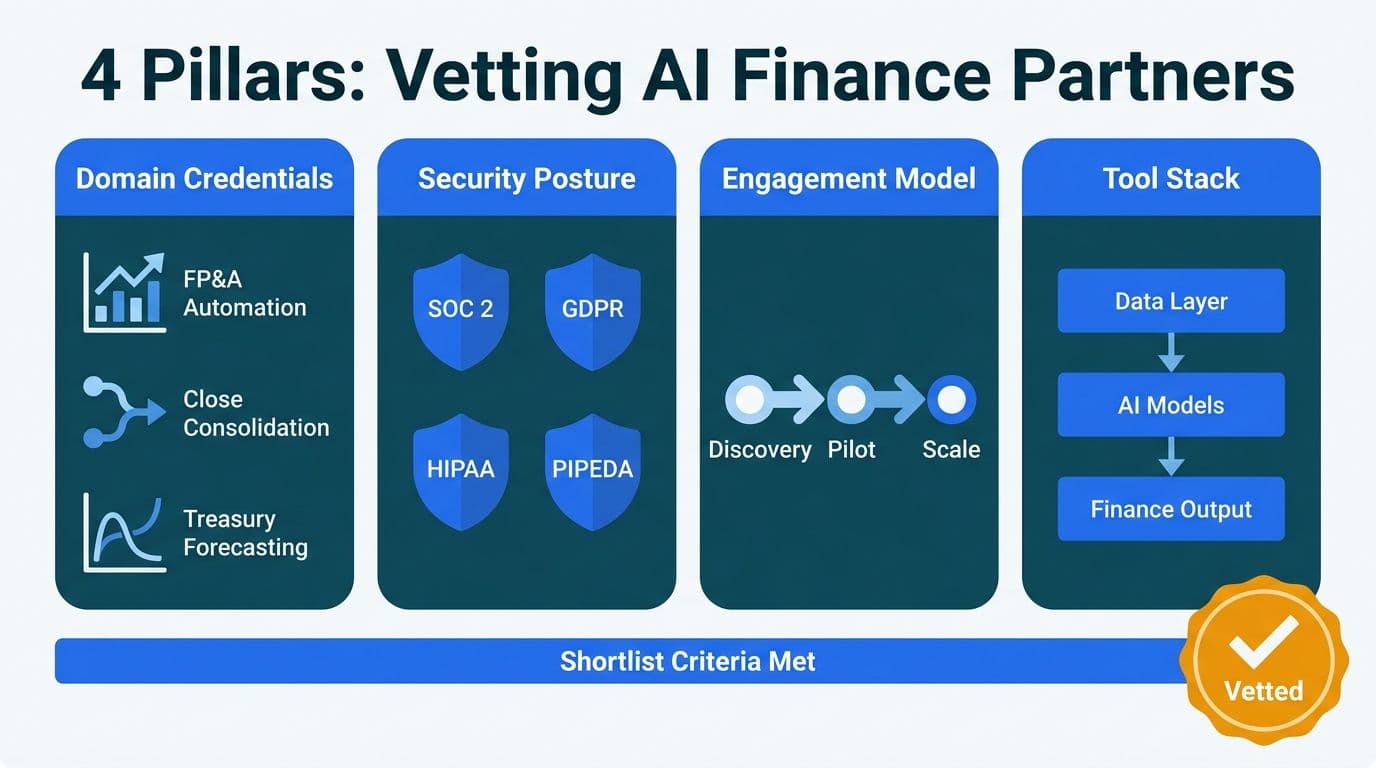
Choosing an AI consulting firm for corporate finance comes down to four non-negotiable pillars: verifiable finance-domain credentials, a documented data-security posture that satisfies your regulatory obligations (HIPAA and SOC 2 for US firms, GDPR for UK and EU operations, PIPEDA for Canadian organizations), a clearly defined engagement model, and tool-stack transparency. Vetting on all four before shortlisting prevents costly mid-project rework and regulatory exposure.
Key Takeaways
Demand demonstrated finance-domain experience - FP&A automation, close consolidation, or treasury forecasting - not just general AI delivery track records.
Data-security posture must be documented before contracts are signed; request SOC 2 Type II reports, GDPR DPAs, or PIPEDA compliance attestations as appropriate to your jurisdiction.
Project-based engagements suit scoped deliverables; retainers suit teams that need ongoing optimization, quarterly model updates, or embedded AI support.
Tool-stack fit matters: a firm comfortable with your existing ERP and workflow layer avoids translation overhead and unnecessary integration risk.
The right firm treats finance stakeholders as co-designers, not just ticket-raisers - insist on joint discovery sessions before committing to scope.
What Makes an AI Consulting Firm Finance-Ready?
Finance functions operate under constraints that most AI consulting firms have never navigated: period-end freezes, dual-control over journal entries, restricted-access data environments, and audit trails that must withstand external scrutiny. A firm that has delivered warehouse-management automation brings genuine AI capability but not the finance-function fluency that corporate finance requires.
The minimum bar is a combination of AI delivery capability and verifiable finance-domain knowledge. Look for consultants who have navigated the full finance data stack - ERP extraction, general-ledger reconciliation, planning-tool integration, and management reporting - not just the final dashboard layer.
Firms that specialize in AI automation consulting for finance contexts typically arrive with pre-built discovery frameworks for identifying automation candidates within a chart of accounts. That specificity compresses scoping from weeks to days.
Credential signals to request at the first conversation:
Finance-specific case studies (FP&A, treasury, accounts payable, or close automation - not just adjacent industries)
Named references from past CFO or Finance Director stakeholders, not only IT project sponsors
Demonstrated familiarity with your ERP and planning tools - SAP, Oracle, Dynamics, Workday, or Anaplan as relevant
Evidence of working under finance-grade audit and change-management requirements
For US healthcare finance functions, ask whether the firm has delivered projects subject to HIPAA controls. A UK fintech or EU-regulated treasury team should ask whether the prospective partner has operated under FCA or EBA oversight environments. Canadian organizations governed by OSFI guidelines should probe for prior regulatory-facing delivery experience.
Do not accept a demo or a generic capabilities deck as a substitute for reference-checked finance credentials. The demo shows what the firm can build; the references tell you whether they can navigate a controller's sign-off process and a CFO's quarterly close.
How Do You Assess Finance-Domain Credentials Before Signing?
The most reliable diagnostic is a structured working session designed to reveal whether the consulting team genuinely understands corporate finance operations - or is pattern-matching from adjacent industries such as HR automation or sales operations.
Ask the lead consultant to describe how they would map an accounts-payable automation to your existing approval hierarchy. A finance-experienced team will immediately ask about approval tiers, delegation-of-authority matrices, and ERP posting rules. A generalist team will jump straight to tool selection.
Request a concrete example of a project where they had to reconcile AI-generated outputs against a controller's manual close process. The answer reveals how they handle the last-mile problem of finance data - where model outputs meet human accountability.
Ask how they approach change management with finance teams accustomed to Excel-based workflows. A finance-experienced firm will describe a concrete phased approach: for example, running the automated reconciliation in parallel with the existing Excel process for a full close cycle, keeping sign-off authority with the finance team throughout, before cutting over. Firms that have not navigated this before default to generic user-training language and discover the adoption risk only after go-live.
For projects involving intercompany reconciliation or variance-analysis automation, ask specifically about exception-handling logic. Finance processes break at edge cases - accruals, FX revaluations, prior-period adjustments - and a credible firm will have thought through these failure modes before implementation begins, not during it. A practical test: ask the lead consultant how the system handles a prior-period adjustment that arrives after month-end close has already posted. A team with genuine finance-automation experience will describe a specific routing rule - for example, quarantining the entry for controller review rather than auto-posting - before you finish asking the question.
Finally, confirm the team structure for your engagement. Some firms sell on senior-partner credentials but deliver with junior generalist staff. The named project lead must have direct finance-domain experience, not just AI technical skills.
What Data-Security Posture Should an AI Consulting Partner Demonstrate?
Data security is the most common point of failure in finance AI engagements. Corporate finance data - board-level forecasts, management accounts, personnel cost files, intercompany transfer records - is among the most sensitive information an organization holds. A compliance gap during an AI project carries regulatory and reputational consequences that outlast the engagement itself.
Before any statement of work is executed, request the following documentation:
For US finance teams:
SOC 2 Type II report covering the firm's own infrastructure, not only the SaaS platforms they recommend
Confirmation that HIPAA Business Associate Agreements are available if health-cost, benefits, or patient-revenue data is in scope
A Data Processing Addendum specifying where data is stored, processed, and retained
For UK and EU finance teams:
GDPR-compliant data processing documentation, including lawful basis for processing and sub-processor disclosures
Confirmation that no personal or financial data transits US-based infrastructure without Standard Contractual Clauses in place
The GDPR Compliant SaaS Financial Reporting checklist covers exactly what to verify in vendor data agreements
For Canadian finance teams:
PIPEDA compliance documentation, including consent mechanisms if personal financial data is involved
Confirmation of data residency - Canadian-region hosting on major cloud providers is the standard expectation for federally regulated entities
For any GDPR, HIPAA, or PIPEDA compliant AI workflow automation initiative, the consulting firm must demonstrate that automated pipelines carry the same data-handling controls as the human processes they replace. Automation does not reduce compliance obligations - it redistributes where the controls sit in the process chain.
Also confirm that the firm's Zoho CRM GDPR, HIPAA, and PIPEDA compliance configuration capabilities extend to all integrated systems if your finance stack includes CRM-linked revenue or pipeline data. Each integration point between a CRM and a planning tool is a compliance checkpoint that must be documented and controlled.
For healthcare finance functions specifically, the AI Workflow Automation for Healthcare Operations guide covers the additional compliance layer that applies when patient-linked financial data enters the automation scope.
Project vs Retainer: Which Engagement Model Fits a Finance Team?
Neither model is universally superior. The right choice depends on whether your AI initiative is bounded and deliverable, or ongoing and evolving.
Project-based engagements suit defined, terminal-scope work: building a cash-conversion-cycle forecasting model, automating a month-end reporting package, or migrating a planning process to a new platform. Projects typically run 8-20 weeks with fixed or milestone-based fees, and transfer IP ownership to the client at completion. The structural risk is knowledge exit: when the consulting team closes out, institutional memory about design decisions and data quirks leaves with them. Mitigate this by requiring structured handover documentation and ensuring at least one internal team member is trained to maintain deliverables independently.
Retainer engagements suit finance teams that need ongoing model recalibration, quarterly scenario updates, or continuous optimization of an automation layer. Monthly or quarterly fixed fees allow scope to shift between periods based on evolving priorities. Zoho CRM ongoing support and maintenance costs - and similar retainer structures for CRM-linked finance automation - typically follow a tiered model: a lower tier covers monitoring and minor updates; a higher tier includes proactive optimization and new-workflow development. Request the standard tier structure from any prospective firm so you can map it to realistic use.
| Factor | Project-Based | Retainer-Based |
|---|---|---|
| Best fit | Defined-scope build: one model or one pipeline | Ongoing optimization and quarterly planning cycles |
| Cost structure | Fixed or milestone payments | Monthly or quarterly flat fee |
| Flexibility | Lower - scope changes require change orders | Higher - redirect priorities each period |
| Knowledge retention | Risk of knowledge exit at delivery | Continuity builds embedded familiarity |
| Typical commitment | 6-20 weeks | 3-12 months minimum |
| Regulatory audit support | Often excluded or separately priced | Can be structured into scope |
For most mid-market corporate finance functions, a hybrid approach is optimal: a project to build the core automation layer, followed by a lighter retainer for quarterly recalibration and ongoing compliance reviews.
How to Evaluate AI Workflow Automation Tool Stacks for Finance?
A consulting firm's tool preferences are a reliable signal of their delivery philosophy. Be skeptical of firms that recommend the same platform regardless of client context. Finance automation tool selection should follow your existing infrastructure, your IT team's operational capabilities, and your compliance obligations - not a firm's preferred vendor relationships.
The AI workflow automation tools pricing comparison landscape has consolidated. Major platforms now occupy distinct tiers by capability, compliance posture, and ecosystem fit:
| Platform | Typical Finance Use Case | Key Compliance Feature | Pricing Model |
|---|---|---|---|
| Power Automate | M365-native workflows, Dynamics 365, SharePoint triggers | SOC 2, GDPR, HIPAA via Microsoft compliance center | Per-user or per-flow; often included in M365 E3/E5 |
| n8n (self-hosted) | Data-sensitive pipelines requiring on-premises control | Self-hosted: data stays in your own VPC | Open-source core; cloud tiers available (n8n.io, as of 2025) |
| Make | Mid-complexity integrations, CRM-to-ERP sync | SOC 2 Type II, GDPR DPA available | Scenario-based; multiple tiers (Make.com, as of 2025) |
| Zoho Flow | Zoho ecosystem automation (CRM, Books, Analytics) | GDPR, HIPAA, PIPEDA configuration supported | Included in Zoho One; standalone option available |
For enterprise n8n vs Make vs Power Automate decisions in finance, the deciding variable is usually data residency. If compliance requirements prohibit finance data from transiting shared multi-tenant infrastructure, self-hosted n8n is the structurally correct choice even at the cost of additional DevOps overhead. If your organization already runs on Microsoft 365, Power Automate's native connectors reduce integration surface area and simplify audit-trail generation.
A credible consulting firm will present this comparative analysis unprompted. A first-pitch deck containing only one tool recommendation with no comparison rationale is worth noting - it may reflect vendor incentive structures rather than client-first analysis.
Review the AI workflow automation mistakes pre-launch checklist before finalizing scope with any firm. For a current overview of which platforms lead by use case, the best AI automation tools for business 2026 breakdown provides a useful independent reference.
The CFO Checklist: How to Choose an AI Consulting Firm for Corporate Finance
The following five-phase checklist consolidates the evaluation criteria above into a structured vetting framework. Apply it consistently across all shortlisted firms before reaching a final decision.
Phase 1 - Finance-Domain Credentials
[ ] Finance-specific case studies provided (FP&A, treasury, AP automation - not only adjacent industries)
[ ] CFO or Finance Director references available and reachable
[ ] Demonstrated ERP and planning-tool familiarity relevant to your specific stack
[ ] Prior experience operating under your regulatory environment (SEC/PCAOB, FCA, OSFI, or equivalent)
Phase 2 - Data-Security Posture
[ ] SOC 2 Type II report available (US); GDPR DPA available (UK/EU); PIPEDA compliance statement available (Canada)
[ ] Sub-processor list disclosed; data residency confirmed to your jurisdiction
[ ] HIPAA BAA available if health-cost or benefits data is in scope
[ ] Proposed automation pipelines carry the same data-handling controls as the manual processes they replace
Phase 3 - Engagement Model Clarity
[ ] Project scope clearly bounded with a documented change-order process
[ ] Retainer tier structure explained with specific deliverables per tier
[ ] Handover documentation and internal knowledge transfer included in scope definition
[ ] Exit clause defined: ownership of IP, models, and configurations if the engagement ends
Phase 4 - Tool-Stack Independence
[ ] Firm presented multiple tool options with documented rationale for the final recommendation
[ ] Tool selection aligns with existing IT infrastructure and compliance posture
[ ] Ongoing licensing costs for recommended tools disclosed upfront
[ ] Firm can support the chosen tooling under retainer without creating proprietary lock-in
Phase 5 - Governance and Delivery Approach
[ ] Named project lead with verifiable finance-domain background assigned to your account
[ ] Regular steering committee cadence proposed - not only ad-hoc status updates
[ ] Version control and audit trail confirmed for all models and automations
[ ] Finance stakeholder (not just IT) included in discovery and sign-off process
A US SaaS finance team, a UK fintech treasury function, and a Canadian manufacturing finance department each face different regulatory documentation requirements at Phase 2 - but all five phases of this checklist apply uniformly. The differentiator across geographies is not the structure of the evaluation, but the specific compliance artifacts required at each stage.
---
About Lets Viz: Lets Viz has delivered data and AI automation engagements for corporate finance, US healthcare, UK fintech, and Canadian manufacturing clients since 2020. With a 5.0 Clutch rating and a delivery track record spanning financial services, healthcare operations, and global SaaS businesses, the team combines deep technical capability with genuine finance-function experience.
When you are ready to apply this checklist to your own vendor selection, AI automation consulting from Lets Viz covers the full engagement lifecycle - from discovery and tool-stack assessment through to go-live and ongoing retainer support.