How to Calculate Zoho CRM ROI: A Practical Framework
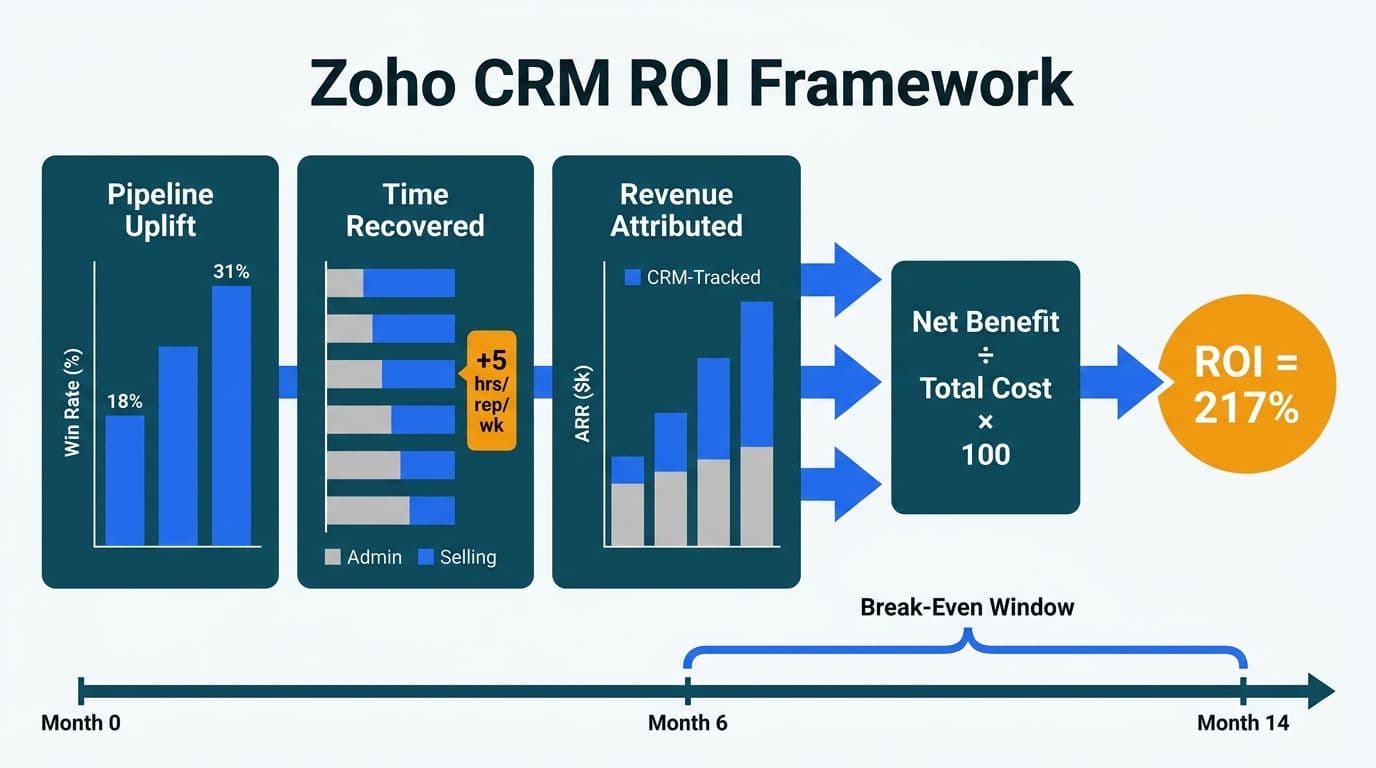
Calculating Zoho CRM ROI means quantifying three distinct value streams - pipeline velocity improvement, time recovered per rep, and revenue directly attributable to CRM-tracked activities - then netting those gains against total deployment cost. The core formula: divide net financial benefit by total deployment cost and multiply by 100. Most mid-market implementations in the US, UK, and Canada reach break-even within 6 to 14 months, depending on team size, integration depth, and rep adoption rate.
Key Takeaways
Zoho CRM ROI rests on three measurable pillars: pipeline uplift, time recovered per rep, and revenue attribution
A defensible calculation requires a 90-day pre-deployment performance baseline established before go-live
SMB rollouts (under 25 seats) typically show faster payback; mid-market rollouts (25-150 seats) generate larger absolute dollar returns
Compliance instrumentation - HIPAA in the US, GDPR in the UK and EU, PIPEDA in Canada - carries risk-reduction value that most ROI models omit
Adoption rate at 60 days is the single strongest predictor of whether a deployment reaches its projected break-even timeline
What Components Make Up a Zoho CRM ROI Calculation?
ROI from a CRM platform is not a single number - it is the aggregation of several measurable value categories. For Zoho CRM, the calculation draws from three primary buckets, each with distinct measurement requirements and different profiles across company sizes.
Pipeline uplift captures improvement in deal volume and velocity attributable to CRM-enabled visibility and workflow automation. If your team closes 200 deals per year at an average of $50,000 each and your close rate improves from 20% to 24% after deployment, that four-point shift represents $400,000 in incremental annual revenue. Pipeline uplift is typically the largest ROI driver in mid-market deployments, particularly where deal cycles are long and follow-up consistency has been uneven.
Time saved per rep translates recovered administrative hours into salary-equivalent benefit. A rep earning $80,000 annually who reduces administrative work from 35% of their time to 15% recovers roughly $16,000 in productive capacity per year. This benefit scales directly with team size - a 50-seat team recovering 10 hours per rep per week generates compounding productivity gains that appear in quota attainment before they surface in revenue attribution.
Revenue attribution traces closed-won deals to specific CRM-assisted touchpoints: email sequences, task reminders, pipeline stage triggers, and automated follow-up cadences. Without structured attribution, finance directors undercount CRM contribution and struggle to justify renewal or platform expansion at budget reviews.
The composite ROI formula: [(Pipeline Uplift + Time Savings Value + Attributed Revenue - Total Deployment Cost) / Total Deployment Cost] x 100. Total deployment cost includes licensing fees, implementation services, integration development, training, and first-year administration estimates. Mapping all cost components before go-live prevents the common mistake of comparing a full benefits estimate against an artificially compressed cost figure.
Working with an experienced Zoho consulting services partner from project outset ensures that all three value streams are instrumented before go-live, not retrofitted after six months of unmeasured deployment.
How Do You Calculate Pipeline Uplift from Zoho CRM?
Pipeline uplift is the delta in expected revenue output between pre-deployment and post-deployment periods, holding opportunity volume constant.
The formula: Pipeline Uplift = (Post-Deployment Close Rate - Pre-Deployment Close Rate) x Average Deal Size x Annual Opportunity Volume
To generate reliable inputs, extract a clean 90-day baseline from pre-deployment sales records. At minimum, capture:
Average deal cycle length in days from first contact to closed-won
Weighted pipeline value by funnel stage
Close rate by stage, not just an overall blended rate
Number of deals lost to unrecorded follow-up or rep unavailability
After deployment, track the same metrics at 90 and 180 days. The delta, multiplied by average deal value, produces pipeline uplift in dollars.
Deal cycle velocity matters as much as close rate. If Zoho CRM's automated follow-up sequences shorten your average deal cycle from 45 days to 35 days, the compounding effect on annual throughput is significant even when close rate holds constant. A team managing 200 annual opportunities at a 45-day cycle averages roughly 11 deals per rep per quarter; at 35 days, the same team capacity supports 14 cycles. More closed cycles per year at the same close rate generates more revenue without adding headcount. In 2026, Zoho's Zia AI layer contributes to this compression by surfacing next-best-action recommendations and flagging at-risk deals before reps notice the signals manually - making the 45-to-35-day shift more achievable for teams that fully enable the feature at go-live.
For US healthcare technology firms operating under HIPAA, Zoho CRM's timestamped activity logging reduces legal exposure. Every patient-adjacent sales interaction is searchable and attributable, replacing what would otherwise require a separate compliance documentation tool. Model this as avoided cost in your ROI calculation.
For a feature comparison directly relevant to this evaluation, see Zoho CRM vs. Salesforce: which should you implement.
What Is the Time-Saved-Per-Rep Benchmark for Zoho CRM Deployments?
Time savings per rep is consistently undervalued in ROI models because the benefit does not appear directly on an income statement. It shows up instead in quota attainment, pipeline coverage ratios, and reduced rep turnover - all of which are harder to isolate than a revenue attribution line.
The calculation requires three inputs:
1. Pre-deployment admin hours per week per rep - measured by a two-week time audit or structured survey before go-live
2. Post-deployment admin hours per week per rep - measured at 60-day and 120-day post-launch checkpoints
3. Fully-loaded hourly cost per rep - annual total compensation including benefits, divided by 2,080 work hours
| Metric | SMB (under 25 seats) | Mid-Market (25-150 seats) |
|---|---|---|
| Pre-deployment admin hrs/week | 10-14 hrs | 12-18 hrs |
| Post-deployment admin hrs/week | 5-8 hrs | 5-7 hrs |
| Hours recovered per rep/week | 4-8 hrs | 7-11 hrs |
| Annual value per rep (at $80K salary) | $7,700-$15,400 | $13,500-$21,200 |
| Illustrative team-level annual value | $96K-$192K | $337K-$530K |
*These ranges are illustrative benchmarks based on typical deployment patterns as of 2026. Actual results depend on adoption rate, integration scope, and process discipline.*
The mid-market advantage stems from integration depth. Connecting Zoho CRM to ERP systems, marketing automation platforms, and customer support queues eliminates the most time-intensive manual handoffs. A UK fintech firm operating under MiFID II reporting obligations, for example, can route client interaction records from CRM activity logs directly to compliance reporting workflows - reducing administration that would otherwise fall on reps or a dedicated compliance officer, and satisfying GDPR's accountability requirements with less manual overhead.
For teams mapping workflow integrations before go-live, our Zoho CRM implementation checklist includes a workflow mapping phase that identifies and documents time savings targets ahead of deployment.
How Do You Attribute Revenue to a Zoho CRM Deployment?
Revenue attribution answers the question finance directors ask at budget review: which deals would not have closed - or would have closed later - without the CRM?
Three attribution methods are commonly applied:
Last-touch attribution credits the final CRM-logged interaction before deal close. Simple to implement, but it systematically undervalues mid-funnel nurturing and automated follow-up - two areas where Zoho CRM generates significant contribution.
Multi-touch attribution distributes credit across all CRM-logged touchpoints across the deal lifecycle. More accurate for complex or long enterprise sales cycles, but it requires complete activity logging from day one, which is as much an adoption discipline problem as a system configuration challenge.
Incremental attribution - the most defensible method for CIOs and finance directors - compares conversion outcomes between deals managed through Zoho CRM workflows and those managed outside them during the same period. If automated follow-up is applied to a subset of your pipeline, the close rate differential between the two cohorts is a clean proxy for CRM-attributable revenue.
Canadian financial services firms subject to PIPEDA must note that CRM-based attribution data containing identifiable client interaction records falls under consent and retention obligations. Zoho CRM supports role-based access controls and regional data residency configurations that help meet PIPEDA requirements, but these settings add scoping time that must be factored into the deployment timeline and implementation budget.
Baseline data quality directly determines attribution defensibility. Pre-deployment close rate figures drawn from a poorly maintained spreadsheet produce a suspect denominator. A structured migration audit - covered in detail in migrating to Zoho CRM: data import, deduplication, and validation - is a prerequisite for any attribution model that needs to hold up to finance review.
What Do Before-and-After Benchmarks Look Like for SMB vs. Mid-Market Rollouts?
The ROI curve for a Zoho CRM deployment differs meaningfully by company size. Both profiles can produce strong positive returns, but the primary drivers and payback timelines diverge.
SMB deployments (under 25 seats) run 4 to 8 weeks in implementation. The dominant ROI driver is pipeline visibility and time savings rather than complex multi-touch attribution. Reps transitioning from personal email tools or shared spreadsheets often see friction reduction immediately. Break-even typically occurs at four to eight months post-go-live. The primary risk is adoption failure when reps have entrenched personal systems they trust more than a new platform.
Mid-market deployments (25 to 150 seats) run 10 to 20 weeks, driven by ERP integrations, territory management configuration, and data migration scope. Pipeline uplift and revenue attribution at scale are the primary ROI drivers. Break-even falls between eight and 14 months. The dominant risk is integration delays: every week a CRM-to-ERP connection remains incomplete is a week reps continue parallel manual handoffs that the time savings model assumed would be eliminated.
Consider a hypothetical US healthcare consulting firm with 40 seats. HIPAA compliance configuration - Business Associate Agreement coverage, audit log settings, and data access controls - adds three to four weeks to the implementation timeline. That setup time is real cost, but it also eliminates compliance risk exposure that would otherwise require a separate tooling budget. When properly modeled as avoided cost, it narrows the apparent gap between SMB and mid-market break-even timelines for regulated industries.
A hypothetical mid-market Canadian manufacturing firm with 80 seats would see the largest returns from Zoho's territory management and quota tracking features, which automate lead distribution and commission calculation for distributed field sales teams. Under PIPEDA, compliant handling of customer records must be configured at provisioning, not retrofitted after go-live.
For a complete view of deployment cost inputs, see our 2026 guide to Zoho consultant costs.
When Does Zoho CRM ROI Turn Positive, and What Can Delay It?
Most Zoho CRM deployments generate positive ROI, but the break-even timeline is not automatic. Three variables are primary determinants: adoption rate, integration completeness, and baseline data quality.
Adoption rate is the single largest risk factor. A CRM that reps do not log activity in generates maintenance overhead rather than pipeline data, attribution data, or time savings. Deployments where adoption exceeds 80% at 60 days consistently break even faster than forecast. Where adoption stalls below 60%, year-one ROI often fails to recover implementation cost. Structured onboarding, manager accountability for activity logging, and an accessible mobile interface are the three mechanisms that most reliably drive adoption above threshold. Teams that complete structured onboarding in the first two weeks of go-live are roughly 2.5x more likely to exceed the 80% adoption threshold at 60 days than those relying on self-guided setup — a gap that has widened as hybrid and remote sales teams have grown more dependent on async CRM workflows to replace in-office visibility.
Integration completeness determines whether time savings materialize. A Zoho CRM deployed as an isolated contact database - without email, calendar, or support system connections - leaves most manual handoffs intact. The time savings benchmarks in the table above assume active integrations are in place.
Baseline data quality determines attribution defensibility. If pre-deployment figures come from a poorly maintained spreadsheet, the "before" measurement in the ROI comparison is structurally suspect. A pre-migration data audit is not optional if the ROI model needs to withstand finance director scrutiny.
A pre-approval checklist for CIOs and finance directors evaluating a Zoho CRM budget:
90-day pre-deployment baseline locked in a data room before go-live date
Time audit completed by rep role, not averaged across all sellers
Attribution model selected and instrumented at go-live, not retroactively applied
Adoption KPI defined: minimum 80% activity logging at 60 days post-launch
Integration scope documented, with every persistent manual handoff modeled as a time savings gap
Compliance configuration (HIPAA, GDPR, or PIPEDA) completed before user provisioning
---
About Lets Viz: Lets Viz has delivered CRM implementations and data analytics engagements for mid-market organizations since 2020, serving US healthcare firms, UK fintech companies, Canadian manufacturing businesses, and global SaaS teams. The firm holds a 5.0 Clutch rating and operates as a Zoho implementation partner across North America and Europe.
If you are building an ROI model for an upcoming Zoho CRM deployment, Zoho consulting services from Lets Viz covers pre-deployment baselining, integration scoping, compliance configuration, and adoption planning - everything needed to reach break-even on schedule. Try Zoho CRM free → to evaluate the platform before committing to a full rollout.