How to Align ServiceNow ITSM with ITIL 4 Practices
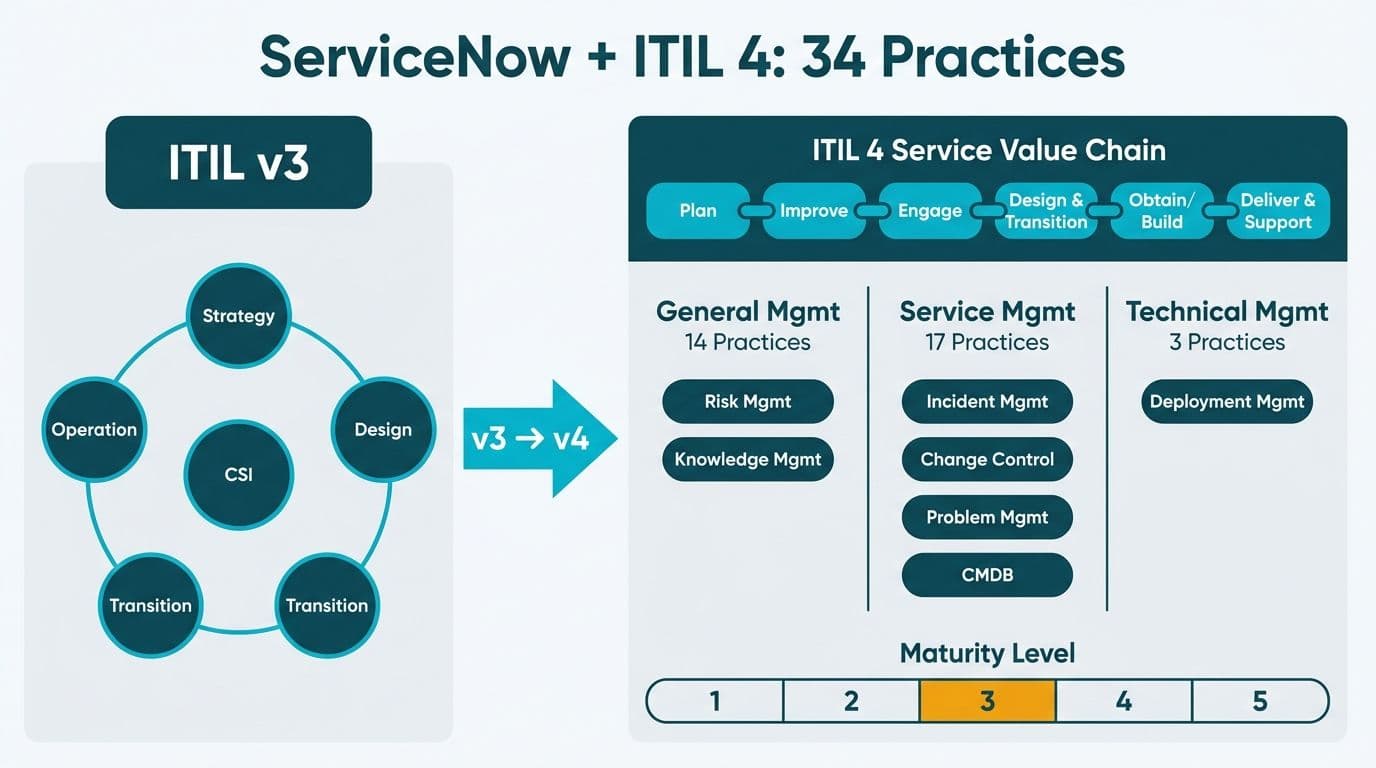
Aligning ServiceNow ITSM with ITIL 4 means mapping each of the 34 ITIL 4 management practices to a specific ServiceNow module, configuring workflows to reflect the Service Value Chain, and benchmarking your organization against a five-level maturity model. Teams migrating from ITIL v3 need to shift from a lifecycle-stage mindset to a practice-group model - a reconfiguration that touches governance, reporting, and tooling simultaneously.
Key Takeaways
- ITIL 4 replaces ITIL v3's five lifecycle stages with 34 management practices across three categories: General Management, Service Management, and Technical Management.
- ServiceNow ITSM covers the majority of ITIL 4's Service Management practices natively; ITOM and GRC modules extend coverage to monitoring, risk, and security.
- The most disruptive ITIL v3-to-v4 shift for ServiceNow teams is Change Enablement - the CAB-centric model is replaced by risk-based routing that fast-tracks standard changes.
- A five-level maturity model (AXELOS ITIL Maturity Model) gives CIOs a practice-by-practice benchmark independent of overall platform adoption.
- Healthcare and finance organizations in the US and Canada face HIPAA, SOC 2, and PIPEDA requirements that make ITIL 4 alignment a compliance lever, not just an operational improvement.
What Changed from ITIL v3 to ITIL 4?
ITIL v3 structured IT service management around five sequential lifecycle stages: Service Strategy, Service Design, Service Transition, Service Operation, and Continual Service Improvement. ITIL 4, the current AXELOS framework, replaces that linear model with a Service Value System (SVS) - a holistic architecture that encompasses the Service Value Chain, 34 management practices, guiding principles, governance layers, and an embedded continual improvement loop.
For teams working with a ServiceNow consulting services partner or configuring the platform in-house, the practical implication is direct: ITIL v3 process categories that shaped most pre-2023 ServiceNow configurations do not map cleanly to ITIL 4 practice groups. Workflow names, record types, reporting dimensions, and approval structures all need intentional revision.
Three structural shifts drive the reconfiguration work:
1. Processes become practices. ITIL 4 acknowledges that IT work is not purely procedural. Each "practice" bundles four components: a process or procedure, organizational roles, information and technology, and partners and suppliers. A ServiceNow configuration that treats Incident Management as a workflow alone is incomplete under ITIL 4 - role definitions, KB linkage, and CMDB integration are part of the practice, not optional extensions.
2. Change Control becomes Change Enablement. The ITIL v3 Change Advisory Board model - where every change routes through a single approval gate - is replaced by a risk-tiered approach. ITIL 4 segments changes into Standard (pre-approved, low-risk), Normal (assessed individually), and Emergency (expedited for critical fixes). ServiceNow's Change Management module supports all three categories but must be reconfigured from a single-queue CAB model to a risk-categorized routing workflow. Teams that skip this step retain the bottleneck without the framework justification.
3. Problem Management is formalized and separated. Under ITIL v3, many organizations ran problem management reactively and informally, often as an extension of major incident review. ITIL 4 gives Problem Management its own practice definition, its own KPIs - including problem identification rate and known-error database coverage - and a formal feedback loop to Knowledge Management and Incident Management. In ServiceNow, this means activating the Problem Management module separately from Incident, linking problem records to the Known Error Database, and standing up a KPI dashboard that tracks resolution cycle time independently.
For a foundational overview of the platform before diving into ITIL 4 alignment, What Is ServiceNow? A CIO's Complete Platform Guide covers the full module architecture.
How Do You Align ServiceNow ITSM with ITIL 4 Practices? Module-by-Module Mapping
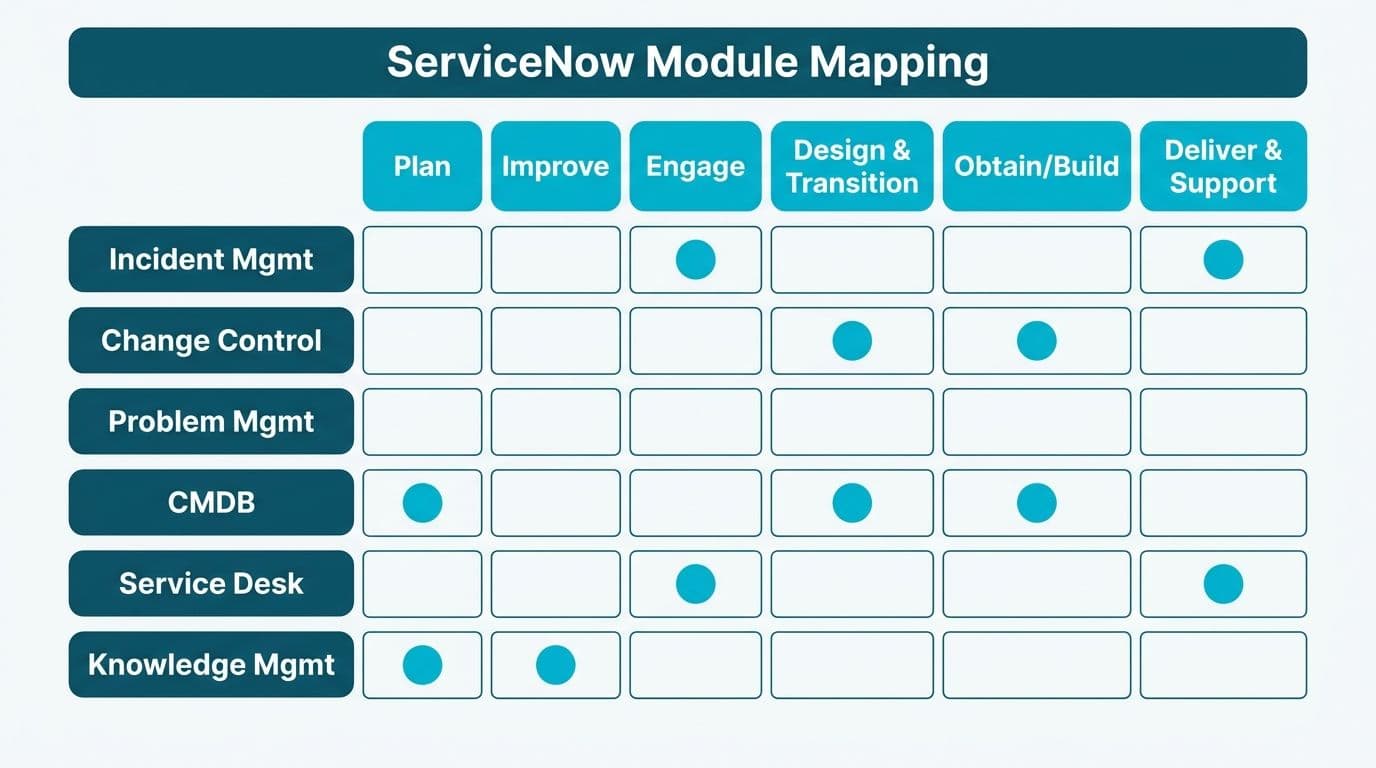
The alignment process begins with a structured mapping of ITIL 4's 34 practices against your current ServiceNow configuration. The table below covers the Service Management Practices - the 17 practices most directly relevant to ITSM teams - along with the ServiceNow module that fulfills each practice and the configuration gap most commonly found in ITIL v3 environments.
| ITIL 4 Practice | ServiceNow Module | Typical ITIL v3 Gap |
|---|---|---|
| Incident Management | ITSM - Incident | Inconsistent priority matrix; SLA clocks not paused correctly |
| Problem Management | ITSM - Problem | No formal Known Error Database; problems closed without root cause |
| Change Enablement | ITSM - Change | Single CAB queue; standard changes not pre-approved |
| Service Request Management | Service Catalog + Requests | Catalog items stale or unmaintained |
| Service Desk | Virtual Agent + IT Service Desk | Self-service deflection rate not measured |
| Service Level Management | SLA Management | SLAs configured but not reviewed in regular cadence |
| Knowledge Management | Knowledge Management | Articles not linked to incident or problem records |
| IT Asset Management | ITAM (Hardware / Software) | Asset lifecycle tracked outside the platform |
| Service Configuration Management | CMDB | CI records stale; relationships incomplete |
| Monitoring and Event Management | ITOM Event Management | Alerts not correlated to CMDB CI records |
| Continual Improvement | Continual Improvement Management | No formal improvement register or owner assignment |
| Release Management | ITSM - Release | Release and deployment conflated into a single workflow |
| Service Catalogue Management | Service Catalog | Published catalog not governed or reviewed periodically |
| Availability Management | ITOM Visibility | Availability SLAs not tracked within the platform |
| Capacity and Performance Management | AIOps / Predictive Intelligence | Managed entirely outside ServiceNow |
| Service Design | Service Portfolio + PPM | Design work ad hoc and undocumented |
| Business Analysis | Strategic Portfolio Management | Business requirements not formally linked to service records |
The General Management Practices - including Risk Management, Information Security Management, Supplier Management, and Workforce and Talent Management - are served by ServiceNow GRC, SecOps, and Vendor Risk Management modules. These require separate licensing from core ITSM and are most commonly activated in regulated industries where continuous audit trails are mandatory.
What Are the ITIL 4 Maturity Benchmarks for ServiceNow Teams?
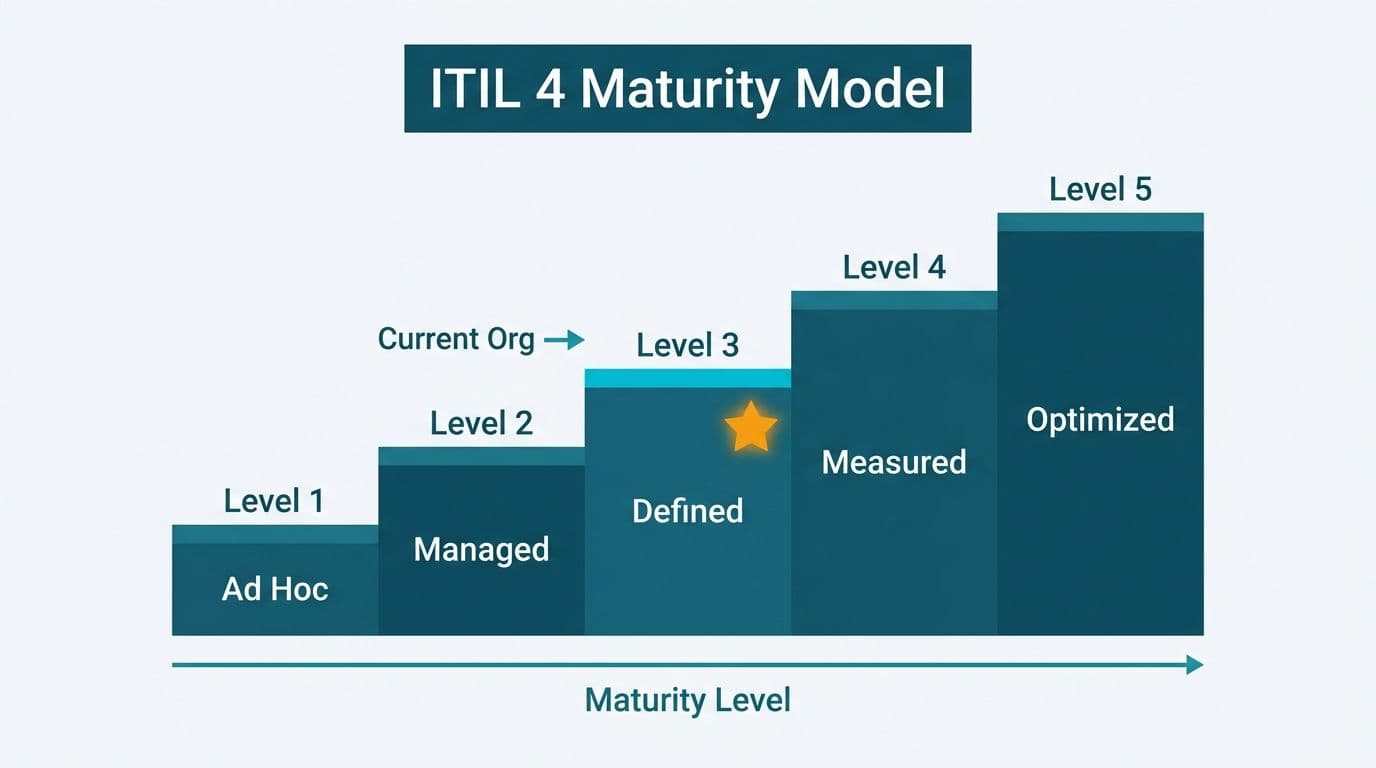
The AXELOS ITIL Maturity Model (IMM), documented in official AXELOS guidance, defines five maturity levels that apply independently to each practice. A team can be Level 4 in Incident Management and Level 1 in Continual Improvement simultaneously - a pattern that is extremely common among organizations that have operated ServiceNow for several years without a formal framework review.
| IMM Level | Label | ServiceNow Indicators |
|---|---|---|
| 1 | Initial | Tickets logged inconsistently; no SLAs enforced; CMDB empty or unmaintained |
| 2 | Managed | Active workflows; SLAs configured; basic incident and change reporting available |
| 3 | Defined | CMDB populated with CI relationships; risk-based Change routing active; Knowledge articles linked to records |
| 4 | Quantitatively Managed | Real-time KPI dashboards per practice; SLA breach alerts; formal review cadence with named owners |
| 5 | Optimizing | AIOps active; predictive event correlation; monthly improvement cycles with documented outcomes |
Where do mid-market teams typically land? Organizations moving from ITIL v3 to ITIL 4 for the first time most often score between Level 2 and Level 3 on core practices - Incident Management, Change Management, and Service Desk - and at Level 1 on practices that were informal under v3, particularly Continual Improvement, Availability Management, and Capacity and Performance Management.
The gap between Level 2 and Level 3 is where most alignment projects spend the majority of effort. Reaching Level 3 requires integration work - connecting CMDB records to incident workflows, linking KB articles to resolution records, and routing changes by risk category - rather than simply configuring individual modules in isolation.
Targeting Level 4 across all core practices is a realistic 12-to-18-month goal for a mid-market team working with an experienced implementation partner. Level 5 requires ITOM and AIOps licensing in addition to core ITSM and is typically a 24-to-36-month horizon.
How Does ITIL 4 Alignment Apply in Healthcare and Finance?
In regulated industries, ITIL 4 alignment produces compliance documentation as a direct output - not as a separate exercise.
US Healthcare - HIPAA: The HIPAA Security Rule requires documented procedures for access control, audit logging, and security incident response for any system handling Protected Health Information. ServiceNow Incident Management and Problem Management, configured to ITIL 4 Level 3 or higher, generate the timestamped audit records, assignment histories, and resolution documentation that HIPAA assessments require. A US hospital system running ServiceNow without ITIL 4 alignment typically has the underlying data but lacks the governance structure to present it coherently under audit.
US and Canadian Finance - SOC 2 and PIPEDA: SOC 2 Type II engagements require evidence of change control, access management, and availability monitoring over a 12-month observation period. A US asset manager or a Canadian credit union using ServiceNow Change Enablement at ITIL 4 Level 3 or higher can produce a complete change history with approvers, risk assessments, and implementation records directly from the platform - the primary evidence set for SOC 2 CC8 (Change Management) controls. Under Canada's PIPEDA, documented incident response procedures and data-handling records align directly with ITIL 4's Information Security Management practice as implemented in ServiceNow SecOps.
UK and EU - GDPR: For a UK fintech firm or an EU-regulated financial institution, GDPR Article 32 requires "appropriate technical and organisational measures" to secure personal data. ITIL 4's Risk Management and Information Security Management practices, implemented in ServiceNow GRC, map directly to GDPR control categories - producing auditable evidence of risk assessment, control implementation, and monitoring cadence. The ServiceNow ITSM for Healthcare IT Teams: HIPAA, GDPR and PIPEDA guide covers configuration across all three regulatory frameworks in a single implementation approach.
Suppose a Canadian regional bank needs to demonstrate PIPEDA accountability for a regulatory review. If its ServiceNow CMDB is maintained at ITIL 4 Level 3, it can map which configuration items store personal data, document who holds access, and produce a change audit trail for each affected system - meeting the data inventory and accountability requirements without a separate compliance platform.
When Should You Upgrade from ITIL v3 to ITIL 4 in ServiceNow?
Three conditions signal that it is time to initiate ITIL 4 alignment:
Platform migration or upgrade. Moving to a new ServiceNow release or consolidating from a legacy ITSM tool creates a natural configuration reset point. Carrying ITIL v3 process patterns into a new platform instance embeds technical debt from Day 1 and typically triggers a second reconfiguration project 18 months later. Aligning to ITIL 4 practice groups during the initial migration prevents that cycle.
Incoming compliance audit. If a HIPAA, SOC 2 Type II, or GDPR audit is scheduled within the next 12 months, formalizing the six highest-impact ITIL 4 practices in ServiceNow - Incident Management, Change Enablement, Service Configuration Management, Information Security Management, Problem Management, and Continual Improvement - produces the documentation evidence those audits require on the shortest path.
Maturity plateau. Persistent high incident volumes with flat resolution time trends, or recurring major incidents without root cause resolution, indicate that informal v3 practices have reached their ceiling. ITIL 4's Problem Management and Continual Improvement practices, activated in ServiceNow with named owners and a formal improvement register, address that pattern at a structural level rather than through operational workarounds.
For teams assessing the cost of this work before committing, ServiceNow Implementation Cost 2026: A Mid-Market Breakdown provides a budget framework that includes ITIL 4 alignment as a configuration workstream. Teams that also use ServiceNow as a reporting data source should review ServiceNow Power BI Integration: A Complete Guide for the BI reporting layer.
How Do You Run an ITIL 4 Gap Assessment in ServiceNow?
A structured gap assessment runs in four steps:
Step 1 - Practice inventory. Export a list of active ServiceNow workflows, SLA policies, service catalog items, and CMDB CI classes. Map each item to the ITIL 4 practice it nominally supports. Any ITIL 4 practice with no corresponding ServiceNow configuration is automatically rated Level 1 and flagged for the roadmap.
Step 2 - Maturity scoring. For each active practice, score against the five-level IMM criteria. Prioritize the six highest-impact practices first: Incident Management, Change Enablement, Service Configuration Management, Problem Management, Service Level Management, and Continual Improvement. These six practices account for the majority of audit evidence requirements and operational KPI improvements.
Step 3 - Gap prioritization. Rank identified gaps by three factors: regulatory impact (does this gap create an audit finding?), operational impact (how many incidents or changes are affected?), and implementation effort (is this a configuration change or a full module activation?). The ranking produces a sequenced roadmap rather than an undifferentiated backlog.
Step 4 - Practice sprints. Execute configuration changes by practice group, not by module. A focused Problem Management sprint - standing up the Known Error Database, linking it to incident records, and activating a KPI dashboard - delivers a measurable Level 3 outcome before the team moves to the next practice. Validating each sprint against IMM criteria before closing prevents scope drift and produces a documented evidence trail for the next audit cycle.
---
About Lets Viz: Lets Viz has delivered data analytics and IT service management consulting since 2020, partnering with US healthcare providers, UK fintech firms, Canadian manufacturing companies, and global SaaS businesses. The practice holds a 5.0 rating on Clutch, with engagements spanning ServiceNow ITIL 4 alignment, Power BI governance, and Zoho platform implementations across regulated industries.
Ready to map your ServiceNow configuration to ITIL 4 and benchmark your team's maturity practice by practice? ServiceNow consulting services covers the full engagement model, from gap assessment through go-live.