How Much Does Power BI Consulting Cost? 2026 Guide
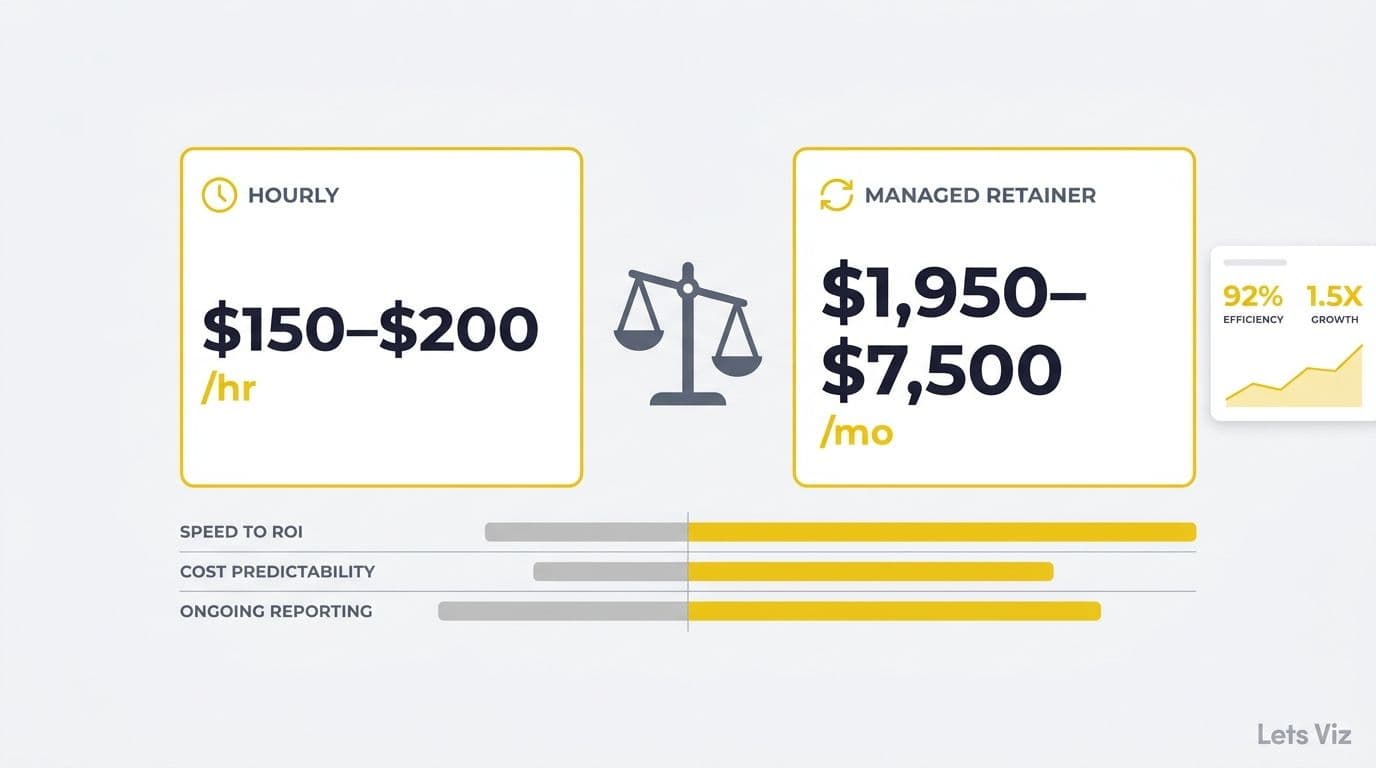
Power BI consulting in the US typically costs $150-$200 per hour for senior-level work, or $1,950-$7,500 per month on a managed retainer. For mid-market organizations in healthcare and finance, a managed retainer almost always delivers faster ROI than hourly billing or a full-time hire - but only when your reporting demands are ongoing rather than a one-time project.
Who This Is For
This pricing guide is written for you if:
You are a CIO, data team lead, or finance director at a US, Canadian, or UK company with 100-2,000 employees who needs to budget for Power BI consulting or ongoing support
Your organization operates in healthcare or finance, where dashboards must meet compliance and audit requirements
Your team already has Power BI service login access across a reporting group, but the backlog is growing faster than internal capacity
You are planning a migration from another BI platform and need firm numbers before submitting a capital budget request
This guide is not a fit if you are a solo analyst who just needs a Power BI download to explore data independently - Microsoft's own documentation is the right starting point for that. It also does not apply if your reporting needs are a single static dashboard with no ongoing stakeholder demands; a one-time freelancer build is likely more cost-effective in that case.
How Much Does Power BI Consulting Cost? A Model-by-Model Breakdown
The answer depends almost entirely on the engagement model you choose. There are three primary structures in the US market.
Hourly Consulting
Senior Power BI consultants in the US bill at $150-$200 per hour. This model suits architecture reviews, data model audits, or one-off troubleshooting sessions where scope is genuinely fixed. The practical risk: a dashboard project quoted at 40 hours routinely runs 60-80 hours once business stakeholders begin weighing in on requirements.
Project-Based Fees
For defined deliverables - most commonly a Tableau-to-Power BI migration - expect to budget $15,000-$40,000 as a one-time project fee. The range reflects report count, data source complexity, and whether calculated fields and custom visuals need to be rebuilt from scratch. Use our free project cost calculator to get a scoped estimate before your next planning conversation.
Managed Retainers
A managed Power BI retainer bundles builds, maintenance, optimization, and support into a fixed monthly fee. The US mid-market retainer range runs $2,000-$8,000 per month. Lets Viz structures three tiers within that range:
| Tier | Monthly Cost | Core Scope |
|---|---|---|
| Essentials | $1,950/mo | Core dashboards, monthly model updates, email support |
| Growth | $3,950/mo | Expanded report library, DAX optimization, stakeholder training |
| Enterprise | $7,500/mo | Full BI function, compliance-ready data model, priority SLA |
CFO Power BI Dashboard Build Cost Guide: DIY, Freelance, or Managed Service?
For a mid-market CFO evaluating how to build a Power BI reporting layer, the first decision is not which vendor to call - it is which delivery model fits the organization's financial profile and ongoing demand. This guide covers the three realistic options for US, UK, and Canadian organizations in 2026: build it internally (DIY), hire a freelance consultant project-by-project, or engage a managed service on a retainer. The right answer turns almost entirely on reporting complexity and how stable your demand is month over month.
DIY / Internal Build
Microsoft offers Power BI Desktop for free and Power BI Pro licenses at $10 per user per month. A CFO can assign an analyst or data-aware finance team member to build initial dashboards at no incremental vendor cost. The hidden cost is capacity: an analyst spending 15-20 hours per week on report development and maintenance is pulling that time from core finance functions. At a fully loaded internal cost of $55-$75 per hour for a mid-market analyst, the real DIY cost is $3,300-$6,000 per month in absorbed labor - without the technical depth to build a governed, audit-ready data model. DIY works for simple operational dashboards with one data source and one primary user. It routinely breaks down when the CFO needs cross-functional data, row-level security, or dashboards that will face board or audit scrutiny.
Freelance (Hourly or Short-Term Project)
Freelance Power BI consultants bill at $100-$175 per hour in the US, £80-£130 per hour in the UK, and CAD $120-$180 per hour in Canada. For a bounded, well-scoped project - a single executive dashboard with two clean data sources - a freelancer delivering 40-60 hours of work is often the most cost-effective path. The structural limitation: freelancers are optimized for delivery, not maintenance. When a data source schema changes, a calculated measure breaks, or a new stakeholder needs access, you re-enter the queue at their current availability and billing rate.
Managed Service (Retainer)
A managed retainer bundles ongoing builds, maintenance, stakeholder updates, and governance into a predictable monthly fee. In US markets, this runs $1,950-$7,500 per month depending on scope. UK equivalents run approximately £1,500-£5,500 per month; Canadian organizations typically see CAD $2,500-$9,000 per month at comparable service levels.
Decision Matrix for Mid-Market CFOs
| Scenario | Best Fit |
|---|---|
| Single dashboard, one data source, no ongoing changes | DIY or freelance |
| Defined project (migration, new data model) with clear end date | Freelance or project-based fee |
| Monthly close reporting, board dashboards, ongoing stakeholder requests | Managed retainer |
| Compliance requirements (HIPAA, SOC 2, FCA) | Managed retainer - compliance scope built in |
| Team lacks internal BI expertise but needs reporting today | Managed retainer |
| Internal analyst has capacity and technical depth | DIY or hybrid |
The SaaS-CFO use case - where a finance leader manages a product-led growth company with relatively clean data in a single CRM and billing system - is the scenario where DIY or a short freelance engagement is most defensible. For multi-entity, multi-currency, or operationally complex mid-market organizations, the managed retainer math nearly always wins on a fully loaded cost basis by month six.
Managed Retainer vs Hiring In-House: The Real Break-Even
The most common question we hear from finance directors: *"Why not just hire someone internally?"*
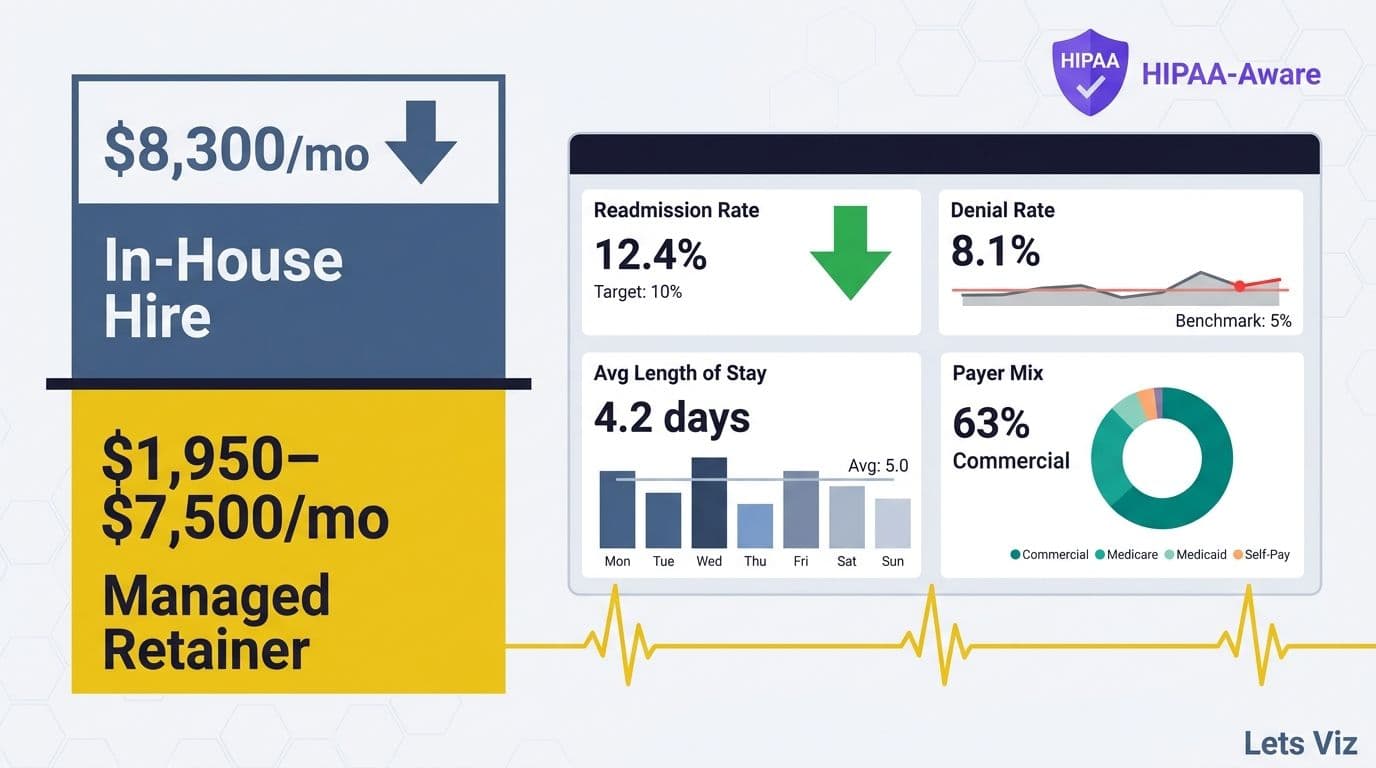
A mid-level Power BI developer in the US costs roughly $112,000 per year fully loaded as of 2026 - base salary, benefits, payroll taxes, and tooling - which works out to approximately $9,300 per month. That is the in-house break-even. Below that number, a retainer is cheaper on an apples-to-apples basis. Above it, a full-time hire begins to make financial sense. Demand for BI talent has continued to tighten in 2026 as organizations adopt Microsoft Fabric and Copilot features, compressing the available candidate pool and pushing offer salaries toward the high end of that range.
| Factor | In-House Developer | Managed Retainer |
|---|---|---|
| Monthly cost | ~$9,300 (fully loaded) | $1,950-$7,500 |
| Time to first dashboard | 60-90 days to productivity | 2-3 weeks |
| Coverage during leave or turnover | None | Continuous |
| Skills depth | One person's skill set | Team: DAX, modeling, governance |
| Scalability | Fixed headcount | Adjust tier up or down |
| Recruiting timeline | 10-14 weeks average (2026) | None |
For a full scenario-based cost analysis, the Managed Power BI vs In-House BI Team guide walks through multi-year projections for several mid-market staffing configurations.
---
Comparing engagement options for your organization? Our Managed Power BI services page outlines scope, SLAs, and typical client profiles for each tier. Most prospective clients find the right fit in under five minutes.
---
What Working With Us Looks Like
Buyers in healthcare and finance consistently tell us the engagement process with BI vendors feels opaque. Here is exactly how a Lets Viz retainer runs from contract signing to steady-state delivery.
Week 1 - Discovery: A 30-minute structured call to understand your data sources, Power BI online environment, reporting cadence, stakeholder groups, and compliance obligations. We are diagnosing your situation, not pitching a solution. No proposal is finalized without this step.
Weeks 2-3 - Architecture and First Build: We map the data model, connect your sources, and deliver a first working dashboard in your environment. You review and annotate directly in the report - no email attachment chains or static screenshots.
Week 4 - Review and Handoff: Revisions, DAX optimization, and row-level security configuration scoped to your access requirements. Your team receives a live walkthrough covering how to read the reports and how to submit change requests through the shared queue.
Month 2 and beyond: Monthly model updates, new report requests prioritized in a shared backlog, and a standing 30-minute sync to align on what matters next. Enterprise-tier clients receive a dedicated communication channel and a four-hour response SLA on urgent issues.
Healthcare finance teams will find this workflow familiar: we build to audit standards by default. If your organization requires HIPAA-aligned data handling or controls that satisfy an internal SOC 2 review, those requirements are scoped in discovery - not retrofitted after delivery. The Healthcare Financial Analytics Market is projected to grow at an 8.58% CAGR from 2025 to 2035 (source: Market Research Future, as of 2026), and organizations building audit-ready reporting infrastructure now are positioning themselves well ahead of that growth curve.
For a closer look at the financial reporting use case in healthcare, the Power BI financial dashboard guide for healthcare walks through what a production-ready build looks like end to end.
When Should You Choose a Retainer Over Hourly Billing?
Choose a retainer when you have ongoing reporting demands - monthly financial close cycles, operational dashboards, board reporting cadence - that require consistent maintenance and evolution over time. If your team accesses Power BI Desktop or Power BI online more than a few times per week and the backlog keeps accumulating, the retainer math almost always favors you over ad hoc hourly billing or a single in-house developer.
Choose hourly for genuinely bounded engagements: a data model audit before a system migration, a training session for an internal team, or a one-time dashboard build with no expectation of future changes.
If you are unsure which side of that line your organization falls on, the decision framework for outsourcing Power BI management covers the specific trigger criteria in detail.
What Does a Tableau-to-Power BI Migration Cost?
Migration projects are scoped at $15,000-$40,000 as a one-time fee. Three variables drive the range: report count, complexity of calculated fields and custom visuals, and whether the underlying data model can be reused or must be rebuilt from scratch. In 2026, a fourth variable has emerged for organizations moving to Microsoft Fabric: clients who want native Copilot or AI-assisted reporting features enabled from day one face additional data model restructuring that adds $3,000-$8,000 to otherwise comparable projects.
A healthcare organization with 20 operational dashboards and a reasonably clean cloud data warehouse typically lands in the $18,000-$25,000 range. A financial services firm with 60 reports, multi-source joins, and complex business logic will be closer to the top of the range.
Because migrations are high-stakes - a broken calculation discovered in production is significantly more costly to fix than one caught in scoping - we always run a paid discovery sprint before committing to a fixed-fee proposal. The sprint runs $1,500-$2,500, takes five business days, and is credited in full toward the project fee if you proceed. This protects you from change orders and ensures the scope reflects your actual data environment, not assumptions made from an introductory call.
Three Objections We Hear Most - and Honest Answers
"We will be locked in and lose control of our reports."
Our retainer agreements run month-to-month after an initial 90-day ramp period. The first 90 days cover onboarding, data architecture, and the first complete reporting cycle - the minimum required to deliver a meaningful outcome. After that, you can scale, pause, or exit with standard notice. Every report, data model, and DAX calculation we build is yours, fully documented, from day one. For the specific questions to ask any BI vendor about knowledge transfer and asset ownership, the Power BI consultant hiring framework has a vetted screening list.
"Offshore vendors charge a fraction of your rates. Is the quality difference real?"
The rate difference is real. So is the quality gap for compliance-sensitive environments. We are a US-based team, and every engagement is led by a senior consultant with production experience in healthcare or financial services. The cost of a flawed data model in these industries is not a vendor quality complaint - it is a regulatory exposure and a potential audit finding. A single misclassified data element in a HIPAA-covered dashboard can trigger breach notification, remediation, and legal costs in the $150,000-$400,000 range (as of 2026) - a figure that routinely exceeds the full annual rate differential with offshore teams. Evaluating consultants on cost-per-hour in isolation is measuring the wrong variable for your risk profile.
"Can we hire a Power BI developer directly and skip the consulting overhead?"
Sometimes the right answer is yes. If your reporting needs are large, stable, and predictable enough to justify a full-time salary - roughly the $9,300 per month fully loaded break-even - hiring in-house is the right call. The scenario where it consistently fails: mid-market organizations where demand fluctuates seasonally, where a single developer cannot cover DAX, data governance, and stakeholder management simultaneously, and where the 10-14 week recruiting cycle means the backlog compounds while you wait. The Power BI Consultant vs Developer guide breaks down the role distinctions clearly if you are unsure which type of resource your situation actually requires.
What Drives Power BI Consulting Cost Up or Down?
Factors that push cost higher:
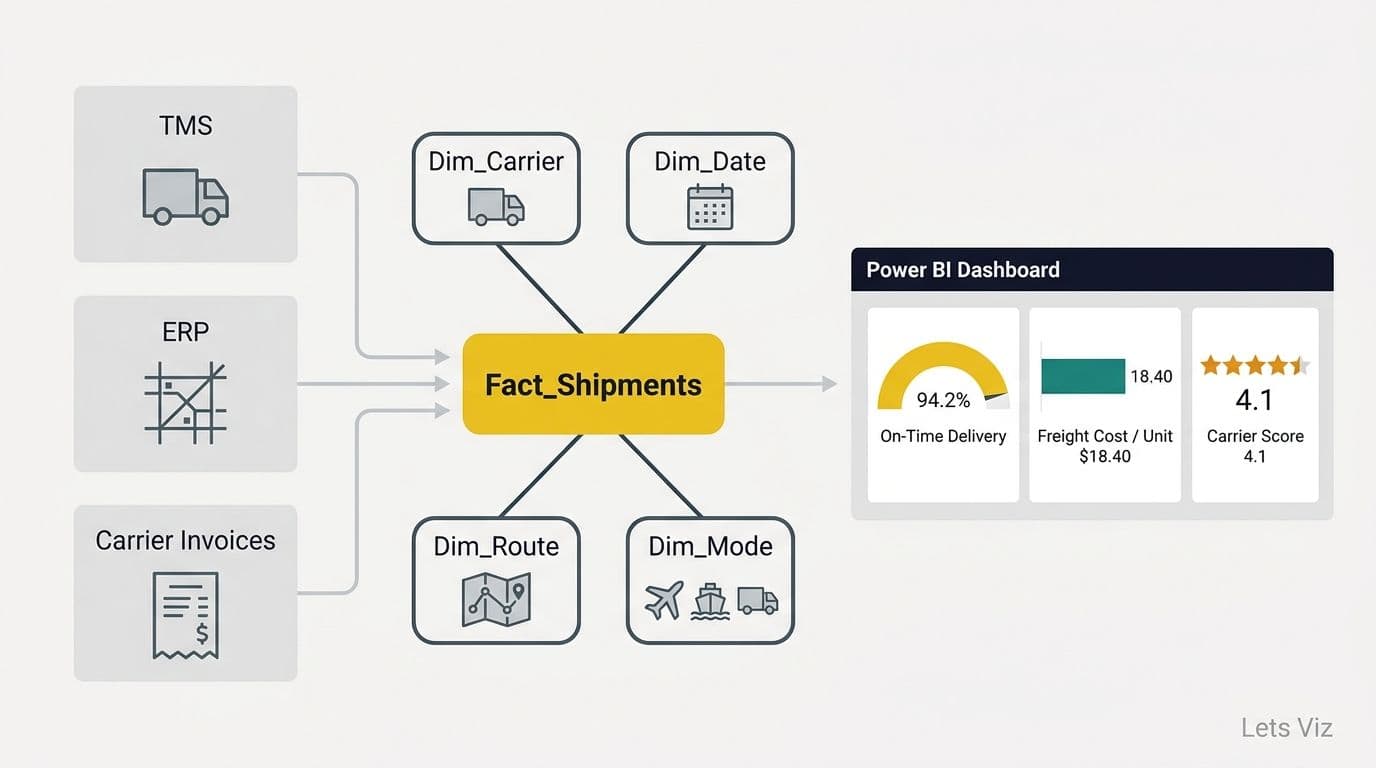
Multiple disconnected data sources requiring custom connectors or complex ETL logic
HIPAA, SOC 2, FCA, or other compliance requirements adding governance and documentation overhead - typically 25-40% additional scope on otherwise comparable projects
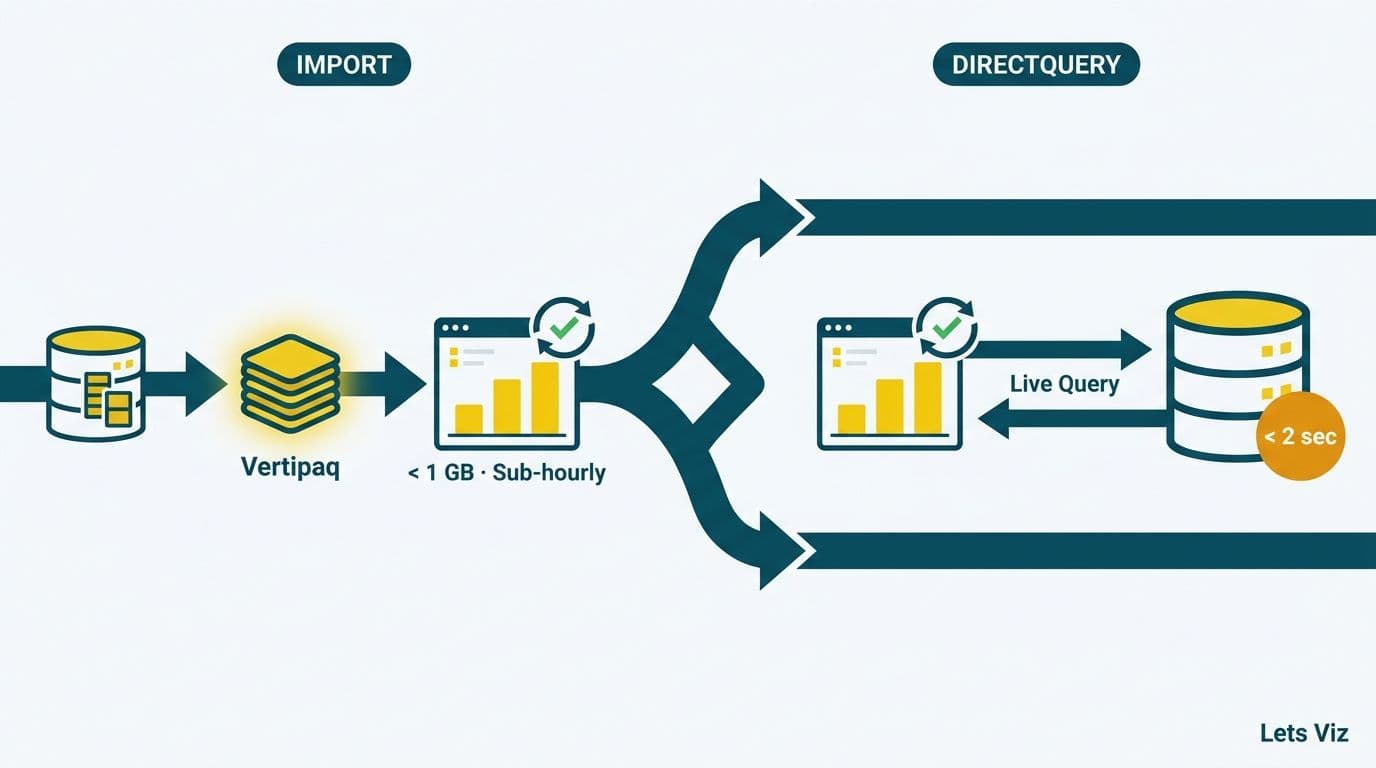
Near-real-time refresh requirements versus scheduled daily or hourly refreshes
Large or fragmented stakeholder groups with conflicting reporting requirements
Power BI as a service dashboard deployments with complex row-level security across multiple business units, geographies, or legal entities
Factors that bring cost down:
A clean, well-documented data warehouse already in a cloud environment
A single primary reporting use case with well-defined stakeholders and stable requirements
A responsive internal data owner who can answer source-system questions quickly
Existing Power BI Premium or Microsoft Fabric licensing already in place, reducing infrastructure setup time
---
If you are ready to see specific tier and scope recommendations for your organization, start with our Managed Power BI services page and book a free 30-minute discovery call. No proposal commitment required - just a clear picture of what your reporting infrastructure should realistically cost.
---
About Lets Viz: Lets Viz has delivered Power BI and analytics solutions for healthcare, finance, SaaS, and agency clients since 2020, earning a 5.0 rating on Clutch. Our team combines data engineering, BI development, and compliance-aware reporting expertise to help mid-market organizations move from spreadsheet-driven workflows to production-grade dashboards - without the overhead and risk of a full-time in-house hire.