Power BI Consultant vs Developer in 2026: Roles, Skills, and Which One You Actually Need

Hiring teams routinely confuse Power BI consultants and Power BI developers. The job titles overlap on LinkedIn, the certifications are similar, and the day-to-day work can look identical from the outside. But they're different roles, with different skill profiles, different price points, and different fit profiles — and getting the choice wrong is the most common reason Power BI engagements deliver the wrong outcome.
This guide draws the line clearly, with 2026 salary and rate ranges for each, and a decision framework for picking which role your project actually needs.
The honest definition of each role
Power BI Developer
A Power BI developer is a builder. Their job is to take a defined specification and ship working dashboards: the visual layer, the DAX measures, the data refresh schedules, the row-level security setup. Strong developers are technically deep — they know DAX optimization, semantic model patterns, Power Query M, and the Power BI Service deployment workflow. They're best when the question is how do we build this, not what should we build.
Typical Power BI developer responsibilities:
- Build dashboards and reports against existing data sources
- Write and optimize DAX measures
- Design and maintain Power BI semantic models
- Configure refresh schedules, gateways, and capacity
- Implement row-level security and workspace governance
- Debug performance issues
Power BI Consultant
A Power BI consultant is a problem-shaper. Their job is to bridge between business goals and Power BI capabilities — they spend less time in Power BI Desktop than a developer does, and more time in conversations with stakeholders, defining what should be built and why. Strong consultants combine technical Power BI knowledge with business-domain literacy (often finance, RevOps, or operations), and their value is upstream of the build: scoping the right project, designing the right semantic model, defining the right KPIs.
Typical Power BI consultant responsibilities:
- Discovery sessions with business stakeholders
- Translate business questions into Power BI specifications
- Define KPIs and metric definitions
- Design overall reporting architecture
- Recommend Power BI vs alternatives (Tableau, Looker, Sigma)
- Coach internal analysts on Power BI best practices
- Sometimes also build dashboards (especially in boutique firms or independent practice)
The honest overlap
In smaller engagements and at boutique firms, the same person plays both roles. An independent specialist building a $10,000 dashboard project is doing both: scoping the work like a consultant, then building it like a developer. The role distinction matters most as the engagement size grows — at $50,000+ projects, the two roles are usually different people.
Side-by-side comparison
| Power BI Developer | Power BI Consultant | |
|---|---|---|
| Primary skill | Technical execution | Business + technical translation |
| Deep skills | DAX, M, semantic model design, performance optimization | KPI definition, stakeholder management, architecture decisions, plus enough DAX to validate |
| Day-to-day work | 80% in Power BI Desktop / Service | 40% in Power BI, 60% in Slack, Zoom, Notion, spreadsheets |
| Best for | Projects with defined specs | Projects without defined specs |
| Independent rate (US, 2026) | $80–$150/hour | $150–$250/hour |
| FTE salary (US, all-in) | $110K–$160K | $140K–$220K |
| Typical certifications | PL-300 Power BI Data Analyst | PL-300 + business background (CPA, MBA, finance / ops experience) |
| Where you find them | LinkedIn, Toptal, Upwork; full-time roles | Boutique BI firms, independent practice, advisory side of GSI partners |
Which one do you actually need?
The honest decision framework, by project type:
You need a developer if:
- You already have clear specs ("here are the 5 dashboards we need, here are the metric definitions, build them")
- You have an internal analyst or finance lead who will own the requirements
- The work is execution-heavy — DAX optimization, performance tuning, model rebuilds
- You're staffing a larger project with a consultant already in the lead role
- You have an existing Power BI environment that needs maintenance and incremental builds
You need a consultant if:
- You're not yet sure exactly what should be built ("we need better reporting" without specifics)
- You need someone to align stakeholders before any building starts
- The project requires non-obvious architecture decisions (Fabric vs Premium, Snowflake vs Azure SQL, dbt vs Power Query)
- You need help defining the right KPIs, not just building visuals
- You're running a transformation that touches process and tooling, not just dashboards
You need both — sequentially or together — if:
- It's a larger project ($30K+ services) with both definition and execution work
- You're doing a full Power BI rollout (consultant for first 4 weeks, developer for next 8)
- You have a strong internal team but need outside expertise for the architectural decisions and the technical depth (consultant strategic + developer-tier execution)
For most 50–200 person SaaS companies hiring outside Power BI help for the first time, you need a consultant who can also build — which is what most boutique firm engagements provide. That's the right answer until project complexity grows enough to justify separating the roles.
The cost difference, explained
Power BI consultants charge more than Power BI developers — typically 50–80% more on hourly, and 25–40% more on FTE salary. The gap is real but the reason is often misunderstood.
The premium isn't because consultants are technically better than developers — many of the strongest Power BI technicians are pure developers, and they get paid less. The premium is because consultants spend most of their billable time on work that isn't visible: discovery calls, stakeholder alignment, scoping decisions, KPI debate. That work has high leverage on outcomes (a wrong KPI definition costs more than slow DAX) but low visibility, and consultant pricing reflects the value of the upstream decisions.
For pricing details across all engagement models, see our Power BI consulting cost guide.
What a "Power BI Analyst" is, and why the title is everywhere
The title "Power BI Analyst" is increasingly common in 2026, and it usually refers to a hybrid role: someone who has the developer's technical skills (DAX, M, model design) and the consultant's domain literacy (finance, RevOps, ops), but operates inside a single function rather than across multiple clients. A Power BI Analyst at a SaaS company typically reports to the CFO or VP RevOps, owns the company's reporting environment end-to-end, and isn't formally a consultant.
From a buyer's perspective, when you see "Power BI Analyst" in a job posting or on LinkedIn, you're usually looking at a developer-plus-domain-knowledge — closer to consultant in capability but priced like a developer. For an internal hire on a SaaS finance team, this is often the right title.
How this maps to our service offerings
Our own services map directly to which role fits which engagement:
- Power BI Consultant service — for project work where you need a consultant who can also build. Fixed-fee scoped engagements. Typically a senior advisor plus a hands-on builder, working as one team.
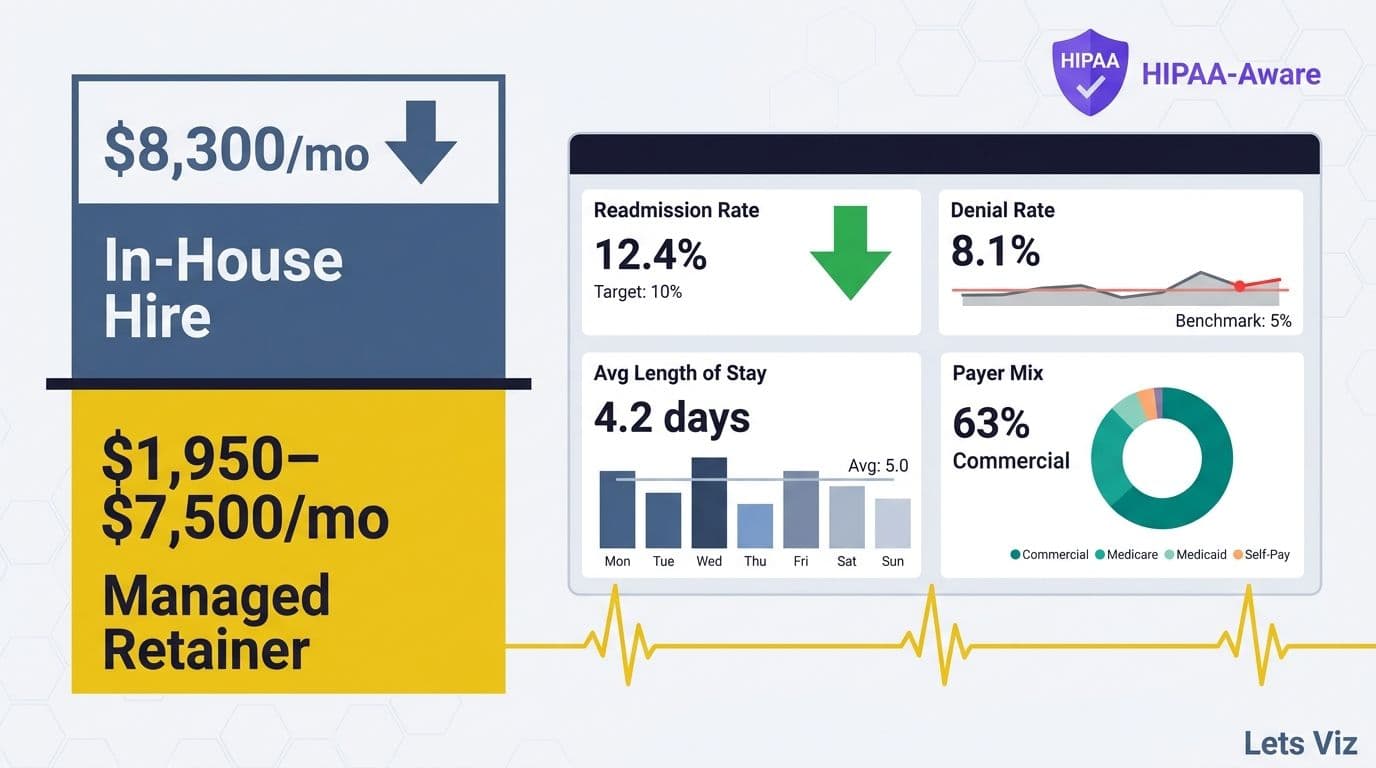
- Managed Power BI retainer — for ongoing function-level work. A named analyst (developer-tier execution) plus a strategic advisor (consultant-tier architecture and KPI definition) on a monthly retainer.
- Tableau to Power BI migration — a hybrid where the consultant role dominates Phase 1 (audit, semantic model design) and the developer role dominates Phases 2-3 (translation, parity testing).
FAQ
Power BI consultant vs developer: what's the actual difference?
A consultant translates business goals into Power BI specifications and architecture decisions. A developer takes those specifications and ships working dashboards. In a small engagement they're often the same person; in larger projects they're typically different people. Pricing reflects this: consultants run $150–$250/hour and $140K–$220K all-in salary; developers run $80–$150/hour and $110K–$160K.
What does a Power BI consultant do all day?
Discovery calls with business stakeholders, translating ambiguous "we need better reporting" requests into specific dashboard scopes, defining the metric definitions that go into those dashboards, designing the overall reporting architecture, recommending or rejecting tool choices (Power BI vs Tableau vs Fabric), and coaching internal analysts. They also build dashboards in smaller engagements but not as a primary activity.
What does a Power BI developer do all day?
Builds and maintains dashboards. Writes and optimizes DAX measures. Designs and refines semantic models. Configures gateways, refresh schedules, capacity sizing, and row-level security. Debugs performance issues. Implements requirements they're handed by consultants, business analysts, or product managers.
Should I hire a Power BI consultant or a Power BI developer?
Hire a consultant if you don't yet have clear specifications for what should be built, or if the architecture decisions are non-obvious. Hire a developer if the specs are clear and you mainly need execution capacity. For most first-time engagements at small to mid-sized companies, hire a "consultant who can also build" from a boutique firm — that hybrid covers both roles cost-effectively.
Is a Power BI developer the same as a BI analyst?
Not quite. A Power BI developer is technically focused on building Power BI assets — they may or may not have deep business-domain knowledge. A BI analyst typically has more domain knowledge (finance, sales operations, supply chain) and may use multiple tools, including Power BI, but their primary value is in interpreting data rather than building reports. The "Power BI Analyst" title sits in the middle and usually means a domain-literate hybrid who builds in Power BI as their primary tool.
What certifications matter for hiring?
The PL-300 (Power BI Data Analyst Associate) is the standard Microsoft certification and is meaningful as a baseline. Beyond that, certifications matter less than portfolio. The strongest Power BI consultants and developers usually have 5+ years of project examples they can walk through, and the certification is just a checkbox. For a senior consultant, look for business credentials (CPA, MBA, prior CFO/VP RevOps experience) more than additional Microsoft certs.
Can a Power BI developer do consulting work?
Sometimes — but typically only in narrow scope, where the business goals are well-understood by the buyer and the developer just needs to translate them into Power BI specs. Asking a pure developer to do open-ended discovery and stakeholder management often produces frustrating results: too much focus on the "how," not enough pushback on the "what."
Power BI consultant vs Power BI architect: any difference?
"Architect" usually implies senior-level consultant focused specifically on enterprise architecture decisions: capacity planning, multi-tenant deployment, integration with Microsoft Fabric and Azure data services, governance frameworks. At smaller companies, a consultant covers this scope; at enterprise scale, the architect title tends to emerge as a separate seniority tier above consultants who do day-to-day project work.
Power BI consultants and Power BI developers solve different parts of the same problem, and the question isn't which is better — it's which one fits your specific need. Most engagements that fail with the wrong type of help would have succeeded with the right one. Picking deliberately between "we need someone to figure out what to build" and "we need someone to build what we've already specified" is the single highest-leverage decision in the entire engagement.
If you're scoping a project and want help deciding which role fits, book a 30-minute call — no pitch, just an honest read on what you actually need, including when the answer is "an internal hire, not us."