How to Hire a Power BI Consultant in 2026: A 7-Question Screening Framework

Most Power BI consulting engagements that fail were doomed at the screening stage. The vendor was good at sales, the buyer didn't know what to ask, and twelve weeks later the dashboards still don't work — except now there's a contract and a sunk cost.
The good news is that the warning signs are predictable. Power BI consultants who ship and Power BI consultants who don't behave very differently in the sales cycle, and a finance leader can tell the difference in a 30-minute call if they know what to listen for. This guide is the 7-question screening framework, four red flags, and engagement-model decision tree we wish more buyers had before signing.
Before you start: be honest about what you actually need
The most expensive screening mistake is misnaming the problem. "We need a Power BI consultant" usually means one of four very different things, and they map to very different consultants:
- "We need someone to fix one specific thing" — a broken DAX measure, a slow report, a single dashboard that needs cleanup. You want an independent specialist on hourly. Don't hire an agency for this; you'll pay 3× and wait 3× longer.
- "We need a defined deliverable by a deadline" — an MVP dashboard, a migration, a board-deck reporting suite. You want a fixed-fee project from a boutique firm or specialist. Don't hire on hourly; you'll absorb all the scope risk.
- "We need Power BI to keep working and evolving" — ongoing dashboards, pipelines, change requests, monthly close automation. You want a managed retainer. Don't hire a series of one-off projects; the institutional memory cost will dwarf the savings.
- "We need to build a Power BI function inside the company" — a long-term capability with internal ownership. You want to hire a full-time Power BI lead, often paired with a short-term advisor. Don't outsource this entirely; you'll never build the institutional knowledge.
If you're not sure which you need, that's a useful conversation to have with two or three consultants before signing anyone — but it should be a free 30-minute call, not the start of a $20,000 engagement. Anyone willing to take 30 minutes to help you scope without selling is already passing the screening.
For pricing details on each engagement model, see our Power BI consulting cost guide.
The 7-question screening framework
Use these questions in the first call. The answers tell you more about whether the engagement will succeed than any portfolio or case study will.
1. "Walk me through how you'd assess our current Power BI environment."
What you're testing: whether they have a methodology, or just enthusiasm. A consultant who has shipped multiple engagements has a structured discovery process — they'll mention specific things they look for (semantic model design, DAX patterns, refresh schedules, RLS configuration, license tier). A consultant who has not will give a generic "we'll review everything and get back to you" answer.
Good signal: "We start with a 90-minute working session covering your data sources, your current model design, and your top three KPIs. Output is a one-page memo with our scoping plan and a fixed quote." Bad signal: "We can definitely help with that, let me put together a proposal."
2. "What does a typical engagement look like, week by week?"
What you're testing: whether they've done this before. A real schedule has specific milestones, specific deliverables, specific go/no-go gates. A vague "8-12 weeks depending on scope" answer means they're guessing.
Good signal: "Week 1 is discovery and signed scope. Weeks 2-3 are model build and the first dashboard. Week 4 is QA and stakeholder sign-off. Weeks 5-8 are bulk delivery. Last week is training and handover." Bad signal: "We'll figure that out together once we get started."
3. "What's gone wrong on past engagements, and how did you handle it?"
What you're testing: intellectual honesty. Every consultant who has shipped 10+ projects has stories about scope creep, broken integrations, stakeholder misalignments — and handled them. A consultant who claims they've never had a problem is either inexperienced or untrustworthy.
Good signal: a specific story about a project that almost went sideways and what they did. Bad signal: "We have a 100% client satisfaction rate" with no examples.
4. "Who specifically will be doing the work, and can I meet them?"
What you're testing: whether the senior person on the call is the same person who will actually build your dashboards. The classic agency bait-and-switch is a senior partner in the sales cycle, then a junior offshore team in delivery. There's nothing wrong with junior team members — they're usually fine — but you need to know that's what you're getting and meet them before signing.
Good signal: "I'll be the strategic advisor. Sarah is the senior analyst on your engagement. Here's her LinkedIn — she'll be on the next call." Bad signal: "We have a team of certified consultants who will be assigned based on availability."
5. "How do you scope changes mid-engagement?"
What you're testing: whether they have a real change-order process, or whether the contract is built to absorb scope creep without your visibility. A real consultant will explain their change-order process before you ask. A bad sign is "we just keep working until it's done" — that's how a $20,000 project becomes a $60,000 invoice.
Good signal: "Scope changes go through a written change order with revised cost and timeline before we touch them. You sign, then we work." Bad signal: "We're flexible on scope — happy to make whatever changes you need."
6. "What's the handover process at the end of the engagement?"
What you're testing: whether they're building you a dependency or capability. A good consultant ships dashboards your team can maintain, with documented DAX, named conventions, and trained internal users. A bad consultant ships dashboards only they understand, ensuring you'll need them again next quarter.
Good signal: "Handover includes a documented model, a training session for your analysts, and a 30-day support window for follow-up questions." Bad signal: evasion or "we're available for ongoing support" with no specifics.
7. "Who can I talk to who has worked with you on a similar project?"
What you're testing: whether their references are real, recent, and relevant. Anyone can curate a marketing page; not everyone can put you on a 15-minute call with a finance lead who hired them last year. Ask for two references in your industry or at your company size, and actually call them.
Good signal: "Here are three names. I'll connect you over email — you can ask them anything." Bad signal: testimonials on the website but no live references on offer.
Four red flags that should end the call
Red flag 1: They quote without asking about your data sources
A Power BI engagement priced before the consultant has seen your data stack is priced for the wrong reality. Most cost variance comes from data integration, not dashboards. A vendor who quotes $25,000 in the first call without knowing whether you're on Snowflake or raw Salesforce APIs is either guessing or planning to use change orders to find the real cost later.
Red flag 2: They promise specific dashboards before discovery
"We'll deliver a financial dashboard, a sales dashboard, and an operations dashboard" — said before they've understood your KPIs, your business model, or your reporting cadence — is a sign of a templated agency that will deliver templates. The dashboards may technically work; they won't answer your specific questions.
Red flag 3: The senior person doing the sales call won't be on the project
Already covered in question 4. The bait-and-switch is the single most common reason buyers feel "the consultant we hired isn't the consultant we got." Insist on meeting the actual delivery team before signing.
Red flag 4: They can't articulate when they'd say no to your project
Ask: "Under what circumstances would you tell us you're not the right fit?" A consultant who can't answer this — who says they could help anyone with anything — is selling, not consulting. Real specialists have a clear ICP and will tell you when you're outside it.
Independent specialist vs boutique firm vs large agency
Three structurally different vendor types, three different fits.
| Independent specialist | Boutique BI firm | Large agency / GSI | |
|---|---|---|---|
| Typical hourly | $100–$200 | $150–$250 blended | $200–$400 blended |
| Project size sweet spot | Under $20K | $15K–$150K | $100K+ |
| Speed | Fastest | Fast | Slowest (process-heavy) |
| Risk profile | Single point of failure | Small team, redundancy | Bench depth, but turnover |
| Best for | Specific fixes, small builds | Most mid-market projects | Enterprise transformations |
For most 50–500 person companies hiring a Power BI consultant for the first time, a boutique firm is the right answer. Independent specialists are great for known-scope work but have key-person risk; large agencies have structural overhead that doesn't pay back unless you're a $1B+ enterprise with regulatory complexity.
Special case: hiring help for SaaS finance specifically
If you're a SaaS CFO, VP RevOps, or Head of FP&A hiring a Power BI consultant, the screening is slightly different. Generic Power BI experience is necessary but not sufficient. The questions that filter most heavily for SaaS finance:
- "What's the difference between contracted ARR, invoiced ARR, and GAAP revenue, and which would you use for our board deck?" A consultant who can't answer this in 30 seconds shouldn't be building your finance dashboards.
- "How would you reconcile MRR between Stripe, Salesforce, and NetSuite?" The right answer involves a semantic model with explicit ARR walks, not "we'll just match the Stripe number."
- "Have you built NRR cohort analysis at customer-level granularity before?" If yes, ask for an example. If no, factor in the learning curve.
For more on the SaaS finance fit specifically, see our Power BI for SaaS Finance page — same screening principles, but with a pre-configured SaaS metrics model that doesn't require the consultant to invent definitions for ARR, NRR, CAC payback, and runway from scratch.
What we charge and how we work
For full transparency on our own pricing and engagement structure:
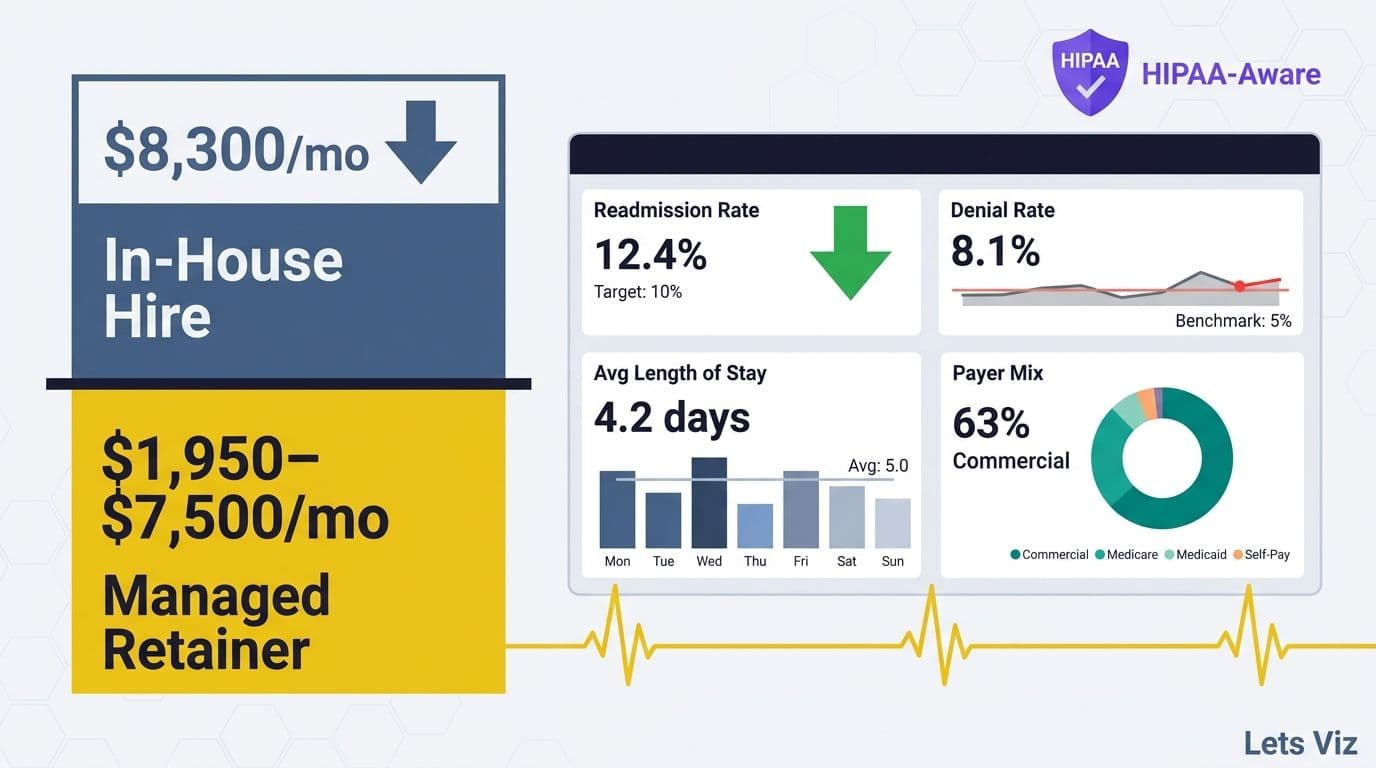
- Managed Power BI retainer from $5,000/month (100 hrs) or $8,000/month (160 hrs) — for ongoing function-level Power BI ownership. Industry-standard pricing for the same scope is $8,000+/month.
- Tableau to Power BI migration fixed-fee, typically $25K–$110K — for time-bound migrations with KPI parity guaranteed
- Power BI Consultant service fixed-fee — for one-off scoped projects
- Discovery call — free, 30 minutes, no pitch
FAQ
Should I hire an independent Power BI consultant or an agency?
Independent specialists are best for narrowly-scoped tasks under $20,000 — quick fixes, single-dashboard builds, code reviews. Boutique BI firms are the right choice for most mid-market projects ($15K–$150K), where you need a small team's redundancy but not a large agency's overhead. Large agencies (Big 4, Microsoft GSI partners) make sense only at enterprise scale where you need bench depth and formal governance.
How do I check if a Power BI consultant is qualified?
Beyond the 7 questions above: ask for Microsoft Power BI certification (PL-300 is the common one); ask to see a stripped-down version of a past project (a portfolio without sensitive client data); insist on a 15-minute call with two recent clients in your industry. Skip the certification if the consultant has a strong portfolio — many of the best Power BI specialists never bothered with the cert because their work speaks for itself.
What questions should I ask a Power BI consultant in an interview?
Use the 7 in this guide — discovery methodology, week-by-week schedule, past project failures, who's actually doing the work, change-order process, handover process, and live references. If you have time for two more: "How do you handle data security and RLS?" and "What does a successful engagement look like to you, in your own words?"
How long does it take to hire a Power BI consultant?
From first vendor call to signed contract typically 2-4 weeks for a fixed-fee project, 4-6 weeks for a retainer relationship. Expect to evaluate 3-5 vendors. Skipping evaluation to "save time" is a false economy — the wrong consultant costs more weeks downstream than the screening saves upfront.
Do I need a Power BI consultant if I have an internal data team?
Often yes — for the work your internal team isn't best-positioned to do. Internal analysts are usually best on domain-specific analysis (pricing experiments, churn deep-dives) where business context matters most. External consultants are usually best on undifferentiated foundation work (semantic model, integrations, governance setup) where pattern recognition from many engagements pays back. The two roles complement, not compete.
Power BI freelancer vs agency: which is cheaper?
Freelancers are cheaper on hourly rates ($80–$150 vs $150–$250 blended) but more expensive on total project cost when scope creeps, because there's no project-management buffer. Agencies are more expensive hourly but typically deliver predictable total cost on fixed-fee work. For under-$15K work, a freelancer almost always wins on price. Above $25K, an agency or boutique firm usually wins on predictability.
Should I hire offshore Power BI consultants to save money?
It depends on the work. Offshore teams ($40-$90/hour) are cost-effective for well-scoped tasks where the data model is already designed and the requirements are crystal clear — pure visual building, dashboard cloning, simple report formatting. Offshore typically struggles with foundation work (semantic model design, business-domain reasoning, KPI definition) where the cost of getting it wrong compounds. The right offshore engagement is a clearly-scoped delivery contract, not "build us some dashboards."
Hiring a Power BI consultant well isn't about finding the cheapest vendor or the one with the most certifications. It's about understanding which engagement model fits the work, asking questions that reveal whether the vendor has actually done it before, and refusing to skip the live-reference call.
If you're scoping an engagement and want a no-pitch second opinion on the right fit, book a 30-minute call — we'll walk through your situation and tell you honestly whether we're the right partner, including when the answer is "you don't need us, here are three other firms to talk to."