Healthcare BI Vendor Evaluation Checklist for IT Directors
A healthcare BI vendor evaluation checklist gives IT directors a structured scoring framework to compare platforms across compliance, integration, cost, and support before signing a contract. Scored against HIPAA, GDPR, and PIPEDA requirements, EHR connector depth, multi-year licensing TCO, and managed-service SLA terms, a weighted scorecard reduces selection risk and prevents costly renegotiation after deployment.
Key Takeaways
Score vendors across five domains: regulatory compliance, EHR integration depth, security architecture, licensing TCO, and managed-service SLA terms.
HIPAA Business Associate Agreements, GDPR Article 28 Data Processing Agreements, and PIPEDA consent frameworks must each be evaluated independently - conflating them creates compliance gaps that audits will surface.
EHR integration depth - native connectors versus HL7 FHIR R4 API versus custom ETL - directly affects implementation timeline and long-term maintenance burden.
Three-year licensing TCO often diverges sharply from headline per-seat pricing once connector fees, premium support, and renewal escalation clauses are modeled.
Managed-service SLA terms including incident response times and audit log retention are negotiable - establish your minimums before vendor demonstrations begin.
Lets Viz provides Power BI consulting for mid-market and enterprise teams across the US, UK, and Canada -- from initial model design to ongoing optimisation.
What Should a Healthcare BI Vendor Evaluation Checklist Cover?
A complete checklist spans five scoring domains: regulatory compliance, EHR and data integration, security architecture, licensing total cost of ownership, and managed-service SLA terms. Most failed BI selections collapse at one of two points - a compliance gap discovered post-implementation or a licensing cost shock at the year-two renewal.
Before vendor demonstrations begin, use the Instant project cost calculator to establish a budget envelope across platform, integration, and managed-service layers. That baseline prevents headline pricing from anchoring the evaluation before the full cost picture is understood.
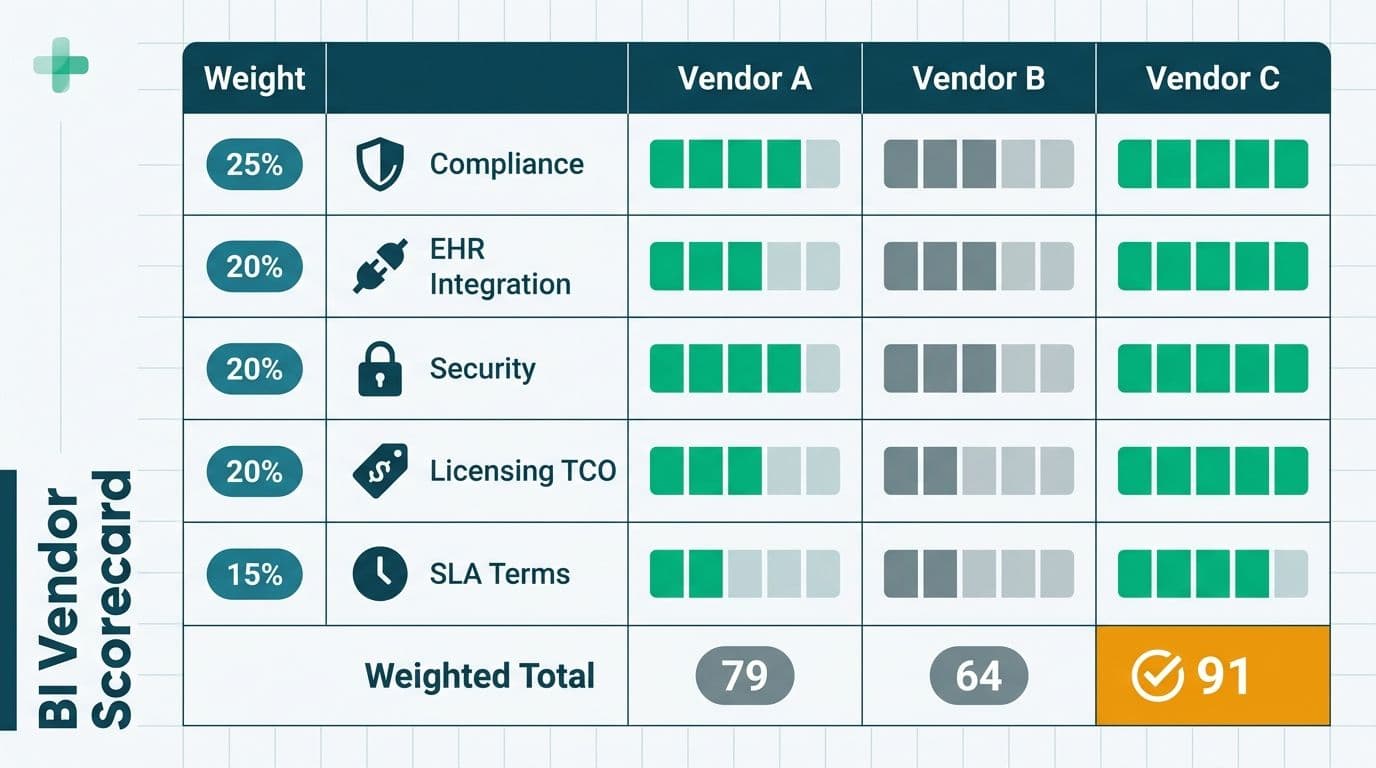
Assign a percentage weight to each domain based on your organization's risk profile, then score each shortlisted vendor on a 1-5 scale within each domain. The weighted total produces a defensible, auditable selection rationale that procurement and legal can review without reconstructing the underlying logic.
Five-Domain Scoring Matrix
| Domain | Suggested Weight | What to Score |
|---|---|---|
| Regulatory Compliance | 30% | BAA/DPA availability, audit logs, data residency options |
| EHR Integration Depth | 25% | Native connectors, FHIR R4 support, HL7 pipeline |
| Security Architecture | 20% | Encryption at rest and in transit, MFA, role-based access |
| Licensing TCO (3-year) | 15% | Per-seat vs. capacity pricing, overage penalties, renewal escalation |
| Managed-Service SLA | 10% | Uptime SLA, incident response time, support tier coverage |
Organizations with complex multi-jurisdiction exposure - a US health system with Canadian affiliates subject to both HIPAA and PIPEDA, for instance - should consider weighting compliance at 35% and reducing the TCO weight accordingly. Healthcare CFO stakeholders should define required KPIs early in the process: cost per patient day, revenue cycle days outstanding, and operating margin by service line shape the integration and reporting requirements vendors must meet.
How Do You Score HIPAA, GDPR, and PIPEDA Compliance in the Healthcare BI Vendor Evaluation Checklist?
Score compliance by requesting specific contractual documents, not vendor presentation slides. A vendor claiming HIPAA readiness must provide a signed Business Associate Agreement before any protected health information touches their platform. UK and EU organizations require a Data Processing Agreement under GDPR Article 28. Canadian organizations subject to PIPEDA need explicit consent frameworks and documented breach notification timelines written into the contract.
For a detailed look at how these three frameworks interact within healthcare IT platforms, ServiceNow ITSM for Healthcare IT Teams: HIPAA, GDPR and PIPEDA covers the cross-jurisdictional compliance architecture in depth.
HIPAA scoring guide (US organizations):
5 points: Signed BAA available pre-contract; PHI encryption at rest and in transit documented; audit logs exportable on demand; breach notification SLA under 60 days; subcontractor BAA chain disclosed
3 points: BAA available but requires extended legal review; partial audit log access; encryption partially documented
1 point: No BAA offered; vendor defers compliance responsibility entirely to customer configuration
GDPR scoring guide (UK and EU organizations):
5 points: Article 28 DPA available; data residency within UK or EU selectable at the standard tier; sub-processor list published and updated quarterly; Data Protection Officer contact provided
3 points: DPA available with negotiation; EU data residency on premium tier only; sub-processor list available on request with delay
1 point: No DPA available; no EU or UK data residency option; generic privacy policy substituted for a DPA
PIPEDA scoring guide (Canadian organizations):
5 points: Consent management framework documented; breach notification as soon as feasible, as PIPEDA requires; Canadian data residency available; accountability officer named in the contract
3 points: Consent frameworks configurable but not pre-built; breach timeline unclear; US-based residency with contractual protections
1 point: No PIPEDA-specific documentation; no Canadian data residency option; breach notification not addressed
A UK NHS trust evaluating a BI platform needs GDPR Article 28 compliance plus NHS Data Security and Protection Toolkit alignment - two separate compliance tests that vendors frequently conflate into a single claim. A US academic medical center needs its BAA to explicitly cover BI workloads, not just the primary SaaS service. A Canadian provincial health authority should verify breach notification timelines and data residency options independently of any umbrella cloud provider agreement.
After scoring, verify vendor compliance claims through reference checks with organizations in the same regulatory jurisdiction. Ask specifically: "Has your BAA or DPA been tested in an actual audit or incident?" and "Can you share a redacted example of your subcontractor disclosure?" Vendors that have operated in healthcare for multiple years typically have these answers ready. New market entrants pivoting from less regulated industries often treat compliance as a checkbox rather than an operational capability.
Any vendor scoring below 3 in the compliance domain should be treated as a disqualifying condition regardless of integration depth or pricing advantages.
What EHR Integration Depth Should the Evaluation Require?
EHR integration depth determines how much custom engineering your team absorbs after contract signature. Score vendors on three tiers: native certified connectors to the EHR platforms your organization runs, support for HL7 FHIR R4 APIs, and fallback ETL pipeline options. A vendor with certified connectors to the major EHR platforms reduces implementation time materially compared to one offering only generic database or flat-file connectors.
For a detailed breakdown of what EHR integration adds to implementation costs, the Power BI Healthcare Reporting implementation cost guide covers the cost components from connector licensing through ongoing maintenance.
Integration scoring criteria:
Native certified EHR connectors: 5 points for certified connectors covering the specific platforms your organization operates; 3 for community-supported connectors with documented vendor support; 1 for manual export-only workflows requiring an internal ETL build
HL7 FHIR R4 compliance: 5 points for native FHIR R4 resource support with documented resource coverage; 3 for FHIR R2 or R3 with a published upgrade path; 1 for no FHIR support
Data refresh cadence: 5 points for sub-hour incremental refresh supporting near-real-time clinical dashboards; 3 for daily batch sufficient for operational reporting; 1 for manual extract-load only
Write-back capability: 5 points if bidirectional write-back is supported and documented; mark not applicable if your workflow does not require it
Integration depth also shapes long-term AI reporting automation potential. The AI reporting automation build-versus-buy question - whether to assemble automation components internally or procure a managed AI reporting layer from the vendor - depends entirely on the underlying data architecture. Vendors with robust FHIR R4 pipelines position your organization to automate operational dashboards covering patient throughput, bed utilization, and readmission flags without rebuilding the data layer when intelligent alerting is added downstream.
How Do You Compare Licensing TCO Across BI Vendors?
Headline per-seat pricing rarely reflects the three-year total cost of ownership a healthcare IT director should model before committing. Factor in platform licensing, EHR connector fees, premium support tier costs, implementation services, end-user training, and storage overage charges. A platform with a lower headline price but expensive add-on connectors can cost significantly more over 36 months than a higher-priced platform with integrations bundled.
The managed-service TCO calculation adds another layer: How to Evaluate a Power BI Managed Service Provider walks through how ongoing managed-service fees interact with platform licensing costs across the full contract term.
Three-year TCO modeling checklist:
Base platform license - per seat, per capacity unit, or consumption-based pricing model
EHR connector licensing - native connectors bundled versus third-party middleware markup
Premium support tier - standard support rarely meets healthcare incident response requirements
Implementation and onboarding professional services - scoped separately per vendor
Training - clinical users, administrative users, and IT administrators priced separately
Storage and compute overage at projected data volumes, modeled at twice current volume to capture growth
Annual renewal escalation clauses - commonly 5 to 10 percent, sometimes CPI-linked
Suppose a 200-seat US health system evaluates two vendors. Vendor A quotes $40 per seat per month; Vendor B quotes $55. At month one, Vendor A appears less expensive. But Vendor A charges separately for EHR connectors, HIPAA-compliant storage, and premium support. Vendor B bundles all three. By month 18, total cumulative cost has often reversed. This hypothetical illustrates why headline comparisons mislead without a full cost model across the complete stack.
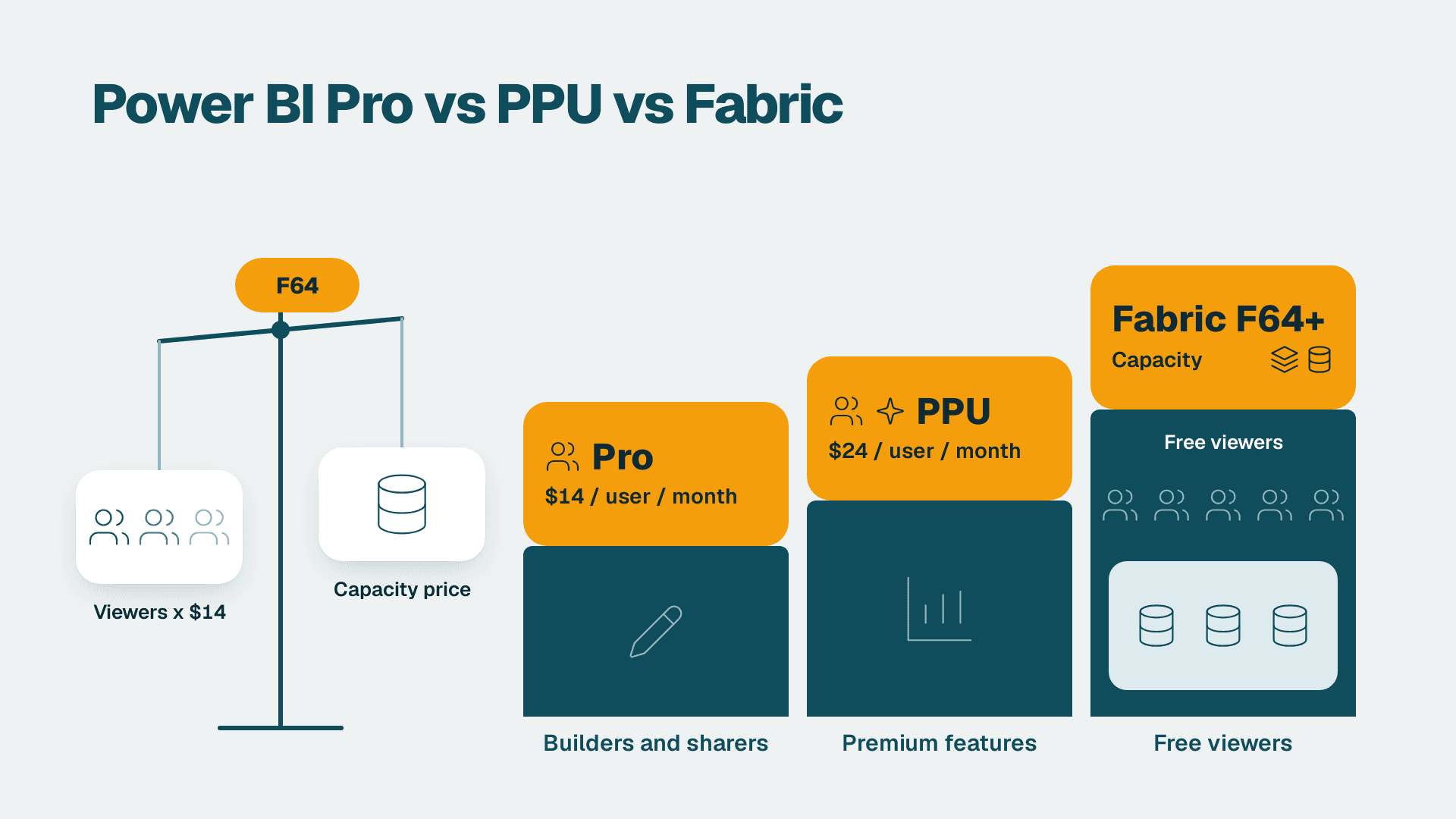
When evaluating platforms at the lower end of the pricing spectrum - including free-tier analytics tools - note that healthcare-grade security controls and enterprise connectors typically require a paid enterprise license. Free-tier Looker Studio pricing, for example, excludes the audit logging, granular access controls, and data governance features that HIPAA and GDPR compliance demands. Google Looker Studio pricing at the enterprise level restores those controls, but the comparison belongs inside the same 36-month TCO model applied to all shortlisted platforms.
What Managed-Service SLA Terms Matter Most for Healthcare IT?
Managed-service SLAs for healthcare BI should specify uptime commitments, incident response times stratified by severity, audit log retention periods, and planned maintenance windows. A 99.9 percent uptime SLA allows approximately 8.7 hours of downtime per year - adequate for back-office reporting but potentially disruptive if clinical operational dashboards are in scope.
For teams establishing governance controls alongside managed-service terms, Power BI Governance Best Practices: 12-Point Checklist identifies the internal controls that underpin a reliable managed engagement.
Key SLA terms to negotiate:
| SLA Term | Minimum Acceptable | Best Practice Target |
|---|---|---|
| Platform uptime | 99.5% | 99.9% with service credits |
| Severity-1 incident response | 4 hours | 1 hour |
| Audit log retention | 90 days | 12 months |
| Planned maintenance window | Weekly | Monthly with 72-hour advance notice |
| Data breach notification | 72 hours | 24 hours |
| Healthcare support coverage | Business hours | 24/7 with named contact |
Vendors offering managed BI services must also clarify who holds the BAA in a shared-responsibility model. In some arrangements, the platform vendor holds the BAA and the managed-service provider does not, leaving a gap that surfaces only during a compliance audit. Request the complete contractual BAA chain in writing before procurement approves any engagement.
How Do You Build and Present the Final Scoring Card?
A defensible scoring card consolidates weighted domain scores into a single comparison view that procurement, legal, and clinical informatics stakeholders can review without vendor bias shaping the outcome. Limit shortlisted vendors to three - beyond three, evaluation fatigue degrades scoring consistency across reviewers.
Assembling the final scorecard:
1. Complete all domain scores for each shortlisted vendor using the criteria above
2. Apply domain weights to produce a weighted score for each vendor
3. Normalize TCO models to a common 36-month baseline in a single currency
4. Treat any vendor scoring below 3 in the compliance domain as automatically disqualified
5. Present weighted totals alongside 36-month TCO and a brief rationale for each score to the selection committee
After the scoring card is presented, run structured reference checks with two to three organizations currently on each shortlisted platform. Frame questions around the same five domains: "How did the BAA process work in an actual audit?" and "What did the EHR connector implementation timeline look like versus what was quoted?" Reference checks consistently surface integration gaps and SLA weaknesses that vendor demonstrations obscure.
A typical selection cycle runs eight to twelve weeks: two weeks for RFI distribution and vendor responses, two weeks for scored demonstrations, two weeks for reference checks and legal review, and two to four weeks for final TCO modeling and committee approval.
---
About Lets Viz: Lets Viz is a data analytics consultancy serving US healthcare organizations, UK fintech firms, Canadian manufacturing companies, and global SaaS teams since 2020. With a 5.0 Clutch rating, the team specializes in BI platform selection, implementation, and ongoing managed analytics services across regulated industries where compliance and data integrity are non-negotiable.
If you are scoping a healthcare BI vendor evaluation or planning a platform replacement, the Instant project cost calculator can model platform, integration, and managed-service costs before your first vendor negotiation.