Healthcare Analytics Compliance: HIPAA, GDPR, and PIPEDA Compared
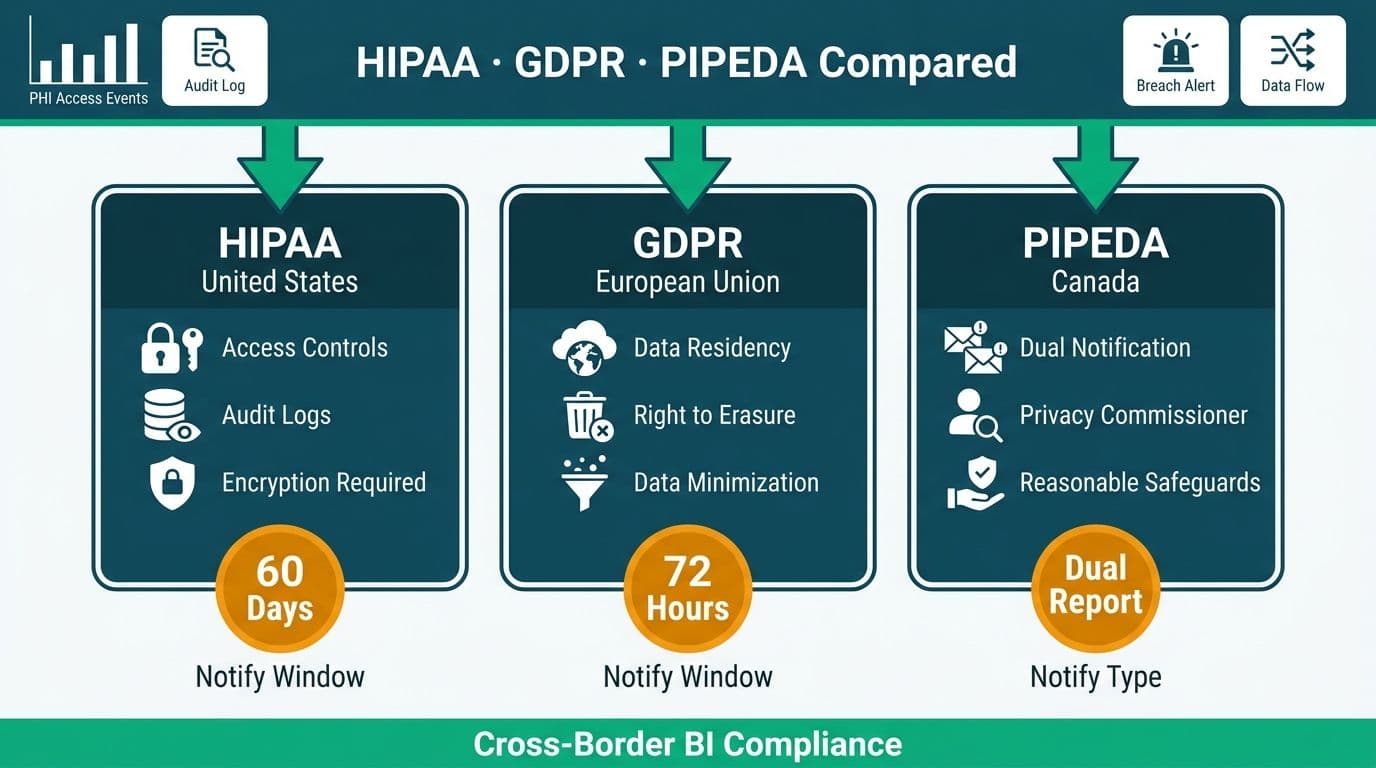
HIPAA, GDPR, and PIPEDA each impose different technical obligations on healthcare BI architectures. HIPAA requires audit controls and 60-day breach notification for US covered entities; GDPR mandates 72-hour reporting and EEA data residency; PIPEDA requires dual notification to Canada's Privacy Commissioner and affected individuals. Cross-border health systems must satisfy all three frameworks within a single BI deployment.
Key Takeaways
HIPAA's technical safeguards - access controls, audit logs, and encrypted transmission - are the compliance floor for any US healthcare BI deployment.
GDPR's 72-hour breach notification window and data residency requirements exceed HIPAA's and affect US organizations with EU affiliates or research partnerships.
PIPEDA and provincial health privacy laws govern Canadian private healthcare organizations, imposing dual breach-notification obligations to regulators and individuals.
Power BI row-level security, Microsoft Purview audit logging, and correct Azure region selection are the three configuration decisions that drive compliance across all three frameworks.
Healthcare IT leaders should map patient data flows to each applicable regulation before selecting a BI deployment model or cloud region.
What Does HIPAA Demand from a Healthcare BI Architecture?
HIPAA's Security Rule requires covered entities and business associates to implement four categories of technical safeguards: access controls, audit controls, integrity controls, and transmission security. For a BI platform this translates into auditable dashboards with role-based access, encrypted data pipelines, and retained activity logs producible during an HHS investigation.
For a US hospital deploying Power BI, compliance starts with a Business Associate Agreement (BAA) with Microsoft - available under Microsoft 365 E3, E5, and Fabric subscriptions. Without a signed BAA, no ePHI should enter the Power BI Service. Once the BAA is in place, the architecture must enforce power bi row level security for healthcare data at the semantic model layer - not just the report layer - ensuring a billing manager cannot access clinical records and a ward nurse cannot view executive financial dashboards.
Power BI healthcare dashboard templates built for HIPAA-regulated environments should include pre-configured RLS roles, automatic session timeout, and export restrictions that prevent downloading raw patient-level data to uncontrolled endpoints.
Key HIPAA technical requirements for a BI architecture:
Access controls: Role-based access enforced at the dataset level, not the report
Audit controls: Full activity logs retained via Microsoft Purview Audit for every ePHI access event
Transmission security: TLS 1.2 minimum for all data in transit
Breach notification: HHS and affected individuals notified within 60 days of discovery; 500-plus-individual breaches also require public media notice
Our Managed Power BI for healthcare teams service handles BAA management, RLS configuration, and audit log retention so internal IT teams focus on clinical insights rather than compliance infrastructure. For a detailed mapping of Power BI settings to each Security Rule safeguard, see the HIPAA-Compliant Analytics Dashboard: Best Practices Checklist.
How Does GDPR Apply to Healthcare Analytics for UK and EU Organizations?
GDPR classifies health data as a special category under Article 9, requiring explicit legal basis for processing - typically explicit consent or substantial public interest for healthcare providers. For a UK NHS trust or a European hospital group running Power BI on patient outcome data, GDPR creates two obligations that materially exceed HIPAA's: strict data residency controls and a faster breach notification window.
Data residency under GDPR means personal data cannot be transferred outside the EEA without adequate safeguards - Standard Contractual Clauses, adequacy decisions, or Binding Corporate Rules. For Power BI this requires selecting EU data center regions in Azure and confirming that Microsoft's Data Processing Addendum (DPA) covers the specific workloads in use. US health systems with UK or EU research partnerships must assess whether those cross-border data flows trigger GDPR obligations even when headquartered in the US.
Breach notification under GDPR is substantially faster than HIPAA: supervisory authorities must be notified within 72 hours of discovery, and affected individuals notified without undue delay when the breach poses high risk. A UK NHS trust that discovers an overshared Power BI report has exposed identifiable patient records must start the notification clock immediately on discovery - not after investigation concludes.
GDPR also introduces the right to erasure under Article 17 - a challenge for BI systems using Power BI Import mode. Deleting a record from the source EHR does not automatically remove it from a cached imported dataset until the next full refresh. Healthcare analytics teams need a documented deletion workflow that propagates through the entire pipeline and can be demonstrated to a supervisory authority. For GDPR-regulated workloads where Article 17 erasure requests are likely, DirectQuery mode is architecturally preferable: because DirectQuery queries the source system live on every report load, a deletion in the EHR propagates immediately without waiting for a scheduled refresh - eliminating the window during which a deleted record may still surface in BI output.
Any US health system with EU research partnerships, clinical trial participants from EU member states, or telemedicine services offered to EU patients should assess whether GDPR applies to those data flows. GDPR's extraterritorial reach is frequently underestimated by US-headquartered organizations.
What Does PIPEDA Require for Canadian Healthcare Analytics?
Canada's Personal Information Protection and Electronic Documents Act (PIPEDA) governs private-sector organizations nationally, with provincial equivalents in Alberta, British Columbia, and Quebec. Quebec's Law 25 (fully in force September 2023) is the most materially demanding of the three: it requires a privacy impact assessment (PIA) before deploying any new technology that processes personal information, mandates appointment of a named Privacy Officer, and imposes a 72-hour breach notification window to Quebec's Commission d'accès à l'information - matching GDPR's speed rather than PIPEDA's more permissive "as soon as feasible" standard. Any analytics deployment serving Quebec patients or processed by a Quebec-based entity must be evaluated against Law 25 in addition to base PIPEDA. Public hospitals in Ontario fall under PHIPA, which adds sector-specific obligations for health information custodians and effectively requires personal health information remain within Canada or be subject to comparable protection.
For a Canadian private health clinic or health-technology company running analytics on patient data, PIPEDA imposes five principles with direct BI architecture implications:
Accountability: A named privacy officer responsible for PIPEDA compliance and breach response
Limiting collection: Only collect data necessary for the identified analytical purpose - arguing against wide data lake ingestion without a clear use case
Retention and disposal: Data must be destroyed or anonymized once its purpose is fulfilled, challenging historical BI datasets that retain patient-level detail indefinitely
Accuracy: Data must be current and accurate upstream of BI dashboards, requiring validated pipelines
Breach notification: Report breaches creating a real risk of significant harm to both the Privacy Commissioner of Canada and affected individuals as soon as feasible - a dual-reporting obligation
Canadian providers accelerating toward advanced analytics face a PIPEDA-specific tension: the purpose-limitation principle constrains how broadly existing patient data can be repurposed for population health management without fresh patient consent.
Data residency is not mandated federally under PIPEDA, but Ontario's PHIPA effectively requires it for personal health information held by health information custodians. Canadian healthcare organizations should confirm with legal counsel whether provincial law applies before selecting an Azure region.
Healthcare Analytics Compliance: HIPAA, GDPR, and PIPEDA Compared Side by Side
The table below maps each regulation's key requirements for a healthcare BI architecture. IT leaders evaluating platforms across jurisdictions can use this as a pre-architectural checklist.
| Requirement | HIPAA (US) | GDPR (UK/EU) | PIPEDA (Canada) |
|---|---|---|---|
| **Data classification** | ePHI (electronic protected health information) | Special category personal data (Article 9) | Personal information about identifiable individuals |
| **Legal basis for processing** | TPO (Treatment, Payment, Operations) | Explicit consent or substantial public interest | Knowledge and consent, with healthcare exceptions |
| **Data residency** | No geographic restriction specified | EEA or adequate safeguards required | No federal mandate; provincial laws may restrict |
| **Retention limits** | 6 years for HIPAA documentation records | No longer than necessary for stated purpose | As long as necessary for identified purpose |
| **Access logging** | Required - unique user ID and audit trail | Required - Records of Processing Activities | Required under accountability principle |
| **Breach notification - regulator** | HHS within 60 days (500+ individuals) | Supervisory authority within 72 hours | Privacy Commissioner as soon as feasible |
| **Breach notification - individuals** | Without unreasonable delay | Without undue delay if high risk | As soon as feasible if real risk of harm |
| **Right to erasure** | Not applicable; covered entities must retain | Article 17 applies; complex for Import mode | Not a strict right; disposal on purpose fulfillment |
| **Vendor agreement** | Business Associate Agreement (BAA) | Data Processing Agreement (DPA) | Accountability provisions in service agreements |
| **Maximum penalty** | Up to $1.9M per violation category per year | Up to 4% global annual revenue or 20M euros | Up to CAD $100,000 per violation |
For a structured framework to audit data flows before a BI deployment goes live, the AI Analytics Data Privacy Risks: Healthcare Audit Guide covers HIPAA, GDPR, and PIPEDA risk vectors in AI-assisted analytics environments.
What Should a Finance and Healthcare Analytics Data Governance Checklist Include?
Organizations whose analytics scope spans both patient data and financial reporting - integrated delivery networks, publicly listed hospital groups, health insurance companies, and health-tech firms - must satisfy a two-stack governance requirement. The finance analytics data governance checklist for these organizations must address HIPAA and SOX simultaneously in the US, GDPR for UK and EU operations, and PIPEDA for Canadian entities. Each framework imposes distinct controls on who can access data, how long it must be retained, and what audit evidence must be producible on demand.
The checklists below are structured for pre-deployment review and annual audit cycles. Each item should be assigned to a named owner before a BI deployment goes live.
United States - HIPAA and SOX
Business Associate Agreement signed with every cloud vendor processing ePHI
Power BI row-level security enforced at the semantic model layer; role assignments documented and reviewed quarterly
Microsoft Purview Audit enabled from deployment day one; logs retained for a minimum of one year
SOX Section 404 internal controls documented for every financial data pipeline feeding executive or board-level dashboards: data source, transformation logic, access rights, and change management history
Segregation of duties enforced between users who can modify financial data models and users who certify financial output
Data lineage documented from source system to published report for any metric cited in financial statements
Breach response procedure tested; HHS 60-day notification workflow assigned to named individuals
United Kingdom and European Union - GDPR
Data Processing Agreement in place with Microsoft; EU data center region selected for identifiable health and financial personal data
Records of Processing Activities maintained under Article 30 for every analytical use case
Legal basis for processing documented per use case: explicit consent or substantial public interest for health data; legitimate interests assessment for financial analytics
Data Subject Access Request and right-to-erasure workflows tested against the full BI pipeline, including cached Import mode datasets
DirectQuery mode evaluated where Article 17 erasure requests are operationally likely
72-hour supervisory authority notification workflow documented, with a named data protection officer or deputy assigned
Canada - PIPEDA, Law 25, and PHIPA
Named Privacy Officer designated and documented
Privacy Impact Assessment completed before deploying any new analytics technology processing personal information of Quebec residents
Dual breach notification procedure documented: Privacy Commissioner of Canada plus affected individuals; 72-hour window for Quebec-origin breaches under Law 25
Azure Canada Central or Canada East region confirmed for workloads subject to Ontario's PHIPA
Purpose limitation documented per dataset; secondary analytics use cases reviewed against original collection purpose before deployment
Cross-Jurisdiction Controls (apply in all three)
Data flow map completed: origin system, processing location, storage region, and applicable regulation for every dataset in scope
Audit log completeness verified across the full data pipeline - not just the BI layer
Vendor agreements reviewed annually: BAA, DPA, and accountability clauses current and countersigned
Incident response procedure reviewed annually; notification ownership assigned per jurisdiction with escalation path documented
Where a US health system is publicly listed, SOX's internal controls requirements and HIPAA's technical safeguards requirements converge on the same financial-clinical data pipelines. SOX Section 404 imposes change-management and segregation-of-duties documentation that exceeds HIPAA's specification at the financial reporting layer - when the two stacks overlap, the more stringent control governs. Finance and compliance teams building joint governance programs for integrated health systems should treat this checklist as a starting point for legal review rather than a substitute for it.
How Does Power BI Row-Level Security Help Meet Each Regulation's Access Requirements?
Power BI row-level security (RLS) is the primary technical control mapping to access restriction requirements under all three frameworks. Properly implemented, RLS ensures any query against a healthcare dataset returns only the records that user is authorized to see - satisfying HIPAA's minimum necessary standard, GDPR's data minimization principle, and PIPEDA's limiting-collection obligation simultaneously.
RLS in Power BI operates at two levels. Static RLS applies fixed role-based filters defined in Power BI Desktop - useful for broad categories but insufficient for most clinical use cases. Dynamic RLS uses the logged-in user's identity via the `USERPRINCIPALNAME()` DAX function to filter data at query time - required when access rules depend on the clinician's department, patient panel, site location, or care team.
A US hospital deploying a hospital patient flow and bed capacity dashboard in Power BI would use dynamic RLS to ensure ICU charge nurses see only ICU census data while the Chief Medical Officer sees facility-wide occupancy. That single RLS configuration simultaneously satisfies HIPAA's access control requirement, GDPR's data minimization principle, and PIPEDA's limiting-collection obligation - making it the most architecturally efficient compliance control across all three frameworks.
For department-level examples of RLS applied across clinical, financial, and operational reporting, the Healthcare KPI Dashboard Examples by Department (2026) provides concrete structures for common healthcare metrics.
Power BI Report Server vs Power BI Service: Which Meets Healthcare Compliance Requirements?
This is the architectural decision healthcare IT teams most frequently escalate to compliance officers. Power BI Report Server is an on-premises deployment keeping all data within the organization's own infrastructure - preferred by organizations that interpret data residency requirements strictly or operate under provincial health privacy law restricting cross-border transfers. Power BI Service (cloud) offers substantially more capability - Copilot, AI Insights, Microsoft Fabric integration - but requires careful region selection and appropriate vendor agreements per jurisdiction.
For US covered entities: Power BI Service with a Microsoft BAA is the standard compliant path. Report Server is appropriate only when governance policy explicitly prohibits cloud ePHI storage, accepting the trade-off of sacrificing modern AI features for on-premises data control.
For UK and EU GDPR-regulated organizations: Power BI Service with an EU data center region and Microsoft's DPA in place can satisfy GDPR. A Transfer Impact Assessment may be required for cross-border data flows. Power BI Report Server deployed within the EEA eliminates cross-border transfer risk entirely.
For Canadian organizations: Power BI Service with Canadian data center regions (Canada Central or Canada East) satisfies PIPEDA's accountability requirements and typically meets provincial health privacy expectations. Organizations subject to Ontario's PHIPA should confirm with legal counsel before storing identifiable PHI outside Canada.
The Power BI Consulting for Healthcare Organizations guide covers licensing, infrastructure, and compliance considerations for both deployment models in detail.
How Do You Build a Compliant Clinical Analytics Pipeline on Microsoft Fabric?
Microsoft Fabric for healthcare analytics introduces a unified platform where data ingestion, transformation, storage, and reporting share a single governance boundary - a meaningful architectural advantage over stitching together separate Azure Data Factory, Azure Data Lake Storage, and Power BI deployments that each require independent compliance configuration. The compliance implications follow directly from that unified design.
The reference pipeline for a compliant Fabric deployment runs: source system (EHR, ADT, claims) - OneLake ingestion via Dataflow Gen2 or Data Pipeline - Fabric Lakehouse (Delta tables) - Power BI semantic model - clinical or operational dashboards. Each layer inherits the same Microsoft Entra identity plane and Microsoft Purview governance surface, so audit logs, access controls, and sensitivity labels propagate end-to-end rather than requiring separate configuration at each tier.
HIPAA and the Fabric BAA. Microsoft's Business Associate Agreement covers Microsoft Fabric workloads under the same enterprise agreement that covers Power BI Service and Azure. A US covered entity that has signed a BAA through a Microsoft 365 E3, E5, or Fabric capacity subscription is covered for ePHI stored in OneLake and processed in Fabric Lakehouses. The critical configuration requirement is selecting an Azure region that maps to a US data center - Fabric capacity must be provisioned in that region, because OneLake anchors data residency to the capacity's home region. RLS defined at the Power BI semantic model layer still governs end-user access; Fabric does not replace that control, it simply ensures the data feeding the semantic model never leaves the BAA-covered boundary.
GDPR and EU data residency in Fabric. For UK and EU deployments, selecting an EU Fabric capacity region (West Europe, North Europe, or UK South) ensures that OneLake stores data within the EEA boundary and that Microsoft's Data Processing Addendum applies to Fabric workloads. EU healthcare organizations building on Fabric should verify that any Spark notebooks or Dataflow Gen2 transformations that process identifiable patient data run within the same EU capacity - cross-capacity data movement can breach residency boundaries in ways that are not immediately visible from report-layer monitoring. The Article 17 erasure challenge that applies to Power BI Import mode extends into Fabric: Delta table records deleted at the source do not cascade to cached semantic model imports until the next refresh. Teams handling GDPR erasure requests should use DirectQuery semantic models over Fabric Lakehouses, or enforce Delta table vacuuming as an explicit step in their deletion workflows.
Microsoft Purview integration. Fabric's native integration with Microsoft Purview means sensitivity labels applied in OneLake propagate to Fabric Lakehouse tables and into Power BI reports automatically, reducing the manual labeling gap that creates audit evidence deficiencies under all three frameworks. For an HHS investigation, a GDPR supervisory authority audit, or a PIPEDA Privacy Commissioner inquiry, this end-to-end labeling chain - from ingestion to published report - provides a defensible paper trail for data classification controls without requiring separate labeling at each pipeline stage.
Healthcare IT teams evaluating Fabric should treat it not as a replacement for RLS, audit logging, or vendor agreement review, but as a platform that consolidates those controls under a single governance surface - reducing the number of separately configured compliance boundaries without changing which controls the regulations require.
What Should Healthcare IT Leaders Prioritize When Building a Compliant Analytics Stack?
The compliance requirements above converge on four decisions that should be resolved before the first dashboard is built.
1. Map data flows to the applicable regulation. A US academic medical center with Canadian affiliates and UK research partnerships may be simultaneously subject to HIPAA, GDPR, and PIPEDA. Data flow mapping - identifying where ePHI originates, where it is processed, and where it is stored - is the foundation of every defensible architecture. Questions of how to connect EHR data to Power BI and how to connect FHIR data to Power BI for clinical reporting must be answered within this map, because FHIR APIs surface ePHI directly and the connection must enforce authentication at the API layer before data enters the BI pipeline.
2. Implement RLS at the semantic model layer. Report-level security is easily bypassed by a user with dataset access and Power BI Desktop. Semantic model RLS enforced through workspace roles and dynamic DAX filters is the defensible access control that survives audit inquiry under all three frameworks.
3. Enable audit logging from day one. Microsoft Purview Audit captures Power BI activity logs including dataset access, report views, export events, and sharing actions. These logs are the primary evidence produced during an HHS investigation, a GDPR supervisory authority audit, or a PIPEDA Privacy Commissioner inquiry. Starting audit logging after deployment creates gaps that are difficult to explain in a regulatory review.
4. Build and test a breach response procedure before go-live. The 60-day HIPAA window, 72-hour GDPR window, and PIPEDA's as-soon-as-feasible standard all begin at the moment of discovery. Organizations without a documented, practiced incident response procedure consistently fail this requirement under investigation. The procedure must specify who assesses whether notification thresholds are met, who drafts the notification, and which legal counsel reviews it.
For teams weighing power bi healthcare reporting implementation cost against compliance scope, a managed service model reduces internal audit burden significantly - consolidating BAA management, RLS configuration, and log retention into a single vendor engagement rather than distributing those responsibilities across internal teams.
Managed Power BI for healthcare teams from Lets Viz delivers pre-configured RLS, BAA management, Microsoft Purview audit integration, and ongoing compliance support - so clinical and operational teams get the dashboards they need without exposing the organization to regulatory risk.
---
About Lets Viz: Lets Viz is a data analytics consultancy serving US healthcare organizations, UK fintech firms, Canadian manufacturing companies, and global SaaS businesses since 2020. With a 5.0 rating on Clutch, our team specializes in compliant Power BI implementations, AI analytics strategy, and managed BI services that maintain regulatory-grade reporting infrastructure across HIPAA, GDPR, and PIPEDA frameworks. Healthcare organizations choose Lets Viz when they need an implementation partner who understands both the technical configuration and the compliance obligations that govern patient data.
---