AI Analytics Data Privacy Risks: Healthcare Audit Guide
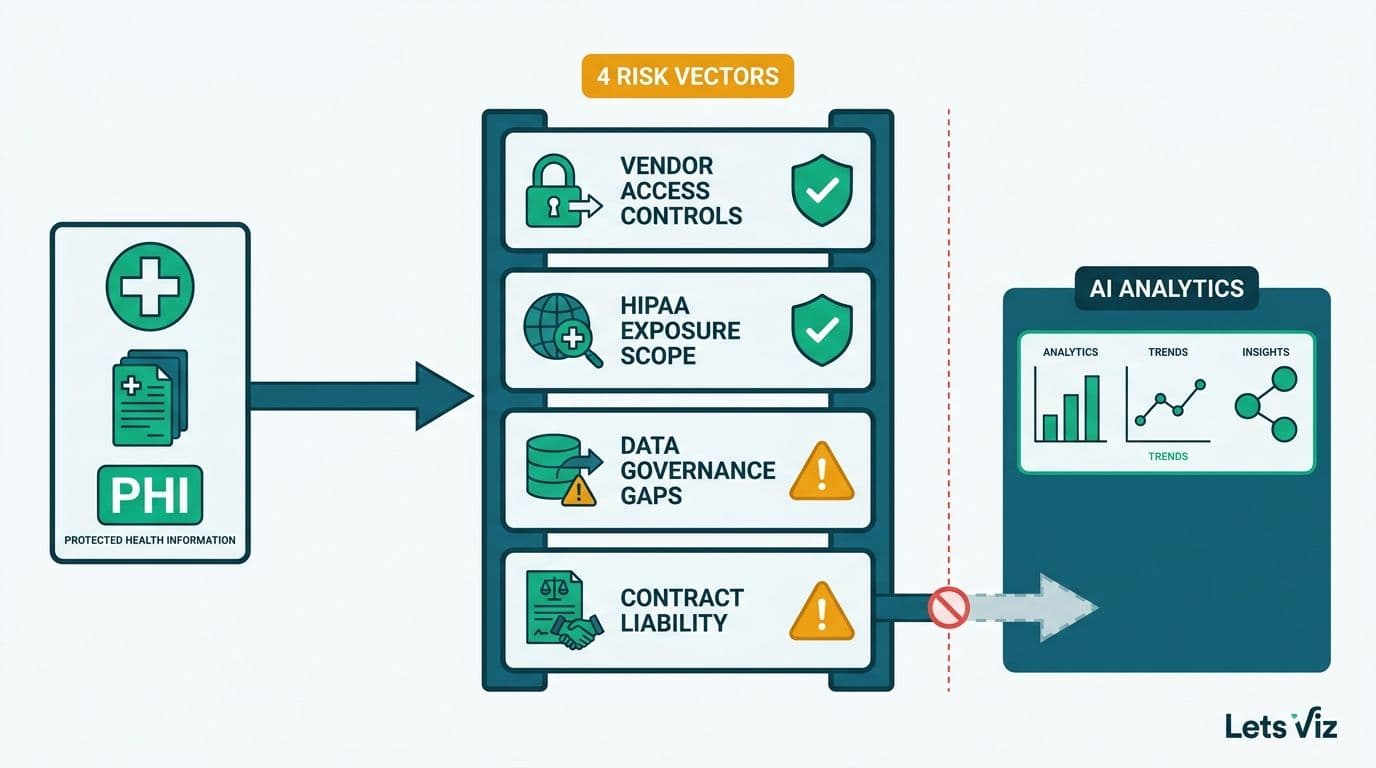
Before any AI tool touches a patient record, your hospital must complete a structured data privacy audit. AI analytics data privacy risks for healthcare organizations span regulatory exposure, vendor access controls, and governance gaps that finance and ops leaders are often ill-equipped to evaluate at procurement. A missed step can result in HIPAA violations, contract liability, or the kind of public trust crisis that derailed NHS data-sharing initiatives in the UK.
Key Takeaways
AI tools that access patient data create HIPAA exposure the moment PHI leaves your controlled environment.
Vendor contracts must include Business Associate Agreements (BAAs), data residency clauses, and retention limits - not just standard SLAs.
Finance and ops teams need a 10-point pre-access audit before any AI tool receives PHI access.
The Palantir-NHS controversy reveals what happens when commercial data access is granted without public accountability controls.
Healthcare Financial Analytics is projected to grow at an 8.58% CAGR from 2025 to 2035 (Market Research Future, as of 2026) - meaning the number of AI tools competing for your data is accelerating.
Lets Viz builds custom AI automation solutions that cut manual processing time by 40-60% within 90 days -- across finance, healthcare, and operations workflows.
What Are the Core AI Analytics Data Privacy Risks for Healthcare Organizations?
AI analytics data privacy risks for healthcare organizations fall into three categories: regulatory non-compliance, vendor data exposure, and algorithmic bias amplification. Each carries distinct financial and reputational consequences.
Regulatory risk is the most immediate. Under HIPAA, any vendor that receives, processes, or transmits Protected Health Information (PHI) must operate as a Business Associate. If an AI tool is onboarded without a valid BAA, your organization holds liability for the vendor's data practices - regardless of what their marketing materials claim.
Vendor exposure risk is subtler. Many AI platforms built for general enterprise use are not architected for healthcare. They may log prompts containing patient data to improve their models, store outputs in shared cloud environments, or transfer data across jurisdictions where HIPAA does not apply.
Algorithmic bias is the third vector. When AI models train on historical clinical or billing data that reflects past inequities, their outputs can systematically disadvantage certain patient populations - creating care quality and regulatory risk simultaneously. HHS Office for Civil Rights signaled in 2025 guidance that AI tools used in clinical and revenue cycle workflows would be evaluated for discriminatory output patterns under existing anti-discrimination statutes. By mid-2026, multiple health systems had disclosed OCR inquiries specifically referencing AI-assisted claims denial patterns as a basis for disparate impact review — confirming that algorithmic bias is a live enforcement priority in 2026, not a theoretical future risk.
According to Market Research Future (as of 2026), the Healthcare Financial Analytics Market is projected to grow at an 8.58% CAGR from 2025 to 2035, driven by technological advancements and regulatory changes. That growth curve means a rising number of AI analytics vendors targeting healthcare finance and ops teams - and a rising surface area for data privacy risk.
For a foundational reference on what HIPAA-compliant dashboard design requires, see the HIPAA-compliant analytics dashboard best practices checklist.
What Does the Palantir-NHS Controversy Teach Healthcare Finance Teams?
The Palantir-NHS data-sharing controversy - which attracted significant attention in online privacy and public accountability communities throughout 2025 and 2026 - is a practical case study in what happens when commercial AI data access is granted without adequate governance controls.
The core issues were accountability gaps, not just technical failures. NHS patient data was accessed under contracts that lacked sufficient transparency about downstream model training, data retention scope, and commercial reuse rights. When those gaps became public, the reputational and political fallout was significant - even though no US HIPAA equivalent was technically violated under UK law.
The lesson for US healthcare finance and ops teams is specific: your BAA does not protect you from reputational or regulatory risk if the underlying data governance is weak. A vendor can be technically compliant with the letter of a BAA while still retaining query logs, using anonymized patient data for model improvement, or granting subprocessor access your team never reviewed.
The World Economic Forum's 2025 AI governance initiative — which convened over 100 experts from more than 50 financial services organizations to develop cross-industry data access frameworks — had, by 2026, shifted from framework development to active adoption requirements, with participating institutions expected to demonstrate board-level AI risk oversight as a condition of continued membership. Data access accountability is no longer aspirational governance; it is becoming a contractual standard across regulated industries.
For context on how these governance questions are reshaping AI analytics procurement in healthcare, see the AI consulting for healthcare data analytics guide.
What Should Be on Your Pre-Access AI Audit Checklist?
The following 10-point checklist is designed for hospital finance and ops teams to complete before approving any AI tool for PHI access.
1. Business Associate Agreement (BAA) Status
Does a signed BAA exist with this vendor?
Does it explicitly cover the AI tool and all subprocessors?
Is the BAA version current to the vendor's latest product release?
2. Data Residency and Jurisdiction
Where is PHI stored? (Region, country, cloud provider)
Does the AI tool's cloud infrastructure fall under HIPAA-covered US jurisdiction?
Does the vendor use cross-border data transfers for model training or inference?
3. Data Retention and Deletion Policies
What is the maximum PHI retention period?
Can your organization trigger deletion on demand?
Are deletion requests auditable with confirmation?
4. Model Training and Data Use
Does the vendor use customer data to train or fine-tune shared models?
If so, is PHI excluded by contract, or only by technical control?
What controls prevent PHI from entering model training pipelines?
5. Access Control and Role-Based Permissions
Does the AI tool support role-based access control (RBAC)?
Can access be scoped to specific data sets (finance data only, not clinical notes)?
Is access logged and auditable?
6. Encryption Standards
Is PHI encrypted at rest and in transit?
What encryption standards are used? (AES-256 minimum at rest; TLS 1.2+ in transit)
Are encryption keys customer-managed or vendor-managed?
7. Incident Response and Breach Notification
What is the vendor's documented breach notification SLA? (HIPAA requires 60 days; enterprise SLAs should commit to shorter timelines)
Has the vendor had any data incidents in the past 24 months?
What is their documented incident response procedure?
8. Third-Party Audit and Certifications
Does the vendor hold a current SOC 2 Type II report?
Is the report available for your security team to review?
Do they hold HITRUST CSF certification? (Not required, but a meaningful signal for healthcare)
9. Vendor Financial Stability and Continuity
What happens to your PHI data if the vendor is acquired or shuts down?
Is there a data escrow or portability provision in the contract?
10. Internal Access Governance
Which internal roles can grant AI tool access to patient data?
Is there a documented approval workflow that includes your CISO and Privacy Officer?
How will access be reviewed on a recurring basis?
For teams building out their broader analytics infrastructure alongside this audit, the AI analytics for healthcare finance teams guide covers the governance layer in more depth.
How Do You Evaluate AI Tool Vendors for Healthcare Data Compliance?
Vendor evaluation for healthcare AI requires a structured comparison framework. The table below maps critical compliance dimensions against minimum requirements and red flags your procurement team should act on immediately.
| Compliance Dimension | Minimum Requirement | Red Flag |
|---|---|---|
| BAA Coverage | Signed BAA covering all subprocessors | BAA excludes AI/ML processing components |
| Data Residency | PHI stored in HIPAA-covered US regions | Data transferred for training to non-US regions |
| Model Training | PHI explicitly excluded by contract | "We anonymize before training" without contract language |
| Encryption | AES-256 at rest, TLS 1.2+ in transit | Vendor-only key management, no customer key option |
| Audit Logs | Immutable, exportable access logs | Logs retained by vendor only, not exportable |
| Breach SLA | 72-hour internal notification, 60-day HIPAA SLA | No defined SLA or "notify as required by law" |
| Third-Party Audit | SOC 2 Type II available on request | Only SOC 2 Type I, or no audit report available |
| Data Portability | Contractual right to export and delete | No portability clause in contract |
The AI consulting services market — projected at approximately USD 14 billion in 2026 and forecast to reach USD 90.99 billion by 2035 at a 26.2% CAGR — will continue producing new vendors targeting healthcare with compliance maturity well below what the sector requires (Future Market Insights, as of 2026). The safest approach is to treat every AI vendor as a potential subprocessor and apply your existing vendor risk management process, not a lighter-touch procurement review.
For teams evaluating how AI tools fit into broader analytics ecosystems, what an AI analytics consultant does explains how governance and technical evaluation intersect in practice.
What Is the Right Data Governance Framework Before AI Goes Live?
Completing the audit checklist is a gate, not a governance framework. Ongoing governance requires three structural elements that most hospital finance and ops teams have not yet formalized.
Data Classification Policy
Before any AI tool accesses your environment, every data asset needs a classification label: PHI, de-identified, aggregate, or administrative. AI tools should be provisioned access only at the classification level they require - and that access should be enforced technically, not just by policy.
AI Access Review Board
High-risk AI tool decisions should not be made by individual department heads. Establish a cross-functional review board that includes your CISO, Privacy Officer, CFO representative, and at least one clinical operations lead. This board approves initial access, reviews scope expansions, and conducts annual audits.
Data Lineage Tracking
AI workflow automation for healthcare introduces a specific risk: automated pipelines may ingest PHI at multiple processing steps without explicit human review at each handoff. For AI tools that generate outputs derived from patient data - financial forecasts based on patient volume, for example - your governance framework must track the lineage from input data to output recommendation. If a model's output is ever challenged in an audit or legal proceeding, you need to demonstrate what data informed it and under what access controls.
According to Future Market Insights (as of 2026), the global AI consulting and support services market is forecast to grow at a 31.6% CAGR through 2030. At that rate of expansion, governance frameworks built for today's tool landscape may be inadequate within 18 months without a deliberate review cycle.
The guide on building an AI analytics strategy for a mid-market company includes a governance layer template that adapts well to healthcare environments.
When Should Healthcare Organizations Bring in Outside AI Analytics Expertise?
The audit checklist and governance framework described above require technical depth that most hospital finance and ops teams do not have in-house. Four triggers justify bringing in outside expertise.
Trigger 1: First AI tool procurement for patient data
If your organization is evaluating its first AI tool that will access patient data, the learning curve on BAA review, vendor risk scoring, and technical due diligence is steep. A consultant who has completed this process for peer organizations can compress that timeline significantly and surface risk patterns your internal team would not know to look for.
Trigger 2: Existing AI tools without documented BAAs
This is more common than it should be. If your teams have already adopted AI tools - even lightweight ones like AI-assisted reporting in your BI platform - and you cannot confirm a current BAA exists for each, that is an active compliance gap warranting immediate review.
Trigger 3: Post-incident review
If your organization has experienced a data incident involving an AI tool, or received a HIPAA audit inquiry related to third-party data access, an independent review is warranted before you expand AI access further. Internal teams often lack the standing to conduct a credible post-incident assessment of tools they selected.
Trigger 4: Formal AI governance program buildout
If your board has commissioned a formal AI governance program, outside expertise helps you design a framework built for the tools you will onboard over the next three to five years - not just the ones you use today. An outside partner also reduces the organizational dynamics that cause internal teams to underestimate compliance gaps in tools they originally championed.
The AI consulting for healthcare data analytics guide covers what to look for when evaluating outside partners for this work.
---
If your hospital or health system is ready to move from audit checklist to a governed AI analytics program, Custom AI automation and consulting from Lets Viz brings healthcare-specific compliance experience to every engagement - from vendor BAA review through ongoing access governance.
---
About Lets Viz: Lets Viz has delivered data analytics and AI consulting to healthcare and financial services organizations since 2020. Our engagements span HIPAA-compliant dashboard design, AI vendor risk assessment, and managed analytics infrastructure. We hold direct experience with regulated-industry data governance requirements and serve mid-market organizations navigating complex analytics transformations.