Fabric Lakehouse Architecture Diagram: Reference Design Guide
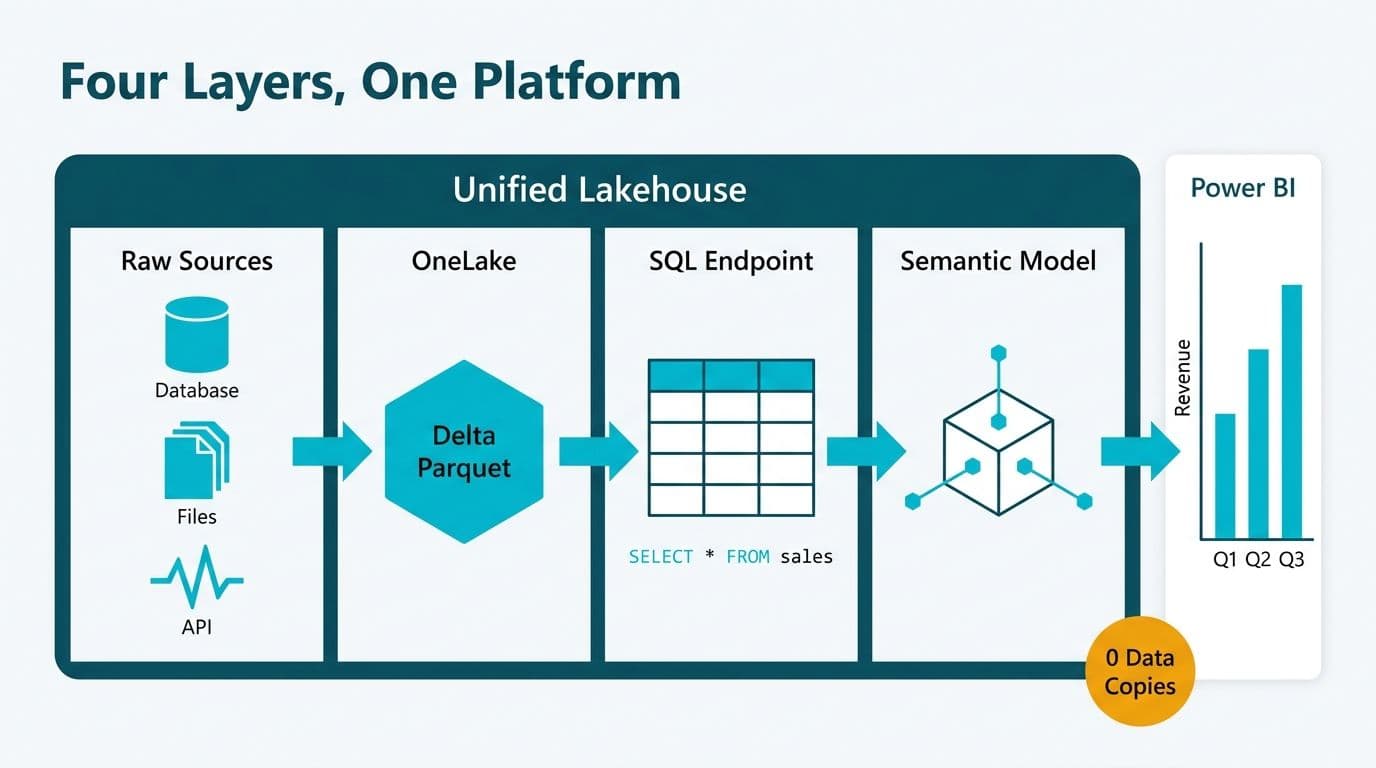
A fabric lakehouse architecture diagram maps the complete path data travels from raw source ingestion, through OneLake's unified Delta Parquet storage, across a SQL analytics endpoint, and into a Power BI semantic model. In Microsoft Fabric, all four layers live in one governed platform with no data copies and no separate warehouse clusters. Finance and healthcare data teams at mid-market organizations can query fresh operational data in Power BI within minutes of ingestion.
Key Takeaways
Microsoft Fabric collapses the traditional data stack into four logical layers: ingestion, OneLake Delta Parquet storage, SQL analytics endpoint, and Power BI semantic model.
All data in Fabric lands in open Delta Parquet format on OneLake - a single logical lake that eliminates the "move data to analyze it" problem.
The SQL analytics endpoint auto-generates T-SQL views over every Delta table, giving SQL analysts direct access without writing Spark code.
Finance and healthcare teams can enforce HIPAA, GDPR, and PIPEDA controls once at the OneLake layer and inherit those policies automatically downstream.
A well-drawn reference architecture diagram reduces stakeholder alignment time and significantly cuts implementation risk for data teams.
What Is a Fabric Lakehouse Architecture?
A Microsoft Fabric lakehouse merges the flexibility of a data lake with the structured querying of a relational warehouse - without maintaining two separate infrastructure stacks. It stores all data as open Delta Parquet files on OneLake, Microsoft's single logical data lake that spans an entire Microsoft 365 tenant and supports shortcuts to external storage.
For data teams already working with a Power BI and Fabric consulting partner, the lakehouse is the natural evolution of the modern data stack: one storage layer, multiple compute engines, and one security boundary.
Four discrete logical layers define every Fabric lakehouse reference design:
1. Ingestion layer - pipelines, Eventstream connectors, Dataflow Gen2, and PySpark notebooks
2. OneLake storage layer - Delta Parquet tables organized as Bronze, Silver, and Gold zones
3. SQL analytics endpoint - automatically generated T-SQL views over every Delta table
4. Power BI semantic model - DAX measures, star-schema relationships, and row-level security
For mid-market teams currently running Power BI on top of a standalone Azure SQL database or a third-party data warehouse, migrating to a Fabric lakehouse is typically a lift-and-shift of the semantic model layer, with OneLake replacing the warehouse as the authoritative storage tier. The benefit is not just cost consolidation - it is the elimination of the overnight refresh window that delays morning reporting for finance and operations teams.
For a deeper look at OneLake's storage model, the Microsoft Fabric OneLake explainer covers shortcut mechanics and cross-workspace federation in detail.
How Does Data Flow from Raw Ingestion to OneLake?
Raw data enters the lakehouse through one of three paths: pipelines for scheduled batch copy, Eventstream for real-time feeds, or PySpark notebooks for complex transformation logic. Every path writes data into the lakehouse file system, where Fabric automatically registers it as a Delta table.
The medallion architecture - Bronze, Silver, Gold - maps directly onto this flow:
| Layer | Delta Zone | Content | Primary Users |
|---|---|---|---|
| Bronze | Raw | Unmodified source extracts | Data engineers |
| Silver | Curated | Cleaned, joined, validated | Analytics engineers |
| Gold | Aggregated | Business KPIs and fact/dim models | BI developers |
| SQL Endpoint | Auto T-SQL | Read-only views over Gold tables | SQL analysts, finance teams |
| Semantic Model | Power BI dataset | DAX measures, RLS, relationships | Report builders, CIOs |
A US healthcare provider - such as a 400-bed hospital system ingesting Epic ADT feeds and claims data - would land raw records in Bronze, apply HIPAA de-identification transforms in Silver, and expose clean encounter metrics in Gold for Power BI dashboards consumed by finance directors and clinical operations leads.
The World Economic Forum (2025) engaged over 100 experts from more than 50 financial services organizations to address AI analytics scalability and found that data architecture consistency - not model sophistication - was the primary barrier to enterprise AI adoption (WEF, 2025). As of 2026, as AI copilot tooling moves from pilot to production deployment across financial services, that finding has grown more acute: organizations without a standardized, governed storage layer are discovering that AI features produce unreliable outputs until the underlying data is clean and consistently structured. A well-designed medallion flow addresses that consistency gap at the storage layer before the AI layer is ever introduced.
What Does the SQL Analytics Endpoint Do?
The SQL analytics endpoint is one of Fabric's most practically valuable components. When a Delta table is created or updated inside a lakehouse, Fabric automatically generates a read-only T-SQL interface over that table - no ETL step, no manual schema registration required.
This means a finance analyst who knows SQL but not Spark can run standard queries directly against the same Delta Parquet files that data engineers write with notebooks:
```sql
SELECT fiscal_quarter, SUM(revenue) AS total_revenue
FROM gold_financials.fact_revenue
WHERE region = 'North America'
GROUP BY fiscal_quarter
```
For a UK fintech firm operating under GDPR, the endpoint enforces column-level masking and row-level access policies defined once at the lakehouse layer. Downstream SQL queries and Power BI reports inherit those restrictions automatically - reducing compliance audit surface considerably.
Canadian organizations under PIPEDA face similar data residency requirements. Fabric's OneLake capacity zones allow Canadian teams to pin storage to Canadian Azure regions (Canada East and Canada Central), satisfying PIPEDA residency expectations while using the full Fabric SQL and Power BI stack without any architecture compromise.
For connecting Fabric pipelines to common source systems, the Microsoft Fabric data pipeline tutorial covers the Copy and Transform activities step by step.
Fabric Lakehouse Architecture Diagram: Layer-by-Layer Reference Design
The following annotated reference traces each layer in the canonical Fabric data path, from first byte of ingestion to a row on a Power BI dashboard:
Layer 1 - Sources
ERP systems, EHR platforms, CRM exports, real-time event buses, and flat-file drops form the source tier. A US SaaS finance team might simultaneously ingest a Salesforce revenue feed, a NetSuite GL extract, and a real-time Kafka billing stream - all routed to a single OneLake destination.
Layer 2 - Ingestion (Pipelines / Eventstream / Notebooks)
Data Factory-compatible pipelines handle scheduled batch extraction. Eventstream processes IoT sensor data, clickstreams, or payment events with sub-second latency. PySpark notebooks handle complex transformation logic that cannot be expressed as drag-and-drop pipeline steps. All three paths deposit data to OneLake.
Layer 3 - OneLake / Delta Parquet (Bronze - Silver - Gold)
A single logical lake, tenant-scoped, with workspace-level access boundaries. Delta format enables time-travel queries and ACID transactions - critical for financial close processes where restating prior periods requires a defensible audit trail. The time-travel syntax is straightforward:
```sql
SELECT * FROM gold_financials.fact_revenue VERSION AS OF 45
```
Layer 4 - SQL Analytics Endpoint
Fabric's auto-generated T-SQL interface allows finance teams to query Gold tables using standard SQL without any Spark knowledge. Column masking and row-level security policies apply here and propagate automatically to all downstream Power BI reports consuming the same tables.
Layer 5 - Power BI Semantic Model
The semantic layer holds all business logic: DAX measures, star-schema relationships, and row-level security roles. A CFO's consolidated P&L report and a hospital CMO's clinical operations dashboard both pull from the same certified semantic model - with RLS filtering the relevant data slice per role. This shared model eliminates "which version is correct?" debates that plague organizations with siloed reporting.
Layer 6 - Consumption (Reports, Excel, APIs)
Power BI reports, paginated reports for regulatory filings, connected Excel tables, and third-party tools via the XMLA endpoint all sit at the consumption tier. XMLA allows non-Power BI tools to query the semantic model without breaking the governance boundary that protects the layers below.
Organizations that established their Fabric lakehouse foundation in 2024-2025 are now activating AI-powered analytics and Copilot capabilities on top of it — Microsoft Copilot for Fabric, generally available in 2026, operates directly against certified OneLake semantic models, making a well-governed medallion architecture the prerequisite for any AI analytics roadmap rather than a future consideration.
How Should Healthcare and Finance Teams Govern Data Across This Architecture?
Governance in Fabric is embedded in the storage layer, not bolted on afterward. The core controls are:
Workspace-level domain isolation
Each business domain - Finance, Clinical Operations, Supply Chain - receives its own Fabric workspace. OneLake shortcuts allow Gold tables to be shared across workspaces without copying data, preserving a single source of truth across domains.
Microsoft Purview sensitivity labels
Sensitivity labels applied in Purview propagate from OneLake tables through the SQL endpoint and into Power BI reports. A file labeled "Confidential - PHI" in a US healthcare lakehouse cannot be exported to CSV without triggering an audit log entry. This propagation model is essential for HIPAA-covered entities.
Delta time-travel for financial audit trails
A US bank operating under SOC 2 can prove exactly which version of a table was used at the time of a quarterly board report - retrievable with a single query. This eliminates the common compliance gap where warehouse snapshots were not retained long enough for external audit review.
Row-level security for GDPR data minimization
A regional VP at a UK fintech group sees only EU-domiciled account data in Power BI reports - satisfying both GDPR's data minimization principle and internal segregation-of-duties controls, without maintaining separate report variants for each geography.
For teams deciding how Power BI should connect to these tables, the Power BI Import vs DirectQuery decision guide explains when to use DirectQuery against the SQL endpoint versus importing Gold aggregates into a semantic model's in-memory cache.
Fabric Lakehouse vs Traditional Data Warehouse: What Changes for Mid-Market Teams?
| Capability | Traditional Warehouse | Fabric Lakehouse |
|---|---|---|
| Storage format | Proprietary, vendor-locked | Open Delta Parquet - portable |
| SQL access | Native | Auto-generated SQL endpoint |
| Spark / Python | Separate cluster required | Native Fabric notebooks |
| Real-time ingestion | Additional tooling required | Eventstream - built-in |
| Power BI connectivity | DirectQuery or import pipeline | Direct Lake mode - zero-copy |
| Governance propagation | Manual per tool | Purview labels propagate downstream |
| Audit trail | Snapshot-dependent | Delta ACID transaction log |
| Multi-cloud portability | Limited by vendor lock-in | Delta files portable across clouds |
Direct Lake mode is the single highest-impact change for Power BI users. Instead of importing data or maintaining a live DirectQuery connection, Power BI reads Delta Parquet files directly from OneLake - achieving import-level query speed with no scheduled refresh and no data duplication. A US healthcare analytics team working with 200 million claims records can serve sub-3-second dashboard loads without a nightly import cycle.
For teams evaluating which report output format suits financial or regulatory use cases, the Power BI Report Builder vs Desktop finance guide covers when paginated reports are the right choice for board packs and regulatory submissions.
When Should a Mid-Market Team Adopt Fabric Lakehouse Architecture?
The architecture delivers clear ROI when at least two of these conditions are true:
The organization holds an active Microsoft 365 or Azure subscription with available Fabric capacity units
Data volumes exceed what Power BI import mode can refresh daily (typically 5-10 GB compressed per dataset)
Multiple teams need to share curated Gold tables without maintaining separate ETL pipelines
Compliance requirements - HIPAA, GDPR, PIPEDA, or SOC 2 - demand a single auditable data lineage from source to report
The organization plans to activate AI or Copilot analytics capabilities — Microsoft Copilot for Fabric is generally available in 2026 and requires a certified semantic model backed by OneLake, making the lakehouse architecture the necessary foundation rather than an optional upgrade path
A Canadian manufacturing company moving from fragmented spreadsheet reporting to a Fabric lakehouse can realistically deploy a Bronze-Silver-Gold medallion pipeline in 6-8 weeks with the right implementation partner - and satisfy PIPEDA data residency immediately by pinning the Fabric capacity to a Canadian Azure region. For a US hospital system with existing EHR data exports, the equivalent implementation typically runs 8-12 weeks due to HIPAA de-identification requirements and the additional governance controls required before protected health information can flow through the Silver transformation layer. Finance teams at UK fintech firms, who often need GDPR data lineage documentation for regulators, benefit from Fabric's built-in Purview integration, which generates that lineage automatically as part of the standard deployment.
---
About Lets Viz: Lets Viz has designed and delivered data analytics and Power BI consulting engagements since 2020, serving US healthcare systems, UK fintech firms, Canadian manufacturing companies, and global SaaS businesses. The firm holds a 5.0 Clutch rating and specializes in Microsoft Fabric architecture, semantic model design, and governed self-service BI at mid-market scale across healthcare and finance.
If you are evaluating a Fabric lakehouse deployment or need an architecture review before committing to a build, the Power BI and Fabric consulting team at Lets Viz designs and implements end-to-end Fabric architectures - from OneLake medallion design through certified semantic models and governed Power BI delivery.