Cognos to Power BI Migration Interview Questions: Prep Guide
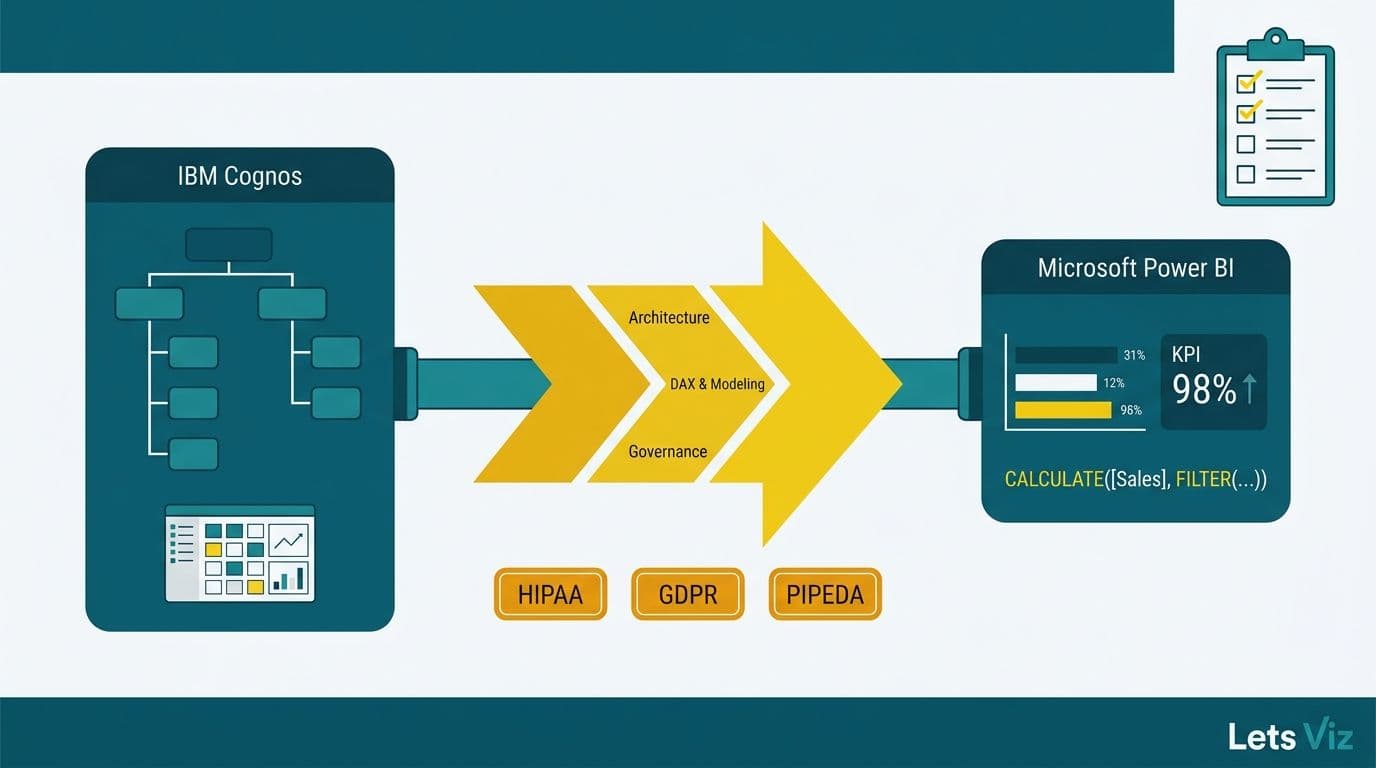
Cognos to Power BI migration interview questions test three core competencies: IBM Cognos architecture knowledge, Power BI DAX and data modeling skills, and enterprise migration governance. Hiring managers in healthcare and finance now add AI data governance and compliance layers - HIPAA, GDPR, PIPEDA - to candidate scorecards. This guide covers the questions both sides of the table need, with model answers that distinguish migration specialists from general BI developers.
Key Takeaways
The most competitive candidates demonstrate hands-on experience with both Cognos Framework Manager and Power BI semantic models - not just one side of the migration.
DAX fluency, especially functions like CROSSFILTER and CALCULATE, is the most-tested technical differentiator in migration interviews.
Healthcare and finance roles now add compliance-specific questions: HIPAA data lineage for US health systems, GDPR data residency for UK and EU deployments, and PIPEDA consent traceability for Canadian organizations.
Behavioral questions probe AI data maturity assessment skills and build vs. buy judgment for post-migration analytics infrastructure.
Hiring managers should score candidates on three dimensions: technical translation ability, governance acumen, and change management experience.
Why Are Cognos to Power BI Migration Interview Questions Different From Standard BI Roles?
Standard Power BI interviews test dashboard design and DAX syntax. Cognos migration interviews test something harder: the ability to translate a legacy enterprise semantic layer into a modern, self-service model without losing institutional business logic.
IBM Cognos dominated enterprise BI through the 2000s and 2010s. Organizations in US healthcare networks, UK fintech firms, and Canadian manufacturing companies built decade-long report libraries on Cognos Framework Manager namespaces, Report Studio burst reports, and TM1 planning models. Migrating these to Power BI is not a lift-and-shift exercise - it is a semantic re-architecture that requires understanding why legacy metadata was structured the way it was.
Interviewers testing for this role need candidates who can explain the translation between platforms at a conceptual level, not just execute it mechanically. For the governance and data modeling discipline that applies across enterprise BI platform migrations, Tableau to Power BI migration services outlines the standards required at each phase - from report inventory to post-migration validation.
Enterprise demand for AI-augmented analytics has continued to accelerate through 2026, with migration specialists — who bridge legacy enterprise BI platforms and modern self-service architectures — among the most consistently sought skill profiles in data hiring. This trajectory shows no signs of reversing as enterprise AI adoption broadens across regulated industries.
Key interview differentiator: Ask candidates not just what they migrated, but what they chose not to migrate - and why. Retired Cognos reports left behind because they had no active users represent a governance decision, not a technical failure.
What Technical Cognos to Power BI Migration Interview Questions Should You Expect?
Technical questions probe translation fidelity: can the candidate convert Cognos logic into Power BI without introducing errors or performance regressions?
1. How does the Cognos Framework Manager namespace map to Power BI datasets?
A Cognos subject area groups query subjects (tables) and query items (columns) into a business-facing namespace that generates SQL at query time. A Power BI semantic model stores relationships and calculated measures statically in an in-memory columnar engine (VertiPaq). Migrating from one to the other requires externalizing Cognos's query-time logic into explicit DAX measures and pre-defined table relationships.
2. How do you convert Cognos Report Studio crosstab calculations to DAX measures?
Identify whether the Cognos calculation is a member-level or set-level expression. Member-level expressions - such as prior-period comparisons - translate well to DAX time intelligence functions like SAMEPERIODLASTYEAR or DATEADD. Set-level expressions typically require CALCULATE with explicit filter arguments and may need REMOVEFILTERS to replicate Cognos's query-level aggregation behavior.
3. What is the DAX CROSSFILTER function and when do you use it in a migrated Cognos model?
The DAX CROSSFILTER function overrides the cross-filter direction between two tables within a specific measure calculation, without changing the model's global relationship settings. In Cognos migrations, this surfaces when a legacy report traversed a many-to-many relationship that Cognos handled implicitly through its query engine. CROSSFILTER makes that relationship explicit and controllable in DAX - a frequent fix for migrated financial or clinical data models where fact tables join to multiple dimension tables.
4. How do you handle Cognos burst report distribution in Power BI?
Cognos bursting distributes report slices to different recipients based on a data field. The Power BI equivalent is row-level security combined with subscriptions or paginated report delivery via the Power BI Service. The interview answer should address RLS role design, the decision between Power BI Report Server and the Service, and how recipient lists are managed at scale.
5. How do you migrate a Cognos dimensional model to a star schema for Power BI?
Map each Cognos dimension to a Power BI dimension table. Flatten query subjects that contain embedded joins into pre-aggregated dimension tables where possible. Validate row counts post-migration against source reports before decommissioning legacy content.
Cognos to Power BI Concept Translation Reference
| Cognos Concept | Power BI Equivalent | Migration Complexity |
|---|---|---|
| Framework Manager namespace | Semantic model / dataset | High - business logic lives here |
| Report Studio crosstab | Matrix visual + DAX measures | Medium |
| Burst report distribution | Row-level security + subscriptions | Medium-High |
| TM1 planning model | Power BI + Azure Analysis Services | High |
| Query subject with embedded joins | Star schema dimension table | Medium |
| Report Studio prompt pages | Power BI slicers + bookmarks | Low-Medium |
| Cognos scorecarding | Power KPI visual + DAX KPIs | Medium |
Healthcare financial analytics remains one of the fastest-growing segments for enterprise BI migration work — making clinical and financial report migration specialists a sustained hiring category. Candidates with Cognos-to-Power-BI experience in healthcare data will command a premium for the foreseeable future.
For a detailed look at DAX measure translation from legacy calculated fields, see the Tableau Calculated Fields to Power BI DAX conversion guide - the DAX patterns apply equally to Cognos measure migrations.
How Do Behavioral and Strategic Questions Test Migration Experience?
Behavioral questions separate candidates who have executed migrations from those who have only observed them. Through 2025 and into 2026, healthcare analytics priorities have shifted sharply toward AI-driven analytics and value-based care reporting — reinforced by ongoing CMS value-based care payment model expansions and the continued rollout of alternative payment structures across US health systems. Interviewers increasingly expect candidates to lead AI-augmented analytics transformation programs, not just technical platform moves.
"Describe a Cognos migration project where stakeholder alignment broke down. What did you do?"
Interviewers want evidence that the candidate treats BI migrations as organizational change programs. A strong answer names the specific friction point - often a finance director or department head who owns legacy reports and fears losing familiar output formats - describes the communication approach taken, and states the measurable outcome.
"How do you conduct an AI data maturity assessment before recommending a migration timeline?"
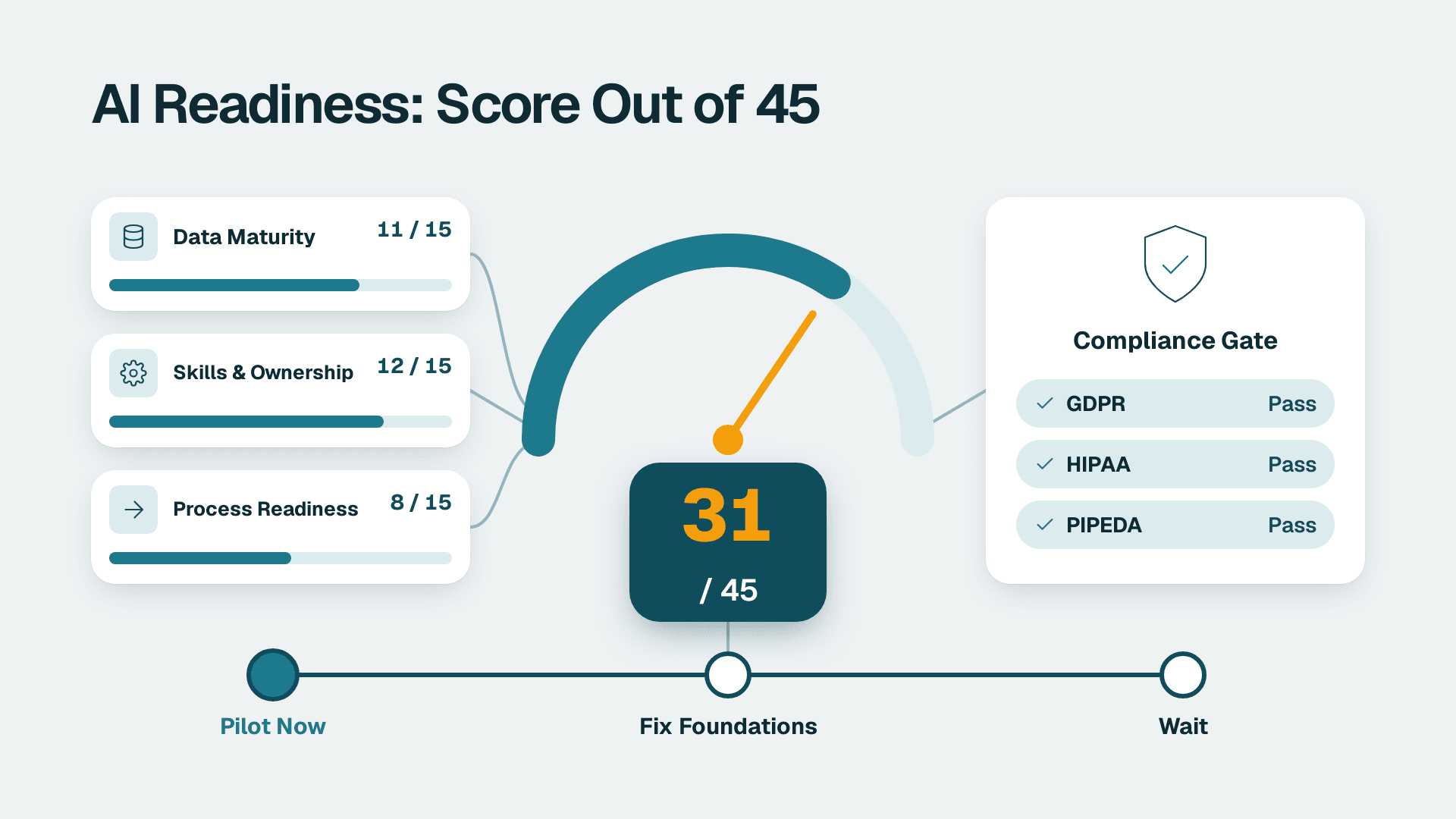
This tests strategic acumen. A strong answer describes a structured AI data maturity assessment covering data source quality, governance readiness, report inventory size, and user adoption capacity. Candidates should state that a low-maturity environment - fragmented sources, undocumented calculations, high technical debt in the semantic layer - requires remediation before migration begins, not during it.
"Build vs. buy: when would you recommend a boutique consulting firm over a large consultancy for a Cognos migration?"
This build vs. buy AI data capability question tests commercial judgment. A boutique AI consulting firm vs. large consultancy comparison for mid-market US companies migrating 200-800 Cognos reports typically comes down to this: boutique firms offer faster mobilization and deeper senior practitioner involvement; large consultancies provide staffing scale but often deploy junior staff on day-to-day execution. Strong candidates articulate the trade-offs and tie the recommendation to the client's internal BI team capacity and governance complexity.
"How do you ensure that business logic in a Cognos model is not lost during migration?"
A documentation-first approach: extract all Framework Manager query subjects, filters, and calculations into a migration registry before touching Power BI. Then validate each migrated measure against legacy report output with a tolerance threshold agreed upon by business owners in advance.
What Data Governance and Compliance Questions Cover Healthcare and Finance?
Compliance questions are the fastest-growing category in migration interview scorecards for regulated industries. Regulatory bodies and enterprise risk functions across the US, UK, and EU have consistently elevated AI data governance framework knowledge from an IT concern to a board-level requirement — and the scrutiny extends to migrated BI environments specifically. In a Power BI context, this means candidates should be able to describe not just Microsoft Purview sensitivity labels and workspace-level access controls, but also how audit logs are configured to satisfy data lineage requirements for AI-assisted report generation.
US healthcare (HIPAA): "How do you ensure Protected Health Information in legacy Cognos reports is handled correctly during a Power BI migration?" Strong answers cover data classification before migration begins, Power BI workspace access controls, sensitivity labels in Microsoft Purview, and audit trail configuration. Candidates should explain how PHI is prevented from appearing in development or UAT workspaces during testing.
UK and EU (GDPR): "If we migrate Cognos to Power BI Premium in a multi-region Microsoft tenant, how do you manage data residency?" Candidates should describe geo-redundancy settings in Power BI Premium, the use of Customer Managed Keys where data sovereignty is contractually required, and how GDPR data subject access requests apply to migrated datasets.
Canada (PIPEDA): "Our Cognos reports include personally identifiable information governed by PIPEDA. How does your migration approach address consent and data minimization?" Strong answers reference field-level masking during migration testing, strict role-based access post-go-live, and documented data lineage for compliance audits.
For US healthcare deployments, the HIPAA-compliant analytics dashboard best practices checklist and the AI analytics data privacy risks healthcare audit guide outline the compliance standards that strong candidates should be able to address fluently in an interview.
How Should Hiring Managers Score Cognos to Power BI Migration Candidates?
A structured scorecard reduces hiring bias and improves signal quality when evaluating migration specialists - especially important given that genuine Cognos-to-Power-BI expertise is concentrated in a small talent pool relative to overall demand.
Dimension 1 - Technical translation ability (40% weight)
Can the candidate explain how Cognos query subjects become Power BI semantic model tables?
Can they write a DAX measure replicating a Cognos calculation without reference material?
Do they understand filter context and the CROSSFILTER function - the two most common DAX pitfalls in Cognos migrations?
Can they articulate the Import vs. DirectQuery trade-off for migrated financial report datasets?
Dimension 2 - Governance and compliance acumen (35% weight)
Does the candidate apply a defined AI data governance framework or improvise?
Can they describe how to build a migration registry and track report retirement?
Do they understand HIPAA requirements for US health systems, GDPR for UK and EU deployments, and PIPEDA for Canadian organizations?
Can they articulate a rollback plan if a migrated report fails post-go-live?
Dimension 3 - Change management and communication (25% weight)
Can they describe how they communicate migration status to non-technical stakeholders - CIOs, finance directors, and data team leads?
Have they managed resistance from report owners who preferred legacy Cognos interfaces?
Do they distinguish between migrating a report and retiring a report, and can they explain that distinction to a business owner?
Organizations evaluating a managed migration partner rather than a single hire should review the governance and QA standards outlined on the Managed Power BI services page.
What Finance-Specific Questions Test Reporting Continuity?
Finance teams have the highest stakes in Cognos migrations because their reports feed board packages, regulatory filings, and executive dashboards. Interviewers in finance-adjacent roles test whether candidates can ensure accuracy while managing the operational disruption of a platform change.
"How do you migrate Cognos financial period reports that use relative time expressions?"
Cognos uses relative time macros that must be replaced with Power BI DAX time intelligence functions - SAMEPERIODLASTYEAR, DATEADD, or DATESYTD - depending on the fiscal calendar logic. Candidates should confirm whether the organization uses a standard calendar year or a non-standard fiscal year before selecting the DAX pattern, and document the translation decision for future audits.
"How do you handle SaaS metrics for board reporting in a migrated Power BI environment?"
Strong candidates describe building a governed SaaS metrics for board reporting model that includes ARR, NRR, churn, and the Rule of 40 SaaS benchmark (revenue growth rate plus EBITDA margin). Power BI's calculated table and measure features allow these KPIs to be stored as reusable, version-controlled measures in permission-controlled workspaces that finance directors access directly.
"What is your approach to the Import vs. DirectQuery decision for migrated financial reports?"
High-frequency financial dashboards with sub-second refresh requirements favor DirectQuery against a well-indexed SQL warehouse. Historical reports with larger data volumes favor Import mode for query performance. For the technical framework candidates should be able to apply, see the Power BI Import vs. DirectQuery mid-market decision guide.
"How do you validate that migrated financial reports match source Cognos output to the cent?"
Strong candidates describe automated reconciliation scripts that compare migrated Power BI report extracts against Cognos report exports in a staging environment, with a zero-tolerance threshold for financial line items and documented variance approval for aggregate metrics - agreed in advance with the finance director or controller before go-live. In practice, the most common source of reconciliation failures is fiscal calendar handling: Cognos relative time macros that use period offsets frequently behave differently from Power BI DAX time intelligence when the organization runs a non-standard fiscal year (for example, a June 30 year-end or a 4-4-5 retail calendar). Identifying and resolving this class of discrepancy in staging — before it surfaces in a live board pack — is one of the clearest markers of genuine Cognos migration seniority versus general Power BI experience.
---
About Lets Viz: Lets Viz is a data analytics consulting firm with a 5.0 Clutch rating, serving US healthcare systems, UK fintech companies, Canadian manufacturing organizations, and global SaaS businesses since 2020. Our migration practice specializes in translating enterprise BI legacy environments - including IBM Cognos - into governed, self-service Power BI architectures that meet industry compliance standards.
If your organization is planning a Cognos platform migration, explore our Tableau to Power BI migration services to understand the governance framework, project methodology, and quality assurance standards we apply to every enterprise BI migration engagement.