AI-Powered Power BI Consulting for Finance Teams
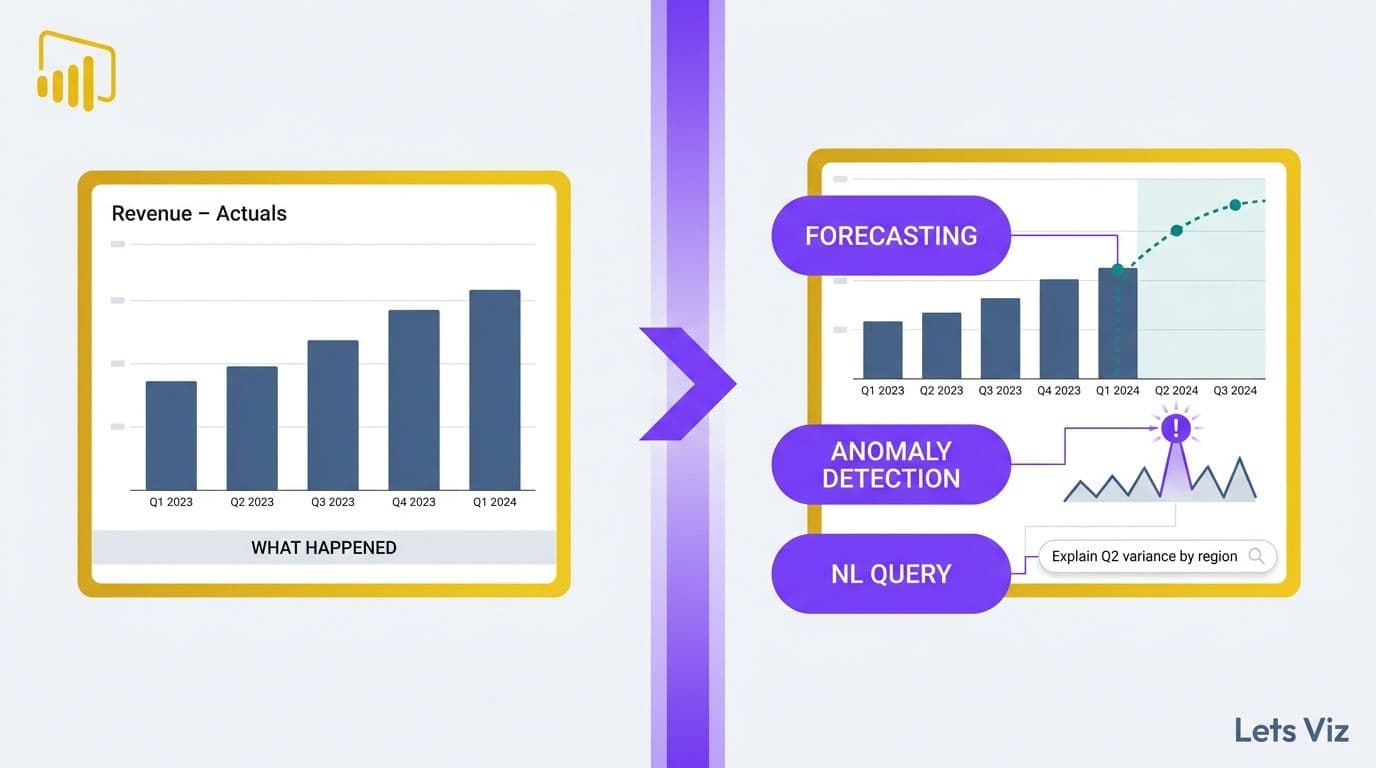
A managed AI analytics consultant adds forecasting models, anomaly detection, and natural-language querying on top of your existing Power BI environment - without replacing the dashboards your finance teams already rely on. The transition moves reporting from descriptive (what happened) to predictive (what is likely to happen next and where risk is building) - delivered as a structured, ongoing engagement rather than a one-time implementation project.
Key Takeaways
AI capability layers - forecasting, anomaly detection, and natural-language querying - integrate directly into existing Power BI environments without a data stack rebuild
Finance and healthcare teams gain predictive and diagnostic insights without replacing current reports or upskilling every analyst
A managed consultant handles model tuning, semantic layer maintenance, governance, and iteration - reducing the burden on in-house teams significantly
ROI measurement requires baseline metrics established at engagement start: cycle-time reduction, error rates, and forecast accuracy improvement
Data privacy and audit readiness are non-negotiable design constraints in financial services and healthcare AI deployments
What Does AI-Powered Power BI Consulting for Finance Teams Actually Deliver?
AI-powered Power BI consulting for finance teams is not a product you buy from a vendor - it is a structured service engagement that adds intelligence layers to the BI environment you already have. The consultant connects Azure Machine Learning models, Copilot features, or custom Python and R visuals to your existing semantic model, extending what your reports can do without requiring your internal team to develop and maintain those capabilities.
According to Future Market Insights (2026), the AI consulting services market has reached approximately USD 14 billion and is forecast to grow to USD 90.99 billion by 2035, at a 26.2% compound annual growth rate. That trajectory reflects genuine enterprise demand - not adoption hype. Finance and healthcare organizations are funding these engagements because the business case is measurable and the alternatives (building in-house, staying descriptive) carry compounding costs.
The three capability layers a managed engagement typically covers are:
Forecasting - Time-series models surfaced as Power BI visuals for revenue, cash flow, cost center spend, and headcount projections. These replace manual Excel models with living forecasts that update on each data refresh.
Anomaly detection - Statistical alerting on key finance KPIs, flagging deviations in accounts payable, collections, transaction patterns, or claim volumes before they surface in a monthly review meeting.
Natural-language querying (NLQ) - Allowing CFOs, finance directors, and non-technical stakeholders to ask questions in plain English and receive chart-based answers from the same governed data model analysts use.
Each layer requires configuration specific to your data architecture, security role model, and compliance environment. That configuration - and the ongoing tuning that keeps it accurate - is what a managed consultant provides. It is the difference between a properly governed AI deployment and a generic feature toggle that produces unreliable outputs.
For a clear-eyed view of which built-in AI features are production-ready today, The 3 AI features in Power BI that are actually worth using is a practical starting point before scoping any engagement.
How Do Forecasting Models Layer onto Existing Power BI Reports?
Forecasting in Power BI operates on a spectrum from the built-in analytics pane trendline - adequate for simple revenue projections on clean monthly data - to ARIMA, Prophet, or gradient-boosted regression models served through Azure ML endpoints and rendered as custom visuals. A managed consultant maps your forecast requirements to the right point on that spectrum, then integrates the model output into your existing report pages rather than building a separate standalone tool.
The configuration decisions that determine forecast quality include:
Training data scope - how many historical periods to include, and how to handle structural breaks like one-time revenue events or external shocks that would otherwise bias model output
Confidence intervals - displaying P10 and P90 bands so executives understand forecast uncertainty as a range rather than treating a point estimate as a commitment
Refresh cadence and retraining triggers - ensuring the model retrains automatically when underlying data patterns shift, not only when an analyst notices accuracy degradation
Writeback integration - in more advanced deployments, allowing finance teams to input driver assumptions (headcount plans, price changes) and see immediate projected impact on the forecast
For finance teams running monthly close cycles, a well-configured forecasting layer typically reduces the analyst hours spent building and reconciling manual Excel projections by 40 to 60 percent. For a mid-market finance team of three to five analysts managing a standard monthly close, that translates to roughly 80 to 120 recovered hours per cycle - capacity that typically redirects toward variance commentary, board-level scenario analysis, and the forward-looking business partnership conversations that create the most value from a CFO's perspective.
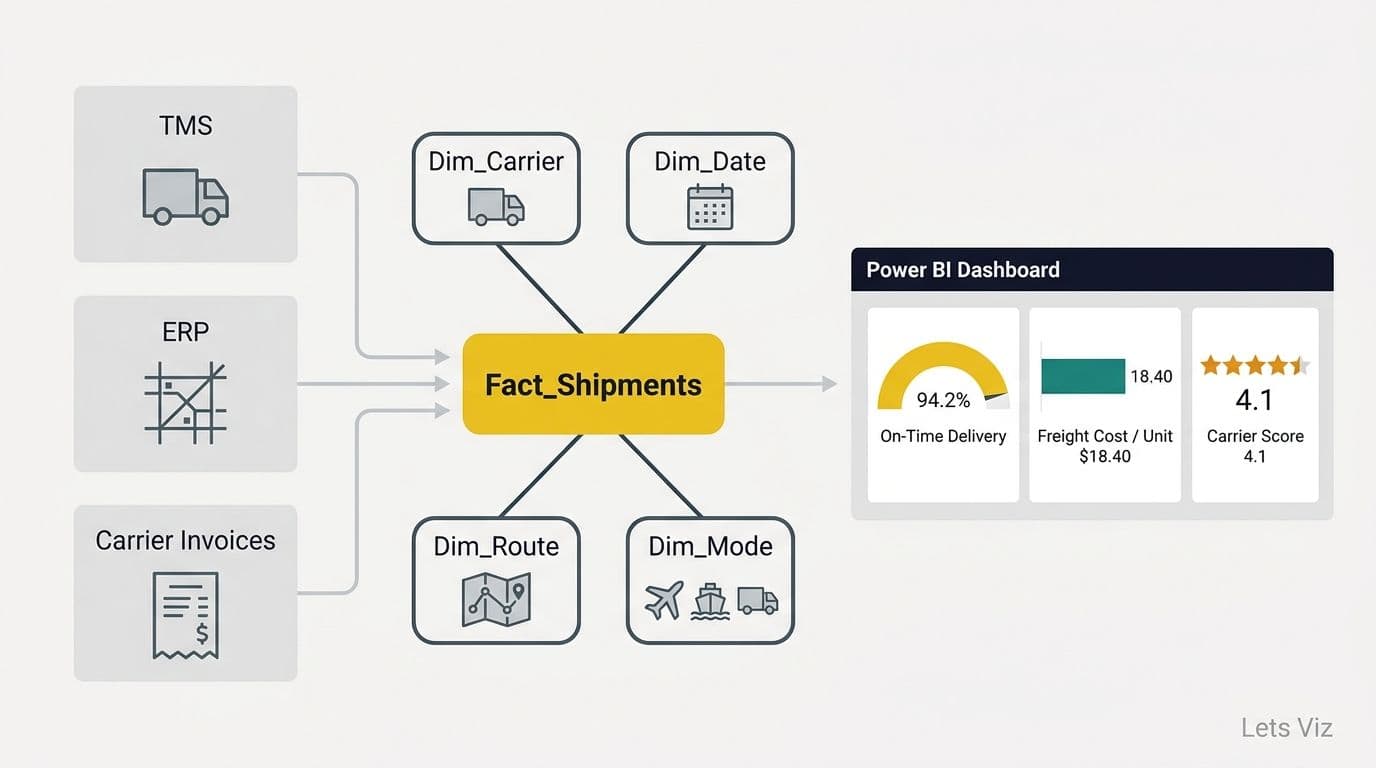
How to Build a Power BI Financial Dashboard for Healthcare illustrates how these architecture components fit together in a real healthcare finance implementation.
What Do Power BI Financial Reporting Examples Look Like Across Finance Teams?
Before committing to a managed engagement, most finance directors want concrete power bi financial reporting examples - not just capability descriptions. Eight report archetypes cover the majority of requirements for US, UK, EU, and Canadian finance teams, each with distinct layout conventions, DAX patterns, and regional formatting considerations. The archetypes below represent the gallery we build as a reusable template layer during onboarding; regional variants share the same measures and differ only in formatting and locale parameters, not in duplicated DAX logic.
1. P&L Statement (Income Statement)
A matrix visual with rows driven by a parent-child account hierarchy and columns for actuals, budget, prior period, and variance. UK teams flip the sign convention on expense accounts using a `Sign` column in the chart of accounts table rather than writing negative-sign logic into every measure. US teams following US GAAP present expenses as positive with subtraction in the P&L hierarchy. Core DAX:
```dax
PL Variance % =
DIVIDE(
[Actual Amount] - [Budget Amount],
ABS([Budget Amount]),
BLANK()
)
```
2. Rolling Forecast
A line chart combining actuals (solid line) and forecast (dashed line) across a 12-month rolling window, with P10/P90 confidence bands shaded. The measure switches between fact tables based on date:
```dax
Rolling Forecast Amount =
IF(
MAX('Date'[Date]) <= TODAY(),
[Actual Amount],
[Forecast Amount]
)
```
3. Cash Flow Statement
A three-section waterfall visual covering operating, investing, and financing activities, with a running balance line overlay. Most mid-market teams build this indirectly from the GL using cash flow category tags on each account rather than a direct method - which simplifies maintenance when the chart of accounts changes.
4. Budget vs Actual
A clustered bar or bullet chart at cost-center or business-unit level, with conditional formatting to flag variances exceeding a materiality threshold. This is the archetype where AI anomaly detection adds the most immediate value, because the model can flag cells where the variance pattern breaks from historical seasonality - not just from a static threshold:
```dax
BvA Flag =
IF(
ABS([PL Variance %]) > 0.05,
"Alert",
"On Track"
)
```
5. Ageing Receivables
A stacked bar with ageing buckets (Current, 1-30, 31-60, 61-90, 90+) built on a calculated column in the invoice table. EU teams under IFRS 9 need this bucketing to map directly to their expected credit loss (ECL) provisioning model - the ageing report becomes an input to the allowance calculation, not just a collections tool:
```dax
Ageing Bucket =
SWITCH(
TRUE(),
'Invoices'[Days Outstanding] <= 0, "Current",
'Invoices'[Days Outstanding] <= 30, "1-30 Days",
'Invoices'[Days Outstanding] <= 60, "31-60 Days",
'Invoices'[Days Outstanding] <= 90, "61-90 Days",
"90+ Days"
)
```
6. Margin Analysis by Product or Service Line
A decomposition tree or small multiples visual showing gross margin, contribution margin, and EBITDA by dimension. The key DAX challenge is shared overhead allocation - distributed across product lines via a driver-based allocation table rather than hard-coded percentages, so the report stays accurate when headcount or floor-space drivers change.
7. Cost Center Variance Report
A matrix with cost centers as rows and GL categories as columns, with 13-month sparklines per row. This is the report most finance business partners use daily, and the one where a persistent anomaly detection layer generates the earliest payback - because it watches every cell continuously rather than waiting for a human to notice a trend break in the monthly review.
8. Working Capital Dashboard
KPI cards for Days Sales Outstanding (DSO), Days Payable Outstanding (DPO), Days Inventory Outstanding (DIO), and Cash Conversion Cycle (CCC), with trend lines and target bands. Canadian teams frequently add a CAD-to-functional-currency conversion layer here since many mid-market Canadian organizations consolidate USD and CAD entities in the same semantic model:
```dax
DSO =
DIVIDE(
[Accounts Receivable Balance],
DIVIDE([Revenue], 365)
)
```
The regional differences that most commonly require customization across all eight archetypes are: fiscal year start (April for UK, January for US/Canada, varies by jurisdiction for EU), currency formatting conventions (GBP symbol placement, EU decimal comma versus period), and VAT/GST treatment in the P&L and cash flow reports. A managed engagement templates these differences at the semantic layer so adding a new regional entity is a configuration task, not a rebuild.
What Is Anomaly Detection in Finance Dashboards - and Why Does It Matter?
Anomaly detection flags data points that fall outside statistically expected ranges and surfaces them before a human analyst would find them in a standard review cycle. In finance, that means catching a sudden spike in vendor payments, an unexplained dip in collections efficiency, or a claim volume pattern deviating from seasonal norms - in practice, 15 to 30 days earlier than a monthly variance report would surface the same issue. For healthcare organizations managing denial rates that climbed to 15-18% at major payers through 2026, that lead time is the difference between a manageable appeal queue and a revenue cycle backlog.
According to Market Research Future (2026), the Healthcare Financial Analytics Market is projected to grow at an 8.58% CAGR through 2035 - momentum that has accelerated as organizations increase investment in AI-driven denial management and payer contract compliance monitoring.
In Power BI, anomaly detection can be implemented through several methods, each with different capability and cost profiles:
| Method | Best for | Limitation |
|---|---|---|
| Built-in smart narrative anomalies | Quick wins on single measures, minimal configuration overhead | Limited to visual-level; cannot alert across multiple measures |
| Azure Anomaly Detector API | High-frequency transactional data, near-real-time flags | Requires API configuration and ongoing cost management |
| Custom Python or R visuals | Complex multi-variate patterns across correlated metrics | Requires data science oversight to maintain model accuracy |
| Power Automate alerts on KPIs | Threshold-based notification workflows to email or Teams | Rules-based only - misses novel patterns outside predefined ranges |
A managed consultant designs the right combination for your data volume, refresh frequency, and organizational alert tolerance - balancing sensitivity (catching real issues early) against specificity (preventing the alert fatigue that causes teams to ignore all notifications). Governance documentation for each alert rule also matters for audit purposes, which is often overlooked in self-service deployments.
How Does Natural-Language Querying Transform Finance Reporting?
Natural-language querying allows a CFO or finance director to type a question - "show me Q2 gross margin by business unit compared to budget" - and receive an accurate chart without routing a ticket through the BI team or waiting for a scheduled report run. In Power BI, this capability is delivered through Q&A visuals, Copilot chat integration, and Azure OpenAI connections that understand your specific semantic model terminology.
The practical impact for finance reporting workflows is significant. Non-technical leaders gain direct data access for the ad-hoc questions that actually drive decisions. The BI team's backlog of one-off report requests decreases - finance teams with Copilot NLQ integrated into a governed semantic model have reported a 30-40% reduction in ad-hoc BI requests within the first quarter post-deployment - freeing capacity for more complex analytical work. Finance business partners can explore scenarios in real time during planning or board prep sessions.
For NLQ to produce accurate, permission-safe results, the semantic layer must be built to production quality - table relationships unambiguous, measure names intuitive, synonyms registered, row-level security enforced consistently. This is where ad-hoc Copilot deployments most commonly fail: the underlying data model was built for analyst use, not natural-language interpretation. A managed consultant's job includes building and maintaining that semantic layer as the data environment evolves - a function that is easy to underestimate and expensive to retrofit.
Understanding how different AI chat interfaces perform on real finance questions matters before selecting a toolset. Copilot for Power BI vs ChatGPT vs Claude: we put all three on the same 3 finance questions provides a grounded, tested comparison of each approach on realistic finance scenarios.
AI Analytics Consulting vs. In-House Data Team: Which Model Fits Finance Organizations?
This is the central strategic question for most finance and healthcare leaders evaluating how to use AI in Power BI for business reporting. The right answer depends less on company size and more on what the AI layer needs to do - and how quickly the organization needs it operational.
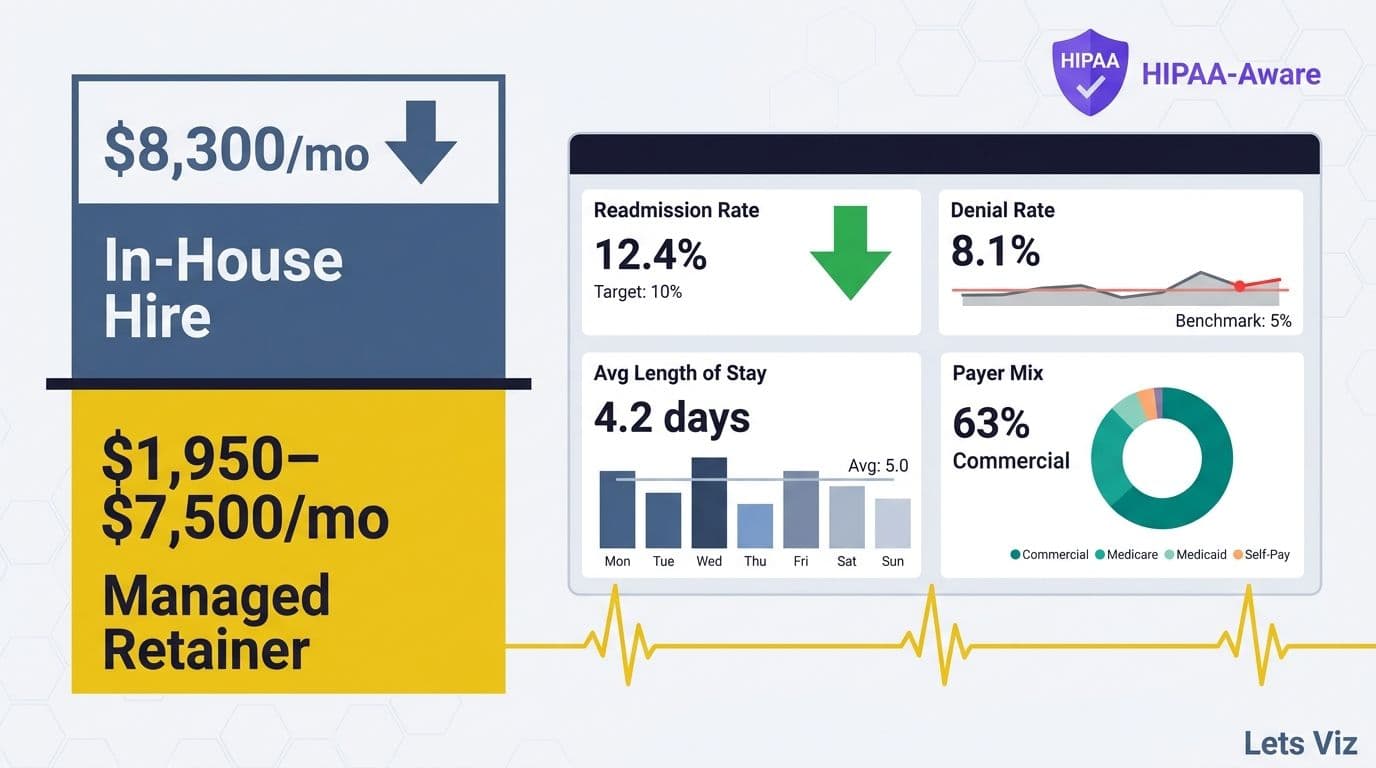
An in-house data team is the right choice when the organization needs to build proprietary models, when analytics is core to competitive differentiation, or when regulatory requirements mandate full internal control of all data processing. Building that team - data engineers, ML engineers, and senior BI developers with finance domain expertise - typically carries a fully loaded annual cost starting at USD 480K to USD 720K (as of mid-2026, reflecting a 15-20% increase in data and ML engineering salaries over the prior two years) before tooling and infrastructure investment.
A managed AI analytics consultant is better suited for finance and healthcare organizations that need production-grade AI capabilities on a defined timeline, without a multi-year hiring and ramp cycle. This model is especially relevant as an AI analytics consulting option for small and mid-size businesses where the fixed cost of a full in-house team is prohibitive relative to the scope of work required.
| Criteria | In-House Team | Managed Consultant |
|---|---|---|
| Time to first insight | 6-18 months (hiring plus ramp) | 4-8 weeks (scoped engagement) |
| Ongoing cost structure | Fixed headcount, high fixed cost | Variable retainer, predictable billing |
| AI model governance | Internal, fully controlled | Contractual SLA with documented audit trail |
| Ability to scale scope | Limited by headcount capacity | Adjustable per quarter based on priority |
| Finance domain expertise | Generalist unless specialized hire secured | Embedded in service delivery model |
| Compliance readiness | Requires dedicated privacy and legal review layer | Built into engagement framework from day one |
| Viability for mid-market | Rarely feasible at full build-out cost | Purpose-built model for mid-market budgets |
For a decision framework grounded in real engagement patterns, When to Hire a Power BI Consultant: 5 Trigger Events That Justify Outside Help identifies the organizational signals that indicate external expertise will outperform internal hiring.
How Do Healthcare Finance Teams Use AI Analytics Differently?
Healthcare finance operates under constraints that make standard AI deployment playbooks inadequate. HIPAA compliance, claim audit trail requirements, and payer contract complexity mean every AI layer added to a Power BI environment must pass a different review than a standard corporate finance deployment.
MedInsight (2026) identified AI-driven analytics as one of three dominant themes reshaping healthcare finance alongside value-based care and payer analytics innovation - a finding that has sharpened through 2026 as denial rates at major payers have climbed, raising the financial stakes of predictive coding and authorization analytics. The specific use cases gaining adoption in healthcare finance teams include:
Prior authorization analytics - predicting denial likelihood by payer and CPT code before submission, enabling coding teams to address issues proactively rather than through appeals
Cost-per-case variance analysis - detecting outlier episodes of care against DRG benchmarks, supporting case management intervention before discharge
Value-based care performance tracking - forecasting quality metric attainment under shared-savings contracts, giving finance leaders forward visibility on bonuses or penalty exposure months in advance
Healthcare organizations must also address AI analytics data privacy risks directly and explicitly as a design requirement. Patient-level data cannot flow into general-purpose language model endpoints without de-identification and contractual Business Associate Agreements in place. Responsible consulting engagements define these data boundaries during the scoping phase and enforce them through technical architecture decisions - not policy documents that sit in a SharePoint folder.
For healthcare CFOs and VPs of Finance weighing platform choices, the question of tableau vs power bi for healthcare finance reporting comes up early in any engagement scoping conversation - particularly for organizations running RCM analytics alongside multi-entity budget consolidation. The section below addresses that comparison directly across the dimensions that matter most for US health systems, NHS trusts, and Canadian health authorities.
For a broader view of how AI analytics consulting is applied across both financial services and healthcare, AI Services and Consulting for Finance and Healthcare Leaders covers the strategic framing and common implementation patterns.
How Should CFOs and VPs of Finance Choose Between Tableau and Power BI for Healthcare Finance Reporting?
The tableau vs power bi for healthcare finance reporting decision is rarely a pure technology call - it is a question of where each platform creates durable operational value across the specific workflows healthcare finance teams run at scale. For CFOs and VPs of Finance at US health systems, NHS trusts, and Canadian health authorities, the comparison surfaces meaningful differences across three decision dimensions: budget reporting with ERP integration, revenue cycle management (RCM) analytics, and multi-currency consolidation.
Budget Reporting
Power BI's native integration with Microsoft 365 and Azure gives it a structural advantage for healthcare organizations already running Epic, Cerner, or Oracle Health on Azure-backed infrastructure. Budget actuals flow from the ERP directly into a governed semantic model via Azure Data Factory or Fabric pipelines, and finance teams can write back driver assumptions through connected Excel sheets without leaving the Microsoft environment. Tableau's strength is visualization flexibility - its nested table calculations and Viz in Tooltip features produce richer comparative layouts for large service-line hierarchies, but they require more manual data pipeline work and lack native writeback without a third-party connector.
For US health systems on a January fiscal year and NHS trusts on an April fiscal year, Power BI's fiscal year offset is a single parameter setting applied once at the semantic model level. Tableau requires a custom calculated field per dashboard, which multiplies maintenance burden as entity count grows - a real friction point for NHS integrated care systems consolidating multiple trust reporting lines.
RCM Analytics
Revenue cycle management is where the platform comparison becomes most consequential for healthcare finance. Denial rate trending, payer contract compliance monitoring, and authorization analytics require high-volume transactional data refreshes - often intraday for large US health systems processing tens of thousands of claims daily. Power BI Premium with incremental refresh handles large claim tables efficiently and integrates Azure Anomaly Detector directly into the semantic model for real-time denial pattern flagging. Tableau relies on Hyper extracts, which perform well but add extract management overhead that mid-market revenue cycle teams frequently underestimate during platform selection.
For US health systems managing denial rates that have remained elevated at 15-18% at major commercial payers through 2026, the ability to layer predictive denial models directly into Power BI's refresh pipeline - without a separate data science infrastructure - provides a meaningful operational advantage. Tableau's predictive analytics depend on Salesforce Einstein integration or external Python and R connections that carry separate licensing and additional data governance review requirements under HIPAA.
Multi-Currency Consolidation
NHS trusts reporting in GBP, Canadian health authorities consolidating CAD and USD entities, and US academic medical centers with international research funding all face multi-currency requirements that expose a clear Power BI advantage. The currency conversion table combined with USERELATIONSHIP DAX patterns handles dynamic exchange rates across any number of entity combinations within a single semantic model, without duplicating measures. Tableau's multi-currency support requires either pre-processing in the data layer or per-dashboard calculated fields that multiply with organizational complexity - creating a governance burden as the entity structure evolves.
The decision summary for healthcare finance leaders:
| Dimension | Power BI | Tableau |
|---|---|---|
| Budget reporting with ERP writeback | Native via Excel or Fabric | Requires third-party connector |
| Intraday RCM refresh on claim volumes | Incremental refresh in Premium | Hyper extract with scheduling overhead |
| Multi-currency DAX across entities | Single semantic model, dynamic rates | Per-dashboard calculated fields |
| NHS April fiscal year offset | Single parameter setting | Custom calculated field per report |
| AI anomaly detection on denial patterns | Azure Anomaly Detector native integration | Einstein or external Python and R |
| Microsoft 365 ecosystem fit | Native | Connector-dependent |
| License cost for mid-market health systems | Power BI Pro approx. $10 per user per month | Tableau Creator approx. $75 per user per month |
For organizations already committed to the Microsoft stack - which describes the majority of US health systems, NHS trusts aligned with NHS England's digital infrastructure, and Canadian health authorities operating on provincial Azure tenancies - Power BI is the operationally lower-friction platform for healthcare finance reporting. Tableau remains a strong option where visualization complexity, an established Tableau Server environment, or a Salesforce-centric data culture justifies the higher per-seat cost and the investment in extract pipeline management. The clearest signal for Tableau is an organization that has already built a mature Tableau governance layer and would face significant migration cost - not one starting fresh with a greenfield healthcare finance analytics program.
How to Measure ROI of AI Analytics Tools for Finance
Every CFO will ask this question, and the answer needs to be specific rather than conceptual to survive budget review. The most defensible ROI measurement framework for AI analytics tools tracks four categories, with baselines established at the start of the engagement:
1. Cycle time reduction - analyst hours per reporting cycle eliminated through automation of manual forecasting, reconciliation, or exception-reporting tasks
2. Error rate improvement - reduction in restatements, reconciliation exceptions, or audit findings tied to data quality or process gaps the AI layer now catches automatically
3. Decision speed - elapsed time from question raised to decision made for recurring finance decisions supported by the AI capability
4. Forecast accuracy - mean absolute percentage error (MAPE) improvement over the baseline forecast method, measured across a defined rolling window of actual-versus-projected comparisons. Finance teams transitioning from manual rolling forecasts to AI-driven Power BI models have reported MAPE reductions of 20-35 percentage points within the first two quarters of an engagement - most pronounced in cash flow and cost center spend projections where historical seasonality patterns are stable and the baseline Excel model lacked confidence-interval discipline.
A well-structured consulting engagement establishes baseline measurements in week one, defines target improvement ranges contractually, and reports against them in monthly or quarterly business reviews. That discipline is what separates AI analytics investment from speculative technology spend - and what makes the business case defensible to a board or external auditor who asks for evidence.
What Metrics Should a Financial Reporting Dashboard Include? provides a baseline framework for defining dashboard KPIs before adding AI layers - a useful prerequisite for any ROI measurement exercise.
---
If your finance or healthcare organization is ready to move Power BI dashboards from descriptive to predictive, Managed Power BI services from Lets Viz deliver forecasting, anomaly detection, and natural-language querying as a managed engagement with measurable SLAs and a defined governance framework.
---
About Lets Viz: Lets Viz is a data analytics consulting firm with over a decade of experience serving finance and healthcare organizations across North America and the UK. Our consultants hold Microsoft Power BI certifications and have delivered AI analytics programs for mid-market and enterprise clients navigating digital transformation, regulatory compliance, and the shift from descriptive to predictive decision-making at scale.