What Does an AI Analytics Consultant Do? A Leader's Guide
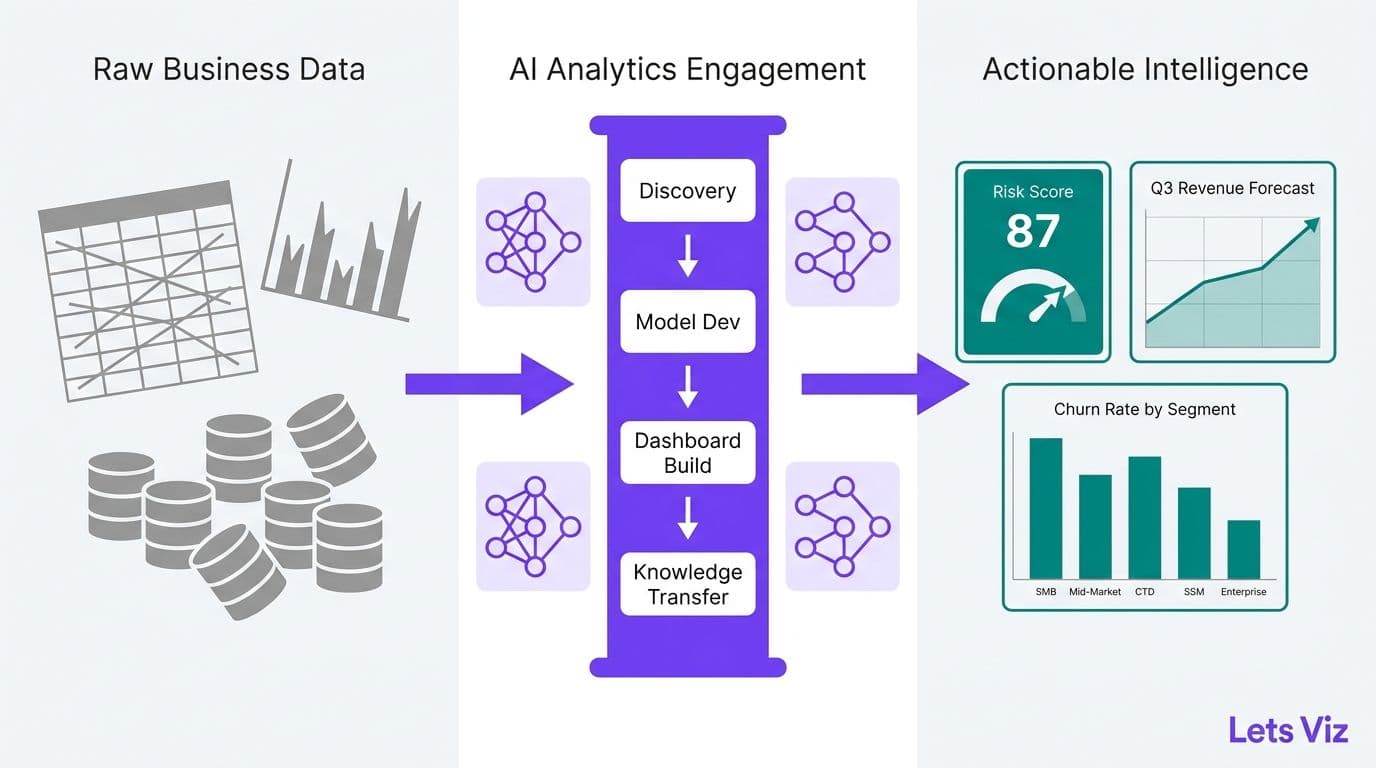
An AI analytics consultant designs and implements data strategies that turn raw business data into actionable intelligence - using machine learning, predictive modeling, and automated reporting to solve specific commercial problems. Engagements typically span three to six months, covering discovery, model development, dashboard build, and knowledge transfer. Outputs range from automated financial dashboards to predictive risk models and real-time clinical decision tools. Whether you hire an independent practitioner, a boutique firm, or an analytics consulting LLC, the core scope of work is the same, and the more technical end of it is often sold as advanced analytics consulting.
Key Takeaways
AI analytics consultants scope work around specific business problems, not generic technology deployments.
Deliverables include predictive models, automated dashboards, and data governance frameworks - not just reports.
Advanced analytics consulting goes beyond descriptive reporting into forecasting, optimization, and prescriptive decision support.
ROI timelines in financial services and healthcare typically run 60 to 180 days for initial measurable returns.
The consultant model differs from an in-house data team: you gain cross-industry pattern recognition without long-term headcount cost.
Data privacy compliance (HIPAA, SOC 2, GDPR) is a core consulting deliverable in regulated industries - not an afterthought.
When you hire an analytics consulting LLC, the contract, liability terms, and data-handling agreements matter as much as the technical pitch.
What Does an AI Analytics Consultant Do?
An AI analytics consultant partners with business leaders to define data problems, build the analytical infrastructure to address them, and transfer capability so the organization can sustain the work independently. The role sits at the intersection of data engineering, business strategy, and machine learning - distinct from a pure software developer and from a traditional management consultant who delivers recommendations without implementation.
A typical engagement covers six core activities:
1. Data audit and gap analysis - mapping what data exists, where it lives, and what is missing.
2. Problem framing - translating a business question such as 'Why is our claims denial rate rising?' into a measurable analytical objective.
3. Model or dashboard development - building the predictive model, automated report, or decision support tool.
4. Integration - connecting outputs to existing systems (ERP, CRM, EMR, Power BI).
5. Validation and governance - ensuring models are accurate, explainable, and compliant with regulatory standards.
6. Knowledge transfer - documenting the solution and training internal teams to operate and maintain it.
The most effective AI analytics consultants combine domain expertise in your industry with genuine technical depth. A financial services consultant should understand regulatory capital requirements and model risk management standards. A healthcare consultant should know HL7 FHIR interoperability standards and clinical workflow. This domain knowledge separates solutions that pass technical review from those that actually change how decisions are made.
Demand for AI consulting keeps growing because organizations hire consultants when building these capabilities in-house would take years, not quarters.
For a practical sense of what this looks like in regulated sectors, our guide to AI services and consulting for finance and healthcare leaders covers the engagement types that deliver the most measurable value.
What Is Advanced Analytics Consulting and How Does It Differ From Standard BI Work?
Advanced analytics consulting applies statistical modeling, machine learning, and optimization techniques to questions that standard business intelligence cannot answer. Standard BI describes what happened. Advanced analytics explains why it happened, forecasts what is likely next, and increasingly recommends what to do about it. In practice, the two sit on a maturity ladder: descriptive reporting, diagnostic analysis, predictive modeling, and prescriptive decision support.
Typical advanced analytics work includes:
- Forecasting - cash flow, demand, patient volumes, or claims trends built on time-series models.
- Classification and scoring - credit risk, fraud likelihood, claim denial probability, or churn propensity.
- Segmentation - grouping customers, providers, or accounts by behavior rather than by static attributes.
- Optimization - allocating staff, capital, or inventory against constraints.
- Natural language processing - extracting structure from contracts, clinical notes, or support tickets.
Most organizations should not begin here. Advanced models depend on trusted, consistently defined data, so a sound advanced analytics consulting engagement usually starts with the data audit and a working dashboard layer, then moves up the ladder once the foundation holds. When a proposal promises machine learning before it has examined your data quality, treat that as a warning sign.
What Deliverables Should You Expect From an AI Analytics Engagement?
Deliverables vary by engagement type, but a well-scoped project produces documented, handover-ready artifacts - not just a slide deck. Vague deliverables are a red flag at the proposal stage; specific, measurable outputs tied to a clear timeline are the industry standard.
| Engagement Type | Primary Deliverable | Time to First Output |
|---|---|---|
| Financial reporting automation | Live Power BI dashboard with automated refresh | 4-6 weeks |
| Predictive risk model | Scored model + API endpoint + documentation | 8-12 weeks |
| Data strategy and roadmap | Prioritized initiative backlog + governance framework | 3-4 weeks |
| AI readiness assessment | Gap analysis report + tool recommendations | 2-3 weeks |
| Clinical decision support | Model + EMR integration + validation report | 12-20 weeks |
The distinction between a dashboard and a predictive model matters at the evaluation stage. A dashboard visualizes what happened; a model forecasts what will happen and - in healthcare or finance - why a particular outcome is likely. Most organizations start with dashboards because data quality issues surface quickly, then graduate to modeling once the foundation is solid.
Knowing which metrics your dashboards should surface from the start eliminates costly rework. Our guide on what metrics a financial reporting dashboard should include covers the standard KPI set for finance and healthcare finance functions.
How Do AI Analytics Consultants Serve Financial Services Teams?
In financial services, AI analytics consulting for finance reporting, risk analytics, and client intelligence concentrates on three distinct problem categories - each with its own data stack and tolerance for model complexity.
The most effective financial services engagements begin with a structured data audit that surfaces two recurring issues: data living in multiple systems with inconsistent definitions, and data everyone assumes exists but does not. Resolving these upstream before model development begins distinguishes consultants who deliver production-ready work from those who hand over a prototype that cannot survive contact with the production environment.
Reporting automation is typically the fastest win. Finance teams still running month-end close on spreadsheets can compress a five-day cycle to same-day with a well-built Power BI model connected to the general ledger. Understanding how to use AI in Power BI for business reporting is increasingly part of what consultants deliver - not just the dashboard, but the AI-assisted interpretation layer on top.
Risk analytics carries the largest ROI potential but the heaviest validation requirements. A credit risk model that reduces charge-off rates by even 10 basis points across a billion-dollar portfolio creates $10 million or more in annual value - but it must clear model risk management review before any production deployment.
Client intelligence covers segmentation, churn prediction, and next-best-product models, including the AI-driven personalization engines behind modern robo-advisory services. Consultants increasingly build these layers on top of existing CRM and portfolio management platforms rather than replacing them.
How Does AI Analytics Consulting Work in Healthcare Organizations?
Healthcare presents the most technically complex and compliance-sensitive environment for AI analytics work. A consultant must simultaneously navigate HIPAA data handling requirements, interoperability standards (HL7 FHIR), and clinical validity expectations - while delivering business value on a timeline that healthcare finance leadership can defend to the board.
The three dominant use cases right now are value-based care analytics, revenue cycle optimization, and payer analytics. How healthcare finance teams use AI analytics typically centers on modeling population health risk, predicting claim denials before submission, and optimizing contract performance under value-based reimbursement agreements. The continuing shift away from fee-for-service reimbursement, reinforced by CMS value-based care programs, keeps this work high on the priority list for health system finance leaders.
AI analytics data privacy risks for healthcare organizations deserve specific attention during vendor evaluation. A well-scoped engagement builds de-identification, role-based access controls, and audit logging into the architecture from the first design session. Consultants who treat privacy requirements as blockers rather than design inputs represent a liability, not a service.
For health system finance teams, our guide on how to build a Power BI financial dashboard for healthcare covers the data model structure that satisfies both operational reporting and compliance requirements simultaneously.
AI Analytics Consulting vs In-House Data Team: What Is the Real Difference?
This is the question most mid-market organizations face before signing their first engagement. The honest answer depends on three factors: how well-defined the problem is, how fixed the timeline is, and how much institutional data knowledge needs to remain internal.
| Dimension | AI Analytics Consultant | In-House Data Team |
|---|---|---|
| Time to first output | 4-12 weeks | 6-18 months (hiring and ramp) |
| Cross-industry pattern recognition | High - draws from multiple client engagements | Low - limited to organizational history |
| Cost structure | Project-based, predictable, clear end date | Fixed headcount plus benefits and management overhead |
| Data privacy risk | Governed by contract, NDA, and data processing agreement | Lower inherent third-party risk |
| Long-term capability building | Moderate - depends on knowledge transfer rigor | High - expertise stays in-house |
| Scalability | Scale up or down by engagement scope | Requires hiring and budget cycles |
The strongest case for consulting is when the problem is well-defined, the timeline is fixed, and the internal team lacks a specific technical skill. The strongest case for in-house is when the work is continuous, mission-critical, and embedded in proprietary data that cannot practically leave the building.
AI analytics consulting for small and mid-size businesses is increasingly common and often more economical than building an internal data team. A three-person analytics function fully loaded costs $700,000 to $1,050,000 annually in most US markets (reflecting 2026 compensation benchmarks). A focused engagement delivering equivalent output in 90 days - typically priced between $50,000 and $150,000 depending on scope - changes the build-vs-buy calculus significantly for mid-market organizations that cannot absorb an 18-month hiring and ramp cycle.
Our breakdown of outsourced financial analytics services for smarter insights covers this decision framework in depth for finance-led organizations.
What Should You Look for in an Analytics Consulting LLC?
Many small and mid-size analytics providers operate as a limited liability company, so "analytics consulting LLC" is a common label on proposals. The LLC designation describes the legal structure of the business, not the quality of its work. It tells you who signs the contract and where liability sits, so it is worth checking alongside the technical credentials.
Before signing with any analytics consulting LLC, confirm five things:
1. Contract and liability terms. Check who is accountable if a model produces a harmful error, and whether liability caps are reasonable for the scope of work.
2. Insurance coverage. Professional liability (errors and omissions) and cyber coverage should match the sensitivity of the data being handled.
3. Data-handling agreements. In healthcare, a Business Associate Agreement is mandatory before any protected health information is shared. In all regulated sectors, require a data processing agreement and clear data-return and deletion terms.
4. Intellectual property ownership. The contract should state that models, code, and documentation transfer to you at handover.
5. Continuity and references. A very small firm can depend on one or two people. Ask who covers the work if a lead consultant is unavailable, and request references from clients in your industry.
A smaller firm often brings senior attention and flexible pricing, while a larger consultancy brings depth of bench. Neither is automatically better. The right choice is the provider whose domain experience, governance practices, and handover discipline match your problem.
How Do You Measure the ROI of an AI Analytics Engagement?
Measuring the ROI of AI analytics tools and engagements requires selecting the right metric category before the work begins - not after delivery. Outcomes fall into three buckets: time savings, revenue impact, and risk reduction. Each requires a different measurement approach and carries a different confidence level at the proposal stage.
Time savings are the most straightforward to quantify. If a finance team spends 40 hours per month on manual reporting and an automated dashboard reduces that to four hours, the value is immediate and defensible.
Revenue impact takes longer to isolate. A churn prediction model that reduces customer attrition by two percentage points is valuable, but attributing that to the model - rather than to pricing changes, product improvements, or market conditions - requires a proper holdout test and at least one full business cycle of data.
Risk reduction is the hardest to monetize but frequently the largest in regulated industries. HHS Office for Civil Rights collected more than $28 million in HIPAA settlements and civil monetary penalties in 2025, with average resolution amounts exceeding $1.5 million per enforcement action. A single avoided breach or model risk management finding can be worth multiples of the entire consulting investment.
Realistic timelines for measurable returns:
60-90 days: Reporting automation and dashboard deployment - time savings visible from day one of production operation.
90-180 days: Initial model performance data, early signal on classification accuracy, first leading indicators of business outcome.
180-365 days: Full business outcome validation - revenue, cost, or risk impact - with enough data to be statistically defensible to a CFO or audit committee.
Across financial services, the firms with the clearest ROI outcomes are consistently those that defined success metrics at the start of an engagement - not retrospectively.
When Should a Business Leader Hire an AI Analytics Consultant?
Five situations reliably justify an external AI analytics engagement over waiting for internal capacity to develop:
1. A defined problem with a non-negotiable deadline. A regulatory requirement, a board mandate, or a product launch creates urgency that internal roadmaps cannot absorb without disrupting existing delivery commitments.
2. Your existing data team is at capacity. Analysts running business-as-usual reporting have no bandwidth for net-new model development, and the opportunity cost of delay compounds quickly.
3. You need a technical skill the team does not have. Natural language processing, computer vision, time-series forecasting, and agentic AI orchestration are specialized enough that hiring cycles run six to twelve months even in favorable conditions. This is where advanced analytics consulting earns its fee.
4. You need cross-industry pattern recognition. Consultants who have solved the same problem across multiple organizations bring tested playbooks - and knowledge of where those playbooks have failed.
5. You are evaluating a major technology investment. An independent AI readiness assessment before committing to a new data platform or AI vendor surfaces the best AI tools for your specific business data analysis needs and prevents expensive lock-in mistakes.
Each of these situations shares one characteristic: the cost of delay exceeds the cost of the engagement. In financial services and healthcare, regulatory timelines, competitive dynamics, and the compounding nature of unrealized efficiency gains make that calculus relatively clear. A well-scoped engagement with defined deliverables and a structured handover plan removes the main risk that keeps organizations in evaluation mode longer than the opportunity warrants.
---
If your organization is at one of these decision points, Managed Power BI services from Lets Viz covers the full engagement spectrum - from initial data strategy through predictive model deployment and ongoing dashboard management - for financial services and healthcare clients.
---
About Lets Viz: Lets Viz is an analytics consulting firm with more than eight years of experience delivering data strategy, Power BI implementations, and AI analytics solutions to financial services and healthcare organizations across the US and UK. The team holds Microsoft Power BI certifications and specializes in turning complex, multi-source data environments into clear, decision-ready intelligence for finance and clinical operations leaders.