Will AI Replace Financial Analysts? What FP&A Teams Must Know
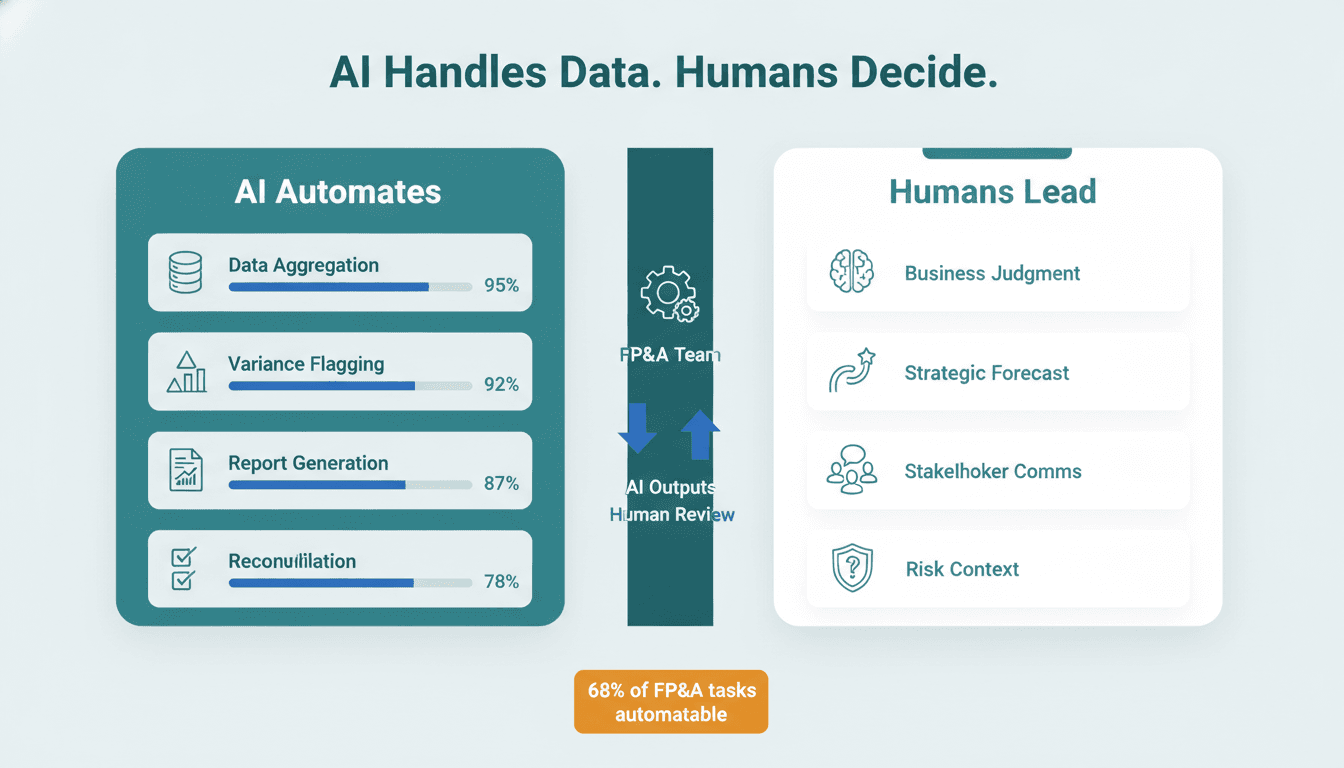
AI will not replace financial analysts in any broad sense. The tools that have proliferated through 2025 and 2026 automate specific, high-volume tasks - data aggregation, variance reporting, routine reconciliations - while leaving business judgment, stakeholder communication, and strategic forecasting in human hands. For CFOs and FP&A directors in the US, UK, and Canada, the practical question is not replacement but effective augmentation.
Key Takeaways
- AI automates repetitive FP&A tasks - data consolidation, variance flagging, report generation - but cannot replicate business context or strategic judgment.
- Workforce data across the US, UK, and Canada shows demand for analysts who can interpret AI outputs is rising, not falling.
- A structured finance analytics maturity model helps teams deploy AI progressively without creating governance gaps.
- Real-time financial reporting becomes more feasible when AI handles data ingestion and anomaly detection, freeing analysts for narrative interpretation.
- Data governance is the single biggest bottleneck: AI output is only as trustworthy as the pipelines feeding it.
What Tasks Is AI Automating in FP&A Today?
AI is most effective in FP&A at tasks that are rule-bound, high-frequency, and historically labor-intensive. Data consolidation from multiple ERP and CRM systems, monthly close reconciliations, and templated variance reports are the clearest examples.
The table below distinguishes where AI replaces manual effort outright from where it acts as a co-pilot for the analyst:
| FP&A Task | AI Role | Human Role |
|---|---|---|
| Data consolidation from ERPs | Fully automated ingestion | Validate pipeline integrity |
| Variance reporting | Automated flag + narrative draft | Interpret root cause |
| Rolling forecasts | Model generation and refresh | Challenge assumptions |
| Budget vs. actuals dashboards | Real-time refresh | Present to stakeholders |
| Anomaly detection in revenue | Pattern detection | Confirm and escalate |
| Covenant compliance monitoring | Rule-based alerting | Legal and strategic response |
| Board deck narrative | Draft generation | Edit, contextualize, approve |
| Capital allocation decisions | Scenario modeling | Final judgment call |
Teams building Power BI for SaaS finance teams reporting stacks often find that the first automation wins come precisely here: connecting live ERP data to a governed semantic layer so that AI-assisted variance flags surface within hours of month-end close rather than days.
The AI-powered data analysis in audits market was valued at USD 2.9 billion in 2025 and is projected to reach USD 20.1 billion by 2035, growing at a CAGR of 21.5% (Market.us, 2025). That growth reflects genuine enterprise adoption concentrated in exactly these high-frequency reconciliation and audit workflows.
Will AI Replace Financial Analysts? What Workforce Data Shows
No - regional labor data and enterprise adoption patterns point in the opposite direction. The roles facing the most pressure are narrow data-entry and report-distribution tasks, not the analytical and advisory functions that occupy most of a senior analyst's week.
In the US, recent Bureau of Labor Statistics occupational outlook data categories financial analysts as stable to growing, with the primary skill shift toward data interpretation and business communication rather than raw data handling. AI tools are increasing the output a single analyst can produce, not reducing team headcount.
In the UK and EU, GDPR obligations create an accountability layer that AI cannot satisfy autonomously: a named individual must sign off on any financial representation that affects data subjects or touches regulatory filings. FCA-regulated firms face the same accountability requirement. The human analyst becomes the compliance checkpoint.
In Canada, PIPEDA governs how personal financial data is handled. Canadian public companies reporting under IFRS or US GAAP need human judgment on disclosure decisions that no model can make independently.
The pattern across all three markets is consistent: AI expands what a finance team can produce, while regulation ensures a human remains accountable for every output.
Which FP&A Functions Does AI Augment Rather Than Replace?
The clearest augmentation cases are where the analyst's core job is interpretation rather than data production - and where removing the human would introduce unacceptable risk.
Strategic forecasting requires knowledge of pipeline health, product roadmap, and competitive signals that live outside any data warehouse. AI can generate scenarios and refresh models; it cannot weigh the strategic trade-offs between them.
Stakeholder communication - the board deck, the investor update, the quarterly business review - requires understanding what the audience needs to hear and in what order. AI-generated narrative drafts are useful starting points, not final products.
Revenue recognition judgment is increasingly critical for SaaS finance teams, where ASC 606 (US) and IFRS 15 (UK and Canada) require contractual interpretation that blends legal and financial expertise. AI can flag deferred revenue mismatches; it cannot make the recognition call.
Cross-functional influence is perhaps the least-discussed gap. A CFO or VP Finance builds trust with revenue, product, and board counterparts over years. That trust is not transferable to a model.
For teams running month-end financial close automation, the consistent finding is that AI cuts time spent on mechanical close tasks significantly - but the time saved flows back into analysis and business partnering, not headcount reduction.
How Does a Finance Analytics Maturity Model Guide AI Adoption?
A finance analytics maturity model provides a structured framework for assessing where a team's capabilities stand today, what the next level is worth building toward, and what governance must be in place before AI is added to critical reporting workflows.
A practical five-level model:
| Level | Capability | AI Readiness |
|---|---|---|
| 1 - Reactive | Ad hoc spreadsheets, no shared definitions | Not ready - data too fragmented |
| 2 - Descriptive | Centralized reporting, basic dashboards | Ready for AI-assisted consolidation |
| 3 - Diagnostic | Variance analysis, drill-down reporting | Ready for AI anomaly detection |
| 4 - Predictive | Rolling forecasts, scenario modeling | Ready for AI-generated model refresh |
| 5 - Prescriptive | Decision support, real-time signals | AI as co-pilot across the finance stack |
Most FP&A teams at mid-market SaaS companies sit at Level 2 or Level 3. Moving from Level 2 to Level 3 is where a finance analytics data governance checklist becomes essential - because AI surfacing anomalies is only useful when the underlying data is clean and metric definitions are shared across finance, revenue, and product.
A critical caution: deploying AI at Level 1 or early Level 2 typically makes reporting worse before it makes it better, because AI amplifies data quality problems rather than correcting them. The foundational investment is always in the data layer first.
Consider a common scenario: a 100-seat SaaS finance team in the US moves from Level 2 to Level 3 by deploying AI anomaly detection on revenue data. The tool flags dozens of anomalies in its first month. A meaningful portion turn out to be false positives caused by inconsistent CRM-to-ERP field mapping. A human analyst triages those flags, fixes the root-cause mapping, and resets the detection baseline. The signal-to-noise ratio improves markedly within two months - but only because an experienced analyst guided the remediation.
Our work with an air-quality remediation company illustrates the same pattern at a smaller scale: a systematic scan of all 9,500 invoices in their system revealed 175 orphaned invoices that a date-filter bug had quietly dropped from the reporting join. The scan surfaced the gap; it took a human analyst to diagnose the ingest logic and fix it permanently.
What Should Be on Your Finance Analytics Data Governance Checklist?
A finance analytics data governance checklist is the operational framework that makes AI-generated outputs trustworthy and auditable. Without it, AI reports are fast but unverifiable.
The minimum viable governance checklist for an FP&A team deploying AI tools:
- Metric definitions: every KPI - ARR, net revenue retention, burn rate - has exactly one documented definition, version-controlled and shared across finance, revenue, and product.
- Data lineage: every number in an AI-generated report traces to a source system through a documented transformation path, satisfying both internal audit requirements and external auditor inquiries.
- Access controls: role-based access governs AI model outputs as strictly as raw data. Under SOC 2 (US SaaS), GDPR (UK and EU), and PIPEDA (Canada), restricted financial data cannot flow freely through an AI pipeline that lacks proper access governance.
- Anomaly thresholds and escalation paths: when AI flags a variance, define who reviews it, within what timeframe, and with what authority to hold or release a report.
- Model refresh cadence: AI forecasting models trained on stale data degrade quietly. Governance requires a documented refresh schedule and a change log capturing what was updated and when.
- Human sign-off requirements: for any report touching regulatory disclosure, covenant compliance, or board communication, a named individual approves before distribution.
For teams using Power BI as the governed semantic layer, AI anomaly detection in financial reporting covers how to implement anomaly flagging and escalation workflows directly within the platform.
What Are Real-Time Financial Reporting Best Practices With AI?
Real-time financial reporting is the practice of delivering finance metrics continuously or near-continuously, rather than at fixed monthly close intervals. AI makes this more feasible but introduces disciplines that finance teams frequently underestimate.
1. Separate speed from precision. Real-time dashboards serve operational decisions - daily cash position, intraday revenue pacing, headcount against budget. Period-end close remains a distinct, governed process. Conflating the two creates audit risk.
2. Define the refresh cadence for each metric. Cash balance may update hourly. Recognized revenue updates at period-end. Gross margin updates when procurement and billing data reconcile. Every metric in a real-time dashboard should carry a visible, documented refresh schedule.
3. Govern the ingestion layer first. AI-powered real-time reporting is only as reliable as the data connectors feeding it. A UK fintech firm operating under GDPR must document exactly which customer transaction records flow into real-time dashboards, under what lawful basis, and with what retention limit - before the dashboard goes live.
4. Build for exception-driven review. Real-time reporting works best when AI surfaces anomalies and alerts the analyst, rather than requiring continuous monitoring of a live screen. The AI anomaly detection in financial reporting framework describes the trigger-and-alert architecture in practical terms.
5. Stress-test at period-end volumes. Real-time pipelines stable under normal load frequently saturate under the data spike of month-end ERP batch jobs. A Canadian enterprise finance team discovered this when their otherwise reliable AI reporting pipeline failed during month-end processing. Load-testing against peak volumes before go-live is non-negotiable.
For analysts modeling the FP&A calculations that underpin these dashboards, DAX CALCULATE examples for FP&A covers the expression patterns that support both real-time and period-end finance reporting in governed semantic models.
How Does Finance Analytics Consulting Cost Scale With AI Maturity?
Finance analytics consulting cost varies significantly based on where an organization sits on the maturity model and how much of the data foundation is already in place.
At Level 2, the primary consulting scope is data architecture: connecting source systems, building a governed semantic model, and establishing shared metric definitions. This is foundational work - typically delivered as a fixed-scope engagement with defined deliverables.
At Level 3 and above, scope expands to include AI model configuration, anomaly detection threshold calibration, governance framework design, and analyst training on interpreting and challenging AI outputs. Cost scales not with headcount but with data complexity and the number of source systems being unified.
For SaaS finance teams, the economics often work like this: the investment in a clean semantic layer and governed AI reporting pipeline pays back through analyst hours recovered from mechanical tasks - hours that flow into the higher-value forecasting and business-partnering work that AI cannot replicate.
Use the instant project cost calculator to scope a typical engagement, or take the free BI readiness self-assessment to identify where data governance gaps are most likely to slow an AI reporting rollout.
---
If your FP&A team is ready to move AI from pilot to production in your reporting stack, Power BI for SaaS finance teams outlines how we build governed, AI-ready finance analytics platforms for US, UK, and Canadian organizations.
---
About Lets Viz: Lets Viz has delivered data analytics and business intelligence solutions since 2020, serving US healthcare, UK fintech, Canadian manufacturing, and global SaaS clients. With a 5.0 Clutch rating, the team specializes in governed, production-grade analytics platforms built to meet the security and compliance requirements of regulated industries.