Which AI Skills Should Finance Teams Learn? CFO Decision Matrix
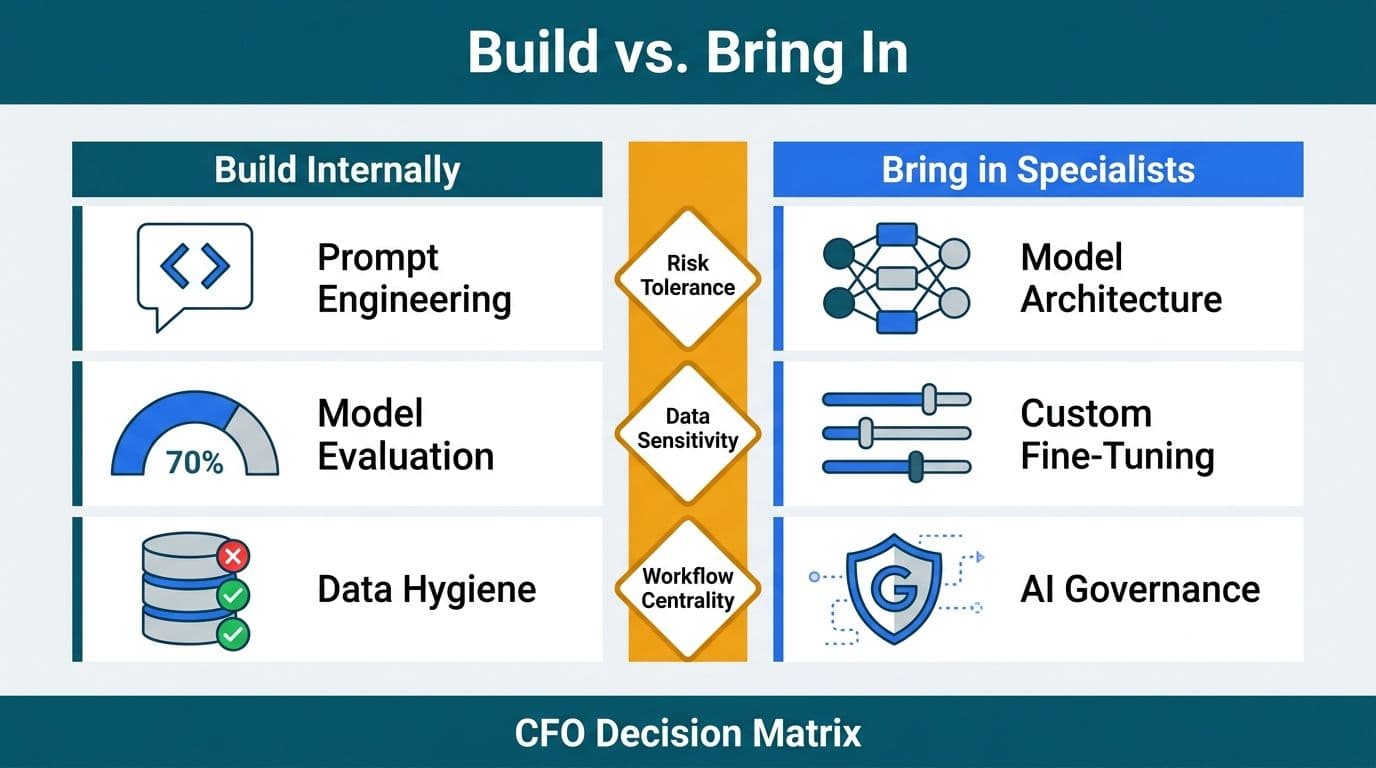
Finance teams should build three AI skills internally: prompt engineering, basic model evaluation, and data hygiene practices. These capabilities let analysts interrogate AI outputs, validate model accuracy, and prepare clean inputs without deep technical expertise. Everything involving model architecture, custom fine-tuning, or enterprise-scale AI governance typically requires specialist support - the decision hinges on risk tolerance, data sensitivity, and how central AI is to the team's core workflow.
Key Takeaways
Prompt engineering, model evaluation basics, and data hygiene are the three AI skills most finance teams can develop in-house within a quarter.
Custom model development, enterprise AI governance, and complex workflow automation consistently require specialist expertise.
AI agents in finance can automate reconciliations, flag anomalies, and draft variance commentary - but need clean, governed data to produce reliable outputs.
AI forecasting tools differ significantly in how they handle regulatory audit trails; governance requirements should drive tool selection.
Finance leaders in the US, UK, and Canada face different compliance contexts - SOC 2, GDPR, PIPEDA - that shape which AI capabilities belong inside versus outside the team.
What AI Skills Should Finance Teams Build Internally?
The strongest case for internal skill development applies where the finance team is the primary user and where a skill transfers across tools rather than tying the team to a single platform. Three capabilities consistently meet this bar.
Prompt engineering is the ability to write structured instructions that reliably direct an AI model toward a useful output. For a financial analyst, this means knowing how to frame a request for variance commentary, structure a prompt for scenario modeling, or constrain an output to a required format. This is not programming - it is closer to writing a precise brief for a capable but literal-minded assistant. Most finance staff can develop working proficiency in prompt engineering within four to six weeks of structured practice, particularly if they have existing experience writing technical specifications or audit procedures.
Basic model evaluation means knowing how to test whether an AI output is trustworthy for a specific finance task. Can the model produce a consistent result when the inputs shift slightly? Does it introduce figures that cannot be traced back to a source? Does it perform differently on month-end data than on mid-quarter data? A finance team does not need to understand the mathematics of machine learning to run structured accuracy checks against a known dataset. What they need is a repeatable test protocol and the professional judgment to recognise when a model's output requires escalation before use.
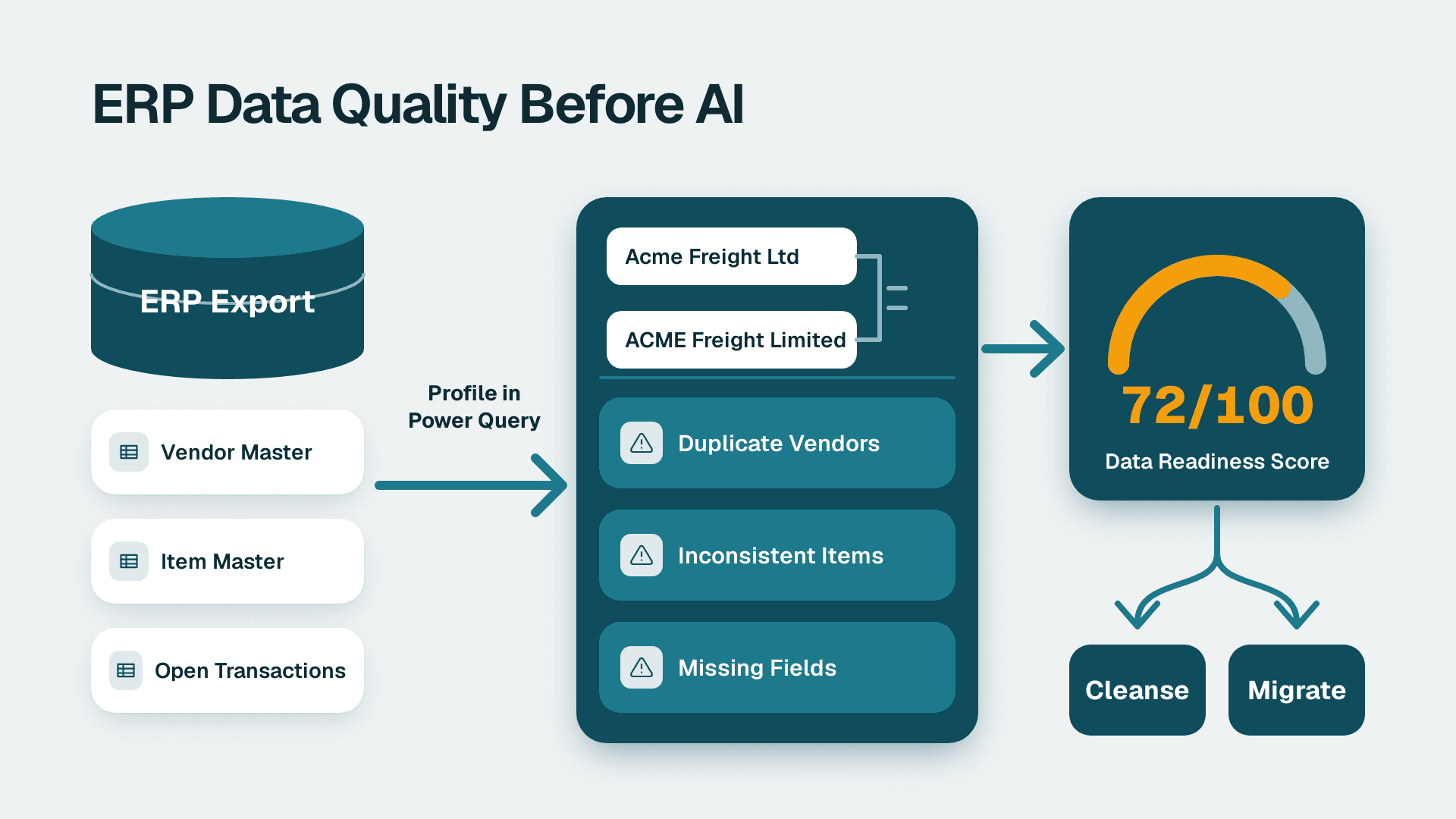
Data hygiene practices are the most underrated AI skill in finance. Large language models and statistical forecasting systems amplify whatever is in the input data - clean inputs produce useful outputs, dirty inputs produce confident nonsense with no visible warning. Finance teams that invest in standardising account coding, resolving duplicate vendor entries, enforcing consistent date formats, and documenting known data exceptions before connecting a data source to an AI tool save significant rework downstream. Finance staff also carry the most relevant domain knowledge here - they understand which anomalies are structural problems versus seasonal artefacts, and that judgment is not something an AI tool can substitute.
These three skills form the foundation of the broader AI automation consulting work that turns isolated capabilities into reliable, end-to-end financial workflows.
What Is the AI Skills Decision Matrix for Finance Teams?
The core question for a CFO or finance transformation lead is not "should we invest in AI skills?" but "which AI capabilities should live inside the team versus outside it?" The answer depends on three variables: frequency of use, regulatory exposure, and technical depth required.
The table below maps common finance AI capabilities against those variables.
| AI Capability | Frequency | Regulatory Exposure | Technical Depth | Recommendation |
|---|---|---|---|---|
| Prompt engineering | Daily | Low | Low | Build internally |
| Model output evaluation | Weekly | Medium | Low-Medium | Build internally |
| Data hygiene and preparation | Daily | Medium | Low | Build internally |
| Copilot for Finance configuration | Monthly | Medium | Medium | Hybrid - train power user, specialist for setup |
| AI forecasting model selection | Quarterly | High | High | Specialist-led |
| Custom model fine-tuning | Rare | High | Very High | Specialist-led |
| AI governance framework design | Once, then maintain | Very High | High | Specialist-led build, internal operation |
| Month-end close automation | Monthly | High | High | Specialist-led build, internal operation |
| Anomaly detection rule design | Weekly | Medium | Medium | Hybrid |
A UK fintech firm operating under FCA model risk guidance would treat AI governance framework design as non-negotiable specialist work - the combination of model risk obligations and GDPR data governance requirements makes internal improvisation too costly. A Canadian manufacturing company's finance team, subject to PIPEDA on cross-border data transfers, might reasonably train two internal staff on prompt engineering and model evaluation while engaging a specialist for the initial data pipeline architecture.
For US healthcare finance teams, HIPAA obligations mean that data feeding AI forecasting tools in a hospital billing department may carry Protected Health Information implications even when the finance team does not initially recognise it as clinical data. Identifying this during an external audit rather than during initial implementation carries a substantially higher remediation cost.
How Do AI Agents in Finance Actually Work?
AI agents in finance are software systems that can take a sequence of actions - querying a data source, running a calculation, drafting a document, flagging an exception - without requiring a human to initiate each individual step. They differ from simple rule-based automation in that they can make conditional decisions based on intermediate outputs, adapting their path through a workflow based on what they encounter.
In practice, AI agents in finance today operate across four established categories.
Reconciliation monitoring - agents that compare ledger entries against bank feeds, third-party statements, or intercompany accounts, flag discrepancies above a defined materiality threshold, and generate an exception report for human review. In production deployments as of 2026, these agents typically surface 2–5% of transactions as exceptions requiring human attention while clearing the remainder without manual intervention — reducing matching time by 60–80% on high-volume intercompany ledgers.
Variance commentary drafting - agents that pull actuals versus budget figures from a reporting layer and produce a first draft of the narrative section of a management pack. A well-configured agent references the correct budget version, applies the organisation's standard commentary format, and flags sections where the variance driver is ambiguous rather than inventing an explanation.
Anomaly detection - agents that apply statistical rules or learned patterns to transaction data and surface items warranting investigation before close. In a US SaaS finance team running a monthly subscription model, this might mean flagging revenue recognition entries that fall outside the normal range for a given customer cohort.
Document extraction and coding - agents that read invoices, contracts, or expense submissions, extract key fields, and propose the correct general ledger coding for human approval. This reduces processing time on high-volume accounts payable workflows without removing human accountability from the coding decision.
In each case, the agent produces a work product that a human reviews and approves. For a practical view of how agent-based workflows are structured across business functions, the guide to AI workflow automation examples for business covers the pattern in detail.
How to Automate Month-End Financial Close with AI
Automating the month-end financial close with AI is one of the highest-value applications available to mid-market finance teams, but it is also one of the areas where under-prepared implementation creates the most risk to financial reporting integrity.
A reliable AI-assisted close process requires these foundations before any AI tooling is introduced: a single, governed data source for transaction data rather than spreadsheets consolidated manually each month; documented reconciliation rules covering the full range of normal and exception cases; a clear ownership model for each close task with defined approval authorities; and audit trail requirements confirmed in advance. For US public companies subject to SOX, or UK entities where external auditors require evidence of controls around automated processing, the audit trail requirement is non-negotiable and must be addressed before a tool is selected.
Once those foundations exist, AI agents can compress the time spent on reconciliation, exception management, and pack preparation. A typical mid-market rollout automates reconciliation monitoring and exception flagging first, then extends to commentary drafting once the team has validated agent output quality over two or three complete close cycles. This staged approach allows internal staff to build the evaluation skills they need to manage the automated workflow before expanding its scope.
The internal skill requirement for a live AI-assisted close is primarily operational: evaluating agent outputs, handling exceptions the agent flags but cannot resolve, and updating rules when business processes change. The initial architecture work is where specialist support provides the most leverage. The resource on AI workflow automation mistakes and pre-launch checks details the specific steps that prevent the most common close-process failures.
What Is an AI Governance Framework for Finance Teams?
An AI governance framework for finance defines how the organisation decides which AI tools to adopt, monitors outputs for accuracy and drift, manages model risk, and maintains accountability when AI-assisted decisions produce errors.
For finance teams, governance is not optional infrastructure - it is what separates a defensible AI implementation from a regulatory and reputational liability. Five components are consistently present in effective finance AI governance frameworks.
Model inventory - a register of every AI tool used in financial processes, including what data it accesses, who approved its use, its documented limitations, and when it was last validated.
Output validation protocols - documented procedures for checking AI-generated figures, commentary, and recommendations before they enter a financial statement, management pack, or regulatory filing. The validation level should be proportionate to the materiality of the output.
Data access and privacy controls - ensuring AI tools access only the data they need, and that all data flows comply with applicable regulation. A US finance team using a cloud AI tool typically requires SOC 2 Type II certification from the vendor and a signed data processing agreement. UK and EU teams need GDPR-compliant data processing arrangements that specify the legal basis for processing. Canadian organisations must satisfy PIPEDA requirements for any cross-border data flows to AI vendors. The GDPR compliant SaaS financial reporting checklist provides the relevant data governance layer for UK and EU finance teams in detail.
Human oversight requirements - explicit rules about which AI outputs require human sign-off before use in financial reporting, and the escalation path when an output is disputed.
Incident response - a defined process for when an AI tool produces an error affecting financial reporting, covering impact assessment, record correction, auditor communication where required, and framework updates to prevent recurrence.
Designing this framework is specialist work. Operating it - maintaining the model inventory, running validation protocols, triaging new tool requests against governance criteria - is work an informed internal team can own after initial setup. This is the pattern the decision matrix above reflects: specialist-led design, internal operation.
How Do AI Forecasting Tools for Finance Teams Compare?
AI forecasting tools for finance teams vary across four dimensions that determine fitness for purpose in a governed environment: data connectivity, explainability, audit trail quality, and regulatory alignment.
Data connectivity determines whether the tool can consume the finance team's actual data sources - ERP exports, general ledger outputs, planning tool data - without requiring extensive custom transformation. Tools requiring proprietary data formats create hidden integration costs that rarely surface in vendor pricing conversations.
Explainability determines whether the tool can show how it arrived at a forecast. For management reporting, a black-box forecast is difficult to defend to a board or audit committee. For financial services firms subject to model risk management requirements, explainability is a regulatory requirement, not a preference.
Audit trail quality determines whether the tool logs input data versions, model parameters, and output timestamps in a format satisfying external audit requirements. This is the most commonly overlooked dimension in initial tool evaluations and the one most likely to cause problems during the first post-implementation audit cycle.
Regulatory alignment determines whether the vendor's data processing practices, security certifications, and contractual terms are compatible with the organisation's compliance obligations. Microsoft Copilot for Finance operates within the Microsoft 365 compliance boundary when properly configured, which simplifies the data governance assessment for organisations already in that ecosystem (Microsoft, 2026).
The reporting infrastructure already in use matters as much as the forecasting engine itself when evaluating tools. The FP&A Dashboard in Power BI build guide provides useful context on how AI forecasting layers typically connect to existing finance reporting environments.
When Should Finance Teams Bring in AI Specialists?
Specialist support is consistently the right choice when the cost of an internal skill gap is measured in regulatory risk or reporting integrity rather than operational efficiency alone. Four situations reliably cross this threshold.
When the data environment is complex - multiple source systems with inconsistent coding, legacy ERP integrations, or material data quality issues. Building AI capabilities on top of a poorly governed data layer produces outputs that undermine confidence in the entire programme, and fixing data problems after AI tools are deployed is substantially more expensive than addressing them first.
When regulatory exposure is high - financial services firms under FCA or SEC oversight, US healthcare finance teams with HIPAA-adjacent data, and any organisation where AI outputs feed SOX-reported financial statement line items. The cost of a compliance failure in these contexts exceeds the cost of specialist support by a wide margin.
When speed to value is required - an internal training programme typically takes six to twelve months to produce staff who can independently manage AI workflows at production reliability. A specialist engagement can deliver a working, governed AI workflow in eight to twelve weeks — a meaningful gap for finance teams facing board-level pressure to demonstrate measurable AI progress before 2026 year-end reporting cycles, where the internal training payback rarely lands before year two.
When the tooling landscape is changing faster than training can track - the honest case for ongoing specialist partnership rather than a one-time engagement. Finance teams that invest heavily in one platform's specific workflows may find those skills need updating as organisational infrastructure evolves. Specialist partners maintain current knowledge across platforms as a core part of their work.
Most finance teams that get this right combine a small internal capability - typically two to four staff with working prompt engineering and model evaluation skills - with an external partner who handles architecture, governance design, and platform-specific implementation.
---
About Lets Viz: Lets Viz is a data analytics and AI consulting firm with a 5.0 Clutch rating, working with clients since 2020 across US healthcare, UK fintech, Canadian manufacturing, and global SaaS organisations. Our teams design and implement AI-assisted finance workflows that meet the governance and compliance requirements of each market our clients operate in.
If your finance team is ready to move from isolated AI experiments to a governed, production-ready capability, our AI automation consulting team can run a structured skills assessment and deliver a prioritised implementation roadmap.