Outsourced Financial Analytics Services for Smarter Insights
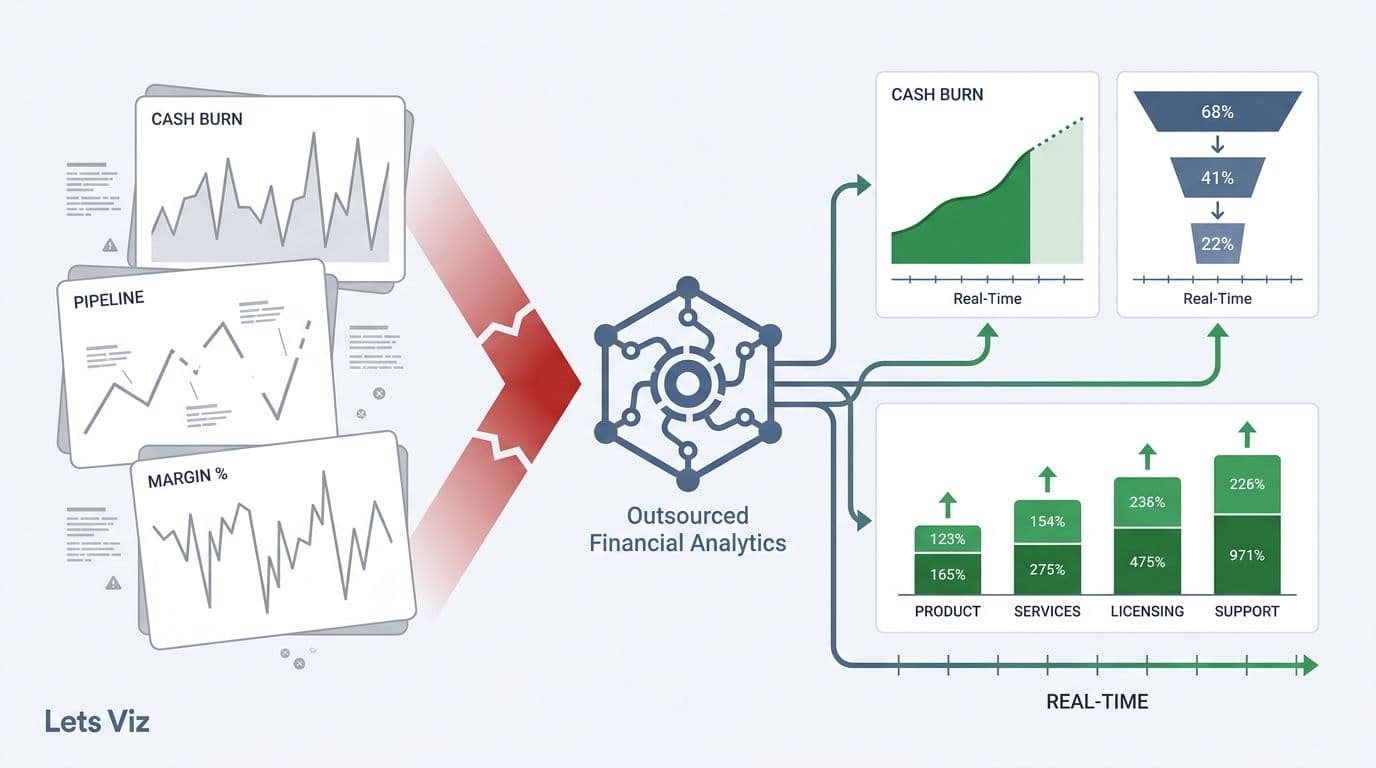
The CFO's pressure test in 2026 has sharpened considerably. Boards demand real-time visibility into cash burn, pipeline conversion, and margin by segment. Regulators require audit trails that can be produced on short notice. Investors expect scenario models updated within hours of a rate decision - not days. Most finance departments were not built to absorb that workload through in-house headcount alone, and the gap between what leadership expects and what existing teams can deliver is widening.
That gap explains the accelerating shift toward outsourced financial analytics consulting services. Companies ranging from Series B SaaS businesses to global enterprise manufacturers are contracting specialist firms to own the data layer of their finance function: the pipelines, the models, the dashboards, and the ongoing maintenance that keeps all three accurate as the business evolves. This guide covers what those services look like in practice, how to evaluate providers, and how to build the internal business case.
Why Finance Departments Are Rethinking Their Analytics Stack
The old model - hire a data analyst, hand them Excel, and hope for the best - has become a structural liability. Finance teams that still rely on manually assembled spreadsheets for monthly close face version-control errors, missed consolidations, and decision delays that compound across the organisation. One incorrect formula in a shared workbook can distort board-level reporting for an entire quarter before anyone catches it.
Business intelligence platforms have changed the calculus, but technology alone does not solve the problem. A Power BI licence without a coherent underlying data model produces dashboards that look polished and mislead reliably. The missing ingredient is domain expertise: professionals who understand both the finance logic - ARR recognition, deferred revenue waterfall, cash conversion cycles - and the technical architecture needed to surface that logic accurately and consistently across every report surface.
According to Future Market Insights, the AI consulting services market reached approximately USD 14 billion in 2026 and is on track to hit USD 90.99 billion by 2035, at a 26.2% CAGR. That growth is not happening because organisations have excess budget. It reflects the compounding cost of poor analytics - missed forecasts, delayed board packs, undetected margin erosion - finally being quantified on income statements and driving procurement decisions.
For a complete grounding in how modern BI platforms fit into the finance function, see Business intelligence: A complete overview.
What Outsourced Financial Analytics Services Actually Deliver
The term covers a wide spectrum of work. At the tactical end, a provider builds and maintains dashboards and automates data pipelines. At the strategic end, they function as a fractional analytics leadership team - owning the data strategy, defining KPI frameworks, and advising the CFO on what the numbers actually mean in commercial terms.
Most engagements sit somewhere in the middle and typically include:
Data pipeline design and maintenance
Raw data from ERP, CRM, billing platform, and payroll system is consolidated into a single, reconciled data warehouse or lakehouse. The provider designs and monitors the ETL processes so the finance team is never blocked by broken data refreshes or time-consuming manual reconciliation. They also handle schema changes when upstream systems are updated - a task that routinely derails in-house pipelines built without dedicated maintenance capacity.
Financial reporting dashboard design
A well-designed financial reporting dashboard does not simply visualise data - it encodes business logic. Revenue should show actual, budget, and rolling forecast side by side. Gross margin should slice cleanly by product line, geography, and customer segment without the analyst rebuilding a pivot table each cycle. Headcount cost should tie to an approved plan with clear variance explanations. These structures require someone who has built them correctly before to build them correctly now.
FP&A model automation
Monthly reforecasting, board pack generation, and rolling 13-week cash flow models are natural candidates for automation. A strong provider converts those recurring, analyst-intensive processes into scheduled, version-controlled outputs - reducing close time and freeing the team for higher-value decision support.
Anomaly detection and proactive alerting
Advanced analytics in finance increasingly includes automated surveillance: flagging a spike in debtor days, a dip in net revenue retention, or a cost line deviating beyond a defined threshold. Providers configure rule-based and statistical alerts so the finance leadership team is informed before a pattern becomes a material problem.
The 5 Key Financial KPIs Every CFO Should Track provides a strong starting framework for defining which metrics belong in a managed analytics programme.
Advanced Analytics in Finance - From Reporting to Decision Intelligence
There is a meaningful difference between a reporting engagement and an analytics engagement. Reporting tells you what happened. Analytics tells you why it happened and what is likely to happen next.
The shift from backward-looking reports to forward-looking models is where the most significant value is created for CFOs and FP&A teams. Providers offering advanced analytics in finance typically work across three layers:
Descriptive analytics - variance analysis, trend visualisation, segment-level cohort breakdowns
Predictive analytics - churn probability scoring, revenue forecasting with confidence intervals, headcount cost modelling under multiple scenarios
Prescriptive analytics - model-driven recommendations on pricing adjustments, go-to-market resource allocation, or cost structure optimisation — for example, a provider working with a mid-market SaaS client in early 2026 used prescriptive modelling to identify a 17% gross margin improvement opportunity by repricing a legacy tier that was disproportionately subsidising high-churn cohorts, a finding that would have been invisible in standard variance reporting
For SaaS businesses specifically, the highest-value application is ARR waterfall modelling - obtaining a clean, weekly read on new ARR, expansion, contraction, and logo churn. This requires both a technically sound data model and a team that understands SaaS metrics conventions deeply enough to handle edge cases like mid-period contract changes, multi-currency bookings, and usage-based billing. The post AI + ARR waterfalls: what works, what still needs a human covers the current state of AI-assisted forecasting for exactly this use case.
As of 2026, the global AI consulting and support services market is expanding at a CAGR of 31.6% through 2030 - a trajectory that reflects the pace at which organisations are moving beyond basic dashboards toward genuinely predictive analytics capabilities embedded in core finance operations.
Outsourced Financial Analytics Services for Smarter Insights - Building the Business Case
If you are a CFO or FP&A director evaluating whether to outsource, the business case rests on four variables: cost, speed, quality, and strategic capacity.
Cost comparisons are rarely straightforward. A full-time senior data engineer plus a BI developer plus a finance-focused data analyst in a tier-one market runs to USD 390,000-480,000 per year in fully-loaded compensation in 2026 - a figure that has risen steadily as specialised finance-data talent has remained scarce despite broader tech hiring slowdowns, with average salaries for finance-data specialists having risen 28-35% cumulatively between 2023 and mid-2026, a persistent trend driven by demand that consistently outpaces supply for candidates who combine FP&A domain knowledge with data engineering skills - before tools, infrastructure, and management overhead. An outsourced engagement delivering equivalent output typically costs 40-60% less, saving USD 150,000-250,000 annually, while also being faster to start and easier to scale up or down as the business cycle demands.
Speed is often the most undervalued benefit. Building an internal team takes months of recruiting, onboarding, and ramp time. An experienced provider has already solved your problem class before - they carry pre-built templates for SaaS metrics packages, manufacturing cost reporting, and professional services utilisation dashboards, and they instrument them in weeks rather than quarters.
Quality depends entirely on provider selection, which the following section addresses. The core point is that a specialist firm has handled more edge cases in financial data modelling than any generalist hire you can bring into the team.
Strategic capacity is the benefit that converts the most sceptical CFOs. When the analytics infrastructure is reliably handled externally, the internal finance team stops spending cycles on data wrangling and starts spending them on commercial decision support. That is the transformation most finance leaders describe as the goal - and rarely achieve sustainably with a purely in-house model alone.
For SaaS teams evaluating the AI layer that many providers now embed in analytics engagements, A CFO's 6-question AI risk checklist for Power BI is worth reviewing before committing to any engagement that leads with AI-first deliverables.
How to Evaluate Top Finance Data Analytics Consulting Companies in 2026
The market for top finance data analytics consulting companies in 2026 has grown considerably in both depth and variety. Vendor selection is now a consequential decision, and a few criteria consistently separate firms that deliver from those that produce impressive presentations and underperforming implementations.
Domain specificity
A firm that has built financial analytics for SaaS companies understands ARR, NRR, CAC payback, and the Rule of 40. A firm experienced in manufacturing understands standard costing, absorption variances, and inventory carrying cost. The right provider is the one whose reference clients resemble your business model - not the one with the broadest portfolio graphic. Ask for two or three case studies from organisations in your sector before proceeding.
Data stack compatibility
Does the provider work fluently with your existing ERP, data warehouse, and visualisation layer? A provider who recommends rebuilding your entire stack in their preferred technology is optimising for their margin, not your outcomes. The best firms work within existing architecture where it is sound and propose changes only with clear, documented evidence for the improvement.
Governance and documentation standards
The most common failure mode in outsourced analytics is knowledge concentration - all logic lives in the provider's environment, and switching costs become prohibitive over time. A reliable provider documents every data model, every calculated measure, and every pipeline dependency as a matter of standard practice. Request examples of their handoff documentation before signing any engagement.
Commercial model alignment
Retainer or outcomes-based pricing is preferable to time-and-materials for ongoing analytics work. A retainer aligns provider incentives with consistency and quality. Time-and-materials creates structural incentives for scope expansion and extended project timelines.
For broader context on what AI-enhanced consulting engagements look like in financial services, the AI Consulting Services for Financial Advisors: 2026 Guide provides a useful comparison framework for evaluating providers.
Power BI and Financial Reporting - A Practical Architecture
Power BI and financial reporting is one of the most widely adopted combinations in mid-market and enterprise finance teams, and for good reason. Power BI integrates natively with Azure, Microsoft 365, and most ERP systems. Its DAX calculation engine handles complex financial logic - cost allocations, multi-currency translations, period-over-period comparisons - with a level of expressiveness that other BI tools rarely match at scale.
A well-architected Power BI financial reporting environment operates across three distinct layers:
1. Data layer - a centralised semantic model, ideally hosted in Power BI Premium or Microsoft Fabric, serving as the single authoritative source for all financial metrics across the organisation
2. Logic layer - DAX measures that encode business rules consistently, ensuring that gross margin, headcount cost, and operating cash flow are calculated identically regardless of which report or dashboard queries them
3. Presentation layer - purpose-built report pages designed for specific audiences: a board summary with five or six headline metrics, an FP&A detail view with full variance analysis, and departmental budget vs. actual pages for operational owners
Governance standards for AI-driven financial analytics, developed through a World Economic Forum initiative that engaged over 100 experts from more than 50 financial services organisations, moved from framework stage to active industry adoption through 2025 and into 2026 — with major financial regulators in the UK, EU, and Singapore formally referencing the standards in updated guidance issued in the first half of 2026. The practical implication for finance leaders is direct: organisations without a structured, well-documented data foundation are now encountering those requirements at audit and board level, not just as forward-looking best practice.
Getting the architecture right from the start is significantly easier with a partner who has built it before. Retrofitting a sound data model onto a poorly structured legacy implementation is one of the most expensive and time-consuming projects in enterprise analytics - and one of the most common outcomes of a poorly selected provider.
The Copilot for Power BI: what it actually does for a finance team in 2026 post covers how AI-assisted features integrate into this architecture - worth reading before your provider recommends a Copilot-enabled workflow.
Starting the Engagement - A Practical Sequence
The best-run outsourced financial analytics engagements share a consistent pattern: start narrow, demonstrate tangible value quickly, then expand scope methodically as trust and confidence in the data are established.
A practical starting point is a core financial reporting dashboard covering three to five metrics: P&L summary, cash position, ARR waterfall (for SaaS), or production cost variance (for manufacturing). A competent provider delivers a working prototype within two to four weeks. That deliverable is useful in itself and is a reliable leading indicator of the quality and rigour that will follow in the broader engagement.
From there, the engagement typically expands into automated monthly reporting cycles, FP&A model support, and eventually the predictive and prescriptive analytics layers discussed earlier. Finance teams that follow this sequenced model consistently report two measurable outcomes by the end of the first full reporting cycle: board pack preparation time reduced by 30-50%, and a material drop in data credibility challenges during leadership reviews - both of which compound in value as the engagement matures. The key principle is not to attempt a complete transformation in month one - it is to establish a reliable, well-documented data foundation and build on it incrementally with clear milestone-based reviews at each stage.
If your finance team is ready to explore what a managed analytics engagement looks like in practice, the Managed Power BI services page outlines how Lets Viz structures these programmes, what the onboarding sequence involves, and what outcomes our finance clients have achieved. For a broader view of the full analytics service portfolio, explore all analytics services.
---
About Lets Viz: Lets Viz is a data analytics consulting firm with over eight years of experience helping finance teams at SaaS businesses, professional services firms, and enterprise manufacturers convert raw data into commercial clarity. Our work spans Power BI architecture, FP&A automation, and AI-assisted forecasting, serving clients across the UK, US, and India. We hold recognised Microsoft Power Platform competencies and have delivered analytics programmes for finance functions ranging from Series A startups to publicly-listed enterprises.