AI Data Strategy Consulting Careers: Full Guide
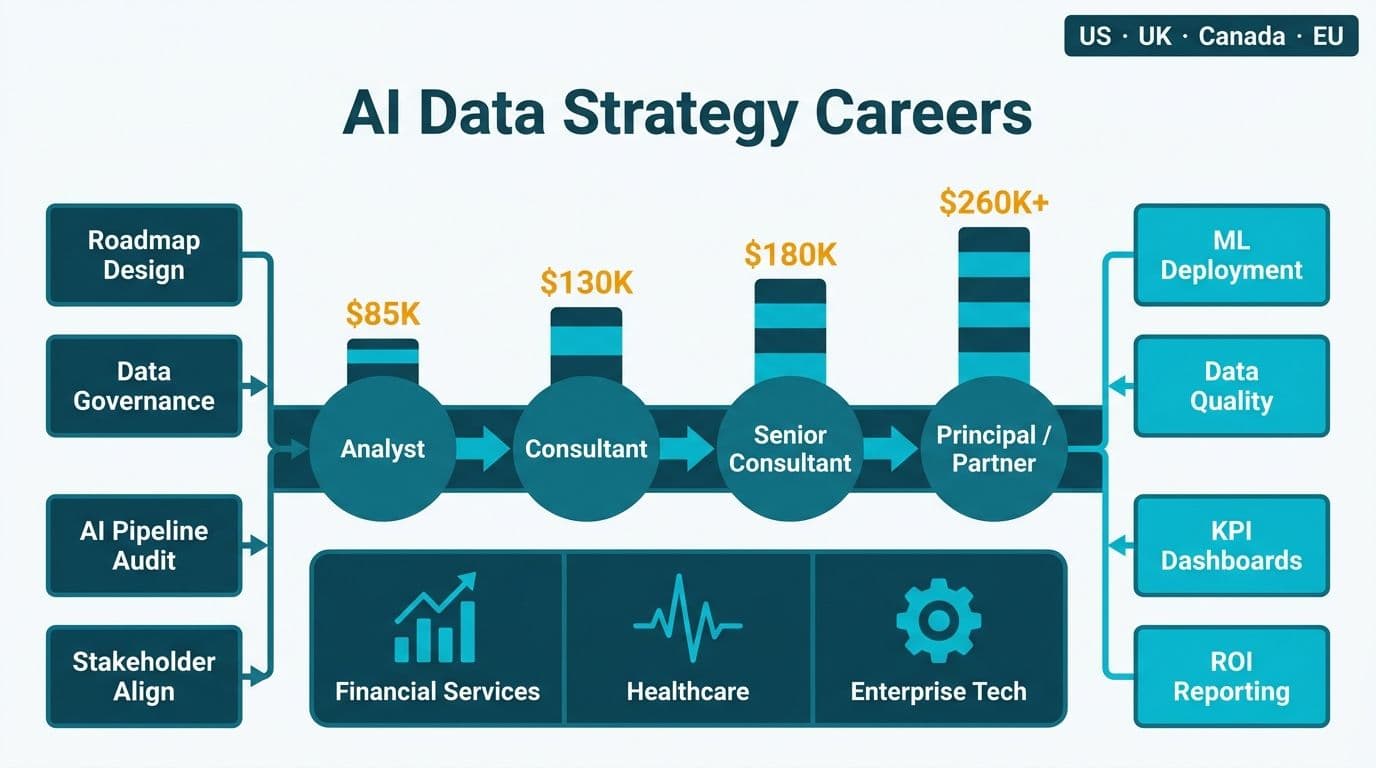
AI data strategy consulting careers combine business advisory, data governance, and AI implementation expertise to help enterprises turn raw data assets into measurable outcomes. Practitioners work across financial services, healthcare, and enterprise verticals - designing roadmaps, auditing data quality, and governing AI pipelines. The field is active across the US, UK, Canada, and EU, with senior roles commanding among the highest compensation packages in the consulting profession.
Key Takeaways
AI data strategy consultants bridge executive ambition and engineering reality - technical coding is secondary to problem framing and stakeholder alignment
Financial services and healthcare are the highest-demand sectors in the US, UK, and Canada, shaped by compliance obligations including HIPAA, GDPR, and PIPEDA
Senior data strategy consultant salaries range from $170K+ in the US to £100K+ in the UK and CAD $140K+ in Canada
Data consulting companies increasingly structure AI strategy as a managed retainer model rather than a one-off project
The fastest entry path combines domain expertise, a cloud data platform certification, and a documented end-to-end project case study
What Is an AI Data Strategy Consulting Career?
An AI data strategy consulting career means advising organizations on how to collect, govern, structure, and deploy data to support AI-driven decisions - not just building models. Consultants in this field translate technical capability into business value, typically operating between the CTO and the business units they serve.
Role titles vary widely: Data Strategy Consultant, AI Advisory Lead, Analytics Transformation Manager, or Principal - Data and AI. In both large data consulting companies and specialist boutiques, core responsibilities include diagnosing data maturity gaps, designing enterprise data architectures, selecting AI tooling, establishing governance frameworks, and defining KPIs that genuinely reflect business performance rather than reporting artifacts.
The distinction between a data engineer and a data strategy consultant is fundamental: engineers build pipelines; strategists decide which pipelines to build and why. This work sits at the foundation of broader AI automation consulting - automation only delivers durable value when the underlying data is clean, governed, and trustworthy.
Clients span every vertical, but financial services (banks, insurers, asset managers) and healthcare (health systems, payers, life sciences) generate the highest demand. Both sectors are shaped by compliance obligations - HIPAA in the US, GDPR across the UK and EU, and PIPEDA in Canada - that elevate data governance from a technical concern to a board-level risk.
How Does Big Data Strategy Consulting Relate to AI Data Strategy?
Big data strategy consulting emerged as enterprises confronted data volumes that traditional relational databases could not handle - log streams, clickstreams, IoT sensor feeds, and social data arriving faster than batch ETL jobs could process them. The discipline built the engineering and organizational foundations that AI data strategy now runs on.
A big data strategy engagement typically addresses three dimensions: infrastructure (distributed storage and compute such as Spark, cloud data lakes, and lakehouse architectures), governance (who owns which data, how long it is retained, and who can access it), and organizational readiness (embedding data literacy across business units rather than concentrating analytical capability in a single team).
The transition from big data strategy consulting to AI data strategy has been directional rather than disruptive. Most practitioners who designed distributed data platforms in the mid-2010s are now governing AI model training pipelines and designing real-time inference layers on top of those same cloud foundations. The underlying questions are identical: Is this data trustworthy? Who can access it? What decisions will it support? The tooling has matured; the discipline has deepened.
For organizations now evaluating their big data strategy, the practical starting point remains the same - an honest audit of data quality and lineage before committing to AI tooling. Vendors lead with capability; a good big data strategy consultant leads with the questions that determine whether that capability will actually work on your data. This is why big data strategy work and AI data strategy work are increasingly delivered by the same practitioners and often scoped as a single engagement.
What Skills Do AI Data Strategy Consulting Clients Look For?
Clients evaluate data strategy candidates on a combination of technical depth, sector fluency, and communication clarity - not purely on coding ability.
Technical skills consistently required in data strategy consulting jobs:
Cloud data platforms: AWS, Azure, Google Cloud (certifications actively valued)
Data modeling and warehousing concepts: star schema, data vault, lakehouse architecture
SQL proficiency and familiarity with transformation tooling such as dbt
Working knowledge of AI and ML platforms including Azure ML, Vertex AI, and SageMaker
Data governance frameworks: DAMA-DMBOK, ISO 8000, or enterprise-specific standards
Business skills that differentiate candidates in practice:
Executive communication - presenting a data roadmap to a CFO or board without technical jargon
Change management fundamentals - implementations fail when adoption is not actively managed
Financial literacy, especially in financial services where consultants must model ROI on data platform investments
Sector fluency - healthcare consultants must understand clinical workflows; fintech consultants must understand regulatory reporting cycles
A UK fintech firm hiring a data strategy lead will typically require GDPR data lineage experience alongside cloud certifications - the regulatory dimension is non-negotiable in that market. A Canadian healthcare network governed by PIPEDA needs consultants who understand data residency requirements, consent management, and HL7 FHIR interoperability. US healthcare organizations require HIPAA-aligned data handling architecture from day one of any engagement.
The strongest AI data strategy consulting clients - the ones whose engagements produce durable results - look for consultants who can operate at both the whiteboard and the data dictionary. Generic technical breadth is table stakes; sector-specific depth is the differentiator.
What Does a Data Strategy Consultant Salary Look Like?
Data Strategy Consultant salaries are among the strongest in the analytics profession, reflecting the seniority, cross-functional scope, and compliance complexity of the role.
| Level | US (USD) | UK (GBP) | Canada (CAD) |
|---|---|---|---|
| Junior / Associate | $90K - $130K | £55K - £80K | $80K - $110K |
| Mid-level Consultant | $130K - $170K | £70K - £100K | $100K - $140K |
| Senior / Principal | $170K - $220K+ | £100K - £130K+ | $140K - $175K+ |
| Director / Partner | $220K - $350K+ | £130K - £200K+ | $175K - $250K+ |
*Ranges reflect 2026-2027 market conditions for AI-focused data strategy roles in major commercial centers.*
In the US, Big Four and top-tier strategy firms typically add 10-20% through structured bonus schemes on top of base compensation. London rates carry a premium over Manchester and Edinburgh, though both northern UK markets have grown materially as financial services operations decentralize. In Canada, Toronto and Vancouver lead, with financial services and natural resources sector clients both driving demand for senior data strategy capability.
Independent consultants working on day-rate engagements generally bill $1,500 to $3,000 USD for senior AI data strategy work in the US, with UK equivalents of £1,000 to £2,000 per day for comparable seniority and sector specialization.
What Do Data Strategy Consulting Jobs Actually Involve Day-to-Day?
Data strategy consulting jobs are project-based and move through distinct phases: discovery, design, implementation, and handover. The day-to-day experience differs sharply across those phases.
Discovery (weeks 1-3): Interviews with business owners, data engineers, and compliance leads. Auditing existing data assets, cataloguing sources, and identifying quality gaps. This phase almost always surfaces the same underlying pattern: reported metrics are built on unreliable foundations that no one has had time to question.
One of our own engagements illustrates the problem precisely. A home-services company's support dashboard showed strong first-response times across the board. The root cause of the distortion: Zoho Desk stores 0 hours - not null - for tickets that were never answered, meaning every ignored ticket counted as resolved instantly. We rebuilt the metric on real response data and validated it row by row across 105,704 tickets with zero mismatches before going live. That kind of foundational data audit is a standard deliverable in AI data strategy work - you cannot build reliable AI on broken metrics, and broken metrics are far more common than most organizations realize before an external audit.
Design (weeks 3-8): Architecting the target state - which data sources to integrate, which transformation logic to apply, and which governance policies to establish. For financial services clients subject to SOC 2 or Basel IV reporting requirements, design decisions at this stage carry direct regulatory weight and must be documented accordingly.
Implementation (weeks 8-20+): Collaborating with the client's engineering team or managing third-party implementers. Strategy consultants typically do not write production code but must be able to review architecture decisions and assess fitness for the business requirements defined in the design phase.
Handover and enablement: Documenting the architecture, training internal teams, and defining an operating model for ongoing governance. A well-delivered strategy engagement leaves the client fully capable of sustaining and extending the work independently - that is the measure of success, not the consultant's continued involvement.
For teams in the financial sector exploring what becomes possible once the data foundation is solid, our overview of generative AI use cases in finance covers practical downstream applications that mature data governance enables.
How Do You Break Into AI Data Strategy Consulting Careers?
The most reliable paths into AI data strategy consulting careers combine domain experience, technical credibility, and documented project outcomes - in that order of importance.
Path 1 - From data engineering or BI: Many strong consultants begin as analysts or engineers who develop business instincts over time. A US SaaS analytics team member who has owned a data warehouse migration and can articulate the business trade-offs has the raw material for a strategy consulting transition. Adding a cloud certification (AWS Data Analytics Specialty, Azure Data Engineer Associate, or Google Professional Data Engineer) and a portfolio of case studies accelerates the move significantly.
Path 2 - From a sector role: A healthcare administrator or financial services analyst who becomes fluent in data tools brings irreplaceable domain knowledge. A Canadian hospital finance analyst who learns dbt and Power BI is far more valuable in healthcare data strategy than a technically pure hire who has never read a clinical coding report - particularly for engagements involving PIPEDA compliance and HL7 FHIR interoperability requirements.
Path 3 - Through a boutique data consulting company: Joining a specialist analytics consultancy as a junior analyst or implementation consultant is the fastest structured path. Exposure to multiple client environments, sectors, and data stacks compresses years of organic learning into months. Many boutiques now blend big data strategy consulting and AI advisory into the same practice, which means junior hires get exposure to both disciplines simultaneously.
Certifications that signal readiness to hiring managers:
DAMA Certified Data Management Professional (CDMP) - signals governance depth
AWS Certified Data Analytics - Specialty
Microsoft Certified: Azure Data Engineer Associate
Certified Analytics Professional (CAP)
Portfolio signals that differentiate applicants:
Evidence of a full strategy cycle - not just model-building or dashboard design in isolation
A case where you identified a business problem, diagnosed the underlying data issue, and measured the business impact of fixing it
Published writing, conference talks, or community contributions on data governance or AI strategy topics
For consultants entering through the financial services angle, the AI compliance requirements for financial services guide covers the regulatory landscape that will define much of your early client work across the US, UK, and EU.
How Do Data Consulting Companies Structure Their AI Strategy Practices?
Data consulting companies have broadly reorganized their AI strategy practices into three delivery models: advisory, delivery, and managed services - each creating a different career environment.
Advisory-only practices focus on strategy design and executive alignment. Found primarily in Big Four and global strategy firms, they hire heavily for sector expertise and partner relationships. Entry is typically post-MBA or post-PhD with relevant sector internships. Compensation is high; exposure to implementation reality is limited.
Delivery practices blend strategists and engineers on the same project team. This is where most practitioner career growth happens because consultants directly observe the implementation consequences of their strategic choices. Most mid-market data consulting companies operate this model, and it produces the most well-rounded data strategy practitioners. Delivery practices are also where big data strategy consulting work most often lives - large-scale data platform builds require the hands-on collaboration that advisory-only models cannot provide.
Managed services arms - the fastest-growing model entering 2026 - provide AI data strategy as an ongoing retainer: continuous roadmap refinement, governance maintenance, and KPI management. For clients in heavily regulated industries, this model spreads compliance overhead across a retained expert team more cost-effectively than a series of discrete projects.
Organizations evaluating their own data readiness before engaging a consultancy can use our free BI readiness assessment as a structured starting point for that conversation.
The delivery model also shapes long-term career trajectory: advisory practices reward communication and relationship skills; delivery practices reward technical depth and project management; managed services reward consistency and deep client intimacy over time.
How Does AI Data Strategy Consulting Differ Between Financial Services and Healthcare?
The core methodology is similar across both sectors - assess, design, govern, implement - but the compliance environment and data complexity diverge enough that most experienced consultants specialize in one vertical rather than operating across both.
Financial services:
Data assets: transaction ledgers, customer profiles, market data, regulatory reports
Key compliance: SOC 2, Basel IV, MiFID II (UK and EU), Dodd-Frank (US)
AI use cases: credit risk modeling, fraud detection, AML transaction monitoring, algorithmic trading governance
Primary data quality challenge: reconciliation across siloed core banking, CRM, and regulatory reporting systems that were never designed to interoperate
UK and EU firms face a dual compliance obligation - GDPR data minimization principles must coexist with MiFID II audit trail requirements that mandate data retention
Healthcare:
Data assets: EHR records, claims data, medical imaging, patient-generated health data
Key compliance: HIPAA (US), GDPR (UK and EU), PIPEDA (Canada), NHS Data Security and Protection Toolkit (UK)
AI use cases: readmission prediction, diagnostic support, prior authorization automation, workforce and capacity optimization
Primary data quality challenge: interoperability between legacy EHR systems and modern analytics platforms - a challenge that no single vendor has fully solved
Canadian healthcare organizations must navigate both federal PIPEDA requirements and provincial variations in data handling standards
The hospital readmission rate analytics dashboard guide shows one concrete output of AI data strategy work in US healthcare - the analytics layer that becomes possible once governed, compliant data infrastructure is in place.
---
About Lets Viz: Lets Viz has delivered AI data strategy, big data strategy consulting, analytics implementation, and BI modernization engagements for US healthcare systems, UK fintech firms, Canadian manufacturing organizations, and global SaaS companies since 2020. The firm holds a 5.0 Clutch rating and specializes in bridging executive ambition with technically sound, compliance-ready data infrastructure across North American and European markets.
Ready to build or accelerate your organization's AI data strategy? AI automation consulting from Lets Viz combines roadmap design, governance architecture, and hands-on implementation to move from plan to production.