Power BI Report Server vs Power BI Service for Healthcare
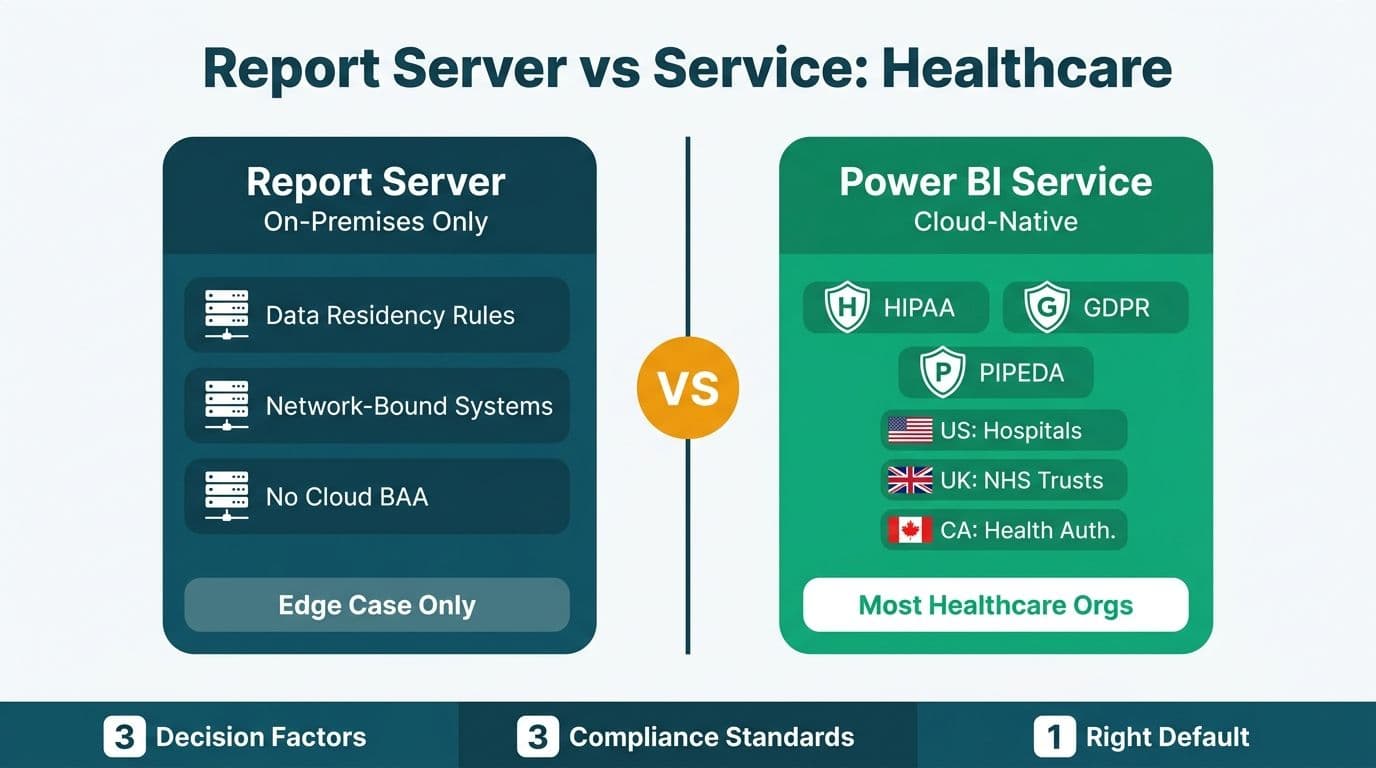
For most US hospitals, UK NHS trusts, and Canadian health authorities, the choice between Power BI Report Server and Power BI Service comes down to three variables: where regulated data must physically reside, how tightly clinical systems are bound to on-premises network infrastructure, and whether your legal counsel has approved a cloud BAA. Power BI Service satisfies HIPAA, GDPR, and PIPEDA requirements for the majority of healthcare organizations. Report Server is the defensible choice only when data residency rules or specific contractual language genuinely rule out cloud deployment.
Key Takeaways
Power BI Service with an Azure in-region tenant satisfies HIPAA (via Microsoft's BAA), GDPR (EU data boundary), and PIPEDA (Canadian Azure regions) for most healthcare organizations
Report Server carries significantly higher infrastructure overhead - three-year TCO is typically 1.5x to 2x higher than Power BI Service at the same seat count
Latency to clinical systems is primarily a network architecture issue, not a cloud-versus-on-premises issue
Power BI row-level security for healthcare data is available on both platforms, but cloud-native RLS in Power BI Service is simpler to audit and certify
Most healthcare IT teams end up in a hybrid model: Power BI Service for the bulk of operational reporting, Report Server reserved for a narrow set of contractually mandated on-premises workloads
What Is Power BI Report Server and How Does It Differ from Power BI Service for Healthcare?
Power BI Report Server is an on-premises, self-hosted version of Power BI that organizations deploy inside their own data centers or private cloud environments. Power BI Service is Microsoft's cloud-hosted SaaS analytics platform, running on Azure. For hospital IT teams, the distinction matters primarily because of where data is processed, stored, and audited - not simply where dashboards appear on a screen.
Hospital CIOs are being asked to deliver richer analytics faster - and the deployment model they choose directly shapes their capacity to scale without proportional infrastructure investment.
Power BI Service offers continuous platform updates, a broader connector ecosystem for EHR and financial data sources, and the full library of power bi healthcare dashboard templates that Microsoft releases on a rolling basis. Report Server, updated four times per year, lags approximately 12 months behind the Service feature set at any given time. As of 2026, cloud-exclusive capabilities include Copilot for Power BI (AI-generated narrative summaries for clinical dashboards, quality metrics, and payer performance reports), Direct Lake mode for zero-copy Fabric analytics, and native FHIR R4 connector enhancements — none of which are available in Report Server. For healthcare organizations investing in AI-assisted analytics - including automated patient flow monitoring and predictive readmission risk scoring - that feature gap has material operational consequences.
Our Managed Power BI for healthcare teams practice guides US hospitals, UK NHS trusts, and Canadian health authorities through this decision regularly. The majority, once they review the compliance and cost evidence, choose Power BI Service with appropriate governance controls.
When Do Data Residency Rules Force You to Choose Report Server?
Data residency rules determine where Protected Health Information (PHI) can physically be stored and processed. When those rules mandate on-premises infrastructure, Power BI Service - even configured to an Azure in-region tenant - may not satisfy the requirement. The scenarios where Report Server is mandatory are narrower than most hospital IT teams initially assume.
US federal and VA-contracted hospitals: Azure Government Cloud carries FedRAMP High authorization, which resolves this for most VA-adjacent deployments. Some older contracts, however, contain explicit on-premises language written before cloud FedRAMP coverage existed. In those cases, Report Server on FedRAMP-authorized private cloud infrastructure remains the only compliant path until the contract is updated.
NHS data with specific sharing agreement restrictions (UK): NHS Data Sharing Agreements governing Secondary Uses Service data sometimes specify that records must not leave NHS network boundaries. For those specific data flows, a Report Server deployment inside the NHS network may be the only option. General operational reporting using non-SUS data can typically move to Azure UK South or UK West regions under UK GDPR without additional restriction.
Provincial health authorities (Canada): Under PIPEDA and provincial acts - including PHIPA in Ontario, PHIA in Manitoba, and HIA in Alberta - some categories of identifiable health data require storage within provincial borders. Azure Canadian Central (Toronto) and Canadian East (Quebec City) regions satisfy the residency requirement for most organizations. Some provincial health authorities have issued supplementary guidance requiring on-premises storage for specific high-sensitivity data categories such as mental health and genomic records.
Before treating on-premises as mandatory, require written guidance from your privacy officer and legal counsel. In practice, roughly half the organizations that initially assume they need Report Server discover - after formal legal review - that Power BI Service with the appropriate Azure region and BAA satisfies their obligations.
How Do HIPAA, GDPR, and PIPEDA Compliance Requirements Compare Between the Two Platforms?
Healthcare analytics compliance under HIPAA, GDPR, and PIPEDA is the most common driver of platform reviews. The compliance reality for cloud analytics is more favorable than many hospital IT leaders expect, but it requires deliberate configuration rather than default platform settings.
HIPAA (US): Microsoft provides a Business Associate Agreement for Power BI Service, covering data at rest, data in transit, audit logging, and access controls. The Service meets HIPAA Security Rule technical safeguard requirements when your team correctly configures workspace permissions, sensitivity labels, and power bi row-level security for healthcare data at the dataset level. Report Server places the entire compliance burden on internal IT - there is no BAA because Microsoft is not a business associate in an on-premises deployment.
GDPR (UK/EU): Power BI Service offers an EU Data Boundary commitment, ensuring data stored and processed by the service remains within EU borders. NHS trusts and UK private providers operating under UK GDPR can use Azure UK South and UK West regions to satisfy residency obligations. For a detailed review of Article 32 technical measures applicable to analytics platforms, see the AI Analytics Data Privacy Risks: Healthcare Audit Guide.
PIPEDA (Canada): Azure Canadian Central and Canadian East regions allow Canadian health organizations to keep data within Canadian borders. The Office of the Privacy Commissioner has not specifically prohibited cloud analytics platforms for health data, provided appropriate data processing agreements and security controls are documented.
| Compliance Dimension | Power BI Report Server | Power BI Service |
|---|---|---|
| HIPAA Business Associate Agreement | N/A (self-managed stack) | Provided by Microsoft |
| HIPAA audit logging | Manual implementation required | Built-in via Azure Monitor |
| GDPR EU data boundary | Fully tenant-controlled | Azure EU boundary available |
| PIPEDA Canadian data residency | Fully tenant-controlled | Azure Canadian regions available |
| FedRAMP (US federal/VA) | Achievable on FedRAMP infrastructure | Azure Government Cloud (FedRAMP High) |
| Row-level security | Supported | Cloud-native, simpler to certify |
| Encryption at rest | Self-managed (TDE, BitLocker) | AES-256, Microsoft-managed |
| Encryption in transit | Self-managed (TLS configuration) | TLS 1.2+ enforced by platform |
For a complete control mapping against HIPAA Technical Safeguards, see the HIPAA-Compliant Analytics Dashboard: Best Practices Checklist.
What Is the Total Cost of Ownership: Report Server vs Power BI Service?
Power BI healthcare reporting implementation cost is routinely underestimated for on-premises deployments. The Report Server license is bundled with Power BI Premium, but supporting infrastructure and operational overhead is substantial.
A representative 100-user Report Server deployment at a mid-size US hospital (as of 2026):
Two Windows Server VMs (primary plus failover): $8,000-$15,000 per year on Azure IaaS or amortized on-premises hardware
SQL Server Standard license: approximately $3,700 per year, or absorbed into an existing Microsoft Enterprise Agreement
Internal IT administration (AD integration, patching, backup, gateway management): 0.25-0.5 FTE
Power BI Premium capacity node required for Report Server licensing: approximately $5,000 per month — Microsoft's legacy P1 SKU and the newer Fabric F64 capacity are both valid paths as of 2026, though new enterprise agreements increasingly use F-SKU purchasing; confirm current list pricing before budgeting
Three-year total: $220,000 to $290,000 at 100 users
A comparable 100-user Power BI Service deployment (as of 2026):
Power BI Pro at $10 per user per month: $12,000 per year
On-premises data gateway for EHR connectivity: low incremental cost on existing server infrastructure
Three-year total: $40,000-$60,000 for standard workloads, scaling to $120,000-$160,000 if Premium Per User capacity is added for paginated clinical reports
Migration from Report Server to Power BI Service for a mid-size 50-report portfolio typically requires $15,000-$40,000 in consulting and rebuild effort. For most organizations, that investment pays back within 12-18 months from infrastructure savings alone.
How Does Latency to EHR and Clinical Systems Factor Into the Decision?
Latency to clinical systems is frequently cited as a reason to keep Power BI on-premises - but it is more often a symptom of network architecture constraints than a fundamental platform limitation. For how to connect EHR data to Power BI in a cloud deployment, the standard path is Microsoft's on-premises data gateway, which creates a secure, outbound-only encrypted channel between your Azure tenant and your local EHR database, HL7 interface engine, or clinical data warehouse.
The latency argument for Report Server holds in two bounded scenarios:
Sub-second clinical decision support: Dashboards requiring live, transactional-speed data from EHR systems for time-sensitive decisions - sepsis early warning, deterioration alerts - may be unacceptable with cloud round-trip latency. This use case is better served by embedded analytics within the EHR workflow rather than standalone BI.
Very high-volume DirectQuery: Hospitals generating more than two million daily Power BI query events against an on-premises clinical data warehouse may find that network egress costs degrade DirectQuery performance below operational thresholds.
For hospitals migrating clinical data to cloud-based lakehouses (Azure Data Lake Storage or Microsoft Fabric OneLake), Direct Lake mode — a cloud-only Fabric feature introduced in 2025 and now widely adopted in 2026 — eliminates traditional DirectQuery latency by reading Parquet files directly from storage at near-import speed, without the network round-trip overhead that makes on-premises DirectQuery a legitimate concern. This makes the performance case for Report Server weaker than at any prior point.
For the vast majority of hospital patient flow and bed capacity dashboard workloads - bed utilization, length of stay, readmission tracking, revenue cycle - a 15- to 30-minute data refresh via gateway is operationally sufficient. For how to connect FHIR data to Power BI for clinical reporting, Power BI Service's cloud-native connector ecosystem and native integration with Azure Health Data Services offers materially richer options than the on-premises Report Server toolchain.
Explore specific refresh cadence recommendations by department in the Healthcare KPI Dashboard Examples by Department guide.
Decision Framework: Power BI Report Server vs Power BI Service for Healthcare
Use this framework to match your actual compliance and technical requirements to the right deployment model - not internal assumptions or legacy infrastructure preferences.
Choose Power BI Report Server if:
A signed contract, regulatory determination, or written legal opinion explicitly mandates on-premises data storage that Azure in-region tenancy cannot satisfy
You are processing specific NHS data flows where a signed Data Sharing Agreement prohibits cloud egress from NHS infrastructure
Your hospital operates under a VA contract with explicit on-premises language that has not been updated to include cloud options
You already hold a Power BI Premium P-SKU for other workloads and have the IT staff capacity to manage Report Server at no material additional cost
Choose Power BI Service if:
Your legal and compliance team confirms Microsoft's HIPAA BAA is sufficient - this is the standard path for the majority of US hospitals
You need continuous platform updates, Copilot integration, and the full power bi healthcare dashboard templates library
Your analytics team is connecting to FHIR R4 APIs, Azure Health Data Services, or cloud-based EHR API layers
You are a UK NHS trust or private provider using Azure UK regions under UK GDPR, or a Canadian health organization using Azure Canadian regions under PIPEDA
You need to scale reporting access beyond 100 users without proportional server infrastructure investment
Hybrid model - the most common outcome in practice:
Most hospital systems deploy Power BI Service for the bulk of operational and management reporting - value-based care performance, payer analytics, quality dashboards - while maintaining a narrow Report Server footprint only for data flows where on-premises is contractually or regulatorily required.
The hybrid model demands disciplined governance: a unified power bi row-level security for healthcare data policy should span both environments wherever feasible, and data lineage documentation must explicitly record which PHI categories flow through which deployment.
---
About Lets Viz: Lets Viz is a specialist analytics consultancy serving US healthcare organizations, UK fintech firms, Canadian manufacturers, and global SaaS businesses since 2020, with a 5.0 Clutch rating. Our team designs HIPAA, UK GDPR, and PIPEDA-aligned Power BI environments that eliminate the overhead of on-premises infrastructure without sacrificing compliance documentation or audit readiness.
Ready to determine the right deployment model for your organization? Our Managed Power BI for healthcare teams service includes a compliance architecture review, TCO comparison, and deployment roadmap - so your hospital's IT and legal teams can make a fully documented, defensible platform decision.