Open Source AI Workflow Automation Tools: Build vs Buy Guide
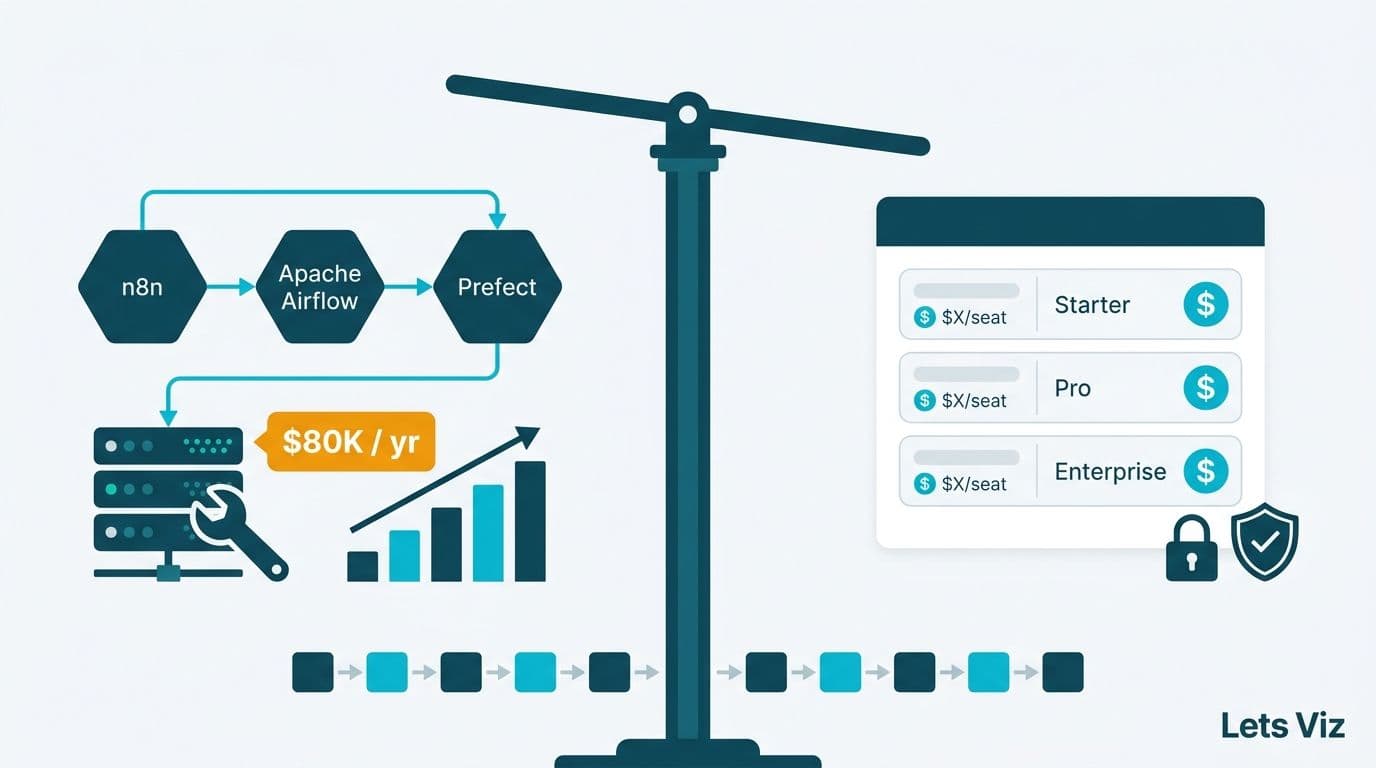
Open source AI workflow automation tools give mid-market operations teams genuine control over their data and infrastructure, but that control comes with a maintenance bill most vendors never mention. The right choice - self-hosted open source or managed SaaS - depends on your engineering depth, compliance obligations, and total-cost tolerance, not on which tool has the most GitHub stars.
Key Takeaways
Self-hosted open-source tools (n8n, Apache Airflow, Prefect) eliminate per-seat SaaS fees but add DevOps overhead that can easily exceed $90,000–$100,000 per year in engineering time.
Data privacy and HIPAA compliance strongly favor self-hosted deployments for healthcare and financial services organizations handling PHI or regulated data.
AI accounts payable automation and month-end close acceleration are the highest-ROI starting points for finance teams in both deployment models.
Build vs buy for mid-market companies hinges on one question: does your team have a dedicated DevOps engineer who can own the infrastructure long-term?
Open source is not free - the license is free, but the talent, hosting, and maintenance are not.
Lets Viz builds custom AI automation solutions that cut manual processing time by 40-60% within 90 days -- across finance, healthcare, and operations workflows.
What Are Open Source AI Workflow Automation Tools?
Open source AI workflow automation tools are orchestration platforms whose source code is publicly available, allowing organizations to self-host, customize, and extend them without per-workflow or per-user licensing fees. The most widely deployed examples in finance and healthcare operations are n8n (node-based visual orchestration), Apache Airflow (Python-first DAG scheduler), and Prefect (modern Python workflow engine).
According to Future Market Insights, the AI consulting services market reached an estimated USD 14 billion in 2026 and is projected to grow to USD 90.99 billion by 2035 at a 26.2% CAGR - a trajectory that reflects how aggressively organizations are adopting AI-driven automation across back-office functions. Open source tooling sits at the center of that shift for mid-market companies that cannot justify enterprise SaaS pricing at scale.
For finance teams, these platforms orchestrate tasks like invoice ingestion, GL reconciliation triggers, and anomaly flagging. For healthcare operations, they route HL7/FHIR data between EHR systems, trigger prior authorization workflows, and coordinate billing handoffs between clinical and revenue cycle teams. A hospital revenue cycle department automating the charge capture reconciliation step typically eliminates 15-20 hours of analyst time per week in facilities processing 500 or more daily claims.
If your team is evaluating how AI-driven reporting fits into your existing stack before committing to an orchestration layer, the AI Analytics for Healthcare Finance Teams guide covers the decision criteria for both clinical and administrative automation.
Open Source vs Managed SaaS: What Is the Real Cost Difference?
The sticker price of open source is zero; the true cost is not. The comparison that matters for a mid-market finance or healthcare team is total cost of ownership (TCO) over a 36-month horizon - and that calculation almost never appears in a vendor pitch.
| Dimension | Self-Hosted Open Source | Managed SaaS |
|---|---|---|
| License cost | $0 | $15,000-$120,000/yr |
| Infrastructure (VPS/cloud) | $3,000-$15,000/yr | Included |
| Engineering maintenance | 0.25-0.5 FTE/yr | Near zero |
| HIPAA/SOC 2 BAA availability | You configure it | Vendor provides |
| Customization ceiling | Unlimited | Vendor roadmap |
| Time to first workflow | 2-8 weeks | 1-5 days |
| Vendor lock-in risk | Low | High |
| Data residency control | Full | Varies by vendor |
For a 100-person mid-market company spending $60,000/year on a SaaS automation platform, switching to self-hosted n8n might save $45,000 in licenses but absorb $50,000 in DevOps time - a net loss of $5,000 with significantly higher operational risk. The math changes dramatically if you already employ a platform engineer whose capacity is not fully utilized.
Healthcare and financial services organizations handling regulated data often find the compliance calculus more compelling than the cost calculus. A self-hosted deployment can be fully VPC-isolated, eliminating the third-party data processor risk that triggers HIPAA Business Associate Agreement negotiations with every new SaaS vendor. See the HIPAA-Compliant Analytics Dashboard Best Practices Checklist for the configuration requirements that apply equally to automation infrastructure.
How Do You Automate the Month-End Close Process with AI?
To automate the month-end close process with AI, finance teams sequence four steps: data ingestion from ERP and GL sources, AI-driven reconciliation and variance detection, exception routing for human review, and automated report generation for stakeholders. Each step can be independently automated and wired together through an orchestration platform like n8n or Airflow.
The Healthcare Financial Analytics Market is projected to grow at an 8.58% CAGR through 2035 (Market Research Future, as of 2026), driven in part by hospital finance teams automating revenue cycle reconciliation and cost center close processes. The same pattern is accelerating at mid-market healthcare operators and financial services firms that have historically closed books manually over 5-8 business days.
Open source tooling handles the orchestration layer. An n8n workflow triggers data pulls from your ERP (NetSuite, SAP, Sage Intacct, Dynamics 365) via REST API or SFTP, routes records through an AI model for anomaly detection, flags exceptions to a Slack or Teams channel, and generates a pre-formatted close package once exceptions are cleared. Finance teams adding a Tableau to Power BI migration to their roadmap often find that establishing this automation layer first prevents the upstream data gaps that slow reporting buildouts.
For teams already using Power BI as their reporting layer, the guide to automating monthly financial reporting in Power BI covers how to connect an automated close workflow directly into a live dashboard with refresh triggers.
Practical sequencing for a mid-market company:
1. Weeks 1-2: Map your close checklist to automatable versus judgment-required tasks.
2. Weeks 3-4: Deploy n8n or Prefect, connect ERP API credentials, build the first data pull workflow.
3. Month 2: Add AI anomaly detection to flag variances above threshold before they reach the controller.
4. Month 3: Automate exception notifications and close-package report generation, targeting a close cycle under 3 business days.
What Finance Tasks Cannot Be Automated with AI?
Understanding what finance tasks cannot be automated with AI is as strategically important as knowing what can. AI automation excels at pattern-matching, threshold-based routing, and structured data transformation - it falls short on contextual judgment, regulatory interpretation, and relationship-dependent decisions. The failure mode for finance teams that over-automate is subtle: the AI completes the task without error, but the output is technically correct and contextually wrong.
Tasks that remain human-dependent in 2026:
Audit judgment calls - materiality assessments, going-concern evaluations, and disclosure decisions require licensed professional sign-off under GAAS and PCAOB standards.
Tax strategy under ambiguous guidance - IRS rule interpretations, OECD Pillar Two analysis, and state-level nexus determinations require counsel review, not pattern matching.
Vendor negotiations - AI can surface payment terms data and flag anomalies, but the negotiation itself depends on relationship context that models cannot access.
Board-level financial narrative - translating quarterly numbers into strategic context for a board requires synthesis that current AI models do not reliably produce at publication-ready quality.
Impairment testing - goodwill and long-lived asset impairment require management judgment about future cash flows that auditors will challenge if fully delegated to automation.
AI accounts payable automation for finance teams, by contrast, handles high-volume, low-judgment tasks exceptionally well: three-way PO matching, duplicate invoice detection, early-payment discount capture, and vendor statement reconciliation. Pilot deployments consistently report 60-80% reduction in manual AP processing time within 90 days, with the highest gains in organizations processing more than 200 invoices per month.
The principle to apply: automate work that is high-volume, rule-based, and low-risk-if-wrong. Reserve human review for work that is low-volume, judgment-heavy, and high-risk-if-wrong.
How Do n8n Finance Workflow Automation Examples Stack Up?
n8n is the open source tool most commonly deployed by mid-market finance teams because its visual node editor reduces the barrier for finance-adjacent technical staff, while self-hosting satisfies data residency requirements that enterprise SaaS tools often complicate. Its permissive license allows commercial deployment without per-workflow fees.
Concrete n8n finance workflow automation examples that are production-tested in mid-market environments:
AP Automation: n8n polls an email inbox or SFTP folder for incoming invoices, passes PDFs through a document intelligence API, extracts vendor, amount, and line-item fields, matches against open POs via REST API, and routes clean matches to a payment queue while sending exceptions to an AP analyst. Teams processing 300–500 invoices per month typically recover $18,000–$30,000 annually in labor costs and capture an additional 1–2% in early-payment discounts that manual queues routinely miss. Human touch only on exceptions.
Month-End Variance Alert: n8n runs nightly via cron, pulls actuals from the GL, compares against budget loaded from a SQL table, and sends a formatted digest to Slack or Teams only when variances exceed a configurable threshold. Zero noise on clean nights, immediate signal when something is off.
AI Anomaly Detection in Financial Data: n8n passes a daily transaction export to an AI model that classifies transactions as expected, anomalous-low-risk, or anomalous-high-risk. High-risk flags trigger an email to the controller with the specific transaction ID and reason code - catching duplicate payments, misclassified expenses, and unusual vendor patterns before month-end.
Cross-Border Compliance Trigger: n8n monitors transaction volumes against Canadian GST registration thresholds and fires an alert when a subsidiary approaches the $30,000 CAD threshold - a workflow that manual processes routinely miss in multi-entity environments operating across the US and Canada.
The AI-Powered Power BI Consulting for Finance Teams overview shows how n8n-style orchestration connects to downstream reporting layers when finance teams want a complete automation-to-dashboard pipeline.
When Should Mid-Market Companies Choose Build vs Buy for Finance Automation?
Build vs buy finance automation for mid-market companies is not an ideological debate - it is an engineering capacity question with a compliance overlay. The most common mistake is letting the license cost dominate the decision when headcount cost is the larger variable.
Choose self-hosted open source when:
You have at least one engineer (or DevOps-capable analyst) who can own the platform and is not already at capacity.
Your data includes PHI, PCI-DSS scope, or other regulated content where third-party processors add compliance risk you cannot mitigate with a BAA alone.
Your workflows are highly custom - uncommon ERP integrations, proprietary data models, or business logic that SaaS vendors cannot support without expensive professional services.
Your 36-month projected SaaS spend exceeds $150,000, at which point the TCO math typically inverts in favor of self-hosted.
Choose managed SaaS when:
Your finance and ops teams need automation running within weeks, not months.
You lack dedicated engineering staff to maintain infrastructure and prefer a vendor SLA.
Your workflows map cleanly to standard templates (AP, expense management, close reporting) that SaaS vendors support out of the box.
You are in an early automation maturity stage and want to validate which workflows deliver ROI before committing to infrastructure.
A third path - increasingly common in 2026 - is managed open source: a consulting partner deploys and maintains your self-hosted infrastructure on your VPS or cloud account. You retain data residency and customization advantages while offloading the DevOps burden. Dedicated managed-open-source engagements typically add $1,500-$3,000/month in service fees - still 60-70% below comparable SaaS licensing at scale for teams processing high workflow volumes. This model is particularly attractive for healthcare organizations that need the compliance posture of self-hosted but cannot justify a full-time platform engineer.
Recent research by the World Economic Forum (2025), drawing on input from over 50 financial services organizations, identified maintenance burden and skills availability as the top two barriers to successful self-hosted AI deployment in mid-market financial services - ahead of cost and regulatory risk. That finding validates managed open source as a legitimate middle ground between full self-service and full SaaS.
For teams evaluating the managed versus in-house decision across business intelligence infrastructure broadly, the Managed Power BI vs In-House BI Team cost guide walks through the same framework applied to analytics.
---
Ready to move from evaluation to implementation? Lets Viz custom AI automation services help mid-market finance and healthcare operations teams design, build, and maintain self-hosted or hybrid AI workflow automation - from AI accounts payable automation to anomaly detection pipelines - with the compliance guardrails your industry requires.
---
About Lets Viz: Lets Viz has delivered data analytics and AI automation solutions for finance and healthcare clients since 2020, with deep expertise in Power BI, Microsoft Fabric, and open source workflow orchestration. Our engagements span mid-market companies across the US and Canada navigating HIPAA compliance, SOC 2 readiness, and the build-vs-buy decision for AI infrastructure. Our work combines technical rigor with the practical constraints of operations teams that cannot afford multi-year implementation timelines.