How to Hire an AI Automation Consultant: 2026 Decision Guide
*By Lets Viz Editorial, Head of AI Automation at Lets Viz. Building LLM-powered workflows for healthcare and finance teams since 2021.*
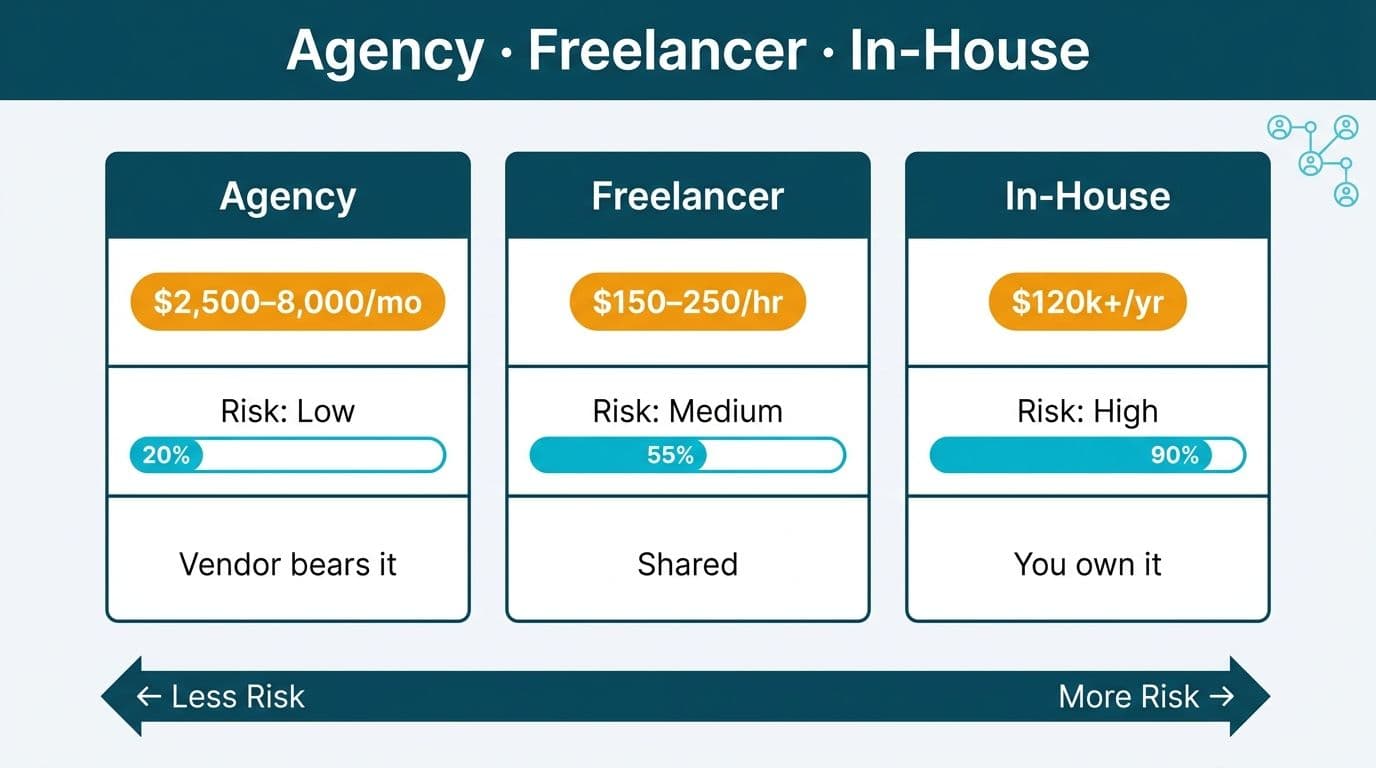
Hiring an AI automation consultant in the US costs $150-$250/hr, or $2,500-$8,000 per month on retainer. Most mid-market projects connecting your EHR, ERP, or finance system to an LLM-powered workflow run $10,000-$50,000 for custom AI agent development. The right choice between an agency, a freelancer, and an in-house hire comes down to one question: how much of the risk do you want to own?
Key Takeaways
AI automation consultants charge $150-$250/hr or $2,500-$8,000/mo on retainer
Agencies beat freelancers for HIPAA/GDPR engagements due to BAA and DPA readiness
In-house hiring takes 4-6 months to first output; agencies can ship working automations in 6 weeks
Always ask a vendor to name the source system, trigger, and error-handling path -- vague portfolio references are a red flag
Refusing to sign a BAA or DPA before any data touches the system is an automatic disqualifier
Who This Is For
This decision guide fits your situation if:
You run a mid-market team in healthcare or finance with 20+ hours per week of manual processing you want to eliminate
You are a CIO or data team lead evaluating your first AI automation engagement and want a structured framework before talking to vendors
You are a finance director who has approved budget for AI and needs to decide between a consultant, an agency, or an in-house engineer
You have used off-the-shelf automation tools (Zapier, Make) and hit a ceiling where LLM reasoning or custom API integration is required
This is probably not for you if:
The target process takes fewer than 5 hours per week -- the project economics rarely justify custom AI development at that volume
You need a fully staffed internal AI team within six months and have the budget to build one (in that case: consult first, then hire)
How to Hire an AI Automation Consultant: Agency, Freelancer, or In-House?
Before you talk to a single vendor, know which model fits your situation. The cost and risk profiles are fundamentally different.
| Option | Typical Cost | Speed to First Value | Accountability | Best Fit |
|---|---|---|---|---|
| AI Automation Agency | $3,000-$15,000 project or $2,500-$8,000/mo retainer | 2-4 weeks to first live workflow | Contract-backed; team depth covers gaps | Multi-process scope; compliance requirements (HIPAA, GDPR, PIPEDA) |
| Independent Freelancer | $150-$250/hr | 1-2 weeks to start | Single point of contact and single point of failure | Single, well-defined project; tight budget |
| In-House AI Engineer | $160,000-$215,000/yr fully loaded | 3-6 months to hire and onboard | Long-term ownership | High-volume ongoing automation; 18-month+ horizon |
The in-house math is worth spelling out. Before a mid-level AI engineer in the US ships their first production workflow, you have typically spent $80,000-$107,000 in salary and benefits, assuming a clean hire with no extended search. An agency retainer at $2,500-$8,000/mo can deliver working automations within weeks, with no recruiting pipeline and no coverage gap when someone leaves.
For US healthcare organizations, the agency model has a direct compliance advantage: a firm with regulated-industry experience arrives with signed Business Associate Agreements (BAAs), documented data handling policies, and prior HIPAA audit experience. Canadian buyers under PIPEDA face cross-border data handling requirements that are cleaner to satisfy with a firm that already has data residency documentation. For UK and EU buyers, GDPR Article 28 processor obligations are far easier to fulfill with an agency that has a standard Data Processing Agreement (DPA) template than with a freelancer who has never been asked for one.
For a full breakdown of engagement types -- from n8n workflow automation to multi-step LangChain agents -- see our AI automation consulting services page before committing to a vendor conversation.
What Working With Lets Viz Looks Like
Most engagements follow a four-phase pattern. The timeline below covers a standard single-workflow project; multi-process programs are scoped after discovery.
Weeks 1-2: Process Audit
We map your highest-value manual workflows -- claims processing, prior authorization, financial close, invoice matching. We rank by hours-at-stake multiplied by technical feasibility, so you know which automations pay back first.
Weeks 3-5: Build and Test
We build in n8n, Make, or a custom LangChain/Claude stack depending on the reasoning complexity of the process. You see a working prototype before week four ends. For any workflow touching protected health information (PHI) in the US, the BAA is signed before any data enters the automation environment.
Week 6: Handover and Monitoring Setup
You receive runbooks, a monitoring dashboard, and a 30-day support window. We do not disappear after go-live.
Ongoing Retainer (optional)
Retainers run $2,500-$8,000/mo and cover new workflow iterations, model updates as LLM APIs evolve, and a dedicated async support channel. Most clients start on a fixed project and move to retainer once the first automation demonstrates ROI.
The benchmark we work toward: 40-60% reduction in manual processing hours within 90 days of deployment (Lets Viz client benchmark, 2026). Across mid-market healthcare and finance engagements, the median payback period -- project cost recovered through labor savings -- runs 4-7 months for single-workflow projects in the $10,000-$25,000 tier. We will tell you before scoping whether your specific process is realistically in that range.
How Much Does an AI Automation Consultant Cost?
Hourly rates for senior AI automation consultants run $150-$250/hr in the US market. UK and EU rates for comparable seniority are similar. Canadian rates typically run 10-15% below US rates.
Project costs scale with scope:
Single workflow with n8n or Make plus one LLM integration: $3,000-$15,000 one-time
Custom AI agent development (LangChain, Claude, or multi-step reasoning): $10,000-$50,000+
Ongoing retainer (monitoring, maintenance, new workflow iterations): $2,500-$8,000/mo
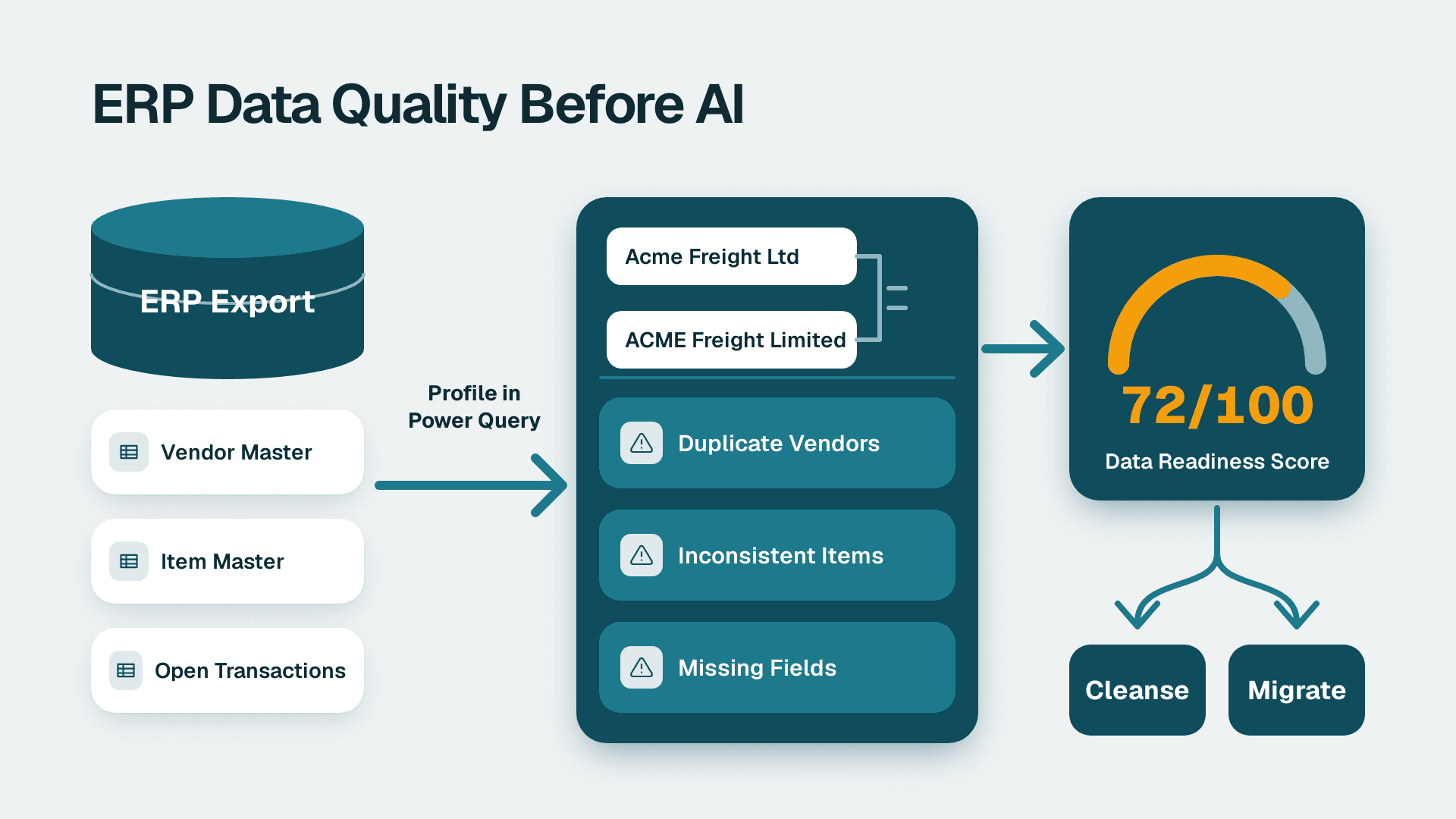
If a consultant quotes a flat number in the first call without asking about your data architecture, integrations, or compliance requirements, treat it as a red flag. Complex projects -- especially those that connect to a modern data layer or involve migrating a legacy data warehouse to Microsoft Fabric lakehouse -- should be scoped after a discovery call that includes a review of your actual systems.
For AI automation projects that intersect with your BI stack -- automating report distribution from Power BI, or routing LLM-generated summaries to a Looker Studio dashboard -- scoping also depends on which analytics platform you are actually on. The Google Looker vs Looker Studio difference is significant here: Looker (the full Google Cloud platform with LookML-based data modeling) and Looker Studio (the free, connector-based visualization tool) have entirely different APIs and integration surfaces. Our Looker Studio consultant cost guide covers the BI-side context if you are building on that stack.
What Questions Should You Ask Before You Hire an AI Automation Consultant?
Use these in every vendor conversation. Weak answers are as informative as strong ones.
1. "Walk me through a workflow you automated in healthcare or finance in the last 12 months."
You want specifics: the source system, the trigger, the LLM prompt architecture, and how errors are caught and routed. Vague answers signal limited domain experience.
2. "How do you handle compliance review for a HIPAA-covered process?"
The correct answer includes: BAA before any data touches the system, PHI minimization in prompts, audit logging, and a defined incident response path. For GDPR or PIPEDA engagements, expect a parallel answer with personal data in place of PHI.
3. "What happens when the LLM API you are building on changes its pricing or model behavior?"
A solid answer: version-pinned prompts, abstraction layers, and advance notice before any forced migration.
4. "What does handover look like, and what does post-handover support cost?"
This separates firms that build and disappear from those that maintain accountability past go-live.
5. "Can you show me a monitoring dashboard from a live project?"
Automation without observability is technical debt in production. Any firm with live automations in the field can show you this.
Red Flags That Should Make You Walk Away
"No compliance questions asked." If you mention HIPAA, GDPR, or PIPEDA and the consultant moves on without follow-up, they have not done regulated-industry work.
"We will automate everything." AI automation delivers highest ROI on well-defined, high-volume, rules-adjacent processes. A consultant who cannot name what falls outside scope is selling, not advising.
Offshore team disclosed only in the contract. Geographic distribution is not inherently a problem. Undisclosed switching is.
No systems named in past examples. "We have done AI automation for finance" is not a reference. "We integrated n8n with NetSuite and a Claude-based classification layer for a mid-market AR workflow" is.
Reluctance to sign a BAA or DPA. In the US, UK, Canada, and EU, this is standard paperwork for regulated engagements. Hesitation signals inexperience or evasion.
For the technical equivalent of these vendor red flags, see our AI workflow automation pre-launch checklist.
Can You Just Hire Someone In-House Instead?
Yes -- and for long-horizon, high-volume programs, it is often the right answer eventually. The practical question is timeline.
A mid-level AI/ML engineer in the US costs $160,000-$215,000 per year fully loaded (US AI talent benchmark, 2026). That is $13,300-$17,900 per month before a single production automation ships. The average time to hire, onboard, and see first output from a new AI engineer runs 4-6 months (industry hiring data, 2026).
An agency engagement at $2,500-$8,000/mo can have working automations in production by week six. If you need coverage for one or two core processes this quarter, the consulting model wins on time-to-value. If you are planning fifty automations over two years, hire -- but start with a consulting engagement to define the architecture and avoid the failure patterns that are well-documented in AI deployments for healthcare operations.
The two approaches are composable: many organizations use an agency to build the first three automations, then hand the architecture and runbooks to an in-house engineer to scale. Your in-house team inherits a working model instead of a blank page.
Does Compliance Exposure Change the Vendor Decision?
Yes, materially. For US healthcare organizations, any AI workflow touching PHI requires a signed BAA with every vendor in the processing chain. For Canadian organizations under PIPEDA, cross-border data transfers and residency requirements shape which tools can appear in the stack at all. For UK and EU buyers under GDPR, your automation consultant is a data processor under Article 28, and you need a DPA that specifies sub-processors, retention periods, and breach notification timelines before any data flows.
These are qualification filters, not deal-breakers. A firm with regulated-industry experience arrives with these documents ready. One without will ask you to draft them.
To make the risk concrete: consider a UK-based financial services firm that engaged a credentialed independent consultant to automate a document-processing workflow. The consultant had no DPA on file and had never been registered as a named sub-processor in the firm's GDPR data register. Six weeks into the build, the firm's compliance officer discovered that personal data had been flowing through the consultant's personal cloud environment without a lawful processing basis. Under GDPR Article 28, any processor handling personal data must be documented and contractually bound before data transfer begins. The firm faced two choices: retroactively document the arrangement and notify the supervisory authority of a likely breach, or restart the project with a compliant vendor. They restarted. The sunk cost -- approximately $18,000 in fees plus internal compliance hours -- was a direct consequence of skipping the DPA qualification at procurement. The sub-processor disclosure gap is the most common compliance failure mode in freelancer-led automation engagements precisely because independent consultants rarely maintain the legal infrastructure that makes Article 28 compliance routine. An agency with a standardized DPA template and a named sub-processor list eliminates this risk at the contract stage.
Projects that also involve modernizing data infrastructure -- evaluating data lakehouse vs data lake vs data warehouse architectures, or migrating a legacy warehouse to Microsoft Fabric lakehouse -- carry a parallel compliance track. Microsoft's 2026 documentation on Microsoft Fabric lakehouse HIPAA and GDPR compliance covers the shared-responsibility model and is worth reviewing before any project that moves regulated data to a new platform.
For more examples of what automatable workflows look like across business functions, see our AI workflow automation examples guide.
Ready to scope your highest-value automation? Our AI automation consulting team runs free 30-minute discovery calls for mid-market healthcare and finance teams. Tell us the process, and we will give you an honest assessment of timeline, cost, and expected ROI -- no obligation.
---
About Lets Viz: Lets Viz is a data analytics and AI automation consultancy serving healthcare, SaaS, finance, and agency clients since 2020. We hold a 5.0 rating on Clutch and specialize in regulated-industry engagements across the US, Canada, and the UK -- from HIPAA-compliant automation builds to GDPR-ready data pipelines.