Fabric Lakehouse vs Data Warehouse for Power BI: 2026 Guide
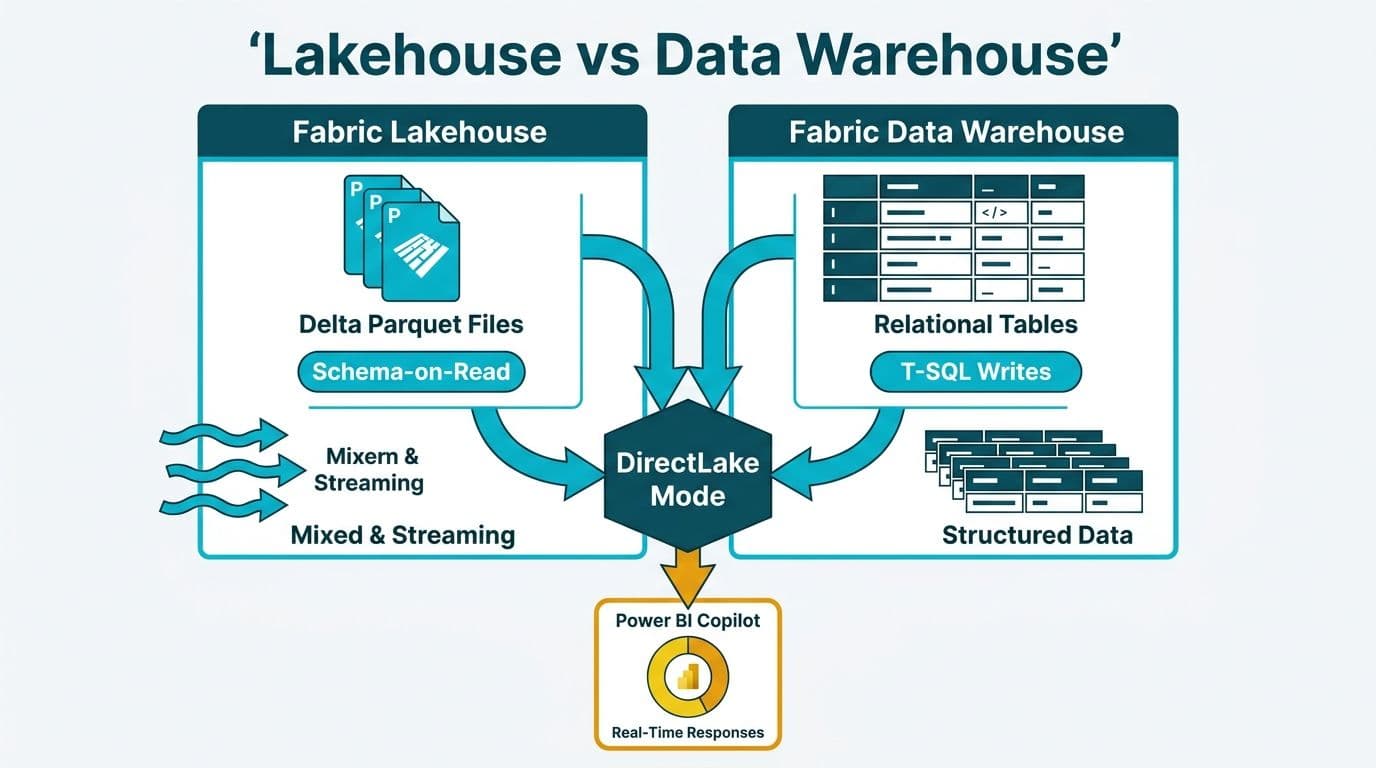
For mid-market data teams choosing the storage tier powering Power BI Copilot and Q&A, Fabric Lakehouse suits mixed and streaming workloads stored as open Delta Parquet files, while Fabric Data Warehouse serves structured relational data requiring full T-SQL write operations. Both tiers support DirectLake mode - the engine that delivers real-time Copilot responses without scheduled refresh delays - so the decision is about data shape and workflow, not AI capability.
Key Takeaways
- Fabric Lakehouse stores data as open Delta Parquet files with schema-on-read; Fabric Data Warehouse enforces schema-on-write with full T-SQL CRUD operations.
- Both tiers support DirectLake mode in Power BI, enabling real-time Copilot and Q&A without scheduled data refreshes.
- Compliance under GDPR, HIPAA, and PIPEDA is governed by Fabric workspace region and Microsoft's Business Associate Agreement - not by which storage tier you select.
- Cost differences are operational: Spark compute for Lakehouse transforms vs T-SQL session compute for Warehouse concurrency, both billed in Fabric Capacity Units.
- Most mid-market teams run a hybrid: Lakehouse for raw and enriched data, Warehouse for curated reporting tables, with a single Power BI semantic model spanning both.
What Is the Difference Between Fabric Lakehouse and Data Warehouse?
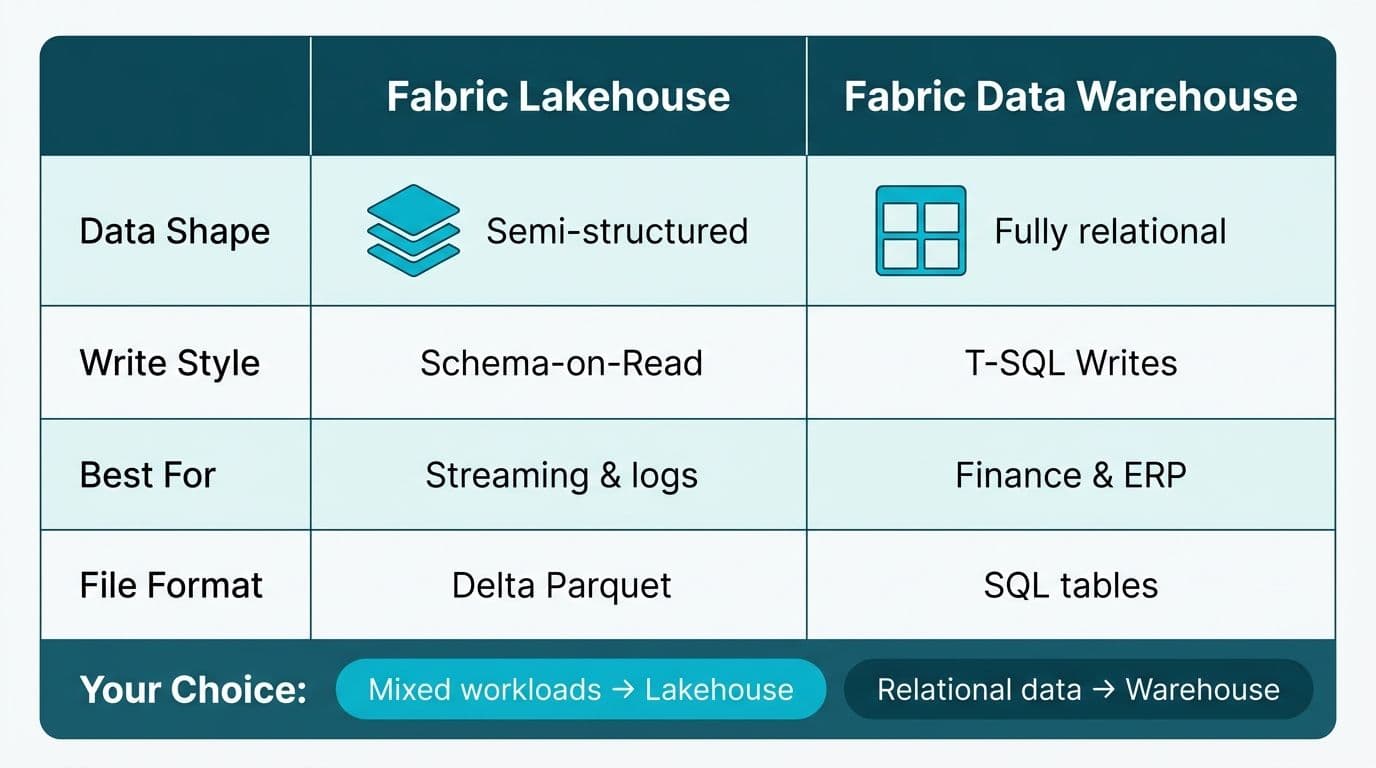
The Fabric Lakehouse stores all data as Delta Parquet files inside OneLake, Microsoft's unified storage layer introduced with Fabric. You access it through a SQL analytics endpoint for read-only T-SQL queries or through Apache Spark notebooks for transforms and machine learning pipelines. Because schema is enforced at read time, you can land raw JSON exports, CSV file drops, and structured tables in the same Lakehouse and impose structure through Delta table definitions or SQL views - without moving data between systems.
The Fabric Data Warehouse is a fully managed, schema-on-write relational engine. You define tables with DDL statements, run INSERT, UPDATE, DELETE, and MERGE operations, and write stored procedures - the same workflow your team carries over from Azure Synapse dedicated SQL pools or on-premises SQL Server. Unlike the Lakehouse SQL analytics endpoint, the Warehouse supports full DML write operations through T-SQL, not just reads.
Teams evaluating this as part of a broader Copilot rollout should review Power BI consulting (Copilot-ready) to understand how the semantic layer connects each storage tier to reports and AI features. For a visual topology reference, the Fabric Lakehouse Architecture Diagram reference guide maps each component from OneLake through to the Power BI report layer.
Microsoft Fabric Lakehouse vs Data Warehouse for Power BI: Side-by-Side Comparison
The table below covers the decision factors most relevant to CIOs, data team leads, and finance directors evaluating a Copilot-ready storage tier.
| Factor | Fabric Lakehouse | Fabric Data Warehouse |
|---|---|---|
| Storage format | Delta Parquet (open format) | Managed columnar (Delta-backed) |
| Schema enforcement | On read - via views or SQL endpoint | On write - DDL-defined tables |
| SQL write operations | Read-only SQL endpoint | Full DML: INSERT, UPDATE, DELETE, MERGE |
| Apache Spark support | Native notebooks | Via shortcut or external pipeline |
| DirectLake for Power BI | Yes | Yes |
| Copilot and Q&A | Full support | Full support |
| Best fit | Streaming ingest, mixed data types, data science + BI | Relational ERP/GL data, heavy T-SQL, high concurrency |
| Cost driver | OneLake storage + Spark/SQL CU compute | CU compute for concurrent T-SQL sessions |
| Open format portability | Yes - Delta Parquet readable outside Fabric | Yes - Delta-backed, exportable |
| Data residency control | Fabric workspace region | Fabric workspace region |
How Does Each Storage Tier Power Copilot and Q&A in Power BI?
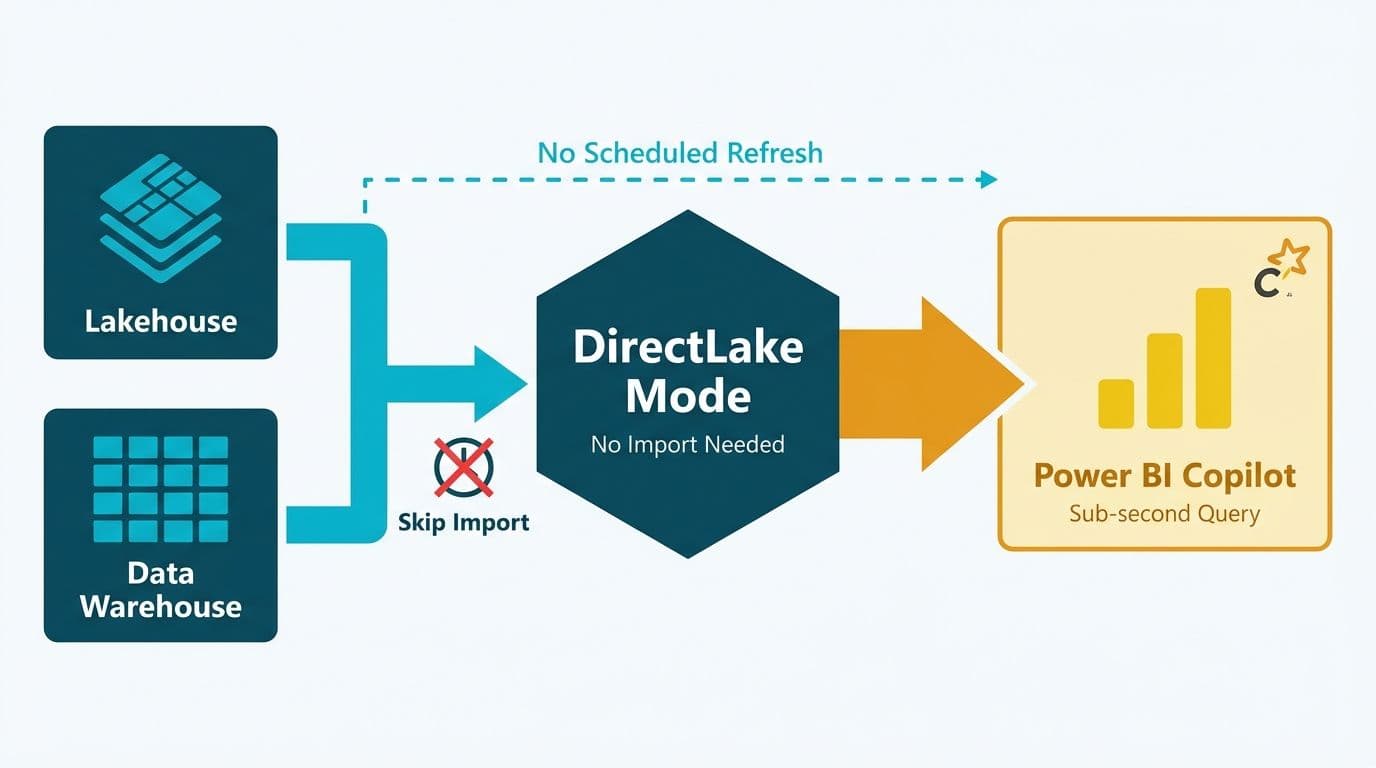
DirectLake mode is the architectural bridge between Fabric storage and Power BI AI features. According to Microsoft's Fabric documentation (2025), DirectLake reads Delta files directly from OneLake into the Analysis Services in-memory engine, bypassing the traditional data copy used by Import mode. Copilot and Q&A queries therefore hit current data without waiting for a scheduled refresh - a meaningful difference for finance teams running end-of-day GL closes and healthcare teams monitoring real-time inpatient metrics.
Both tiers expose DirectLake-compatible semantic models. In practice:
- Lakehouse performs best as a DirectLake source for large, append-only fact tables such as event logs, IoT sensor readings, or EHR audit trails, where data arrives as streaming Delta writes that DirectLake picks up immediately.
- Warehouse performs best when Copilot queries involve complex multi-table joins defined as SQL views, or when 20 or more concurrent analyst sessions query the same model simultaneously.
A US SaaS finance team on Fabric F64 would typically configure a Warehouse as the Copilot source for general ledger data - structured, reconciled, schema-on-write - while maintaining a Lakehouse for Salesforce event streams and product usage telemetry feeding the same Power BI app through a composite model. A logistics team building a Power BI shipping and delivery dashboard would benefit from the Lakehouse tier when shipment events stream from multiple carrier APIs: Delta writes feed DirectLake instantly, keeping on-time delivery and exception metrics current for dispatchers without a manual refresh step.
For licensing pre-conditions, Power BI Copilot licensing requirements: the complete 2026 guide details which Fabric SKU unlocks Copilot for different seat counts before storage tier selection becomes relevant.
What Are the Cost Differences Between Fabric Lakehouse and Fabric Data Warehouse?
Both tiers bill through Fabric Capacity Units (CUs) - there is no per-tier licence fee or storage-tier surcharge. Cost differences are operational:
Storage is charged per GB in OneLake regardless of tier. Delta Parquet compression reduces file sizes substantially versus raw CSV or JSON source formats, benefiting both Lakehouse and Warehouse equally.
Compute for transforms: Spark notebooks (Lakehouse) bill in CU-seconds while a job runs and cost nothing when idle. T-SQL queries (Warehouse) consume CUs during execution. For large ELT batch jobs that process billions of rows, Spark is often more cost-efficient at scale; for frequent short analyst queries against well-indexed tables, T-SQL Warehouse compute is more predictable.
Concurrency costs: A Warehouse under heavy concurrent load - 30 or more simultaneous analyst sessions during business hours - can exhaust a Fabric F64 SKU. Lakehouses sharing the same CU pool can see dashboard query performance degrade when unscheduled Spark jobs run concurrently without scheduling isolation.
A typical mid-market data estate of 200 GB with moderate concurrency runs comfortably on Fabric F64. Finance teams with end-of-quarter reporting bursts often scale temporarily to F128 using Fabric's elastic compute model rather than a permanent upgrade commitment.
How Do GDPR, HIPAA, and PIPEDA Shape the Storage Tier Decision?
The compliance answer is simpler than most teams expect: both tiers inherit the same Microsoft Fabric compliance posture. The storage tier choice does not change your regulatory exposure - workspace region and Microsoft's contractual commitments are the compliance control points.
GDPR (UK and EU): Microsoft Fabric supports EU Data Boundary commitments as documented in Microsoft's 2025 EU Data Boundary guidance. Processing and storage remain within the EU when the workspace is provisioned in a qualifying Azure region such as West Europe, North Europe, or UK South. A UK fintech firm deploying Power BI Copilot for automated financial commentary should verify that all Fabric workspace regions fall inside the EU Data Boundary before ingesting customer or transactional data. This requirement applies equally to Lakehouse and Warehouse items within that workspace.
HIPAA (US healthcare): Microsoft's Business Associate Agreement (BAA) covers Microsoft Fabric as of 2025, per Microsoft Trust Center documentation. US healthcare organizations must provision Fabric capacity in a BAA-covered Azure region and configure workspace-level access controls, audit logging, and row-level security (RLS) on the Power BI semantic model. Neither Lakehouse nor Warehouse is inherently more HIPAA-compliant; both require identical RLS and encryption configuration. HIPAA Compliant BI Tools for Hospital Data Visualization covers the configuration checklist applicable to either Fabric tier.
PIPEDA (Canada): Canada's Personal Information Protection and Electronic Documents Act requires adequate protection for personal data about Canadian residents. A Canadian health insurer or financial services firm should provision the Fabric workspace in Azure Canada Central or Canada East to keep data within Canadian borders, and request a data processing addendum from Microsoft before ingesting personally identifiable information. A Canadian benefits administrator running a Lakehouse for raw claims telemetry and a Warehouse for adjudicated payment records within the same Canada Central workspace would satisfy PIPEDA data-residency requirements without additional boundary measures - a hypothetical but representative architecture for mid-market health plans in Ontario or British Columbia.
For US and Canadian finance teams navigating overlapping obligations, AI Compliance Requirements for Financial Services: 2026 Regulatory Map maps the regulatory landscape alongside Fabric adoption decisions.
When Should You Choose Lakehouse vs Data Warehouse for Your Power BI Stack?
Choose Fabric Lakehouse if:
- Data arrives from streaming sources (Azure Event Hubs, Kafka) or periodic file drops from vendors, carriers, or IoT devices
- Your team runs Python or PySpark notebooks for feature engineering or ML pipelines alongside BI reporting
- Open-format portability is required - data must be accessible outside Fabric without a vendor conversion step
- You are building a medallion architecture with bronze, silver, and gold zones coexisting in one workspace
Choose Fabric Data Warehouse if:
- Source systems are relational (ERP, accounting GL, insurance claims, order management) with stable schemas maintained via DDL
- Analysts write T-SQL and expect CRUD operations, stored procedures, and views to behave identically to SQL Server
- Concurrent analyst load is high - 20 or more simultaneous sessions querying production reporting tables
- Finance, actuarial, or compliance workloads require row-level reconciliation and ACID transaction guarantees on inserts
Hybrid (most common for mid-market): Most teams run a Lakehouse for raw and enriched data, then promote curated gold-layer tables into a Warehouse for final reporting. Power BI connects to the Warehouse semantic model via DirectLake. Microsoft's Fabric end-to-end tutorials (2025) describe this medallion architecture pattern; it keeps the semantic model clean without duplicating data outside OneLake.
A note for DAX practitioners: the CALCULATE function and aggregate measures using SUMX behave identically in DirectLake mode versus Import mode - the underlying Analysis Services engine is unchanged. Finance teams migrating hundreds of parameterised measures for budget variance or margin analysis do not need to rewrite those measures when moving to a Fabric storage tier. The filter context mechanics that govern how CALCULATE overrides row context apply the same way regardless of whether data lives in a Lakehouse or a Warehouse.
How Do You Migrate to Fabric from a Legacy Data Stack?
Migration path depends on your current system:
From Azure Synapse Analytics: Microsoft's Synapse-to-Fabric migration guide (2025) covers dedicated SQL pool export. Tables are written as Parquet to ADLS Gen2 and loaded into either a Fabric Lakehouse via Delta conversion or a Warehouse via COPY INTO. Synapse Spark pool notebooks migrate to Lakehouse notebooks with minimal changes.
From on-premises SQL Server or other relational databases: Export via BACPAC or Parquet to ADLS Gen2, then land in OneLake through Azure Data Factory or Fabric Dataflow Gen2. Schema-heavy systems - Oracle ERP extracts, SAP subledger tables, reconciled finance marts - land more cleanly in the Warehouse. Schema-light or semi-structured sources (API webhooks, vendor file drops, telemetry streams) land better in the Lakehouse.
From Power BI Import mode: If existing reports use Import mode against Azure SQL Database or on-premises SQL Server, recreating the semantic model to point at a Fabric Warehouse and switching to DirectLake eliminates nightly refresh lag. For teams adopting Copilot, this migration has the most immediate impact: Copilot responses reflect current data rather than yesterday's refresh snapshot. Report-level DAX measures, including complex CALCULATE and SUMX patterns built for filter context manipulation, carry over without modification.
Typical timelines for mid-market teams run four to eight weeks for a single subject area (finance, claims, supply chain), depending on schema complexity, data volume, and the number of Power BI reports that need semantic model updates.
---
When you are ready to move from evaluation to implementation, Power BI consulting (Copilot-ready) covers Fabric architecture design, storage tier selection, DirectLake semantic model build, and compliance configuration for mid-market healthcare and finance teams.
---
About Lets Viz: Lets Viz has delivered Power BI and Microsoft Fabric solutions to US healthcare systems, UK fintech firms, and Canadian manufacturing organizations since 2020, earning a 5.0 Clutch rating across engagements. Our consulting practice spans Fabric architecture design, regulatory compliance configuration (HIPAA, GDPR, PIPEDA), and Copilot-ready semantic model development for mid-market teams that need production-grade analytics without enterprise overhead.