Delta Lake Open Format: Microsoft Fabric Lakehouse Complete Guide
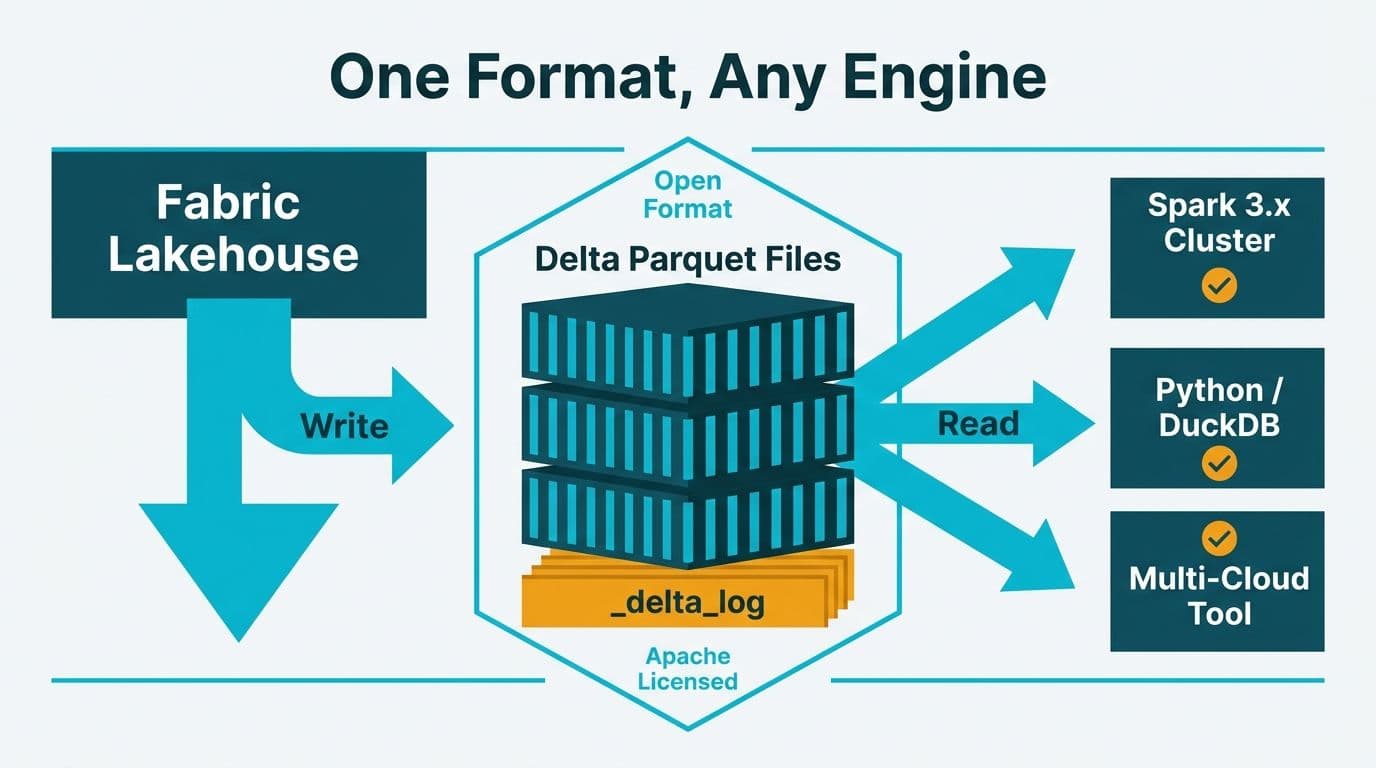
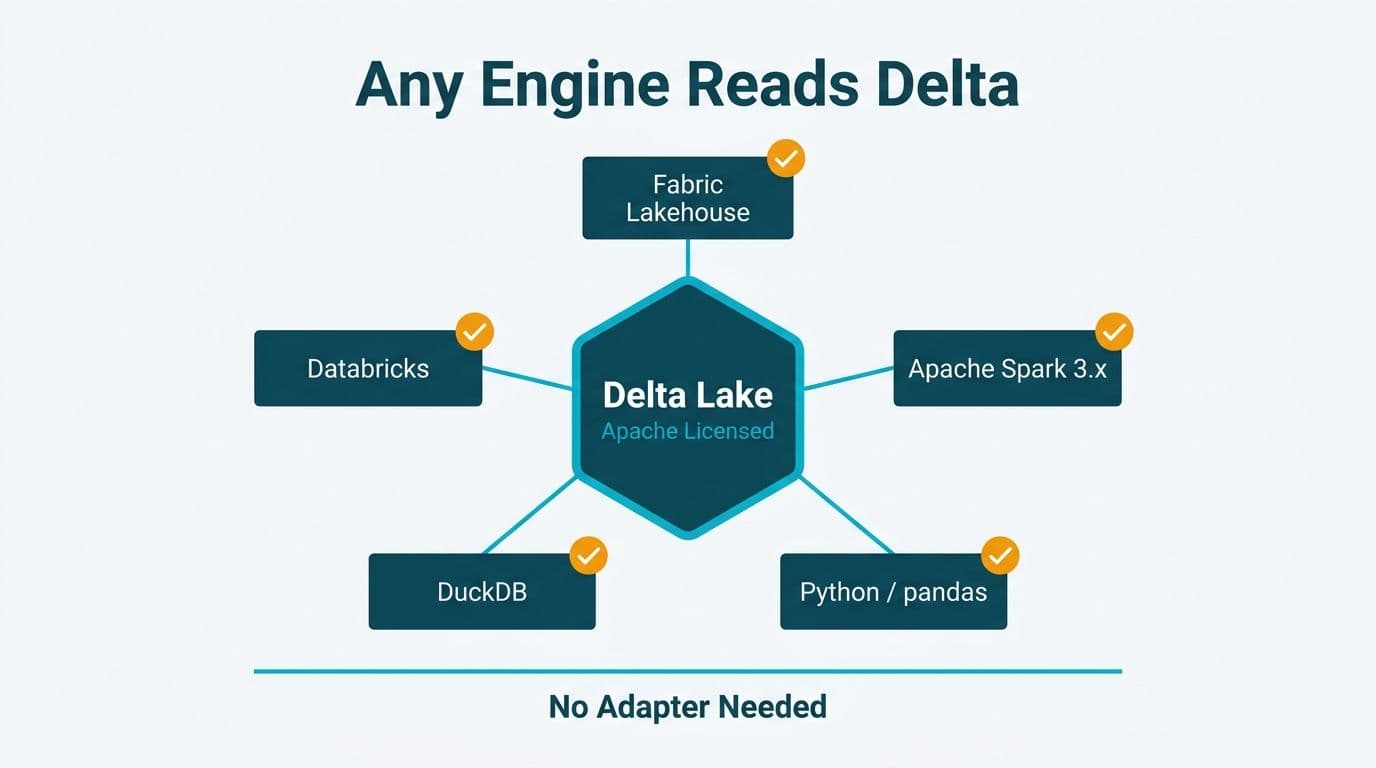
Microsoft Fabric Lakehouse stores every managed table as Delta Lake open format, an Apache-licensed, Linux Foundation-governed specification built on standard Parquet column files. Because the format specification is public and vendor-neutral, any Spark 3.x cluster, Python environment, or multi-cloud tool can read those files directly. No proprietary adapter, no data movement, and no vendor dependency to access your own data.
Key Takeaways
- Fabric Lakehouse writes all managed tables as Delta Parquet natively; any Spark 3.x engine reads the same files without a proprietary adapter.
- The SQL Analytics Endpoint auto-exposes Delta tables as T-SQL views, so SQL-based reports require no ETL rebuild.
- Fabric Shortcuts federate Delta data from ADLS, Amazon S3, and Google Cloud Storage without copying files, a critical capability for GDPR and PIPEDA data residency compliance.
- Power BI Direct Lake mode reads Parquet segments from OneLake directly, enabling large-scale DAX calculations without the performance trade-offs of DirectQuery.
- Teams migrating from SSRS can point Power BI paginated reports at the SQL Analytics Endpoint, reducing migration cost and timeline by reusing existing SQL logic.
What Is the Delta Lake Open Format in Microsoft Fabric Lakehouse?
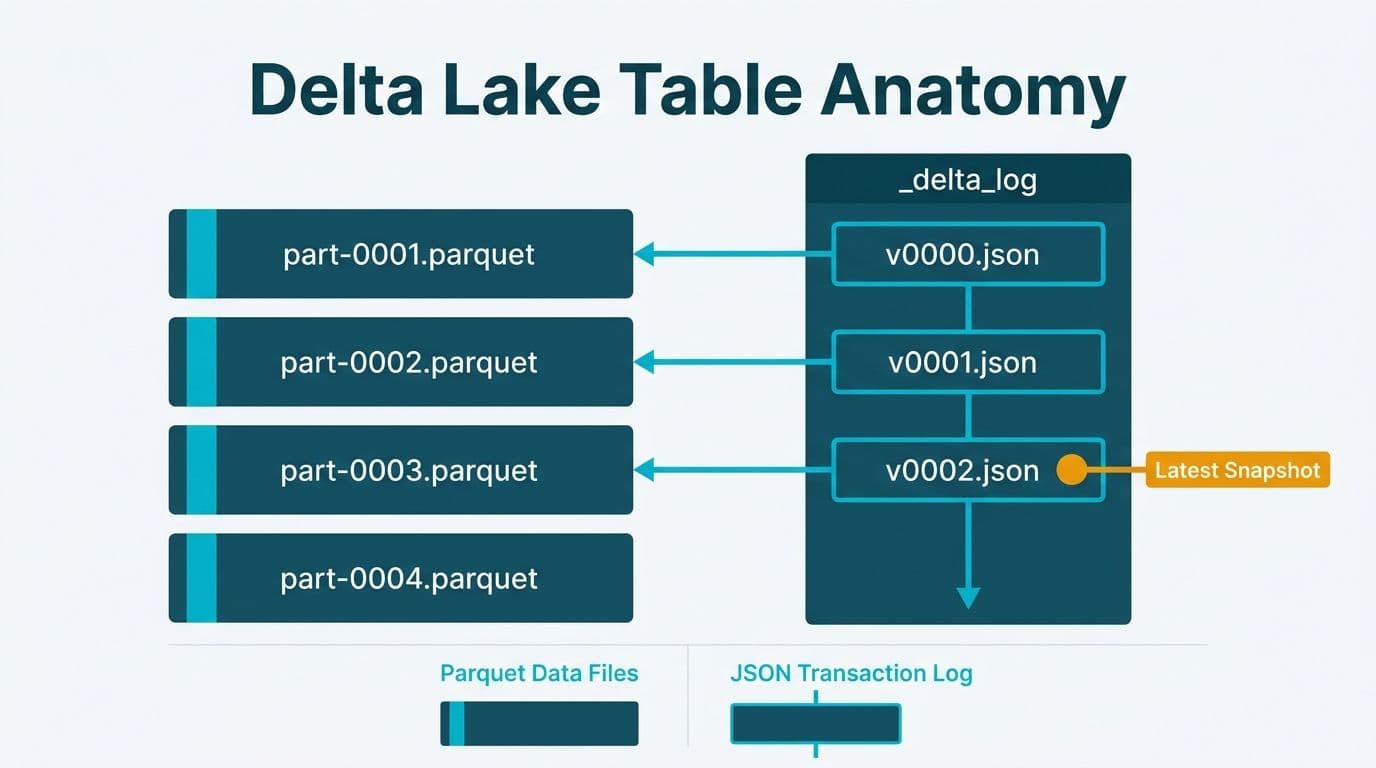
Delta Lake is an open-source storage layer governed by The Linux Foundation. It wraps standard Parquet column files with a transaction log, the `_delta_log` folder, that records every insert, update, delete, and schema change as a human-readable JSON or Parquet checkpoint file. The result is a table format that supports ACID transactions, schema evolution, and time-travel queries while remaining readable by any tool that understands the published Delta specification.
For enterprise buyers, the distinction between "open format" and "open source platform" matters. A vendor can ship open-source software while persisting data in a proprietary binary that no outside engine can parse. Delta Lake is structurally different: the format specification is public, reference implementations exist in Rust, Java, and Python, and no vendor controls access to the format. According to Microsoft's official Fabric documentation (2025), OneLake stores all managed Lakehouse tables as Delta by default, with no additional configuration required.
The vendor lock-in risk is not hypothetical for mid-market buyers. Organizations that have migrated between data warehouse or analytics platforms recall the cost of extracting data from proprietary storage: delayed migrations, expensive ETL rewrites, and reduced negotiating leverage at renewal. Delta Lake's open format addresses that procurement risk structurally, not contractually.
In practice, architects confirming that the `.parquet` files in OneLake are readable from an external Spark environment using a standard ADLS credential and the Delta library, with no Fabric subscription required for that read path, find this portability argument convincing on its own merits.
Understanding this portability also matters for teams building a Copilot for Business Intelligence adoption checklist that includes data governance pre-work. AI-generated insights are only as trustworthy as the data layer beneath them, and an open, auditable format makes that layer independently verifiable.
How Does Fabric Lakehouse Store and Expose Delta Lake Data Natively?
When you load data into a Fabric Lakehouse via a dataflow, a Spark notebook, or a pipeline activity, Fabric writes it to OneLake as Delta-formatted Parquet files at the path `<workspace>/<lakehouse>.Lakehouse/Tables/<table_name>/`. A `_delta_log` subfolder alongside those Parquet files records the full transaction history. This structure is identical to what a standalone Apache Spark cluster produces with `df.write.format("delta").save(path)`. Nothing in that structure is Fabric-proprietary.
The SQL Analytics Endpoint, provisioned automatically for every Lakehouse, reads the `_delta_log` to expose Delta tables as T-SQL views. A SQL analyst who has never opened a Spark notebook can run standard `SELECT` statements against those tables from SQL Server Management Studio or from a Power BI DirectQuery connection. This dual-engine design means existing SQL-dependent workloads, including reports historically served by SSRS, can point at Fabric without an ETL rebuild.
For teams working through an SSRS to Power BI migration, this architecture reduces rework substantially. SSRS report subscriptions that ran against a SQL Server data warehouse can be replaced by Power BI paginated reports pointed at the SQL Analytics Endpoint. The T-SQL surface is familiar, and the table structure maps directly from the source. When analysts then build interactive dashboards on top of the same data, they can use Direct Lake mode rather than a separate import model. The DAX layer supports the full analytical expression set: the CALCULATE function applies filter context overrides for conditional aggregations, while SUMX iterates row by row over large datasets without the volume penalties that constrain DirectQuery-based measures.
Schema evolution is handled transparently. When an upstream source adds a new column, the Delta transaction log records the schema change. Downstream consumers, whether Spark notebooks, the SQL Analytics Endpoint, or Power BI semantic models, pick up the new column on their next read without manual intervention. For organizations with frequently changing source schemas, this eliminates a category of pipeline failures that traditionally required on-call engineering effort to resolve.
How Do Spark and External Tools Read Delta Lake Data from Microsoft Fabric Lakehouse?
Three access patterns cover the most common external-tool scenarios for organizations that need to read Fabric Lakehouse data from outside the Fabric workspace boundary.
Azure Databricks and External Spark Clusters
Any Spark 3.x cluster can connect to OneLake using the Azure Data Lake Storage Gen2-compatible ABFS endpoint. Authentication uses a service principal or Microsoft Entra credential. Once connected, `spark.read.format("delta").load(abfs_path)` returns the full Delta table, including time-travel capability, with no Fabric SDK and no proprietary driver. A data engineering team that operates Databricks for complex transformation workloads can read and write the same Lakehouse tables that Power BI reports consume, without synchronizing data between separate storage systems. This bidirectional access makes Fabric Lakehouse a practical integration hub in multi-tool data engineering environments.
Python and the delta-rs Library
The `deltalake` Python package, built on the open-source Rust delta-rs implementation, reads Delta tables from local storage, ADLS Gen2, S3-compatible object storage, or Google Cloud Storage without a Spark runtime. A data scientist running a local Jupyter notebook can load a Fabric Lakehouse table into a pandas DataFrame, useful for ad-hoc statistical analysis, model training pipelines, or compliance-driven data extracts that must operate outside the Fabric workspace environment. The absence of a Spark dependency means lower infrastructure cost for read workloads that do not require distributed compute.
Power BI Direct Lake Mode
Direct Lake is Fabric's native read path for Power BI semantic models. Instead of importing data or routing every visual query through the SQL Analytics Endpoint via DirectQuery, Direct Lake reads Parquet column segments from OneLake at query time. According to Microsoft's official Fabric documentation (2025), Direct Lake achieves import-level query performance while keeping data resident in OneLake, eliminating the scheduled refresh cycle and the dataset size constraints that govern standard import models. Complex DAX patterns including row-context iterators like SUMX over tens of millions of rows become practical in real-time analytical workloads under this read mode.
What Are Fabric Shortcuts and How Do They Solve Multi-Cloud Data Residency?
Fabric Shortcuts are virtual pointers that make external storage appear as a native Lakehouse table without physically moving data into OneLake. A Shortcut to an ADLS Gen2 container, an Amazon S3 bucket, or a Google Cloud Storage path presents external Delta or Parquet files as first-class Lakehouse tables. Spark notebooks, the SQL Analytics Endpoint, and Power BI Direct Lake all resolve the Shortcut transparently, so from the consumer's perspective, the data behaves identically to a managed Lakehouse table.
Three regulatory scenarios illustrate why this capability matters for organizations in healthcare and finance:
A US hospital system operating under HIPAA retains its clinical records in an ADLS Gen2 account governed by its legal and compliance team, separate from the Fabric workspace. A Fabric Shortcut federates that data into a Lakehouse for Power BI reporting without creating a second copy of protected health information. PHI never leaves the governed storage account; Fabric reads it in place. Teams building this architecture can reference our HIPAA-compliant BI tools guide for hospital data visualization for the broader governance framework.
A UK fintech firm subject to GDPR stores transaction records in an EU-region ADLS container to satisfy data residency obligations set by its data protection officer. A Shortcut points Fabric compute at that EU-region container, allowing London-based analysts to query the data from Fabric notebooks and Power BI reports while the underlying Parquet files never cross the geographic boundary. For fintech teams also navigating AI governance obligations, our AI compliance requirements guide for financial services covers the regulatory overlap with Fabric's AI-augmented reporting features.
A Canadian financial institution bound by PIPEDA uses Delta Lake's time-travel capability to reproduce the exact dataset that underpinned a quarterly regulatory filing. Delta's transaction log records every schema and data change with a timestamp; querying a table AS OF a specific version satisfies both audit reproducibility requirements and the access-to-records obligations that PIPEDA shares conceptually with international data protection frameworks.
Delta Lake Open Format vs. Proprietary Lakehouse Storage: Direct Comparison
The table below is designed for architects and CIOs presenting the lock-in risk profile of Fabric Lakehouse against a proprietary alternative at a steering committee level.
| Capability | Proprietary Lakehouse Format | Delta Lake Open Format (Fabric) |
|---|---|---|
| External Spark read | Vendor-specific adapter or export required | Native - any Spark 3.x engine reads directly |
| ACID transactions | Varies by vendor | Yes, via `_delta_log` transaction log |
| Time-travel queries | Limited or absent | Yes - default 7-day log retention, configurable |
| Python / pandas access | Requires vendor SDK | Via `deltalake` (delta-rs) - no Spark runtime needed |
| Multi-cloud portability | High migration effort | Shortcuts federate S3, GCS, ADLS natively |
| SQL access | Proprietary SQL dialect | Standard T-SQL via SQL Analytics Endpoint |
| Power BI integration | Import or DirectQuery only | Direct Lake adds a third, high-performance access pattern |
| Compliance audit trail | Proprietary binary log format | `_delta_log` is plain, human-readable JSON |
The compliance audit trail row warrants particular attention for regulated industries. The Delta transaction log is a sequence of plain JSON files stored alongside the data. A regulator, auditor, or internal compliance officer can parse that log without any vendor tooling. This interpretability is qualitatively different from a proprietary binary audit format that requires the original platform's software to decode, a meaningful distinction in HIPAA audit responses, GDPR data subject access request workflows, and OSFI (Canada) operational risk reporting requirements.
How Should Healthcare and Finance Teams Evaluate Fabric Lakehouse Readiness?
For mid-market organizations in regulated industries, the adoption question is rarely whether the technology is capable. It is whether the organization can govern it, audit it, and exit it if necessary. Delta Lake's open format addresses the exit clause directly. Governance and audit readiness require additional Fabric configuration: workspace-level sensitivity labels via Microsoft Purview, row-level security on the SQL Analytics Endpoint, and private endpoint networking that satisfies HIPAA Security Rule technical safeguard requirements or FCA operational resilience expectations for UK financial services firms.
Building a Copilot for Business Intelligence adoption checklist before enabling Fabric Copilot features for end users is a necessary governance step. Copilot generates DAX expressions and SQL queries against the semantic model; if the underlying Delta tables carry miscategorized sensitivity labels, generated queries may expose data the analyst was not cleared to access. Label propagation, semantic model certification, and user role scoping are prerequisites for responsible AI-assisted analytics, not optional overhead.
For teams still running SSRS, the Fabric migration path is more incremental than a direct lift-and-shift implies. A practical sequence: land source data in a Fabric Lakehouse as Delta tables using Fabric pipelines; expose them through the SQL Analytics Endpoint; redirect SSRS subscriptions to Power BI paginated reports pointed at that endpoint. Interactive analytics that lived in SSRS matrix format but are better served by drill-through visuals migrate to Power BI Desktop using DAX. SQL CASE WHEN logic typically maps to SWITCH(TRUE(), ...) in DAX, and filtered aggregate expressions map to the CALCULATE function with explicit filter context arguments. Teams that build this mapping early keep the overall SSRS to Power BI migration cost and timeline predictable across all report types.
For organizations assessing their current readiness, our free BI readiness self-assessment surfaces gaps in data architecture, governance maturity, and reporting capability before a platform commitment is made. For a visual breakdown of how OneLake, Delta tables, Direct Lake, and Shortcuts interconnect in a production deployment, the Fabric Lakehouse Architecture Diagram reference guide is a useful companion resource.
---
About Lets Viz: Lets Viz has delivered data analytics and Power BI consulting since 2020, serving US healthcare systems, UK fintech firms, Canadian manufacturing companies, and global SaaS organizations through platform migrations, governance buildouts, and managed analytics programs. The firm holds a 5.0 Clutch rating across engagements spanning Microsoft Fabric, Power BI, Zoho Analytics, and enterprise data architecture.
Ready to evaluate Microsoft Fabric Lakehouse, plan an SSRS migration, or design a Direct Lake rollout? Our Power BI and Fabric consulting team structures these engagements from architecture assessment through production deployment.