Data Governance in Outsourced Power BI: A CIO's Guide
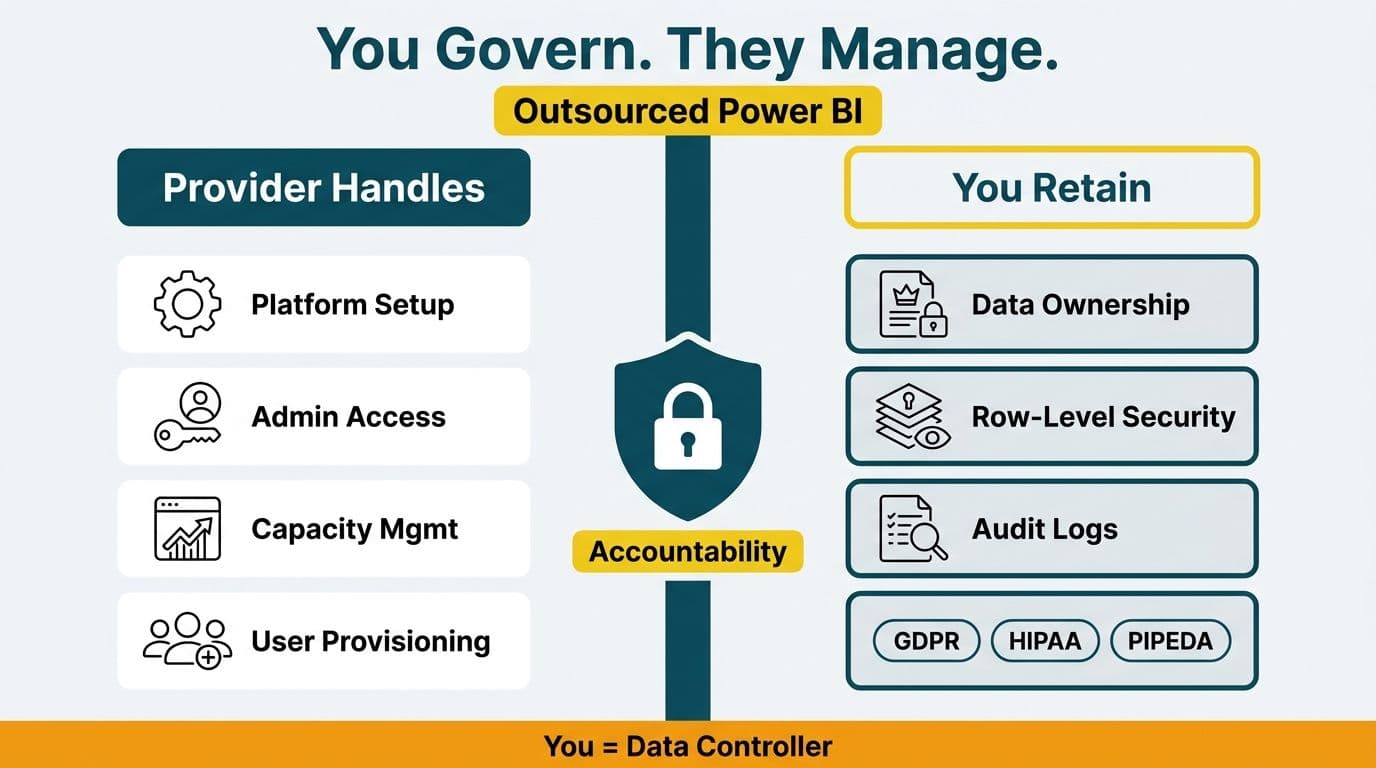
When an external provider holds admin access to your Power BI tenant, your organisation remains the data controller - the legal and operational accountability does not transfer to the provider. Effective data governance for outsourced Power BI means locking in row-level security ownership, contractual audit log access, and documented compliance controls for GDPR, HIPAA, and PIPEDA before the engagement begins. The provider manages the platform; you govern the data.
Key Takeaways
Data ownership and regulatory accountability stay with your organisation, not your managed service provider
Row-level security must be defined, owned, and periodically audited by your internal team - not delegated
Power BI activity logs are the primary monitoring instrument - your contract must grant you direct, unmediated access
GDPR, HIPAA, and PIPEDA each impose specific data processing agreement requirements when a third party administers your analytics environment
Offboarding clauses covering credential revocation, data return, and workspace transfer must be negotiated before work begins
What Does Data Governance Mean in an Outsourced Power BI Environment?
Data governance defines who owns data assets, who can access them, and what accountability mechanisms apply when something goes wrong. In an outsourced Power BI arrangement, a managed service provider typically holds Power BI Administrator or Fabric Administrator roles, granting them broad visibility into your tenant, workspaces, and the data connections that feed every report.
That visibility does not transfer ownership. Under GDPR, the organisation that determines the purpose and means of processing is the data controller; the provider is a data processor. Under HIPAA, a US healthcare organisation is the covered entity - the provider becomes a subcontractor who must sign a Business Associate Agreement (BAA). Under Canada's PIPEDA, the organisation that collected the data retains accountability even when processing is delegated to a third party.
For regulated organisations, governance is not a constraint on outsourcing - it is the prerequisite for it.
Start by evaluating Managed Power BI services that explicitly include a governance framework as part of their scope of work, rather than treating compliance controls as an optional or billable extra.
How Do You Maintain Data Ownership With an External Provider?
Ownership must be established in both the service contract and the Microsoft 365 tenant configuration simultaneously. Neither instrument alone is sufficient.
Contractual controls to put in place:
The provider must be named as a data processor in a formal Data Processing Agreement (DPA) or, for US healthcare organisations, a Business Associate Agreement (BAA)
Define data residency explicitly: EU and UK organisations under GDPR must confirm that data remains within the European Economic Area or within the UK adequacy framework; cross-border transfers require Article 46 safeguards
For Canadian organisations under PIPEDA, cross-border transfer clauses must document where data flows and what contractual safeguards apply during transit and storage
Specify that all service accounts, service principals, and credentials created during the engagement are registered under your Azure Active Directory tenant, not the provider's
Require that provider staff accessing your environment have completed relevant security training - HIPAA security awareness training annually for US healthcare engagements, and data protection training aligned to GDPR or PIPEDA for UK, EU, and Canadian scopes
Tenant-level controls in Power BI:
Retain at least one internal Global Administrator account - do not delegate this role entirely to any external party
Use Microsoft Entra ID Privileged Identity Management (PIM) to assign just-in-time admin elevation to provider staff rather than permanent admin roles; PIM creates a time-bounded, auditable access window
Keep Power BI service principal registrations within your Azure subscription; if the provider registers app credentials in their own Azure environment, you lose control the moment the engagement ends
Enable sensitivity labels via Microsoft Purview Information Protection and define who can assign or remove them - this prevents data reclassification without internal approval
A US healthcare insurer engaging a managed analytics provider should ensure the contract contains a HIPAA BAA, specifies that Protected Health Information is never extracted to provider-owned storage environments, and requires annual HIPAA security awareness training for all provider personnel with tenant access.
A UK fintech firm operating under FCA oversight and UK GDPR must additionally ensure that any sub-processors the provider uses - ETL vendors, cloud monitoring tools - are disclosed and approved in writing before they have access to any client data.
What Row-Level Security Controls Should Clients Retain in Outsourced Power BI?
Row-level security (RLS) restricts which rows of data a given user sees inside a Power BI report or semantic model. An analyst at a regional health system should see only the patient or claims data assigned to their geography; a finance manager should see only their division's cost centres. When a provider builds and maintains the data model, they also hold the technical ability to modify or remove RLS definitions.
The governance principle is separation of concerns:
Client responsibility: Define RLS roles, the business rules that determine access, and the formal approval workflow for any change
Provider responsibility: Implement the DAX filter expressions that enforce the approved rules; no RLS changes should be deployed without written client sign-off
Joint responsibility: Quarterly RLS validation testing using dedicated test accounts that confirm no unintended data is visible across any role
Maintain a RLS Role Register - a documented inventory of every role name, the DAX expression it applies, the date it was approved, and the approving stakeholder. This register serves as audit evidence for HIPAA Security Rule assessments, GDPR Article 32 reviews, SOC 2 Type II audits, and internal compliance reporting.
Connection mode also affects how RLS propagates to the underlying data source: import mode enforces security at the Power BI layer, while DirectQuery pushes it to the source database. Our guide on Power BI Import vs DirectQuery for mid-market decision-making covers the security implications of each approach.
Sensitivity labels applied via Microsoft Purview interact with RLS as a second enforcement layer. A report carrying a Confidential label can be configured to block export for users in certain RLS roles. Coordinating these two mechanisms is a governance decision that must be documented before model build begins, not retrofitted after deployment.
A Canadian manufacturing company using Power BI to consolidate cross-border financial data discovered that its managed provider had disabled RLS in the development workspace as a build-phase shortcut. Without an explicit policy requiring RLS enforcement in all environments - production, UAT, and development - the exposure went undetected for several weeks. The corrective action required a contractual amendment and a formal policy document specifying that RLS is mandatory in every workspace at every stage of the engagement lifecycle.
How Do You Build Audit Trails Into an Outsourced Power BI Arrangement?
Microsoft Power BI maintains an activity log that records every administrative and user action: report views, dataset refreshes, permission assignments, workspace modifications, gateway credential changes, and data export events. This log is the primary governance instrument in any outsourced arrangement.
The critical risk is structural: by default, only Power BI Administrators can access the activity log through the Admin API or the Power BI Admin Portal. If the provider is the sole administrator, they effectively control who reviews the audit trail - a fundamental governance gap that creates both compliance risk and operational blind spots.
What a sound audit trail arrangement looks like:
1. Retain at least one internal Power BI Administrator account that is not managed or shared with the provider
2. Configure activity log export to Azure Monitor, Microsoft Sentinel, or a corporate SIEM tool, so logs flow to infrastructure your security team controls independently
3. Establish an expected activity baseline - how many times per week should the provider access each workspace, run dataset refreshes, and modify configurations - and set automated alerts for deviations
4. Review logs monthly for high-risk event types: ExportArtifact (data exported from the service), AddGroupUser (new members added to a workspace), and UpdateDatasourceCredentials (gateway credential changes)
For HIPAA-covered organisations in the US, this is a regulatory obligation. The HIPAA Security Rule at 45 CFR §164.312(b) requires covered entities to implement procedures to review information system activity regularly. Maintaining direct, provider-independent access to Power BI activity logs satisfies this requirement; relying on provider-generated summaries does not.
For finance teams, an unexpected ExportArtifact event tied to a provider service account - particularly one referencing a sensitive financial dataset - warrants immediate investigation and, if personal data or PHI is involved, a formal breach notification evaluation under the applicable regulation. Organisations that route activity logs to a SIEM under their own security team's control typically detect anomalous provider behaviour within hours rather than weeks - a material difference when the GDPR 72-hour breach notification clock is running.
For GDPR purposes, activity logs demonstrate the appropriate technical measures required under Article 32, and they contribute to the records of processing activities that Article 30 requires data controllers to maintain.
The broader intersection of analytics governance and healthcare compliance is explored in our guide on AI analytics data privacy risks in healthcare.
What Regulatory Controls Apply to Data Governance in Outsourced Power BI - GDPR, HIPAA, and PIPEDA Compared
Regulatory requirements vary by geography and sector, but the Power BI controls that satisfy them follow a consistent pattern. The table below maps each major framework to the specific governance action it demands.
| Regulation | Applies To | Key Requirement | Power BI Governance Action |
|---|---|---|---|
| GDPR (EU and UK) | Organisations processing EU/UK personal data | Data Processing Agreement; EEA/UK data residency; right to erasure | DPA with provider; EU/UK data centre selection in tenant settings; documented deletion procedures |
| HIPAA | US healthcare covered entities and business associates | Business Associate Agreement; audit controls; minimum necessary access | BAA with provider; direct activity log access retained internally; RLS scoped to PHI fields |
| PIPEDA | Canadian organisations collecting personal information | Accountability; meaningful consent; cross-border transfer safeguards | Written data transfer agreements; residency documentation; breach notification contact in contract |
| SOC 2 Type II | US SaaS and financial services | Logical access controls; change management; availability and confidentiality | Entra ID PIM for just-in-time access; change log reviews; anomaly alerting via Azure Monitor |
A World Economic Forum initiative on AI and data governance in financial services (WEF, 2025; as of 2026) has grown to encompass more than 150 experts across 60 financial institutions, with its outputs now informing standard contract language across the EU, UK, and North America - a shift from aspirational guidance to enforceable baseline requirements within a single year.
As regulated industries increasingly rely on external providers for analytics delivery, governance provisions are transitioning from differentiators to baseline requirements in managed service contracts.
Note that UK organisations post-Brexit operate under UK GDPR, which mirrors EU GDPR standards through domestically retained legislation. The same DPA discipline and residency requirements apply; UK personal data must remain within the UK or be transferred under adequacy arrangements or standard contractual clauses.
How Should Offboarding and Data Return Be Handled in a Managed Power BI Contract?
Offboarding provisions are the most frequently neglected element of managed Power BI contracts. When an engagement concludes, the transition back to internal control - or to a new provider - must be swift and clean to avoid governance gaps and regulatory exposure.
A structured offboarding clause should address:
Credential revocation timeline: All provider accounts removed from your Azure AD tenant within 24-48 hours of written termination notice
Data return format: Custom semantic models, dataflows, and reports exported as .pbix files, with M query scripts and DAX documentation delivered in a structured, readable format
Workspace transfer: All production workspaces migrated to client-owned Premium or Microsoft Fabric capacity; no production content should reside on provider-owned Premium Per User licences at the point of transition
Sub-processor clearance: Any third-party tools that accessed your data through the provider must be identified, and their access revoked and confirmed in writing
Retention and deletion certification: The provider certifies in writing, within 30 days of engagement end, that no copies of your data or report assets remain in their systems
A UK financial services firm that outsourced its Power BI environment without explicit offboarding terms discovered during a regulatory examination that the provider had retained data exports in their own Azure storage for support reference purposes for over eight months post-engagement. Under UK GDPR, this constituted unauthorised retention, triggered a formal breach assessment with the ICO, and required a remediation programme that cost significantly more than a robust offboarding clause would have. The lesson: offboarding provisions deserve the same legal scrutiny as the Data Processing Agreement itself.
Practical Governance Checklist for Outsourced Power BI Data Governance
Use this checklist as a pre-engagement validation tool and an ongoing review framework throughout the engagement lifecycle.
Pre-engagement:
[ ] DPA or BAA reviewed by legal counsel and counter-signed before access is provisioned
[ ] Data residency requirements documented and confirmed with the provider in writing
[ ] Provider security credentials verified: ISO 27001 certification or SOC 2 Type II report reviewed
[ ] Microsoft Entra ID PIM configured; provider receives delegated, time-bounded access - not permanent admin elevation
[ ] Offboarding provisions drafted and included in the contract before signature
[ ] Incident response contact and escalation path agreed with the provider in writing
During engagement:
[ ] Monthly internal review of Power BI activity logs by an internal administrator
[ ] Written approval required before any RLS role is created, modified, or removed
[ ] Quarterly RLS validation testing with dedicated test accounts across all defined roles
[ ] Workspace inventory reconciled against approved project scope at each milestone
Regulatory checkpoints:
[ ] HIPAA (US healthcare): BAA signed; PHI fields mapped in the semantic model; audit log access retained internally
[ ] GDPR/UK GDPR: Article 30 records updated; sub-processor list reviewed and approved by legal
[ ] PIPEDA (Canada): Cross-border transfer agreements in place; breach response contact designated
[ ] SOC 2 (US SaaS/finance): Logical access controls documented; change management log retained
For finance teams building secure, access-controlled reporting layers within a governed Power BI environment, the FP&A Dashboard in Power BI step-by-step build guide and the Power BI Report Builder vs Desktop comparison for finance teams show how reporting architecture choices affect both governance posture and compliance readiness.
---
About Lets Viz: Lets Viz is a data analytics consultancy that has partnered with mid-market organisations on analytics governance and delivery since 2020. With a 5.0 Clutch rating, the team brings hands-on compliance expertise to engagements across US healthcare, UK fintech, Canadian manufacturing, and global SaaS - including HIPAA BAA structuring, GDPR and UK GDPR DPA review, and PIPEDA cross-border transfer controls embedded into every managed analytics engagement.
To assess your current Power BI governance posture and explore what a compliant, well-governed outsourced arrangement looks like in practice, review the full scope of Managed Power BI services.