Build vs Buy AI Data Capability: The Decision Matrix
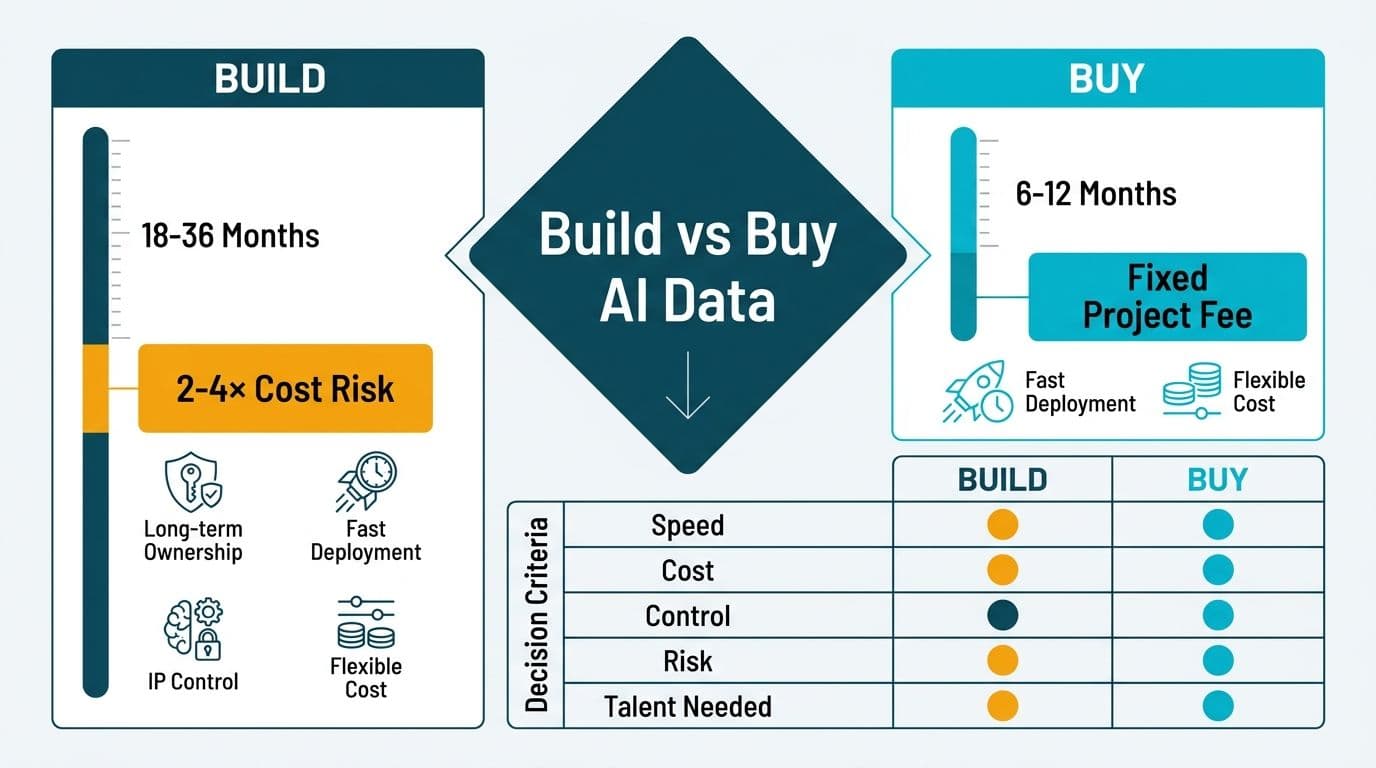
Deciding whether to build vs buy AI data capability is one of the most consequential strategic choices a business leader can make. Building in-house delivers long-term ownership and competitive differentiation but requires 18-36 months and significantly higher upfront investment. Partnering with a specialist firm reduces time-to-value by 6-12 months and converts fixed hiring costs into flexible project engagements - making it the faster, lower-risk starting point for most mid-market organizations.
Key Takeaways
Building in-house typically costs 2-4x more than initially projected, with talent acquisition and governance infrastructure as the primary drivers.
Specialist consulting partnerships reduce time-to-value by 6-12 months versus a pure in-house build.
A baseline AI data maturity assessment is the essential prerequisite before committing capital to either path.
Financial services and healthcare organizations face compounding regulatory costs (HIPAA, GDPR, PIPEDA, SOC 2) that frequently favor specialist partnerships over in-house builds.
A hybrid model - external partnership for capability building, internal team for ongoing operations - is the dominant successful pattern in 2026.
What Does "Build vs Buy AI Data Capability" Mean in Practice?
The build vs buy AI data capability decision asks whether your organization should develop AI data infrastructure, governance, and analytical talent entirely in-house, or engage external specialists to accelerate and de-risk that journey. Buying does not mean surrendering strategic ownership - it means acquiring deployed capability faster while retaining full control over data, models, and roadmap.
For leaders evaluating an AI automation consulting engagement, understanding what "buy" actually delivers - embedded expertise, pre-built governance frameworks, proven delivery methodology - is essential to structuring a productive contract.
The decision is not permanent. A US regional bank might engage a boutique firm for the first 18 months to build a fraud detection pipeline, then transition the operational layer to an internal team once models are validated and documented. A UK fintech firm navigating GDPR data minimization requirements may find that a partner with EU regulatory experience eliminates compliance risk that an internal hire would take 12 months to develop independently. A Canadian manufacturing company operating under PIPEDA obligations may need a data residency-certified partner before any AI model can process customer records.
When Should You Build an In-House AI Data Team?
Building in-house is the right choice when your AI data maturity is already at level 3 or above - meaning repeatable, documented processes exist - when use cases involve proprietary IP that cannot leave the organization, and when you have a credible 3-5 year talent retention plan with compensation structures that compete in a tight specialist labor market.
It is also appropriate when regulatory obligations require on-premise or regionally controlled processing. EU organizations under GDPR Article 44 data transfer restrictions, US federal healthcare systems requiring on-premise HIPAA-compliant model training, and Canadian government-adjacent entities under PIPEDA Schedule 1 all face contexts where a third-party vendor relationship would create additional compliance exposure that outweighs the speed advantage.
According to the World Economic Forum's 2025 financial services AI governance report, over 50 financial services organizations had collaborated to develop shared AI data governance frameworks as of that publication; by mid-2026, that coalition has grown substantially as EU AI Act implementation deadlines concentrate governance urgency across the sector - a clear signal that even well-resourced institutions recognize governance infrastructure requires collective knowledge-building that isolated in-house teams rarely replicate quickly.
Readiness indicators for building in-house:
Internal data infrastructure is governed, documented, and audit-ready
A Chief Data Officer or equivalent holds a funded mandate approved for 36+ months
At least two AI use cases are in production and generating measurable ROI
The organization can credibly compete for senior ML engineers and MLOps talent
The board has approved a multi-year AI investment horizon
Retaining specialist AI talent also requires more than competitive base salaries. In markets where hyperscalers and fintech startups compete aggressively for ML engineering roles, organizations without equity-heavy compensation structures face structural attrition risk within 18 months of hire. This is particularly acute for US healthcare systems and Canadian financial institutions operating under pay structures that cannot easily match private-sector total compensation packages. If fewer than four of the above conditions apply, beginning with an external partnership is almost always the faster and more capital-efficient path.
What Are the Real Costs of Each Path?
Cost comparisons in this space are regularly distorted by optimistic internal projections that omit governance infrastructure, compliance overhead, and talent attrition. The table below reflects realistic total cost of ownership for a mid-market organization (200-2,000 employees) deploying its first enterprise AI data capability over 24 months in a competitive US or UK talent market.
| Cost Element | Build In-House (24 months) | Specialist Partnership (24 months) |
|---|---|---|
| Senior AI/ML Engineers (x2) | $380,000 - $460,000 | Included in retainer |
| MLOps / Data Engineering (x1) | $160,000 - $200,000 | Included in retainer |
| AI Data Governance Framework | $80,000 - $120,000 | Included |
| Cloud Infrastructure (AWS/Azure/GCP) | $60,000 - $100,000 | $60,000 - $100,000 |
| Tooling and Licenses | $40,000 - $70,000 | $20,000 - $40,000 |
| Compliance Overhead (HIPAA/GDPR/SOC 2) | $50,000 - $90,000 | $15,000 - $30,000 |
| Specialist Retainer or Project Fee | N/A | $180,000 - $320,000 |
| **Total 24-Month Estimate** | **$770,000 - $1,040,000** | **$275,000 - $490,000** |
*Figures reflect 2026 market rates in a competitive US or UK talent market. In-house costs exclude severance if headcount is later reduced. Partnership costs assume a mid-tier boutique engagement with structured knowledge transfer built into the contract.*
The hidden cost that most build-side estimates omit is AI data governance framework construction. A healthcare provider pursuing HIPAA-compliant AI analytics must document data lineage, model risk controls, and audit trails before a single model reaches production. A UK fintech operating under FCA conduct rules and GDPR faces parallel obligations. Constructing that governance layer with internal staff typically adds $60,000-$90,000 and 4-6 months to the project timeline - costs that specialist partners amortize across multiple client engagements.
For a parallel view of AI analytics tooling costs, our guide on best AI tools for finance professionals provides current platform-level benchmarks.
How Do Risk Factors Differ Between Build and Buy?
Risk profiles diverge sharply between the two paths. A structured AI data maturity assessment identifies five primary risk categories: talent stability, governance readiness, speed-to-value, vendor lock-in, and competitive differentiation.
Talent risk is the defining liability of the build path. In 2026, senior ML engineering roles command base salaries of $190,000-$240,000 in competitive US markets, with total compensation packages frequently exceeding $300,000 once equity and bonuses are included. A Canadian manufacturing company that builds a proprietary demand forecasting model around two key engineers faces an operational continuity risk if either leaves - and with replacement timelines of 6-9 months standard for specialist roles, the fully-loaded cost of a single departure (recruiting fees, productivity loss, ramp time) routinely exceeds $130,000 per position. Demand for senior AI engineers in the US, UK, and Canadian markets continues to significantly outpace supply.
Governance risk disproportionately affects the build path in regulated industries. A US hospital system building an AI-driven revenue cycle analytics tool internally must self-certify HIPAA technical safeguard compliance and document model risk controls before going live - a process that takes 4-6 months without specialist input. UK and EU organizations must additionally satisfy GDPR Article 22 obligations on automated decision-making and document their systems under emerging EU AI Act requirements.
Vendor lock-in risk is the primary liability of the buy path. Organizations that omit knowledge transfer clauses from consulting contracts can find themselves dependent on a single vendor for model maintenance and updates. Mitigating this requires structured handoff milestones, model cards, and source code ownership - terms that should be non-negotiable in any engagement contract.
The boutique AI consulting firm vs large consultancy question also surfaces in this analysis. Large consultancies offer broad capability and brand credibility; boutique firms typically offer faster deployment, more direct senior practitioner access, and lower blended day rates. For mid-market financial services and healthcare organizations, boutique partnerships often deliver stronger risk-adjusted outcomes because the engagement principal remains active on the account throughout delivery rather than delegating to junior analysts.
The risk calculus also differs by geography. A UK financial institution navigating FCA model risk management guidelines alongside GDPR must invest significantly in governance documentation regardless of which path it chooses - but an external partner already holding those frameworks can deploy in half the time. A US SaaS finance team expanding into healthcare data under HIPAA faces a different risk: the organizational discipline required for PHI handling is a cultural competency that takes years to embed, making specialist partnership with embedded compliance expertise more valuable than the raw cost comparison alone suggests.
Review common deployment failure modes in our AI workflow automation mistakes checklist before structuring any engagement.
Build vs Buy AI Data Capability: The Decision Matrix
A structured decision matrix maps organizational context to the right strategic path. The framework below applies across financial services and healthcare organizations in the US, UK/EU, and Canada.
Choose Build In-House When:
AI data maturity is at level 3+ (repeatable, documented processes with existing model governance)
Use cases involve proprietary IP that must not leave the organization's environment
Data residency regulations require on-premise or regionally controlled model training
Executive sponsorship includes a budget line approved for 36+ months
At least two AI models are already in production and generating measurable ROI
Choose Specialist Partnership When:
The first production use case must be live within 12 months
AI data governance documentation does not yet exist
You need a validated AI data strategy for supply chain optimization, fraud detection, or patient cohort analytics deployed without a 12-month internal ramp
Budget is fixed and cost predictability is a board-level requirement
The partner demonstrates jurisdiction-relevant compliance certification: HIPAA BAA, SOC 2 Type II, GDPR Article 28 DPA, or PIPEDA Schedule 1
Choose a Hybrid Model When:
You want external partners to build foundational infrastructure and governance, then transition operations to an internal team within 18-24 months
Use cases include both proprietary IP (requiring internal control) and commodity functions (suitable for external delivery)
Your organization is mid-maturity: some documented processes exist but governance gaps remain
The hybrid path is the dominant pattern for mid-market organizations in regulated industries in 2026. It captures the speed and governance benefits of external expertise during the highest-risk phase while preserving the long-term competitive advantage of internal capability ownership.
What Is an AI Data Maturity Assessment and Why Does It Come First?
An AI data maturity assessment evaluates five organizational dimensions before any capital commitment: data quality and lineage, governance and risk controls, infrastructure scalability, organizational AI literacy, and use case prioritization. This baseline step eliminates the most common strategic error - organizations overestimating their readiness to build in-house, or underestimating the complexity of deploying specialist-delivered models into existing infrastructure.
Organizations scoring below level 2 on any single dimension should treat a specialist engagement as the prerequisite to building internal capability, not an alternative to it. Our free BI readiness self-assessment gives financial services and healthcare teams a structured starting point for benchmarking current state before requesting proposals. For sector-specific context on what mature AI deployments look like, our AI analytics use cases in healthcare and finance guide covers validated patterns across both industries.
Organizations that delay their maturity assessment risk entering a more competitive and costly specialist market as demand continues to outpace supply of qualified practitioners.
---
About Lets Viz: Lets Viz has delivered data analytics and AI consulting engagements since 2020, serving US healthcare systems, UK fintech firms, Canadian manufacturing organizations, and global SaaS businesses. With a 5.0 Clutch rating and a practitioner-led delivery model, the team has designed AI data governance frameworks and executed build-vs-buy transitions for regulated industries where HIPAA, GDPR, and PIPEDA compliance requirements are non-negotiable constraints, not afterthoughts.
Ready to determine which path is right for your organization? Our AI automation consulting team delivers structured build-vs-buy assessments and maturity benchmarks in under two weeks.