Power BI Consulting for Marketing Agencies: A Buyer's Guide
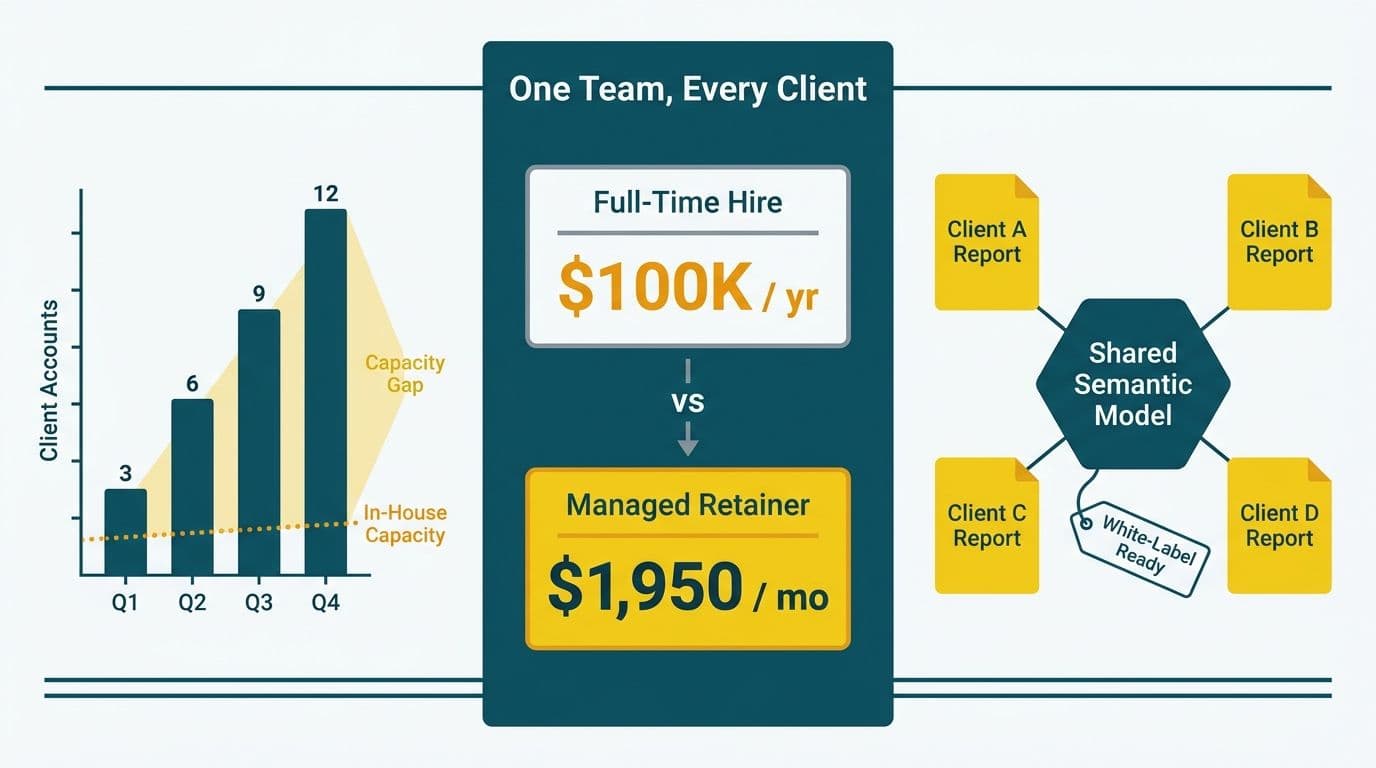
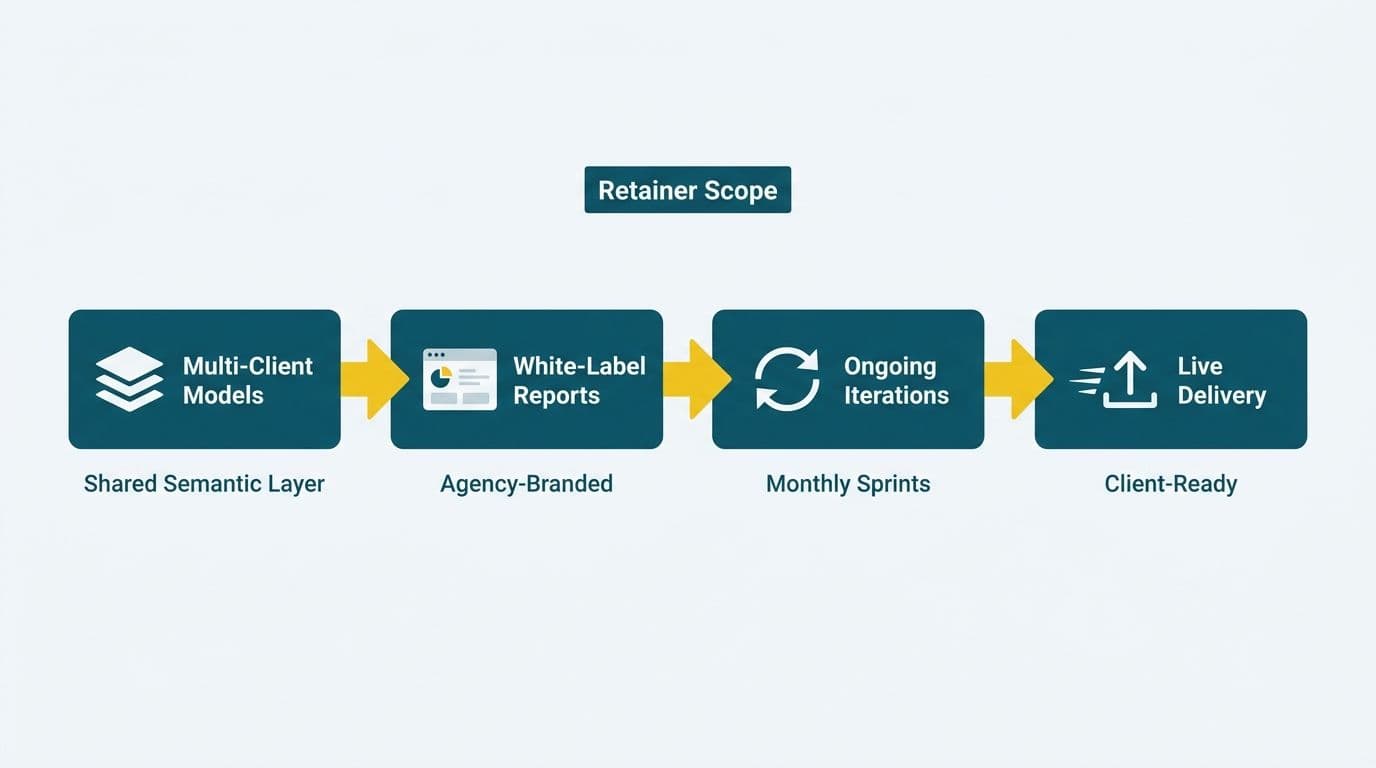
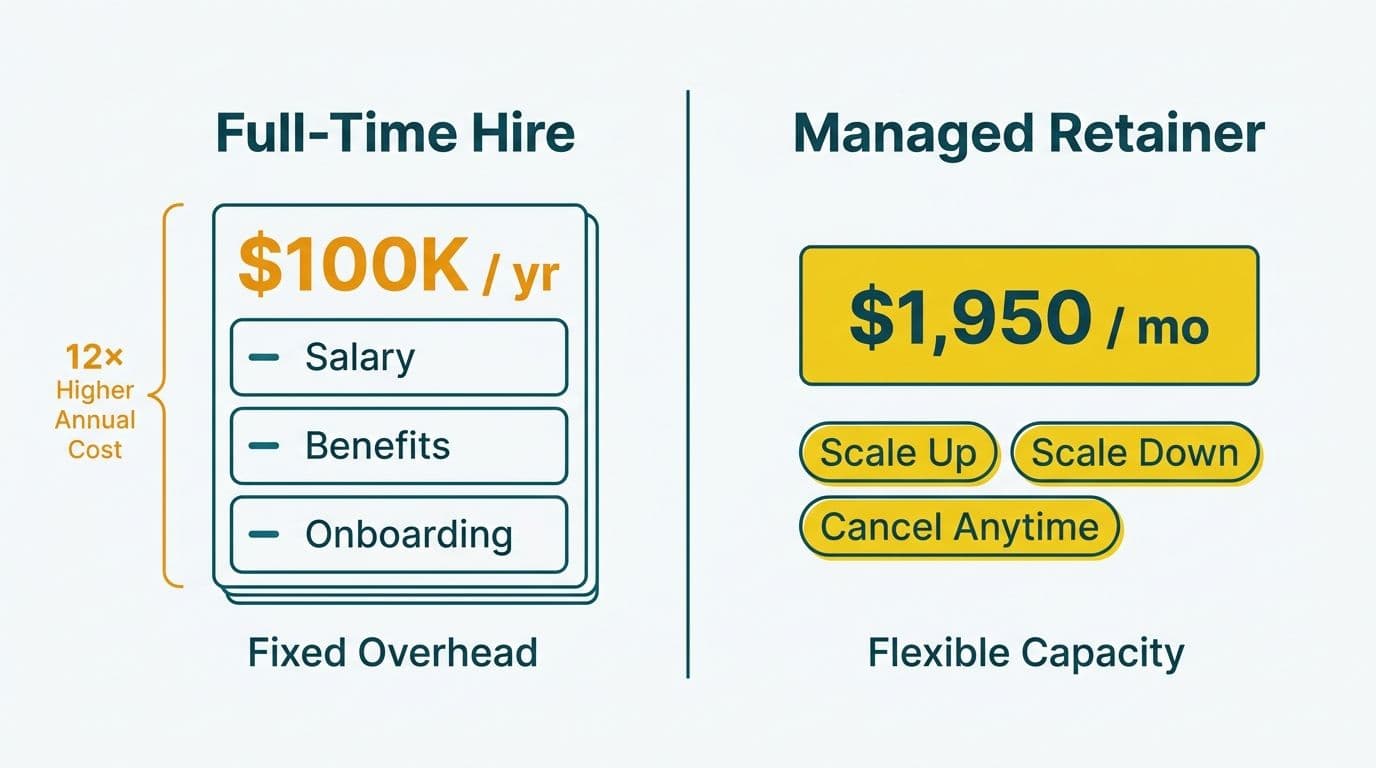
Power BI consulting for marketing agencies solves a core resource problem for client-facing analytics teams: every new account adds reporting scope, but headcount grows slowly and full-time Power BI developers cost roughly $100k per year fully loaded (LinkedIn Salary Insights, 2025). A managed Power BI retainer solves the math. Our Managed Power BI services start at $1,950 per month and cover white-label reporting, multi-client semantic models, and ongoing iterations - giving agencies the delivery capacity of a dedicated team without the hiring risk.
Power BI consulting for marketing agencies covers white-label dashboard delivery, multi-client semantic models, and row-level security governance across your full client roster. Engagements run as managed retainers from $1,950/mo, handling data architecture, workspace setup, brand theming, compliance review, and monthly iterations - giving agencies dedicated BI delivery capacity without adding full-time developer headcount.
Key Takeaways
- Managed Power BI retainers run $1,950-$7,500/mo versus $6,000-$8,300/mo for equivalent in-house headcount
- Multi-client semantic models eliminate per-client report duplication and version drift across your agency roster
- Workspace-per-client isolation is required for proper access control - row-level security alone is not sufficient
- GDPR, HIPAA, and PIPEDA compliance reviews are included at Growth and Enterprise retainer tiers
Who This Is For
This service fits if you:
- Deliver monthly or weekly performance dashboards to clients as a formal agency deliverable
- Need white-label reporting your clients can access directly, under your brand and domain
- Serve five or more accounts and want a single governed semantic model that scales across clients rather than copy-pasting reports per engagement
- Work in regulated verticals - healthcare marketing in the US (HIPAA), financial services in the UK or EU (GDPR), or any client base in Canada (PIPEDA) - where compliance evidence is part of the service promise
This is not the right fit if:
- You serve a single large client with simple, fixed reporting needs - at that scope, a freelancer at $150-$200 per hour (Upwork enterprise rate card, 2025) is likely more economical
- Your dashboards live entirely inside each client's own Power BI tenant and there is no cross-account data model to manage
Power BI Consulting for Marketing Agencies: Cost Breakdown
The honest comparison across delivery options:
| Delivery model | Typical monthly cost | What you get |
|---|---|---|
| Freelancer (senior US rate) | $6,000-$8,000 | $150-$200/hr at 40 hrs; no SLA, no team bench |
| In-house junior developer | ~$5,500 fully loaded | One skill level; benefits and overhead included |
| In-house senior developer | ~$8,300+ fully loaded | Deep skill; single point of failure if they leave |
| Lets Viz Essentials retainer | $1,950/mo | Templates, white-label setup, SLA, iteration cycles |
| Lets Viz Growth retainer | $3,950/mo | Multi-client models, RLS per account, more capacity |
| Lets Viz Enterprise retainer | $7,500/mo | Full governance, Fabric integration, compliance review |
US mid-market Power BI retainers typically range from $2k to $8k per month (Clutch BI services market data, 2025) depending on model complexity, client count, and data source variety. Our tiers sit inside that range with published pricing - no custom quote needed to understand the investment.
For agencies with finance clients asking what to expect from a managed Power BI service for finance teams: the answer is structured access controls, audit-ready dataset lineage, and dashboard refresh schedules that align to financial close cycles. Those specifics are scoped in the first two weeks of engagement.
If you're weighing the options, our Managed Power BI services page breaks down exactly what each retainer tier covers and the ramp timeline for a typical agency onboarding.
Common Data Sources We Connect for Agency Clients
Google Ads
Google Ads connects via the Google Ads API or the native Power BI connector, with support for campaign, ad group, and keyword-level granularity. We schedule daily refreshes aligned to your client reporting cadence, typically pulling the previous day's data by 6:00 AM local time so performance summaries are ready before client standups.
Meta Ads
Meta Ads data flows through the Marketing API, which requires a system user token scoped to your agency's Business Manager. We configure 15-minute incremental refreshes during active campaign flights to capture intraday performance for clients running time-sensitive creative tests.
GA4
GA4 integrates via the Google Analytics Data API or a BigQuery export for higher-volume properties. For most agency clients, direct API pulls with daily refresh are sufficient; BigQuery export becomes necessary for sites exceeding one million monthly sessions where row limits constrain the standard connector.
HubSpot
HubSpot connects through a private app token scoped to the CRM objects your client reports on - contacts, deals, and engagement data. We set daily refreshes at 05:00 UTC so deal pipeline and lead attribution data are current before morning standups.
Salesforce
Salesforce integrates via the native Power BI connector or a custom REST API call for non-standard objects. Refresh cadence is typically hourly for live sales pipeline dashboards and daily for executive summary reports where near-real-time data is not a requirement.
LinkedIn Ads
LinkedIn Ads uses the LinkedIn Marketing Developer Platform API with Campaign Manager access. Data latency from LinkedIn is 24-48 hours for impression and click metrics, so we schedule refreshes at 08:00 UTC daily and include a data-freshness note in client-facing dashboards to prevent confusion over apparent same-day gaps.
What Working With Us Looks Like
Week 1-2: Data audit and model architecture
We map every data source your clients use - ad platforms, GA4, CRM exports, call-tracking systems - and design a multi-client semantic model that avoids the report-per-client duplication trap. We establish workspace isolation in your Power BI tenant: one workspace per client, not a shared workspace with row-level security as the only barrier between accounts.
Week 3-4: Template build and white-label configuration
A white-label Power BI theme is built against your brand guide. Row-level security (RLS) roles are configured so Client A never sees Client B's data, even inside the same underlying semantic model. If you need embedded dashboards inside a client portal, we configure the Power BI REST API embed token flow at this stage.
Week 5-6: First client accounts live
The first accounts go live with client-facing embed URLs or publish-to-web links. You receive a governance documentation pack and a refresh schedule. UK and EU client environments get a GDPR compliance review of sensitivity labels and data residency settings. Canadian client environments are reviewed against PIPEDA data-handling requirements.
Week 7 onward: Iteration and expansion
Monthly iterations cover new data source connections, updated DAX measures, and visual updates as clients' reporting needs evolve. New client accounts onboard against the existing template, which cuts setup time significantly after the first few deployments.
How Does a Multi-Client Data Model Work in Power BI?
A multi-client data model is a single Power BI semantic layer that serves multiple accounts without duplicating business logic. Calculations - including DAX functions like CROSSFILTER that control how filter context propagates across table relationships - are written once and parameterized by client ID at the row level via RLS.
Using the crossfilter DAX function in a multi-client setup means you define relationship cardinality and filter direction once, then let the security layer determine which rows each client's users can access. This is more reliable than copying reports per client, which creates version drift the moment one client's source schema changes.
For agencies uncertain where to put calculation logic, our Power Query vs DAX guide covers when transformations belong in the data pipeline versus the measure layer - a decision with real performance implications at scale.
Should You Outsource Power BI Development or Hire In-House?
Outsourcing wins when your agency has fewer than two developers' worth of consistent Power BI work, or when you need coverage across specialisms - DAX authoring, gateway management, embed API development, governance documentation - that a single hire cannot realistically provide.
The in-house cost question comes up regularly in agency finance reviews. US senior Power BI developers earn roughly $100k per year fully loaded (LinkedIn Salary Insights, 2025). Reviewing BI hiring communities confirms the same pattern: full-time headcount is expensive, and the workload is often cyclical - heavier at month-end reporting, lighter mid-cycle.
UK agencies face the same math: a London or Manchester contractor typically runs £500-£700 per day (ITJobsWatch contractor survey, 2025). Canadian agencies see equivalent CAD costs once statutory requirements are factored in. In all three markets, a managed retainer between $1,950 and $3,950 per month is substantially cheaper than full-time headcount until you cross the two-developer threshold.
What About Microsoft Fabric for Agency BI?
Microsoft Fabric is Microsoft's unified analytics platform. For BI teams: instead of importing data into Power BI Desktop file by file, data lives once in a centralized OneLake storage layer and is served to reporting, data science, and engineering workloads from the same governed source - per Microsoft's Fabric product documentation, updated 2025.
For most agencies today, Fabric is on the roadmap but not an immediate requirement. Standard Power BI with DirectQuery or import mode against a well-structured data warehouse handles multi-client reporting at current scale. Fabric becomes compelling when you're ingesting high-volume ad event streams, running ML models alongside dashboards, or consolidating multiple client data environments into one lakehouse.
We scope Fabric migrations at Growth or Enterprise retainer level when the capability-to-complexity tradeoff justifies the transition.
Power BI Governance: What Agencies Need to Get Right
Running Power BI across multiple client accounts creates governance obligations most agencies underestimate. A practical governance checklist for agency environments:
- Workspace isolation: one workspace per client, not a shared workspace with RLS as the only access barrier
- RLS audit schedule: test row-level security roles quarterly - a misconfigured role can expose one client's data to another account's users
- Sensitivity labels: apply Microsoft Purview labels to PII-containing datasets - required under GDPR for UK and EU client data, and best practice under PIPEDA for Canadian accounts
- Gateway discipline: use a dedicated gateway per client group; shared gateways create refresh dependencies across clients that surface as unexplained failures
- Certified dataset promotion: use Power BI's certified flag so client-facing reports always pull from governed sources, not ad-hoc extracts or personal workspace files
US agencies serving healthcare marketing clients face an additional compliance layer. If a data pipeline touches PHI shared for campaign targeting or attribution, HIPAA applies to the BI environment. Our HIPAA compliant BI tools guide covers what that means for Power BI configurations specifically.
Three Objections We Hear from Agency Decision-Makers
"We'll just hire a developer."
Run the math first. A fully loaded senior hire costs roughly $8,300 per month. Our Growth retainer is $3,950 per month and covers equivalent developer output plus access to specialists in DAX, embed APIs, and gateway management. A retainer makes more economic sense until you have enough consistent work to justify two or more dedicated heads.
"Our data is spread across a dozen platforms - is that manageable?"
That complexity is the job, not the exception. A book distributor we worked with had over five million billing rows locked inside Power BI's visual export cap, which tops out at 30k rows per CSV export. We connected directly to the Analysis Services engine underneath and streamed all 5,042,721 rows out at roughly a million rows per minute. Complicated data plumbing is where this work gets interesting.
"What if we want to move everything in-house later?"
Your semantic model, workspaces, data connections, and RLS roles live in your Power BI tenant - not ours. At the close of any engagement, we hand over a full documentation pack: every DAX measure with a plain-language description, every gateway configuration, every workspace permission matrix. If you later hire internally and take over, the transition is clean.
---
When agencies treat client dashboards as a strategic deliverable - not a reporting afterthought - client retention improves and reporting fees justify themselves. Scalable white-label Power BI reporting makes that possible; a managed engagement makes it repeatable across every new client you onboard.
To see what the engagement looks like for your client count and data stack, start with our Managed Power BI services page or book a free discovery call to walk through scope, pricing, and a timeline for your first client go-live.
---
About Lets Viz: Lets Viz is a data analytics consultancy serving healthcare, SaaS, finance, and agency clients across the US, Canada, and UK since 2020. We hold a 5.0 rating on Clutch across Power BI and Zoho Analytics engagements. Our team designs, builds, and manages client-facing reporting systems so agencies can deliver analytics as a scalable service without building a full internal BI team.