When to Hire a Power BI Consultant: 5 Trigger Events That Justify Outside Help

"When should I hire a Power BI consultant?" almost always means "is the pain bad enough to outsource?" The honest answer is that it depends on which pain. Some Power BI problems pay back outside help reliably; others are usually solved better by an internal hire or by sharpening internal processes. This guide covers the five trigger events that make a strong case for hiring help, the three signals that suggest you should solve it internally instead, and the decision framework for each.
5 trigger events that justify hiring a Power BI consultant
1. Board deck prep eats your finance team's weekend
The signal: every month, someone on the finance team spends 15-30 hours rebuilding the same charts in PowerPoint, manually copying numbers from three systems, and chasing down why the ARR in Stripe doesn't match the ARR in Salesforce. The board deck ships, but the team is exhausted, and the analysis time always loses to the chart-building time.
This is one of the highest-ROI cases for hiring a consultant, because the work is repeatable, the pain is monthly, and the fix has compounding returns. A managed Power BI engagement that automates the board-deck workflow typically pays back inside 6 months on saved time alone — and the secondary effect (your finance team spending Sunday night on commentary instead of charts) is often more valuable than the time savings themselves.
Decision: hire a managed retainer with experience in your specific stack (Stripe + Salesforce + NetSuite is the most common combo). For SaaS finance specifically, see our Power BI for SaaS Finance page.
2. Month-end close runs 8+ days
The signal: your accounting team is closing the books in 8-12 days because consolidations are manual, journal entries get exported and re-imported, and variance commentary is hand-drafted from spreadsheets that get rebuilt every month.
This is fixable, and it's the most measurable win in the entire BI consulting space. Most teams that automate month-end with Power BI get from 8-day close to 2-3 day close, and the saved analyst time alone — typically 20-40 hours per month at fully-loaded $80/hr — pays back the engagement inside a year. The secondary effect is bigger: faster close means earlier visibility into business performance, which means decisions get made on current data instead of stale data.
Decision: hire a managed retainer specifically scoped to month-end automation. The Power BI work is paired with process redesign and small upstream automation (variance templates, journal extracts, consolidation packs) — your consultant should be able to handle both.
3. Excel sprawl is the source of truth
The signal: your business runs on 30+ critical Excel files. Each one has slightly different definitions of the same metric. Nobody knows which version is canonical. Every reporting question turns into "let me check with [Sarah / Mike / the FP&A team]" because they're the only ones who know which file to trust.
This pain is more strategic than technical. Excel sprawl is rarely about Excel — it's about the absence of a defined data layer that the business agrees on. A Power BI consultant who tries to "replace the spreadsheets" without first solving the canonical-definition problem will produce a Power BI report that nobody trusts more than the spreadsheets.
Decision: hire a consultant (not just a developer) who can lead the metric-definition work first, then build the Power BI layer on top. The first month of the engagement is spent in conversations, not in Power BI Desktop. If the vendor wants to skip the definition work and start building, they're the wrong vendor for this trigger event.
4. The internal Power BI dashboard project failed (or is failing)
The signal: someone on your team — usually an analyst or a junior FP&A hire — built a Power BI dashboard that was supposed to fix everything six months ago. The dashboard exists, but nobody uses it. The numbers are wrong, or the model breaks every refresh, or the visualizations don't actually answer the questions stakeholders asked.
This is the case where a consultant pays back fastest, but the engagement is sensitive because it's a salvage job. Diagnose first: was the failure technical (bad semantic model, broken DAX), or was it scope (built the wrong thing)? The fix is different in each case. A good consultant will spend the first session on the diagnosis, not on selling you a rebuild.
Decision: hire a consultant for a 2-4 week diagnostic engagement first. Output: a memo explaining what's broken and a fixed-fee scope to fix it. Don't accept "we'll just rebuild it" without seeing the diagnosis. If the original analyst can be retrained and the model can be salvaged, that's often the cheaper outcome.
5. A new fundraise or strategic event is on the horizon
The signal: you're 3-6 months from a Series B, a strategic acquisition, a board change, or a major investor process. The data room will need waterfall charts, NRR cohorts, CAC payback, runway scenarios — and right now, your team would have to assemble all of that from spreadsheets in a 2-week sprint when the term sheet lands.
This is the trigger event where the value of consulting help is most asymmetric. The cost of a 6-month managed engagement ($50,000) is small relative to a fundraise process where being ready vs not-ready can affect terms by millions. The value isn't the dashboards — it's the ability to respond to investor questions in 24 hours instead of 2 weeks.
Decision: hire a managed retainer with explicit fundraise-support scope, ideally 4-6 months before the round opens. The consultant should be able to feed the same Power BI model into both your board deck and your data room without re-building anything.
3 signals that suggest you should NOT hire a consultant
The same honesty applies in reverse. Some Power BI pains are solved better internally:
1. You have one specific small problem that's bothering you
"This DAX measure is wrong" or "this dashboard is too slow." These are 4-8 hour fixes. Don't hire a $25,000 consultant. Either ask an internal analyst to spend a focused day on it, post the question to the Power BI community on Microsoft's forums, or hire an independent specialist for a 4-hour scoped engagement at $100-$150/hour. Anything else is overkill.
2. You have an internal Power BI specialist who could do it but is at capacity
Sometimes the right answer is to hire a second internal analyst, not a consultant. If you have a strong internal Power BI lead, they're already cheaper per dashboard than any consultant — the only reason to outsource is when the work doesn't justify a permanent hire (under ~70% utilization) or when the consultant has specific experience your internal team doesn't (a SaaS finance specialty, a Tableau migration playbook). For raw capacity, internal usually wins.
3. The dashboards work fine and "executives just want them prettier"
Aesthetic preferences from one or two stakeholders rarely justify outside help. Either the existing dashboards are wrong and need rebuilding (different problem) or they're functional and the request is cosmetic. Cosmetic requests are best solved by giving an internal analyst a few hours and a Power BI design template, not by hiring a consultant for a "redesign engagement."
The decision framework
For any Power BI pain you're considering outsourcing, ask:
- Is the pain recurring or one-time? Recurring monthly pain (board prep, month-end close, refreshes) justifies retainer-level help. One-time pain justifies project-level help. Ad-hoc questions justify hourly-level help.
- Is the bottleneck definition or execution? Definition bottlenecks (we don't know what to build) need consultants. Execution bottlenecks (we know what to build but lack capacity) often need developers or staff augmentation.
- Is the cost of getting it wrong asymmetric? If wrong dashboards inform CFO decisions, board reporting, or investor processes, the cost of error is high — pay for experience. If wrong dashboards just embarrass you in an internal review, the cost of error is low — internal experimentation is fine.
- Is there a deadline that can't move? Deadline-driven engagements (fundraise, license renewal, audit) justify consultants because of the asymmetric cost of missing the deadline. Open-ended improvement initiatives can wait.
- Do you already have someone internal who could solve this? If yes, give them the time and budget to focus on it before outsourcing. Most "we need a consultant" decisions are really "our internal person is too thinly spread."
The "we'll just hire someone full-time" alternative
The most common alternative to hiring a consultant is hiring a full-time Power BI specialist. The math:
- Full-time US Power BI specialist: $130K-$200K all-in, 12-16 weeks to hire and onboard, single point of failure if they leave
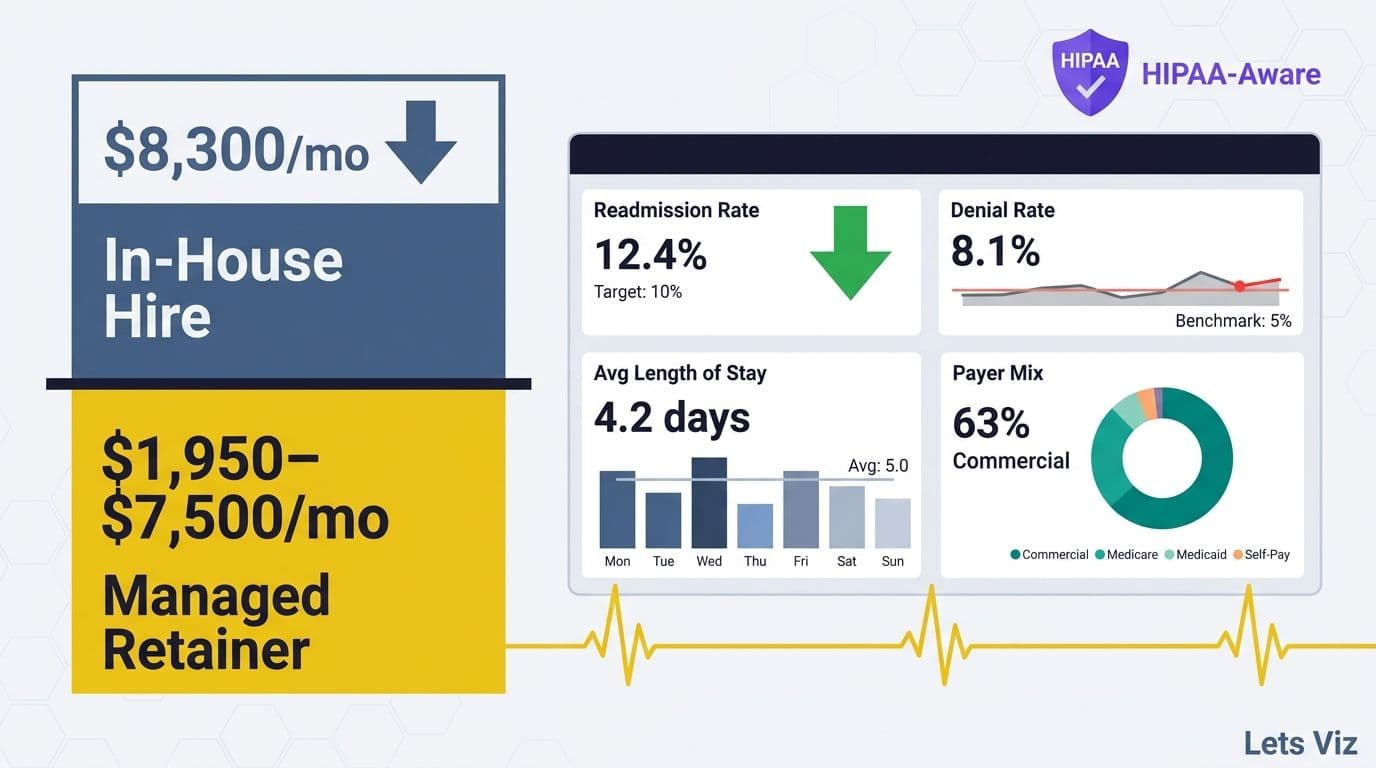
- Managed retainer: $36K–$60K/year (Lets Viz), industry-standard $96K-$180K/year — starts in week 2, replaceable team
- Internal hire makes sense if: there's enough work to keep one person at 100% utilization, the institutional knowledge of being internal matters more than flexibility, you have the management bandwidth to onboard and develop them
- Retainer makes sense if: the work would only utilize an FTE 50-80%, you don't want recruitment risk, or you need the work to start before a hire could realistically be onboarded
For most 50-200 person companies, the retainer wins on day one — and many companies that eventually do hire an FTE find it useful to start with a retainer for the first 6-12 months while the role and scope get clearer.
What we offer for each trigger event
- Board deck pain / fundraise prep: Power BI for SaaS Finance — pre-configured for SaaS metrics, board-deck automation included.
- Month-end close acceleration: Managed Power BI retainer — scoped to include close automation in the first 30 days.
- Failed internal Power BI project: Power BI Consultant service — diagnostic engagement first, scoped fix afterward.
- Migrating off Tableau: Tableau to Power BI migration — translation-first methodology, KPI parity guaranteed.
- One small problem: we don't take these — we'll point you at the right independent specialist instead.
FAQ
When should I hire a Power BI consultant vs build in-house?
Hire outside help when the pain is recurring, the cost of getting it wrong is high (board, investor, or financial reporting), or you have a specific deadline that can't move. Build in-house when you have steady ongoing work that justifies a full-time role, when the institutional knowledge of being internal is valuable, or when the pain is too small to justify consulting overhead.
What are the signs that I need a Power BI consultant?
Recurring 15+ hours/month spent on board prep, month-end close longer than 5 days, Excel files as the source of truth for critical metrics, an internal Power BI dashboard that nobody uses, or an upcoming fundraise or strategic event that will demand investor-grade reporting. Any one of these alone is borderline; two or more together is a strong case for outside help.
How do I know if my Power BI problem is big enough to outsource?
Use the time test: if the pain is consuming 20+ hours per month of analyst or finance team time, the math typically favors outsourcing. At fully-loaded $80/hour, that's $1,600/month or $19,200/year — well above the cost of a managed retainer's incremental impact, and growing as the team grows.
When does a Power BI consultant NOT make sense?
Three cases: (1) you have one small specific bug that needs 4-8 hours of focused work — hire an independent specialist or use internal time, not a consulting engagement; (2) you have a strong internal Power BI lead who's already at the work — hire a second internal analyst instead of outsourcing; (3) the request is cosmetic ("make the dashboards prettier") rather than functional — internal time is the right path.
Should I hire a Power BI consultant before or after migrating to Power BI?
If you're migrating from Tableau or another tool, the consultant should be involved in the migration itself — not waiting for it to finish. The migration phase is where the most consequential decisions get made (semantic model design, KPI definitions, governance setup), and getting those right matters more than the visual layer that comes next. See our Tableau to Power BI migration guide for the full methodology.
How do I scope a Power BI consulting engagement?
Start with the trigger event — name the specific pain you're trying to solve. Define what "solved" looks like in measurable terms (board prep time cut from 30 hours to 5; close time cut from 8 days to 3; data-room readiness in 30 days vs 30+ hours under deadline). Have the consultant scope the engagement against that outcome, not against a generic "X dashboards by Y date." Use our 7-question screening framework when evaluating vendors.
How long does a typical Power BI consulting engagement take?
Diagnostic engagements: 2-4 weeks. Project-based engagements: 6-16 weeks depending on scope. Migration engagements: 10-12 weeks. Managed retainers: ongoing, with the first measurable outcome (typically a board-ready dashboard) in week 2-3. The mistake to avoid is over-scoping the first engagement — start with one specific trigger event, deliver a measurable win, then expand if useful.
The "when to hire" question is really five questions: which pain, how recurring, how high-stakes, what deadline, and what alternative? Once you have the trigger event named clearly, the model usually picks itself — and the engagement that pays back fastest is almost always the one with the most specific scope.
If you're sitting with a trigger event and want a no-pitch second opinion on whether outside help fits, book a 30-minute call. We'll listen, ask the right questions, and tell you honestly whether we're the right move — including when the answer is "this isn't a job for a consultant."