AI Governance Framework for Finance: Multi-Region Playbook
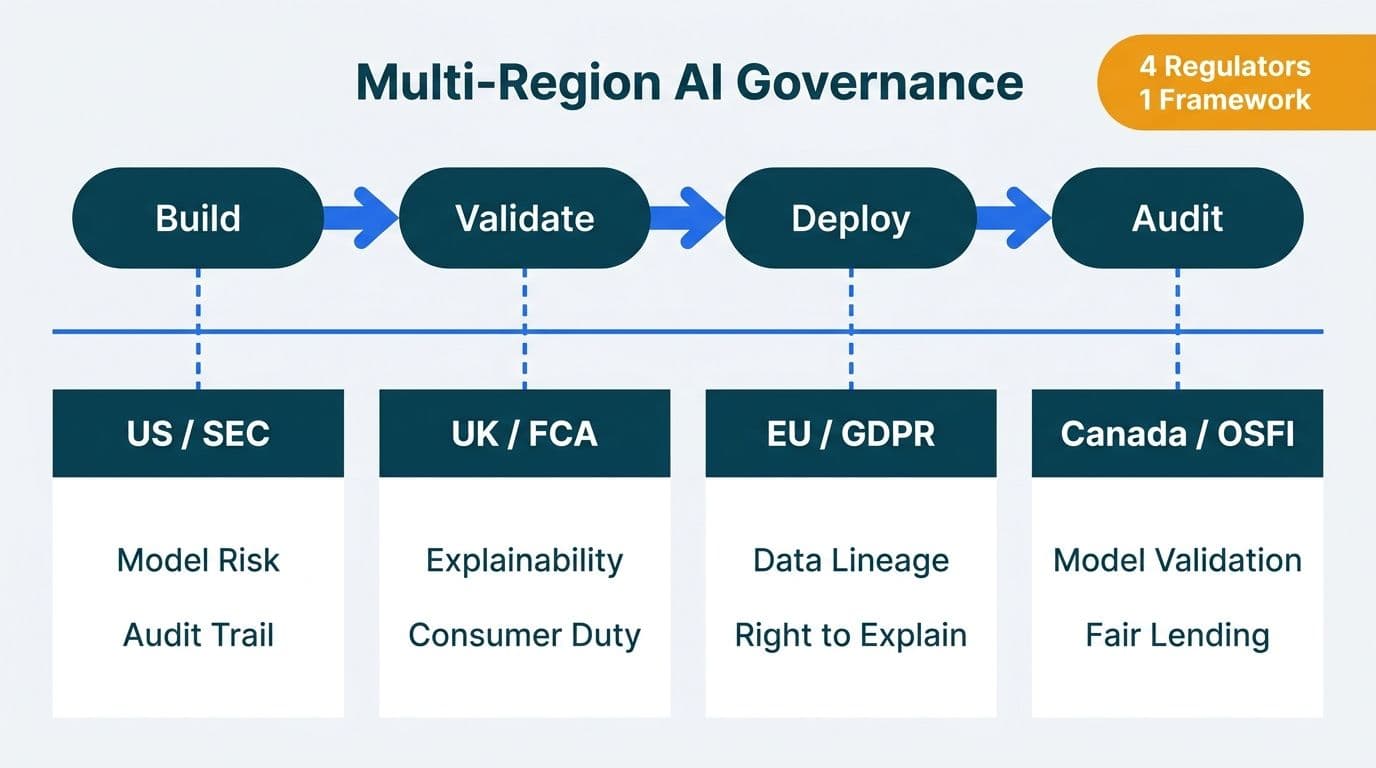
An AI governance framework for finance is a structured set of policies, controls, and accountability mechanisms governing how AI models are built, validated, deployed, and audited within financial reporting and forecasting workflows. For multi-region firms operating across US, UK, EU, and Canadian jurisdictions, the framework must satisfy overlapping regulatory demands from the SEC, FCA, OSFI, and GDPR simultaneously. Without it, model errors, data lineage gaps, and explainability failures become compliance liabilities that no CFO can afford to ignore.
Key Takeaways
A multi-region AI governance framework must address SEC, FCA, OSFI, and GDPR requirements concurrently - not sequentially.
Model risk management (MRM) is the operational core: each AI model used in financial reporting needs a validation cycle and a documented audit trail.
Explainability is a regulatory expectation, not a feature: regulators in all four jurisdictions require finance teams to justify AI-generated outputs.
Data lineage tracking must connect raw source data through every transformation step to the final AI-generated figure.
Automating month-end close with AI is viable, but only inside a governance wrapper that preserves human approval at every material step.
What Is an AI Governance Framework for Finance Teams?
An AI governance framework for finance defines who owns each AI model, what validation it must pass before deployment, how its outputs are documented for regulators, and what happens when it produces an unexpected result.
Finance teams deploying AI in reporting and forecasting face three distinct risk categories: model risk (the AI produces incorrect outputs), data risk (inputs are incomplete or untraceable), and regulatory risk (outputs cannot be explained to an auditor or supervisor). A governance framework addresses all three through four core components:
Model inventory: a register of every AI model in production, with owner, purpose, training date, and last validation date.
Validation protocol: an independent review process before any model touches live financial data or regulated reporting.
Change management: version control and approval gates whenever a model is retrained, its features change, or its deployment scope expands.
Escalation path: a defined process for when a model output is questioned by a finance officer, board member, or external auditor.
The framework must be proportionate. A small-scale AI tool that formats variance commentary requires lighter oversight than a model feeding capital adequacy ratios or investor disclosures. Matching governance intensity to model materiality is the design principle that keeps the framework practical rather than bureaucratic.
For finance teams mapping where AI fits into their reporting stack, AI automation consulting provides a structured starting point - aligning automation opportunities with governance requirements before a single model reaches production.
How Do SEC, FCA, OSFI, and GDPR Shape an AI Governance Framework for Finance?
Each regulator approaches AI from a different angle, but all four demand that AI outputs in regulated financial processes be auditable, explainable, and human-reviewed before they reach investors, counterparties, or supervisors.
SEC (United States): SEC reporting requirements oblige firms to disclose material AI dependencies in financial statements and to document the assumptions underlying AI-assisted inputs. AI used in Form 10-K forecasting or earnings guidance must carry a documented validation trail and a human attestation from a responsible officer. Sarbanes-Oxley certifications signed by CFOs extend to AI-assisted disclosures, making executive accountability explicit.
FCA (United Kingdom): The FCA expects regulated firms to embed human oversight into AI processes touching financial advice, reporting, or credit decisions. A UK fintech firm using AI-generated revenue forecasts for regulatory capital returns must maintain a full audit trail from data ingestion to the final reported figure - and reproduce it on demand for FCA supervisors. Senior manager accountability under SM&CR applies to AI-assisted decisions within those managers' remit.
OSFI (Canada): OSFI's model risk management guidelines are among the most prescriptive frameworks globally. They require a three-line defence: model development, independent validation, and internal audit. Canadian federally regulated financial institutions deploying AI in stress-testing, credit-loss estimation, or liquidity forecasting must satisfy these requirements alongside PIPEDA data handling obligations.
GDPR (EU and UK): GDPR Article 22 prohibits solely automated decisions with legal or significant effect on individuals - a direct constraint on AI-driven credit scoring or customer risk classification in financial services. Finance teams in scope must implement the right to explanation for any individual affected by an automated financial decision. As of August 2026, the EU AI Act's provisions for high-risk AI systems — which explicitly cover AI used in credit scoring, insurance risk assessment, and creditworthiness evaluation — are now in full enforcement, adding a second binding compliance layer for EU-facing finance teams beyond GDPR Article 22 alone. The GDPR Compliant SaaS Financial Reporting: The BI Checklist covers the data handling controls that underpin GDPR compliance in financial reporting platforms.
AI Governance Requirements Across Jurisdictions
| Regulatory Body | Jurisdiction | Core AI Requirement | Human Oversight Mandate | Data Privacy Layer |
|---|---|---|---|---|
| SEC | United States | Material AI disclosure in filings; documented model assumptions | CFO attestation on AI-assisted disclosures (SOX) | SOC 2 / CCPA |
| FCA | United Kingdom | Reproducible AI outputs for supervisory review | Senior manager accountability (SM&CR) | UK GDPR |
| OSFI | Canada | Three-line defence: development, independent validation, internal audit | Board-level model risk appetite statement | PIPEDA and provincial laws |
| GDPR Art. 22 | EU + UK | Right to explanation for automated financial decisions | Human intervention available for material automated decisions | Full GDPR data subject rights |
| EU AI Act | EU | High-risk AI classification for financial services; conformity assessment and technical documentation required | Fundamental rights impact assessment; human oversight obligations for high-risk applications | GDPR + EU Member State implementing laws |
What Is Model Risk Management in AI-Driven Forecasting?
Model risk management (MRM) is the discipline of identifying, measuring, and mitigating the risk that an AI or quantitative model produces incorrect or misleading outputs that drive financial decisions.
In AI-driven forecasting, MRM addresses three failure modes:
Conceptual soundness risk: the model's logic is flawed, or its training data no longer reflects current market or business conditions.
Implementation risk: the code, data pipeline, or infrastructure introduces errors despite sound theory.
Use risk: the model is applied to decisions outside its validated scope.
A US SaaS company running an AI-powered annual recurring revenue forecast, for example, faces use risk if that same model is later applied to project customer lifetime value. These are different prediction problems requiring separate validation - not a simple extension of scope.
A robust MRM programme for finance teams includes a model registry (every forecasting model logged with version, owner, and validation status), an independent validation cycle (a team separate from developers validates each model before production), ongoing monitoring (performance tracked against actuals monthly for operational models, quarterly for strategic ones), and materiality thresholds (models feeding regulatory filings require more rigorous validation than internal management dashboards).
The MRM requirement becomes particularly acute for AI forecasting tools used in finance. When AI forecasting outputs feed board presentations, bank covenants, or regulatory stress tests, each scenario must be traceable to its model version and input dataset - not just its headline number.
How Do You Build Explainability Into an AI Governance Framework?
Explainability means a finance professional, auditor, or regulator can understand - in plain language - why an AI model produced a specific output and which factors drove it most.
Three practical explainability techniques apply to financial AI:
1. SHAP values (SHapley Additive exPlanations): for each model output, SHAP values decompose the contribution of each input variable. A revenue forecast increase can be broken down into pipeline volume, seasonality, and pricing changes - giving a CFO a defensible explanation for any auditor or board member who questions the number.
2. Counterfactual explanations: the model shows what would need to change for a different outcome. In credit risk decisions subject to GDPR Article 22, this satisfies the right-to-explanation requirement directly: "this application was declined because the debt-to-income ratio exceeds the model threshold; reducing it by the specified amount would change the outcome."
3. Model cards: a standardised one-page document covering a model's purpose, training data, known limitations, and performance benchmarks. Model cards are widely accepted by auditors and regulators as evidence that a firm understands and can account for its AI models.
Explainability tooling must be built in at model design stage, not added afterwards. Finance teams that skip it typically discover the gap during an audit, when remediation requires reworking the model architecture rather than adding a documentation layer. The AI Workflow Automation Mistakes: Pre-Launch Checklist covers the most common pre-deployment oversights in AI projects, including explainability.
What Does Data Lineage Mean for AI Governance in Finance?
Data lineage is the documented trail that traces every data point from its original source through every transformation step to its final appearance in an AI model output or regulated financial report.
For AI governance in finance, data lineage is the evidentiary backbone. When an SEC examiner or FCA supervisor asks where a specific number came from, data lineage provides the answer. Without it, a finance team cannot demonstrate that AI-generated forecasts or risk assessments are based on clean, complete, and authorised data - making any regulatory return they feed vulnerable to challenge.
A practical data lineage architecture for financial AI includes:
Source tagging: every data ingestion point tagged with its origin system, ingestion timestamp, and data steward.
Transformation logging: every ETL or pipeline step that modifies data is logged, including who approved the transformation logic and when.
Model input audit trail: the exact dataset version used for each model training run or inference is stored and retrievable on demand.
Output reconciliation: AI-generated figures are reconciled against source data on a defined cycle before they enter any regulatory report or investor disclosure.
A Canadian bank running AI-driven stress-testing models must demonstrate, under OSFI's model risk guidelines, that the data feeding each stress scenario is complete, accurate, and traceable to source systems. A broken lineage chain - where data passes through an undocumented pipeline step - is a deficiency finding, not a minor observation.
Data platforms with native lineage capabilities make this significantly more tractable. The Microsoft Fabric OneLake Explained: The Unified Data Lake covers how OneLake's built-in lineage views translate to audit evidence for financial reporting pipelines.
How Do AI Agents Automate Month-End Financial Close Under a Governance Framework?
AI agents in finance are increasingly applied to month-end close automation — finance teams adopting governed AI close processes report cutting cycle times from 7-10 business days to 3-4 business days as of 2026, while reducing manual reconciliation errors by over 60%. Each automated step must nonetheless be logged, validated, and reversible to remain compliant.
A governed month-end close automation runs in four phases:
Phase 1 - Data ingestion and reconciliation: AI agents pull trial balance data from ERP systems, reconcile intercompany transactions, and flag exceptions. Each ingestion event is written to the data lineage log. Human reviewers resolve flagged exceptions before processing continues.
Phase 2 - Accruals and adjustments: AI models suggest accruals based on historical patterns and current period data. A finance manager approves, modifies, or rejects each suggestion. The AI never books an entry autonomously - it proposes; humans authorise.
Phase 3 - Variance analysis and narrative: AI generates variance analysis comparing actuals against forecast and prior period, and drafts explanatory commentary. The FP&A Dashboard in Power BI: A Step-by-Step Build Guide shows how this output can be visualised for finance leadership review at each stage of the close cycle.
Phase 4 - Disclosure preparation: AI drafts disclosure language for management accounts or regulatory returns. A senior finance officer reviews all AI-drafted disclosures before submission. For SEC filers, CFO attestation under Sarbanes-Oxley extends to AI-assisted disclosures. For UK firms under SM&CR, the responsible senior manager signs off on regulatory returns regardless of whether AI assisted in drafting them.
The governance wrapper for each phase requires three elements: an audit log of every AI action, a human approval checkpoint before material steps are finalised, and a rollback mechanism allowing any AI-proposed change to be reversed without downstream consequences.
How Should Finance Leaders Sequence an AI Governance Implementation?
Finance leaders should establish governance infrastructure before scaling AI deployment. Retrofitting controls after the fact introduces regulatory exposure during the gap and typically costs more than building in from the start.
A practical implementation sequence:
Step 1 - Complete an AI inventory: catalogue every existing AI or algorithmic tool in the finance stack, including spreadsheet models with embedded statistical logic. As of 2026, with AI adoption accelerating across finance functions, many teams uncover 40-60 or more undocumented tools at this stage — often described as "shadow AI."
Step 2 - Risk-classify each tool: tools that feed SEC filings, FCA regulatory returns, or capital calculations are high-risk and require full MRM treatment. Tools that generate internal draft commentary are low-risk. Governance intensity tracks risk classification.
Step 3 - Assign ownership and formalise policy: each model gets a named owner accountable for its performance and validation. A model risk policy referencing the applicable regulatory framework - SEC, FCA, OSFI, GDPR - receives board or audit committee sign-off.
Step 4 - Implement foundational tooling: data lineage tracking, model version control, and explainability tooling go in before the next round of AI expansion. Foundation first; scaling second.
Step 5 - Establish a governance cadence: quarterly model performance reviews, annual full revalidation for high-risk models, and a standing AI governance committee with representation from compliance, technology, and finance.
This sequence applies whether the team is a US healthcare system managing SOC 2 and SEC reporting obligations, a UK fintech under FCA supervision, or a Canadian financial institution subject to OSFI's model risk requirements. The order matters because governance designed alongside deployment is a control; governance imposed on top of it is a remediation.
---
About Lets Viz: Lets Viz has helped finance and analytics teams design governed AI reporting stacks since 2020, working with US healthcare systems, UK fintech firms, Canadian manufacturing businesses, and global SaaS companies. Rated 5.0 on Clutch, Lets Viz combines implementation depth across Power BI, Microsoft Fabric, and AI automation with hands-on compliance experience spanning SEC, FCA, OSFI, and GDPR environments.
If your finance team is ready to move from ad hoc AI adoption to a structured, regulator-ready governance model, AI automation consulting from Lets Viz is the right starting point.