Tableau Consultant Cost 2026: Hourly, Project & Retainer Rates
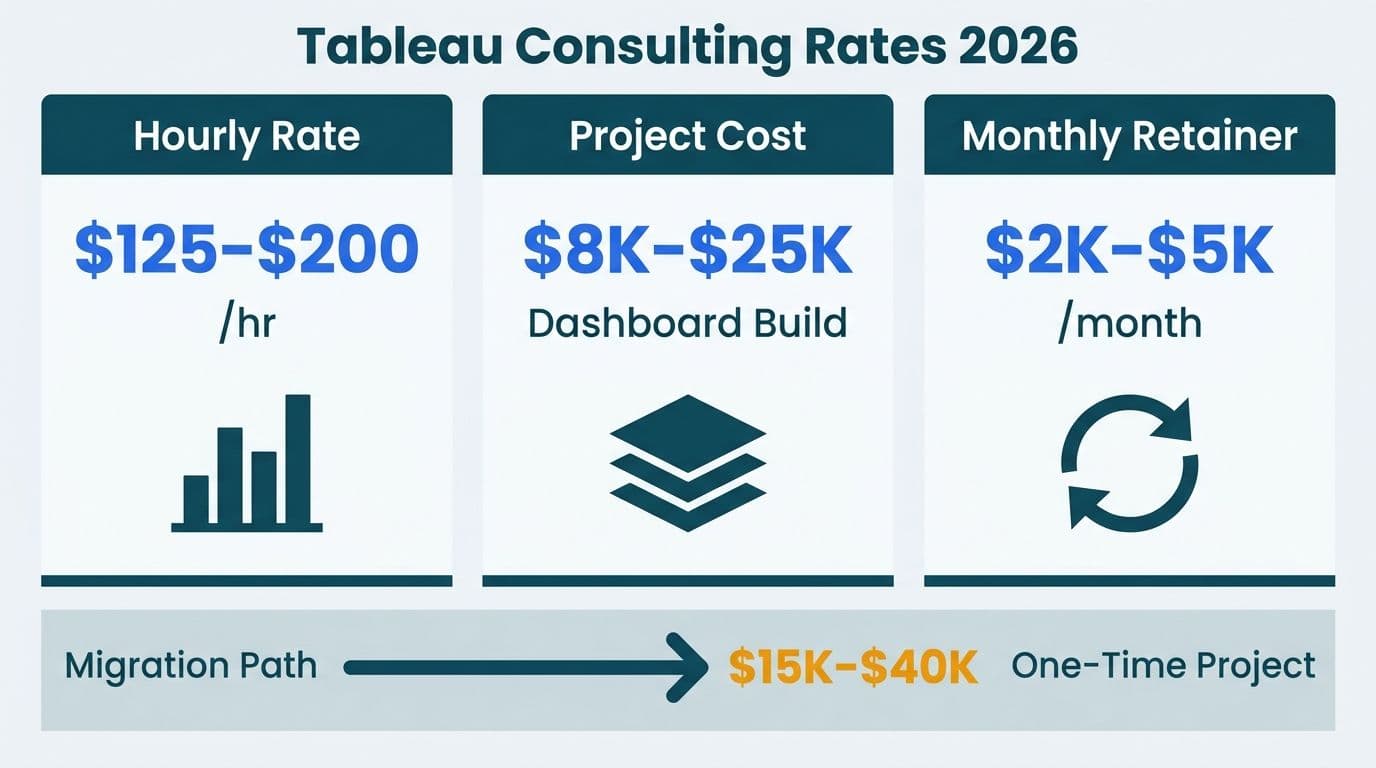
In 2026, a senior Tableau consultant charges $125-$200 per hour in the US market, with project engagements running $8,000-$25,000 for dashboard development and $5,000-$15,000 for server setup or cloud configuration. Ongoing retainers run $2,000-$5,000 per month. If you are weighing Tableau consulting against a platform migration, a Tableau to Power BI switch typically runs $15,000-$40,000 as a one-time project - often the more cost-effective long-term path for Microsoft-heavy organizations.
Who This Guide Is For
This applies to you if:
You manage 10 or more Tableau dashboards and need outside expertise for builds, maintenance, or expansion
You are benchmarking current Tableau spend before your next budget cycle
You are a CIO, data team lead, or finance director evaluating whether to renew Tableau licensing or consolidate to another platform
You operate in healthcare or financial services in the US, Canada, or UK/EU and need a consultant familiar with HIPAA, SOC 2, GDPR, or PIPEDA data governance requirements
This is a poor fit if:
You have fewer than 5 dashboards and a technically capable in-house developer already on staff
Your organization has not yet established a core data infrastructure - a free BI readiness assessment may be a better starting point than a consulting engagement
Tableau Consultant Cost in 2026: The Full Rate Card
Tableau consulting breaks into three billing structures. Most mid-market engagements start as projects and move to retainers once the initial build is complete.
| Engagement Model | Scope | Typical US Range |
|---|---|---|
| Hourly rate (staff augmentation) | Ad hoc fixes, isolated builds | $125-$200/hr |
| Dashboard development project | 5-10 dashboards | $8,000-$25,000 |
| Server/Cloud setup and training | Tableau Server or Cloud | $5,000-$15,000 |
| Ongoing support retainer | Monthly admin and iteration | $2,000-$5,000/mo |
| Tableau to Power BI migration | One-time platform switch | $15,000-$40,000 |
UK and EU buyers are seeing rates in a broadly similar USD-equivalent range. GDPR data residency requirements can push scopes to the higher end, since compliant Tableau configurations require additional security architecture work. Canadian buyers in general commercial sectors often see rates 10-15% below US benchmarks; specialists in regulated industries - healthcare (PIPEDA), financial services - close that gap.
What drives costs within those ranges:
Report complexity: calculated fields, blended data sources, cross-database joins
Tableau Server (self-managed) vs. Tableau Cloud (hosted SaaS)
Compliance documentation: row-level security for HIPAA, data residency for GDPR, audit logs for financial services
Whether training and knowledge transfer are in scope alongside development
Post-handoff support expectations
Tableau Licensing Costs: What Buyers Often Forget
Before scoping consulting fees, know your licensing baseline. Tableau Cloud charges per named user (as of 2026):
| Role | Monthly Cost Per User |
|---|---|
| Creator (build and publish reports) | $75/user/mo |
| Explorer (explore and edit) | $42/user/mo |
| Viewer (view-only access) | $15/user/mo |
A mid-market team with 5 Creators and 25 Viewers spends $750/mo in licensing alone, before a single consulting dollar. US healthcare organizations configuring per-user data access for HIPAA audit trails routinely require consultant involvement to set up row-level security correctly - this adds to initial project cost but reduces compliance exposure materially.
What Working With a Tableau Consultant Looks Like
A 6-8 week project engagement follows a defined sequence regardless of scope size.
Discovery (Weeks 1-2)
Scope confirmation, data source audit, stakeholder interviews, and access provisioning. This is where compliance requirements are surfaced and documented: HIPAA data access controls for US healthcare clients, GDPR data residency constraints for UK and EU organizations, PIPEDA cross-border transfer rules for Canadian teams. Teams operating under PIPEDA requirements around data processed across provinces often need additional time in this phase - time well spent, since it prevents rework in production.
Build and Iterative Review (Weeks 3-6)
Dashboard development against agreed specifications with weekly stakeholder reviews. For Tableau Cloud deployments, user role configuration and published data source management happen in parallel with the development sprint.
QA, Training, and Handoff (Weeks 7-8)
Data validation, performance benchmarking, end-user training, and documentation. Clients in regulated industries receive audit-ready documentation as a standard deliverable, not an add-on.
After handoff, most clients move to a $2,000-$5,000/mo retainer covering a monthly hour bank, a prioritized backlog, and regular syncs. For organizations whose Tableau needs are moderate or variable, this is almost always cheaper than maintaining a full-time Tableau specialist.
How Does Tableau Consulting Cost Compare to Hiring In-House?
A full-time mid-level Tableau developer costs approximately $110,000-$130,000/year fully loaded in 2026 - around $9,200-$10,800/mo when you factor in salary, benefits, and overhead. A senior consultant retainer at $2,000-$5,000/mo delivers higher expertise at a fraction of that cost, provided you do not need 40+ hours of Tableau work per week continuously.
The case for in-house hiring is strongest when you have a high, consistent volume of Tableau work and when knowledge retention is a strategic priority. For most mid-market organizations, the retainer model wins on both cost and capability: access to consultants who have solved the same problem across dozens of clients, with no single-point-of-failure risk.
Organizations relying on a single in-house Tableau developer frequently encounter slow change request queues, and when that person leaves, documentation gaps mean expensive institutional knowledge loss. Transitioning to a retainer typically delivers faster turnarounds and complete documentation as a standard deliverable.
When Does a Tableau to Power BI Migration Make More Sense?
This is the question CIOs quietly ask but rarely say out loud in the first conversation.
Migration makes financial sense when three or more of these conditions apply:
Your organization already pays for Microsoft 365 - Power BI Pro is included in many enterprise licenses
Tableau licensing is a meaningful budget line at your current team size
Your data lives primarily in Azure, SQL Server, or SharePoint
Your analytics team is already asking how to learn Power BI coming from Tableau - a reliable signal that practitioner-level appetite for migration exists
You need tighter integration with Excel-based financial models, which matters particularly for finance and FP&A teams
For Tableau to Power BI migration for regulated industries, the compliance picture deserves careful analysis. Microsoft's enterprise security stack - Azure Active Directory, built-in audit logs, data classification labeling - often maps more directly to SOC 2 and HIPAA requirements than Tableau Server's configuration-heavy equivalent. Organizations already operating within an Azure tenant often find that GDPR data residency obligations are easier to enforce within infrastructure they already control.
Our Tableau to Power BI migration services cover the full project scope: report inventory, a structured Tableau to Power BI migration checklist, DAX translation, data source remapping, user acceptance testing, and go-live support. Projects typically run $15,000-$40,000 depending on report count and complexity. For additional context on Power BI's finance reporting capabilities, the Power BI Report Builder vs Desktop finance guide is worth reviewing before your scoping call.
If you are evaluating a platform switch, our Tableau to Power BI migration services include a no-cost report inventory call where we assess your current Tableau environment and give you a realistic cost and timeline estimate - before you commit to anything.
Common Objections - Addressed Directly
"Can't we just hire a freelancer for less?"
You can, and for a one-off dashboard it may be the right call. The trade-off is coverage: a solo freelancer cannot provide consistent availability, does not carry professional liability insurance, and typically has limited experience with regulated-industry compliance requirements. For production-grade, compliance-sensitive Tableau environments, the risk profile is materially different.
"We worry about consultant lock-in."
A legitimate concern. Ask any potential partner two questions before signing: do they produce documentation you could hand to another consultant tomorrow, and do they operate on month-to-month retainers without long-term contracts? Both should be standard. If a firm cannot answer yes to both, keep looking.
"What if migrating platforms is actually the right answer?"
Sometimes it is, and a credible consultant will tell you so. If your organization runs Microsoft 365 and is paying Tableau licensing on top, the one-time migration cost ($15,000-$40,000) typically recoups within 12-18 months through licensing savings. Use our instant project cost calculator to model both paths before committing to either. The Looker Studio vs Power BI decision guide is also useful if you are evaluating the broader BI platform landscape.
What the 2026 Analytics Market Means for Buyers
Experienced Tableau and Power BI consultants are in strong demand, and senior-level project capacity books out quickly. A meaningful shift in 2026 is the rollout of Tableau AI features — including Einstein Copilot integration and AI-generated viz recommendations — which require consultants who understand both the analytics layer and the underlying Salesforce data model. Organizations expecting to use these features in production are discovering that general Tableau experience is not sufficient; the senior end of the market ($175-$200/hr) is where that expertise lives, and those consultants are routinely booked 6-8 weeks out. If you are planning a project for the second half of 2026, starting scoping conversations now is the practical move.
How to Evaluate a Tableau Consultant Before You Commit
Three questions that separate capable specialists from expensive generalists:
1. Can you show a live example of row-level security in a regulated-industry environment? For healthcare or financial services buyers, this is a baseline requirement, not a differentiator.
2. What does your data source documentation look like? Ask to see an actual data dictionary from a completed engagement.
3. How do you handle scope changes mid-project? Change order processes should be defined in writing in the statement of work before any work starts.
For organizations still in the early evaluation stage, the free BI readiness assessment provides a structured starting point before any consultant conversations.
Whether you need a scoped Tableau build, ongoing retainer support, or a full platform migration, the decision is worth a conversation with someone who has done it in your industry. Our Tableau to Power BI migration services team handles engagements across the US, Canada, and UK - including healthcare and financial services organizations with strict compliance requirements. Book a free discovery call through our contact page - no pitch, just an honest scope assessment.
---
About Lets Viz: Lets Viz has delivered data analytics and BI consulting engagements since 2020, serving healthcare, SaaS, finance, and agency clients across North America and the UK. With a 5.0 Clutch rating, our team specializes in Tableau, Power BI, Zoho, and AI-powered analytics - built on the principle that honest scoping and complete documentation create long-term client relationships.