Microsoft Fabric Certification Exam Path: DP-600 vs DP-700
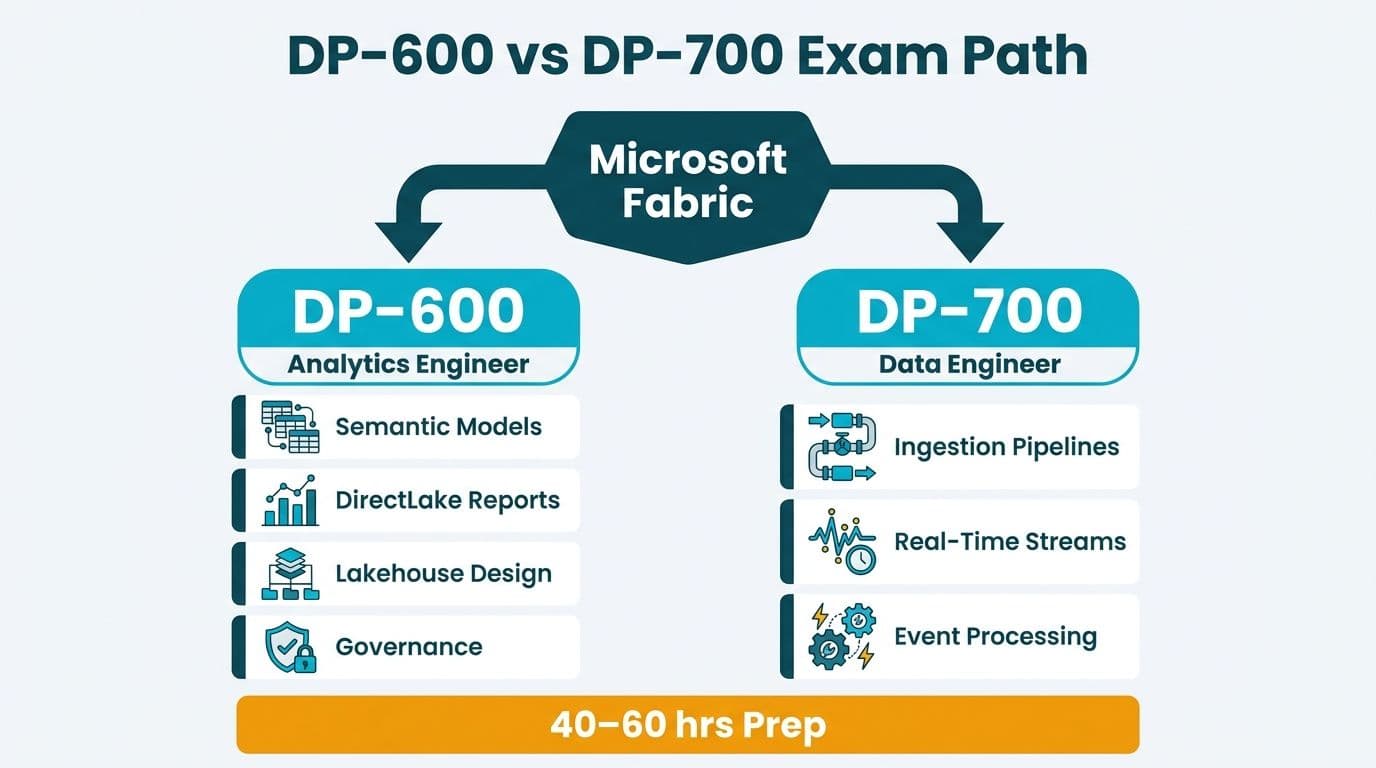
The microsoft fabric certification exam path divides into two associate-level tracks: DP-600 (Fabric Analytics Engineer) and DP-700 (Fabric Data Engineer). DP-600 suits analysts who build Lakehouse schemas, configure DirectLake Power BI reports, and apply data governance workflows; DP-700 suits engineers who design ingestion pipelines and real-time event streams. Both exams have free Microsoft Learn paths and typically require 40-60 hours of preparation.
Key Takeaways
- DP-600 (Analytics Engineer) covers semantic models, DirectLake Power BI, Fabric Lakehouse design, and governance; DP-700 (Data Engineer) covers pipeline orchestration, Spark notebooks, and real-time ingestion.
- Neither exam has mandatory formal prerequisites, but 2+ years of hands-on data experience is the practical baseline for both tracks.
- Microsoft Learn hosts free, structured learning paths for each exam - no paid training course is required to pass.
- Exam vouchers are priced around $165 USD / £115 GBP / CAD $230 as of 2026; verify current pricing at learn.microsoft.com before purchasing.
- Healthcare and finance teams will find that DP-600's governance curriculum maps directly to HIPAA, GDPR, and PIPEDA control requirements.
What Is the Microsoft Fabric Certification Exam Path for Analytics?
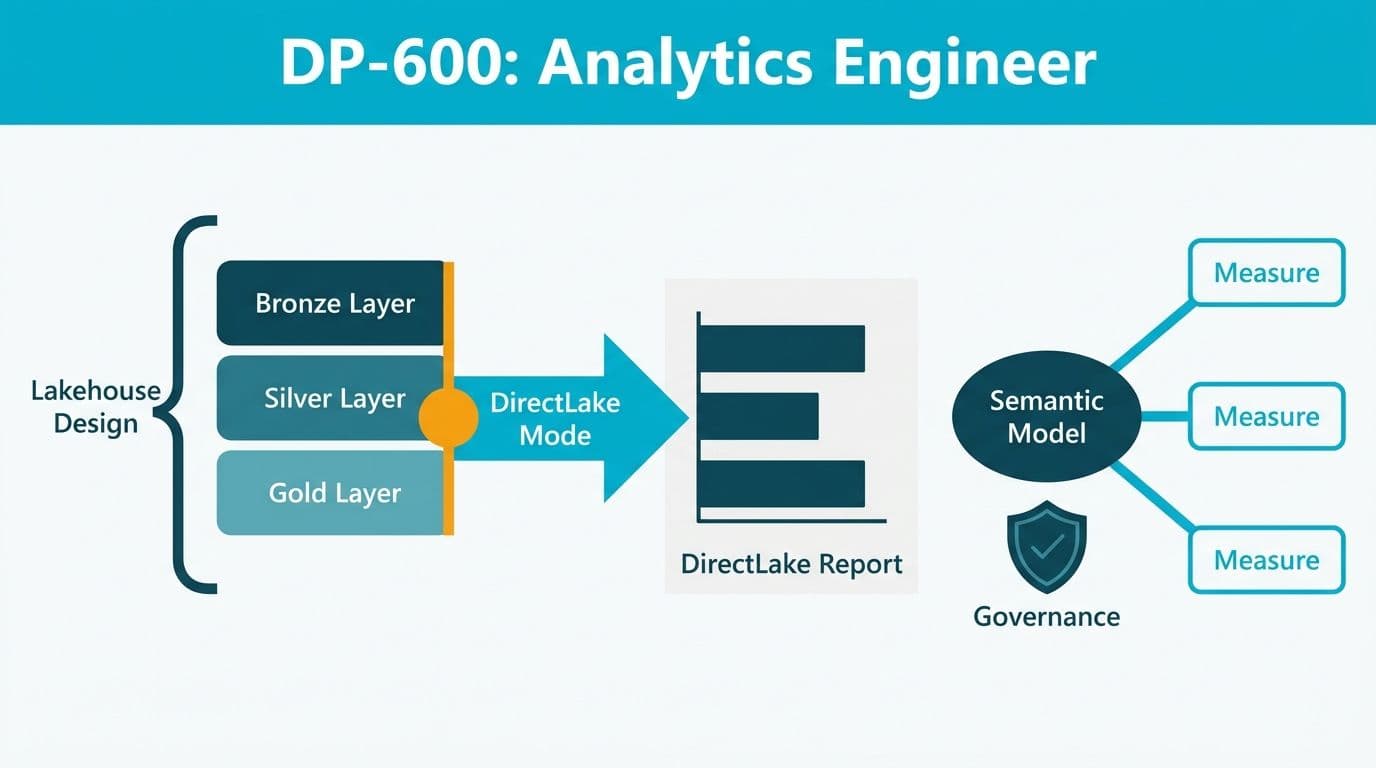
Microsoft Fabric, generally available since November 2023 per Microsoft's official product documentation, consolidates Lakehouse storage, data engineering, real-time analytics, and Power BI into a unified SaaS platform. The certification structure mirrors this architecture: one track for the engineers who build and move data, and one for the analysts who model and surface it.
DP-600 - Fabric Analytics Engineer Associate - is the entry point most relevant to data team leads and Power BI developers already working in Power BI and Fabric consulting environments. The exam covers the full analytics layer: designing Fabric Lakehouse schemas, creating and querying Delta tables, configuring DirectLake connections to Power BI, building and optimizing semantic models, and applying governance policies for sensitive data across the organization.
For teams with live Fabric deployments, the Fabric Lakehouse architecture reference guide provides a complementary technical foundation before sitting the exam - particularly useful for understanding OneLake topology and Delta table partitioning strategies that appear directly in exam scenarios.
DP-700 - Fabric Data Engineer Associate - complements DP-600 by covering the data movement layer: Fabric Data Factory pipelines, Spark notebooks for large-scale transformation, Eventstream for real-time data ingestion, and the monitoring and optimization of production data engineering workflows.
DP-600 vs DP-700: Which Certification Track Fits Your Team?
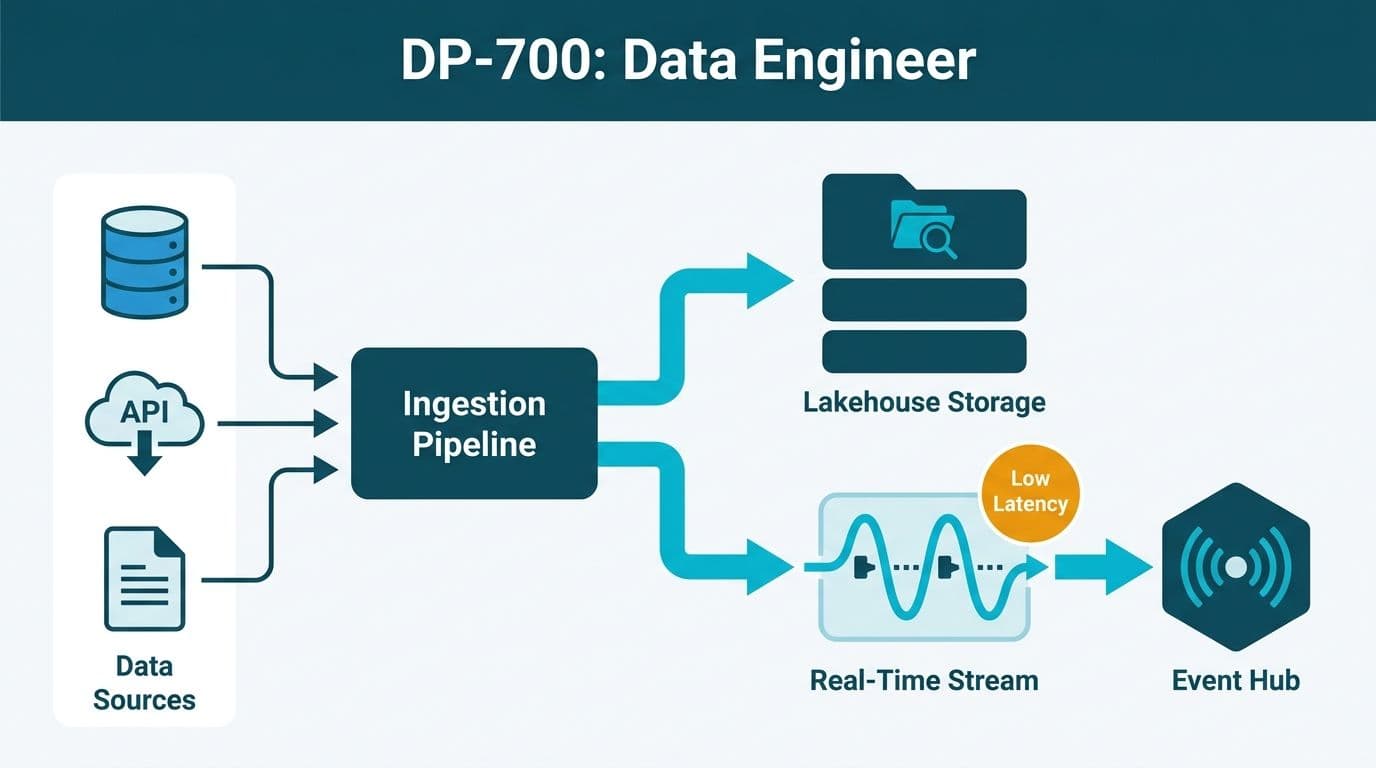
The two tracks share Fabric as their foundation but diverge sharply in role alignment, technical depth, and the operational problems they address. The table below maps the key dimensions to help data team leads and CIOs make the right investment decision.
| Dimension | DP-600 - Fabric Analytics Engineer | DP-700 - Fabric Data Engineer |
|---|---|---|
| Role alignment | Data analyst, BI developer, Power BI lead | Data engineer, pipeline architect, platform engineer |
| Core focus | Semantic models, DirectLake, Lakehouse governance | Pipelines, Spark notebooks, real-time ingestion |
| Key Fabric workloads | Lakehouse, Data Warehouse, Power BI | Data Factory, Eventstream, Spark, Lakehouse |
| SQL depth required | Intermediate (T-SQL, DAX) | Intermediate to advanced (SQL, PySpark) |
| Python/Spark required | Not core | Yes - tested throughout |
| Governance coverage | Sensitivity labels, Purview, RLS, audit logs | Pipeline-level lineage, row-level controls |
| Ideal candidate | BI team lead, analytics engineer, Power BI developer | Data engineer, ETL architect, MLOps engineer |
| Companion credential | PL-300 (Power BI Data Analyst) as useful prior context | DP-900 (Azure Data Fundamentals) as a stepping stone |
A US healthcare analytics team preparing for HIPAA audits will find DP-600 the natural starting point: the exam covers sensitivity labels, access controls, and audit log configurations that map to PHI protection requirements under 45 CFR §164.312.
A UK fintech running fraud scoring on real-time transaction streams will align better with DP-700: the exam covers Eventstream configuration, real-time data ingestion into a Microsoft Fabric Lakehouse, and the Spark transformations that feed near-real-time scoring models under GDPR data minimization constraints.
A Canadian credit union subject to PIPEDA will benefit from DP-600's Microsoft Purview governance module, which covers data classification, cross-workspace access policies, and lineage documentation relevant to provincial data residency obligations.
What Are the Prerequisites and Recommended Study Hours for Each Exam?
Neither DP-600 nor DP-700 has mandatory formal prerequisites - both are open certifications available to any registered candidate. However, the practical knowledge baseline is clear from the skills measured sections of each exam, and arriving underprepared significantly increases the risk of a first-attempt failure.
For DP-600, you should already be comfortable with:
- Building Power BI semantic models, DAX measures, and row-level security configurations
- Writing intermediate T-SQL queries against relational or Lakehouse SQL endpoints
- Understanding the conceptual distinction between a Fabric Lakehouse vs data warehouse - a Lakehouse stores data as Delta tables over OneLake object storage with a SQL endpoint layered on top; a Warehouse uses a traditional relational engine with full T-SQL DML support and stronger consistency guarantees
- Basic familiarity with how Microsoft Fabric pricing capacity units determine workload concurrency limits, since capacity planning appears in the exam's administration module
- Awareness of data governance concepts: sensitivity labels, data classification, and information protection policies in Microsoft 365 environments
For DP-700, you should already be comfortable with:
- Writing PySpark or Spark SQL in Jupyter-style notebook environments
- Designing and debugging multi-step ETL pipelines with branching logic and error handling
- Concepts of event streaming architecture and the producer-consumer model for real-time ingestion scenarios
- Cloud infrastructure fundamentals, particularly Azure storage accounts, virtual network configurations, and autoscale resource management
A common career progression for senior Power BI developers: pursue DP-600 first to formalize Fabric analytics skills, then add DP-700 when the role expands to include pipeline ownership and engineering responsibility. For hiring managers, DP-600 alone is a sufficient credential for a Power BI or Fabric analytics hire; DP-700 becomes relevant when the candidate will own the full data engineering stack from ingestion to serving.
Estimated preparation time by candidate background:
| Candidate background | DP-600 hours | DP-700 hours |
|---|---|---|
| Experienced Power BI developer (2+ years) | 30-40 hours | 50-65 hours |
| Data analyst with SQL background | 40-55 hours | 60-80 hours |
| New to cloud data platforms | 70-90 hours | 90-120 hours |
These estimates assume active, lab-based learning - working through real Fabric workloads in a trial environment - rather than passive video consumption. Candidates who supplement Microsoft Learn with timed practice exams through Pearson VUE consistently report shorter time-to-pass than those who rely on the official path alone.
Where Can You Find Free Microsoft Learn Paths for DP-600 and DP-700?
Microsoft Learn (learn.microsoft.com) is the authoritative, free source for both exam preparation paths. The platform provides structured learning modules, sandbox lab environments aligned to the Fabric workspace, and knowledge checks that mirror the format of exam questions.
The DP-600 official learning path covers six core areas:
1. Getting started with Microsoft Fabric - workspace setup, capacity configuration, and OneLake architecture
2. Ingesting and transforming data in Fabric using Data Factory and dataflows
3. Implementing a Fabric Lakehouse and working with Delta tables, including time travel, schema evolution, and partitioning - all topics that appear in exam scenarios
4. Building and optimizing semantic models with DAX measures, aggregations, and calculation groups
5. Creating Power BI reports inside the Fabric workspace, including configuring DirectLake mode to connect Power BI to a Fabric Lakehouse for high-performance analytics without the latency of data import or the concurrency limits of DirectQuery
6. Administering Fabric workspaces, capacity settings, and governance policies at the tenant level
Working through a hands-on Microsoft Fabric Delta tables exercise in a free 60-day Fabric trial - available through Microsoft's official trial program - is the most effective complement to the Learn path for DP-600. Lab-format exam questions on Delta table MERGE operations, schema enforcement, and time travel queries appear consistently across reported exam attempts.
The DP-700 official learning path extends to cover Fabric Data Factory pipeline orchestration with more than 100 data connectors, Spark notebook authoring and scheduling in the Fabric workspace, and Eventstream configuration for real-time data ingestion into a Microsoft Fabric Lakehouse. Candidates without PySpark experience should budget an additional 15-20 hours beyond the official path to reach exam-ready Spark proficiency.
Both exams also reference Microsoft Fabric data agents - AI-assisted workspace features that help analysts and engineers discover, query, and interpret data assets using natural language. As this capability is actively evolving, reviewing the Microsoft Learn changelog for each exam's skills outline before your scheduled exam date ensures your preparation reflects the current version of the assessment.
What Voucher Options Are Available in the US, UK, and Canada?
Exam fees are broadly consistent across markets, with regional currency adjustments applied at the point of purchase through Pearson VUE. Always confirm the current fee at learn.microsoft.com before scheduling, as Microsoft adjusts pricing periodically.
Standard exam pricing as of 2026:
- United States: approximately $165 USD per attempt
- United Kingdom: approximately £115 GBP
- Canada: approximately CAD $230
Available discount programs in all three markets:
Exam Replay bundle - Available through Pearson VUE, this package includes the first exam attempt plus one free retake at a discounted combined price. For candidates who have studied thoroughly but are uncertain about the exam format on first exposure, the bundle materially reduces the financial risk of an initial attempt.
Enterprise Skills Initiative (ESI) - Organizations holding qualifying Microsoft volume licensing agreements - Enterprise Agreement, MPSA, or equivalent - can access free or heavily subsidized exam vouchers through ESI. US hospital networks, UK NHS digital teams, and Canadian financial institutions with enterprise Microsoft agreements are frequently eligible. Contact your Microsoft account manager or authorized licensing partner to confirm eligibility before purchasing at the standard rate.
Microsoft Cloud Partner Program benefits - Firms operating as Microsoft solution partners receive an annual exam voucher allocation through the partner portal. Analytics consultancies and internal enterprise teams delivering Fabric implementations should check the partner dashboard before purchasing, as these vouchers cover the full exam fee.
Microsoft Applied Skills assessments - Free, scenario-based online assessments introduced by Microsoft in 2023 per Microsoft's official documentation. These do not replace the proctored DP-600 or DP-700 badge but cover overlapping Fabric skills and serve as a zero-cost readiness check before committing to the proctored exam. Available globally with no scheduling fee and no time limit.
Academic pricing - Students and educators in the US, UK, and Canada can access discounted exam pricing through academic verification at the point of registration via Pearson VUE.
For finance directors managing training budgets, Fabric certification costs are typically categorized as professional development expenditure rather than software licensing - a budget-line distinction worth clarifying with procurement teams to avoid approval delays at the point of registration.
How Does Fabric Certification Address Healthcare and Finance Compliance?
For data team leads at regulated organizations, the governance depth in DP-600 is one of its strongest arguments as a team investment. The exam covers Microsoft Fabric data governance, GDPR, HIPAA, and PIPEDA alignment as testable skills, not background context.
DP-600 governance topics that map directly to regulatory requirements:
- Microsoft Purview integration - data classification, sensitivity labels, and information protection policies that align with HIPAA's minimum necessary standard (45 CFR §164.514), GDPR's data minimization principle (Article 5), and PIPEDA's purpose limitation requirement
- Row-level security (RLS) in Fabric semantic models - essential for healthcare dashboards displaying patient-level data, where PHI access must be scoped by clinical role and recorded in audit trails before distribution
- Workspace and capacity permissions - Fabric's admin, member, contributor, and viewer access model, relevant to segregation of duties requirements in financial services under SOX and DORA
- Audit logs and data lineage - required under GDPR Article 30 (records of processing activities), HIPAA's audit control standard (45 CFR §164.312(b)), and PIPEDA's accountability principle
Consider a hypothetical 200-bed US hospital system building a clinical operations dashboard in Fabric. DP-600 certified engineers on that team will know how to configure sensitivity labels on Lakehouse tables containing PHI, apply RLS on the semantic model to restrict ward-level data by nursing role, and pull audit logs into a compliance report - all without a separate governance consultant. That embedded credential materially reduces audit preparation overhead and shortens the time between implementation and sign-off by a compliance officer.
For US healthcare organizations building compliant Power BI and Fabric environments, the HIPAA compliant BI tools guide provides a technical checklist of platform requirements that DP-600 certified engineers are expected to implement and maintain.
For financial services teams mapping analytics investments to regulatory obligations across SEC, FCA, and OSFI jurisdictions, the AI compliance requirements guide for financial services provides the broader regulatory context that determines which Fabric workloads require enhanced governance configurations before production deployment.
---
About Lets Viz: Lets Viz has delivered data analytics and Fabric consulting engagements since 2020 for clients across US healthcare, UK fintech, Canadian manufacturing, and global SaaS - earning a 5.0 rating on Clutch. Our certified analytics engineers help mid-market teams design compliant, high-performance Fabric architectures and prepare internal staff for DP-600 and DP-700 certification readiness.
If your team is evaluating a Microsoft Fabric investment or needs certified engineering support for a healthcare or finance environment, explore our Power BI and Fabric consulting services to see how we structure Fabric engagements for regulated industries.