AI Forecasting for Finance Teams: A Practical Guide
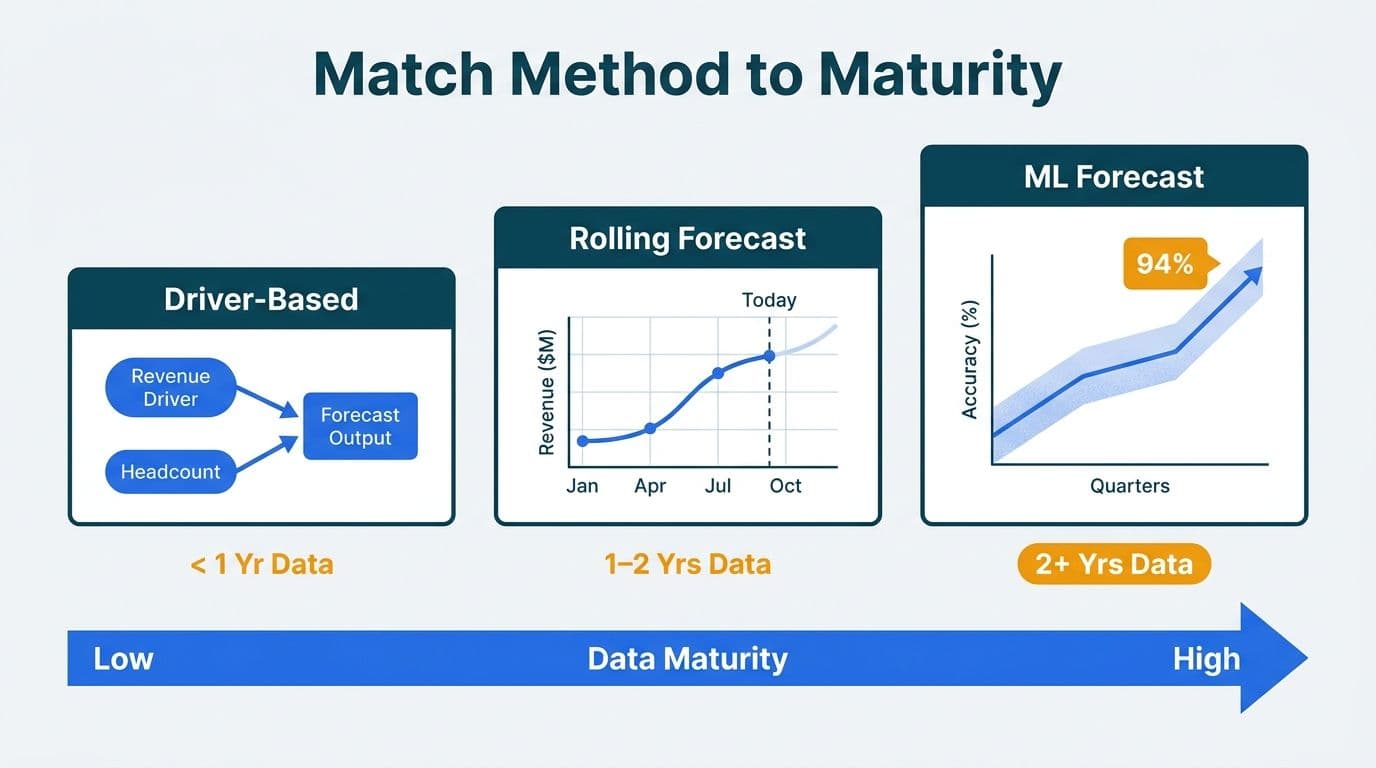
AI forecasting for finance teams replaces static annual budgets with continuously updated predictions using rolling forecasts, driver-based models, or machine learning. The right approach depends on your data maturity: teams with limited clean history should start with driver-based models, while organizations with two or more years of granular transactional data can unlock ML-level accuracy. Mismatching the method to maturity is the most common reason these projects stall before they deliver value.
Key Takeaways
Rolling, driver-based, and ML forecasting serve different data-maturity levels - there is no universal approach.
Clean, consistent historical data is the single biggest predictor of AI forecasting success.
Teams with low data maturity risk overconfident outputs if they jump straight to machine learning.
An AI governance framework and a structured readiness checklist must precede any tool purchase.
AI agents in finance are already automating variance analysis, data ingestion, and narrative generation alongside the forecast models themselves.
What Is AI Forecasting for Finance Teams?
AI forecasting for finance teams is the application of algorithmic models to financial planning and analysis (FP&A) workflows - replacing static spreadsheets with models that continuously update as new data arrives. Unlike traditional budgets that freeze assumptions for 12 months, AI-powered forecasts surface new signals - sales velocity, headcount changes, macroeconomic indicators - and recalculate projections in near-real time.
The term covers a spectrum. At the simpler end, a formula-driven rolling forecast refreshes monthly assumptions against actuals. At the sophisticated end, a machine learning model ingests millions of transactional rows and identifies non-linear patterns that a human analyst would miss. Most finance teams sit somewhere in between, and matching the method to the organization's actual data readiness is what AI automation consulting engagements typically address in the first phase of any FP&A transformation.
Three conditions determine whether AI forecasting delivers real accuracy or faster noise: data quality, model-to-maturity fit, and a governance layer that keeps outputs accountable. All three are required. Skipping one makes the other two irrelevant.
What Are the Three Main AI Forecasting Approaches in FP&A?
Understanding the three core approaches helps finance leaders choose the right starting point before committing to a platform or implementation partner.
Rolling Forecasts
A rolling forecast extends the planning horizon by a fixed number of periods - typically 12 or 18 months - and drops the oldest period each time a new month closes. This is the most accessible AI-adjacent approach because it does not require large historical datasets or machine learning expertise. The AI component is usually a rule-based reforecast engine that updates driver assumptions automatically when actuals land.
Rolling forecasts suit finance teams that are moving off annual budgets but do not yet have the data infrastructure for predictive models. A UK fintech firm with clean P&L data going back 18 months can implement a rolling reforecast in a modern FP&A platform without data science support.
Failure condition: Rolling forecasts break down when assumptions - headcount ratios, churn rates, price per unit - are maintained manually in spreadsheets. If a finance team still updates those drivers by hand, the rolling nature is illusory: it is a refreshed static budget, not an adaptive forecast.
Driver-Based Forecasting
Driver-based forecasting ties financial outcomes to operational metrics: revenue to pipeline coverage and win rate, headcount costs to hire plans, cost of goods sold to production volumes. Adding an AI layer means the model learns the historical relationship between drivers and outcomes and projects that relationship forward, adjusting automatically when driver values change.
This approach suits teams with 12 to 24 months of clean data in both their ERP and CRM or operational systems. A US SaaS finance team integrating CRM pipeline data with general ledger actuals can build a driver-based model that reforecasts revenue the moment a sales rep updates a deal stage - without waiting for month-end close. Finance teams that complete this integration with clean input data consistently report forecast accuracy improvements of 15 to 25 percentage points over prior spreadsheet-based methods, with the largest gains coming in the 30-to-60-day forward horizon (as of 2026).
Failure condition: Driver-based models fail when the drivers themselves are unreliable. If CRM data hygiene is poor - close dates perpetually pushed out, deal values systematically inflated - the model amplifies that bias rather than correcting it. Fixing input data quality must precede deploying the model.
Machine Learning Forecasting
Machine learning (ML) forecasting uses algorithms - gradient boosting, LSTM networks, or ensemble methods - to detect patterns in large datasets and make probabilistic predictions. This is the most accurate approach when data conditions are met, but it requires at minimum two years of granular, consistent transactional history and a data engineer to maintain the pipeline.
A Canadian manufacturing company with four years of daily SKU-level demand data can use ML to produce forecast intervals that account for seasonality, promotional effects, and supply disruptions simultaneously. Microsoft Copilot for Finance is a commercially available example of this approach surfacing ML-driven variance explanations within familiar Excel and Teams environments (Microsoft, 2026), reducing manual commentary effort for FP&A teams already embedded in the Microsoft ecosystem.
Failure condition: ML models trained on fewer than two years of clean data will overfit and produce confident-sounding predictions that perform worse than a simple moving average. The confidence intervals look precise; the underlying forecasts are not.
How Do AI Forecasting Tools for Finance Teams Compare by Data Maturity?
AI forecasting tools for finance teams compared on a data-maturity basis look very different from vendor marketing. Most platforms claim to support all three approaches, but only one will match your current data reality. The table below maps each approach to the conditions it requires, its primary FP&A use case, and the specific condition under which it fails.
| Approach | Data Maturity | Minimum History | Primary FP&A Use Case | Key Failure Condition |
|---|---|---|---|---|
| Rolling Forecast | Low | 6-12 months | Monthly reforecast, cash flow planning | Manual driver updates in spreadsheets |
| Driver-Based | Medium | 12-24 months | Revenue, headcount, COGS forecasting | Poor CRM or ERP data hygiene |
| ML / AI Predictive | High | 24+ months granular | Demand planning, P&L scenario modeling | Insufficient history; model overfitting |
A practical way to use this table: identify your shortest reliable data series. If your most granular financial data runs 14 months, driver-based is your ceiling - not because of budget or tooling, but because ML accuracy requires history that does not yet exist. This is the correct starting point, not a limitation to engineer around.
How Do You Build a Finance AI Readiness Checklist?
Before selecting a tool or engaging an implementation partner, finance leaders should work through a structured readiness assessment. Teams that skip this step typically spend several months configuring a platform only to discover that the underlying data is not fit for the model they purchased.
Data readiness
Financial history is stored in a single source of truth - ERP, data warehouse, or cloud lakehouse - rather than fragmented across spreadsheet shadow systems.
At least 18 months of actuals exist for every line item the model will forecast.
Operational drivers (pipeline, headcount, production volumes) are recorded at the same granularity as financial actuals and accessible via API or scheduled export.
Data has been audited for gaps, restatements, and reclassifications that would corrupt time-series continuity.
Governance readiness
Establishing an AI governance framework for finance teams before the first model goes live is essential in regulated industries. The framework must specify who owns the model, who reviews outputs before they enter a board pack, what triggers a model override, and how outputs are versioned for audit purposes.
For US healthcare finance teams processing patient revenue data under HIPAA and SOC 2, every model input, assumption, and output version must be logged and retrievable on demand. UK and EU organizations must address GDPR Article 22, which requires that any automated process materially affecting individuals - including workforce cost planning - must be explainable and challengeable. Canadian finance teams operating under PIPEDA face equivalent obligations when personal employee or customer data flows through a financial model.
Process readiness
The team has defined what forecast accuracy means in business terms - typically MAPE at the total revenue level, or a threshold such as within 5 percent of actuals.
A change-management plan exists for FP&A analysts whose current workflow involves building the manual forecast. AI forecasting eliminates data assembly hours but creates new demand for model interpretation and challenge skills.
A retraining schedule is defined for ML models. A model trained on historical data that is never retrained after a significant business model change will drift in ways that are invisible without active monitoring.
For organizations already using Power BI for financial reporting, the FP&A Dashboard in Power BI guide covers the data layer structuring that underpins a clean AI forecasting implementation.
What Do AI Agents in Finance Actually Do?
AI agents in finance extend the value of a forecast model by automating the human workflow that surrounds it. Where a static model produces a number and stops, an agent takes that number, compares it to the prior forecast, writes the variance commentary, flags the top three drivers, and prepares the executive summary - all without manual intervention.
In a practical FP&A context, the question of what AI agents in finance actually do maps to four distinct automation layers:
Data ingestion agents pull actuals from ERP systems, exchange rates from central bank APIs, and headcount from HRIS on a scheduled cadence. This is a core component of how organizations automate month-end financial close with AI: the agent replaces the manual process of assembling data before the close pack can begin, typically compressing two to three analyst-days of manual data assembly into under two hours of automated pipeline runs — finance teams benchmarking this shift in 2026 consistently report 80 to 90 percent reductions in pre-close data preparation time.
Variance analysis agents compare actuals to forecast at the GL account level and surface material variances with plain-language explanations, reducing commentary preparation from hours to minutes.
Scenario modeling agents run hundreds of parameter combinations - interest rate scenarios, demand shocks, FX sensitivity - in the time it previously took to run three manual scenarios.
Narrative generation agents draft the management commentary for board and audit committee packs based on structured outputs, which a human reviewer then edits and approves.
Microsoft Copilot for Finance (Microsoft, 2026) is one commercially available implementation of this agent layer, operating within Excel and Teams so that finance teams do not need a separate platform. The agent layer does not replace the forecast model; it automates the repetitive steps surrounding it and keeps analysts focused on interpretation and judgment.
For a broader view of agent-based automation patterns across business functions, the AI workflow automation examples guide covers comparable deployments in operations and revenue team contexts.
When Should Finance Teams Invest in an AI Governance Framework?
The answer is before the first model goes into production - not after the first significant forecast miss triggers a board question about how the number was generated.
A minimum AI governance framework for finance covers four elements:
Model inventory: A register of every AI model contributing to a financial output, including its version, training data window, last validation date, and the analyst accountable for its outputs. Without this register, it is impossible to know which models are in use or when they were last validated.
Human-in-the-loop checkpoints: Defined moments where a human must review and approve before a model output enters a board pack, audit committee submission, or regulatory filing. In banking, insurance, and healthcare, these checkpoints are increasingly expected by regulators, not just by internal audit.
Drift monitoring: A process for detecting when a model's accuracy degrades. Setting an accuracy threshold and alerting when actuals breach it by more than the agreed MAPE is the minimum viable control. Revenue forecasting models that are never retrained after a significant business change will produce systematic bias that is invisible without an active monitoring process.
Escalation and override procedures: Who decides when a model is taken offline, how manual overrides are documented, and how estimates are communicated when a model is suspended during a retraining cycle.
The AI workflow automation mistakes checklist covers governance gaps that are consistently overlooked in pre-launch phases - including several that apply directly to FP&A model deployments.
How Much Does AI Consulting for Finance Cost?
The cost of AI consulting for finance depends on scope, data complexity, and whether the engagement covers readiness assessment, model build, tool configuration, or ongoing support. Readiness assessments - the typical entry point - run as fixed-fee workshops or structured data diagnostics, commonly in the $8,000 to $20,000 range. Driver-based model builds integrating ERP and CRM systems involve a data engineer, an FP&A specialist, and a project lead working across several weeks, with total engagement costs typically falling between $40,000 and $120,000 depending on the number of integrated systems and forecast scope. ML model development adds data science capacity and a longer engagement timeline, generally starting at $150,000 and scaling with dataset complexity and retraining requirements. Ongoing retainers cover model retraining, drift monitoring, and dashboard maintenance.
For a directional estimate relevant to your team's scope and data complexity, the instant project cost calculator provides structured guidance before you engage a vendor or partner.
---
Ready to assess which AI forecasting approach fits your team's current data maturity? Our AI automation consulting team delivers structured readiness reviews - covering data, governance, and tooling - so your finance organization invests in the right model at the right moment.
---
About Lets Viz: Lets Viz has delivered analytics and AI automation projects since 2020, serving clients across US healthcare, UK fintech, Canadian manufacturing, and global SaaS. Our team holds a 5.0 Clutch rating and brings hands-on FP&A automation, data engineering, and AI governance implementation experience to every engagement.