AI Data Strategy for Supply Chain: A Mid-Market Playbook
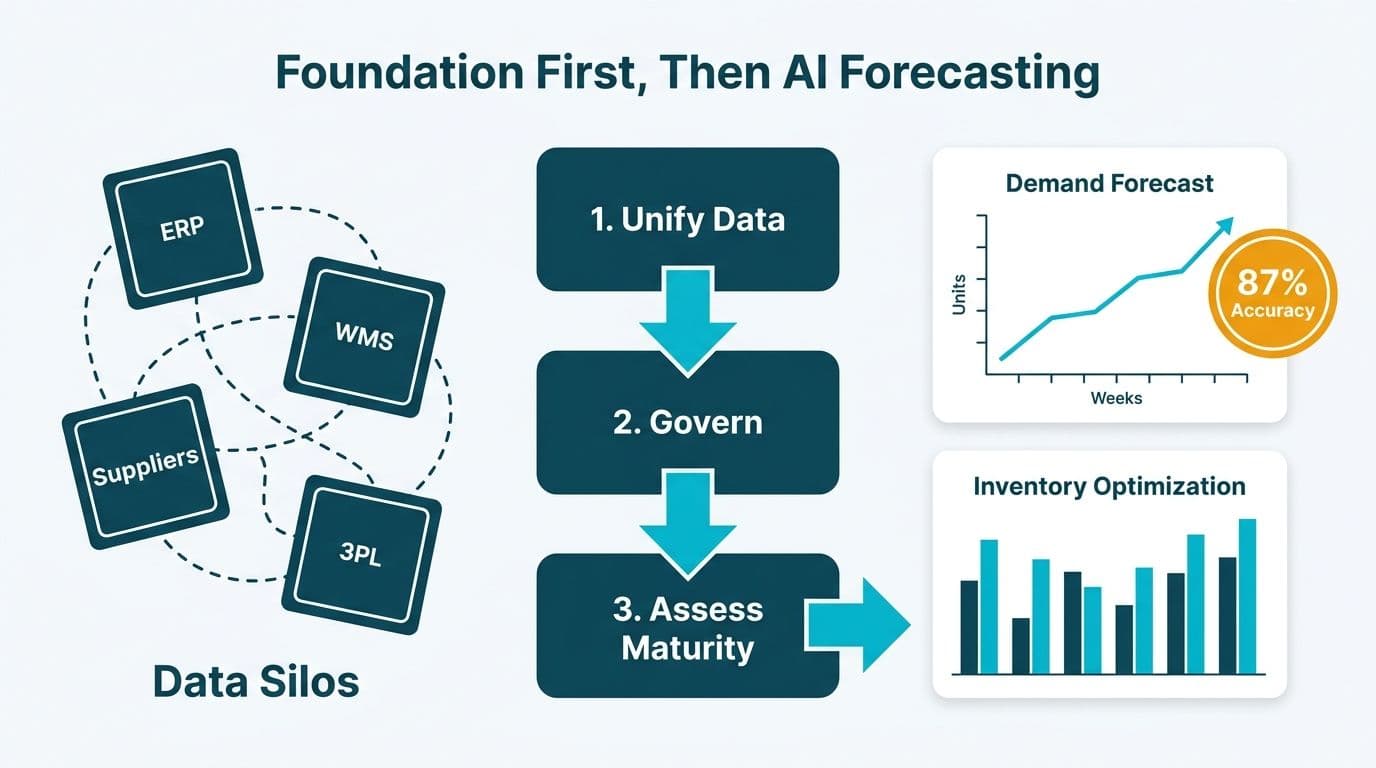
Building an AI data strategy for supply chain starts with getting your data house in order before deploying any model. Mid-market operations leaders in the US, UK, and Canada need three things in place: a unified data foundation, a governance framework that meets regional compliance requirements, and a realistic assessment of in-house AI maturity. Without these prerequisites, demand forecasting and inventory optimization initiatives routinely stall or produce unreliable outputs.
Key Takeaways
Data quality is the prerequisite, not the afterthought - AI forecasting models degrade rapidly when fed inconsistent or siloed supply chain data.
An AI data governance framework must reflect your regulatory environment: HIPAA and SOC 2 in the US, GDPR in the UK and EU, PIPEDA in Canada.
An AI data maturity assessment determines whether you should build internal capability, buy a packaged solution, or partner with a specialized firm.
Mid-market organizations typically see faster ROI from a boutique AI consulting engagement than from a large consultancy because scope stays controlled from the start.
Demand forecasting AI requires at least 18-24 months of clean, granular historical data before model training begins.
What Is an AI Data Strategy for Supply Chain?
An AI data strategy for supply chain is a structured plan that defines how an organization collects, governs, and applies data to power AI-driven decisions across procurement, demand sensing, inventory positioning, and last-mile logistics. It is not a technology roadmap or a model selection exercise - it is a business architecture decision that precedes every technology choice.
For mid-market firms, the practical strategy covers four layers: raw data collection and integration, data quality and lineage standards, governance and compliance controls, and the model or platform layer where AI runs. Most supply chain AI failures happen in the first two layers, not the last. Selecting the right machine learning platform is rarely the bottleneck - clean, connected data almost always is.
This trajectory reflects accelerating demand for structured AI strategy - not just model deployment. Industry analysis from 2026 shows that over 60% of mid-market supply chain organizations have initiated an AI data project, yet fewer than one in five report consistent, measurable ROI - a gap that traces directly to skipping the foundational data work. Mid-market leaders who build a durable data foundation now position themselves well ahead of peers who wait for the technology to fully mature before acting.
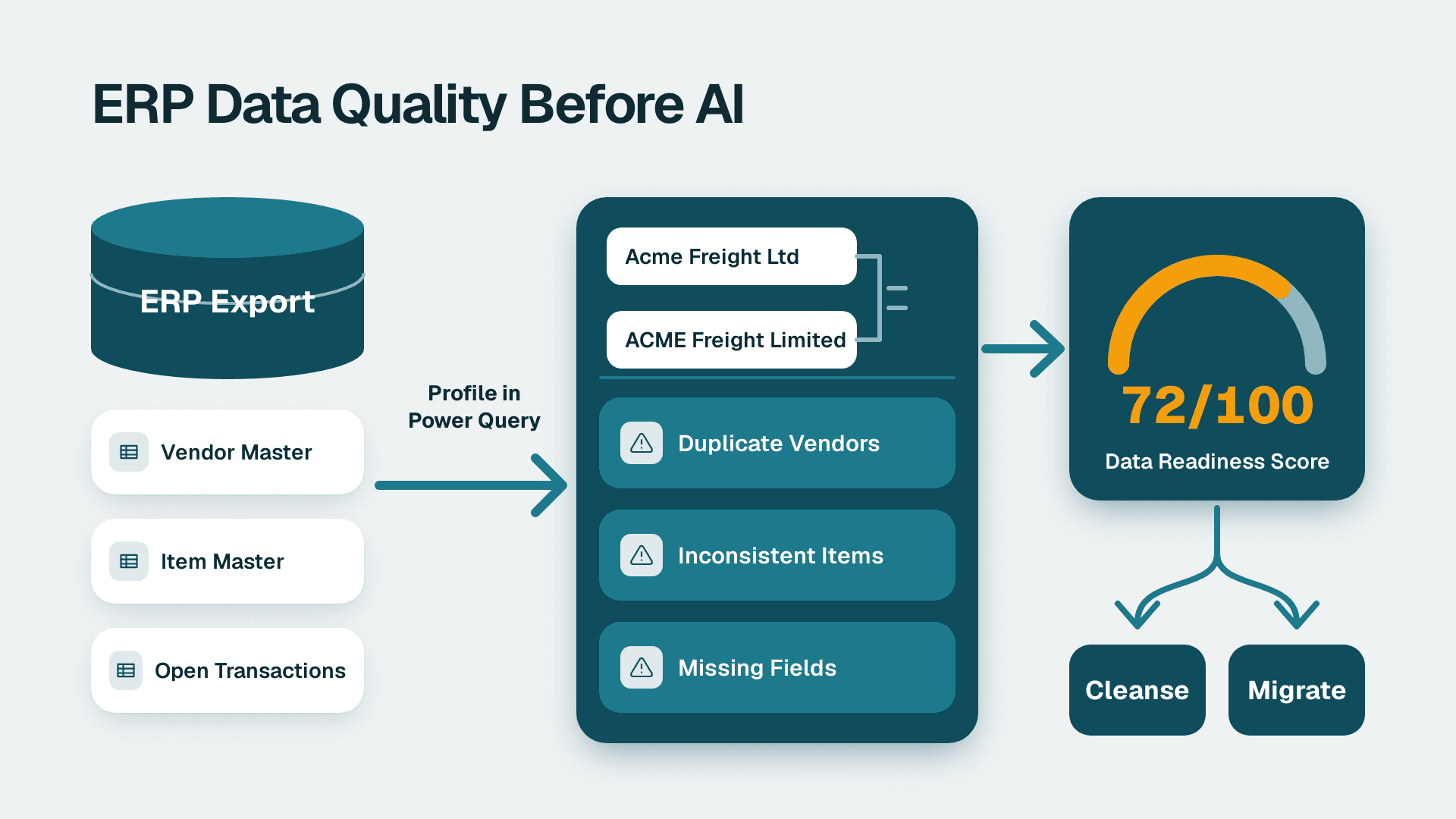
The first practical step is mapping every data source that touches your supply chain: ERP transactions, supplier portals, third-party demand signals, warehouse management systems, and customer order history. Many organizations discover during this mapping exercise that the same SKU is tracked under different codes across systems - a problem no AI model can solve downstream, regardless of how sophisticated the algorithm is.
Partnering with specialists in AI automation consulting at the strategy phase - before a single model is deployed - sharply reduces the cost of course correction and compresses time to measurable value.
What Are the Data Quality Prerequisites for AI Supply Chain Models?
AI supply chain models are only as accurate as the data they train on. The three non-negotiable prerequisites are completeness (no systemic gaps in transaction history), consistency (unified definitions across all source systems), and timeliness (data refreshed at a cadence that matches the operational decision frequency).
A US healthcare distributor building a demand forecasting model for medical consumables faces a different completeness challenge than a Canadian manufacturing company forecasting industrial components. The healthcare distributor must account for seasonal demand spikes driven by outbreak events and policy changes, while the manufacturer must handle commodity price volatility and supplier lead-time variance. Both problems require the same foundational discipline: at minimum 18-24 months of clean, product-level historical transaction data before model training begins.
Common data quality failure points in mid-market supply chains:
ERP and WMS systems using different product codes for the same item
Manual purchase order entry creating inconsistent supplier names and address formats
Returns and adjustments recorded in period-close batches rather than in real time
Third-party 3PL data arriving in inconsistent file formats with 48-72 hour lag
Promotional and event-driven spikes stored without context flags, which distort baseline demand models
Resolving these issues is rarely glamorous work, but it is the single highest-leverage investment a mid-market firm can make before any AI project begins. The AI workflow automation mistakes pre-launch checklist covers the most common data readiness failures that stall automation projects before they gain traction.
In the UK and across the EU, GDPR imposes additional constraints: supply chain data that includes personal information - delivery addresses, individual customer order histories - must be processed under a clear lawful basis and retained only as long as strictly necessary. This means data quality programs for UK and EU organizations must include a data minimization audit before feeding records into AI training pipelines, adding a compliance gate that US and Canadian teams do not always anticipate.
How Do You Build an AI Data Governance Framework for Supply Chain?
An AI data governance framework is the set of policies, ownership structures, and technical controls that determine who can access supply chain data, how it is classified, how long it is retained, and how AI model outputs are audited for accuracy and drift. Without it, even high-quality data becomes a compliance liability and a decision-quality risk.
The framework must answer five questions before any AI project goes live:
1. Who owns each data domain - procurement, inventory, logistics?
2. What is the data classification standard, including sensitivity tiers and PII flags?
3. What access controls govern AI model training environments and output logs?
4. How are model predictions reviewed for accuracy drift over time?
5. What is the escalation process when a model recommendation conflicts with human judgment?
Geographic compliance requirements shape these answers significantly:
US organizations handling healthcare supply chain data must align with HIPAA's minimum necessary standard and should pursue SOC 2 Type II certification for any cloud-based AI platform processing protected health information or sensitive commercial data.
UK and EU organizations must conduct a Data Protection Impact Assessment (DPIA) before deploying AI that processes personal data in supply chain workflows, per GDPR Article 35. This applies even when the personal data is incidental - such as named contacts in supplier records.
Canadian organizations fall under PIPEDA and, increasingly, provincial laws - Quebec's Law 25 in particular - which require organizations to publish privacy policies describing any automated decision-making system used in supply chain operations.
Industry analysis consistently shows that governance frameworks housed entirely within IT, without named business data stewards per domain, fail to stay current as processes evolve. Appointing a business-side data owner for procurement, inventory, and logistics domains is a structural requirement, not an optional best practice. The business steward understands when a definition change in one system should cascade across the data pipeline - IT alone rarely does.
What Does an AI Data Maturity Assessment Reveal?
An AI data maturity assessment benchmarks your current data capabilities against what is required to run and sustain AI-powered supply chain operations. It produces a gap analysis - not a composite score - and that gap analysis directly informs both your build vs buy decision and your realistic project timeline.
A practical assessment covers five dimensions:
| Dimension | Lagging | Developing | Leading |
|---|---|---|---|
| Data integration | Siloed, manual exports | Partial ETL pipelines | Unified data lakehouse |
| Data quality | No systematic monitoring | Spot checks post-incident | Automated DQ rules at ingestion |
| Governance | Informal, IT-owned | Documented but unenforced | Business-owned with audit trail |
| AI/ML capability | No internal skills | 1-2 data scientists | MLOps team with model registry |
| Compliance controls | Ad-hoc | Partially documented | Continuously tested and certified |
Most mid-market supply chain organizations land in the "Developing" column across all five dimensions. That is actually an ideal starting position: enough infrastructure to build on, enough identifiable gaps to justify a focused, phased approach rather than a wholesale transformation.
A UK fintech firm that recently extended AI capabilities into trade finance and supply chain financing found its governance dimension already at "Leading" - financial services regulation had forced rigorous data controls for years - while its AI/ML capability was firmly "Lagging." That asymmetry pointed clearly toward a buy decision: acquire a pre-built demand intelligence platform and integrate it into the existing governed data environment, rather than attempt to build a custom forecasting model with no internal ML team.
For organizations already running Microsoft Fabric or considering a data lakehouse approach, the medallion architecture in Microsoft Fabric guide maps cleanly to these five maturity dimensions - the Bronze layer addresses data integration, Silver addresses data quality and consistency, and Gold delivers the governed, AI-ready data surface where models can run reliably.
Build vs Buy AI Data Capability: How to Decide
The build vs buy AI data capability decision is among the most consequential choices a mid-market supply chain leader makes. It determines budget, timeline, risk profile, and how quickly the organization can adapt as AI technology evolves.
The build path makes sense when your supply chain has genuinely proprietary demand signals - patterns a packaged solution cannot model - and when you have, or can realistically hire, the internal ML talent to sustain and retrain the capability over time. A Canadian manufacturing company with a complex multi-tier supplier network and long-term contract customers providing proprietary demand signals might reasonably invest in a custom forecasting model that reflects those unique inputs.
The buy path - acquiring a SaaS demand planning platform or pre-built inventory optimization module - is right when your forecasting patterns are relatively standard, time-to-value matters more than model flexibility, and internal AI skills are thin. Most mid-market firms significantly overestimate how unique their supply chain patterns are and substantially underestimate the ongoing effort a custom model requires to maintain forecast accuracy as demand conditions shift.
A hybrid path - buy the platform for core demand forecasting, build custom integrations for proprietary data sources - is increasingly common and often the most pragmatic choice for organizations in the 100-1,000 employee range. This approach captures the speed and certification advantages of an enterprise platform while preserving flexibility at the integration layer.
Key decision factors:
Proprietary data advantage: If yes, build favors you. If no, buy wins on speed and cost.
Internal AI talent depth: If you have a functioning ML team, build is viable. If not, a 12-month hiring cycle delays ROI well past the buy alternative.
Regulatory complexity: Complex compliance environments - US healthcare, Canadian financial services - often favor buy, because enterprise SaaS vendors hold certifications you would otherwise need to earn and maintain independently.
ERP customization depth: Heavily customized ERPs often require bespoke integrations regardless of the platform decision, partially narrowing the build vs buy cost gap and making hybrid the default.
The open-source AI workflow automation tools build vs buy guide covers evaluation criteria in detail, including total cost of ownership across a five-year horizon for each path.
Boutique AI Consulting Firm vs Large Consultancy: Which Delivers Better Supply Chain ROI?
The choice between a boutique AI consulting firm and a large consultancy matters acutely for mid-market organizations because large consulting service models are architecturally designed for enterprise budgets and multi-year transformation programs.
Large consultancies bring broad industry benchmarks, established methodologies, and deep delivery benches. They suit multi-year digital transformations where organizational change management is as important as technology selection. The tradeoff is that mid-market clients frequently receive junior team members, generic frameworks adapted from enterprise playbooks, and engagement structures that favor scope expansion over scope control.
Boutique AI consulting firms - typically 10 to 50 person practices with deep domain specialization - operate differently. Engagement scope is tighter, senior practitioners execute the work directly, and a mid-market project in the USD 50,000-200,000 range is a primary client relationship rather than a rounding error in a large portfolio.
A mid-sized US hospital supply chain team evaluating demand forecasting for medical consumables would likely achieve better results faster from a specialized boutique firm with healthcare supply chain experience than from a large consultancy deploying a generalist AI team that rotates off the account after the first phase.
The practical test: ask any consulting firm to name three supply chain AI deployments completed in 2025 or 2026 at organizations of comparable size, then request a reference call with each client. The quality of that answer reliably differentiates firms regardless of brand recognition or headcount.
How Do AI Demand Forecasting and Inventory Optimization Actually Work?
AI demand forecasting models ingest historical sales or order data, enrich it with external signals - weather patterns, economic indicators, market pricing trends - and produce probabilistic predictions of future demand at the SKU-location-time level. Inventory optimization models then translate those forecasts into recommended reorder points, safety stock levels, and replenishment schedules that minimize carrying cost without creating stockouts.
The precision gap between a traditional statistical forecast (typically 25-35% mean absolute percentage error) and a well-trained AI model (typically 12-18% MAPE for mid-market use cases, as of 2026) translates directly into working capital efficiency. A mid-market distributor carrying USD 20 million in inventory who reduces forecast error by 10 percentage points may recapture USD 1-2 million in cash currently locked in excess stock - a return that typically dwarfs the cost of the AI implementation itself.
Three implementation realities that rarely appear in vendor demos:
1. Cold-start problem: New product lines, new markets, and post-disruption periods have insufficient history for AI models to train reliably. Human override protocols must be built into the forecasting workflow from day one, not retrofitted after planners start ignoring model outputs.
2. Data freshness cadence: A model trained on weekly data cannot produce reliable daily replenishment recommendations. The data refresh cadence must match the operational decision cadence, which often requires infrastructure investment before model deployment.
3. Explainability requirement: Supply chain planners need to understand why a model recommends a 30% increase in safety stock - not just accept the output. Explainable AI outputs drive planner adoption; black-box recommendations get overridden consistently and eventually ignored entirely.
Healthcare supply chains carry an additional layer of complexity: demand forecasting for medical supplies must account for regulatory stockpile requirements, formulary changes, and reimbursement policy shifts that a standard demand signal cannot capture.
For operations teams already using Power BI or similar analytics platforms to visualize supply chain performance, the logistics KPI dashboard in Power BI guide provides a practical starting point for the reporting layer that sits above AI demand planning outputs and surfaces forecast accuracy, fill rates, and inventory turn to leadership.
---
About Lets Viz: Lets Viz is a data analytics and AI consulting practice that has partnered with US healthcare organizations, UK fintech firms, Canadian manufacturing companies, and global SaaS businesses since 2020. Our team combines deep supply chain domain expertise with hands-on AI implementation experience across regulated industries, and we hold a 5.0 rating on Clutch based on verified client reviews. Every AI data strategy engagement is led by senior practitioners with direct accountability for measurable outcomes.
If your organization is ready to build an AI data strategy that delivers measurable supply chain results, explore our AI automation consulting services - designed for mid-market operations and supply chain teams across the US, UK, and Canada.