AI Analytics Consulting for Small Businesses: Budget Guide
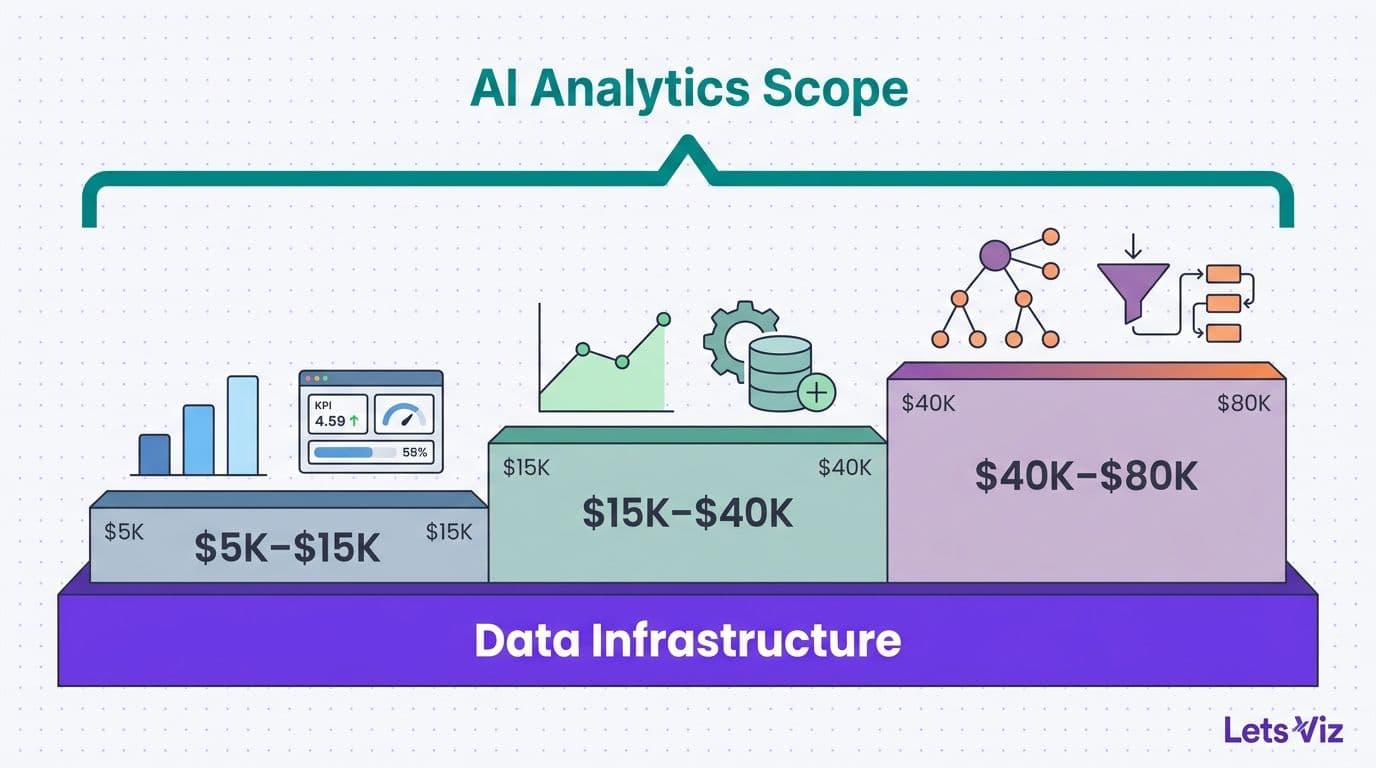
AI analytics consulting for small businesses typically costs between $5,000 and $80,000 for a first engagement, depending on scope and data readiness. At the lower end, you get reporting automation and a working dashboard; at the higher end, predictive modeling and workflow integration. Most SMBs overspend on AI capability and underspend on data infrastructure - the foundation that determines whether any investment pays off.
Key Takeaways
First AI analytics engagements for SMBs realistically cost $5,000-$80,000, with data maturity and scope determining where you land.
Financial services and healthcare firms should prioritize reporting automation before investing in predictive or generative AI models.
Budget tier determines outcome: under $20K buys process efficiency; $20K-$50K adds decision-support dashboards; $50K+ enables predictive analytics.
The biggest budget waste in first engagements is purchasing AI capability before your underlying data is clean and centralized.
Completing an AI reporting readiness checklist for finance teams before any vendor conversation prevents misaligned scope and wasted spend.
What Does AI Analytics Consulting for Small Businesses Actually Cost?
The cost of AI analytics consulting for small businesses varies by scope, industry, and the maturity of your existing data infrastructure. A focused engagement - automating a single reporting workflow - starts at $5,000 to $15,000. A more complete first engagement covering data integration, dashboard build, and AI-assisted report generation runs $25,000 to $50,000. Enterprise-grade predictive analytics programs with ongoing managed services can reach $80,000 or more annually.
According to Future Market Insights, the AI consulting services market is estimated at approximately $14 billion in 2026 — up from $11.07 billion in 2025 — and is forecast to reach $90.99 billion by 2035 at a 26.2% CAGR. That growth trajectory reflects accelerating demand - which is also driving up consultant rates and compressing availability for smaller, fixed-scope engagements.
The cost drivers worth understanding before you speak to a vendor:
Data readiness: If your data lives in spreadsheets or disconnected systems, expect 30-50% of your engagement budget to go toward data preparation before any AI work begins. This is not optional overhead - it is the foundation every subsequent layer depends on.
Integration complexity: Connecting AI tools to existing EHR systems in healthcare or core banking platforms in financial services requires certified integration work that carries a meaningful cost premium.
Ongoing versus one-time: Most vendors structure a project fee for the initial build plus a monthly retainer for maintenance and iteration. Many SMBs underestimate the total annual cost once retainers are included in the calculation.
Vendor tier: Independent consultants typically charge $150-$250 per hour. Boutique analytics firms charge $250-$450 per hour. Large consulting firms charge $400-$800 per hour for comparable deliverables. Through 2026, sustained demand has pushed boutique and enterprise rates 15-20% above 2024 levels — with senior AI analytics capacity increasingly committed to enterprise retainers, compressing availability for smaller engagements — making fixed-scope project pricing preferable to open-ended hourly arrangements for SMBs with well-defined deliverables.
One structural reality specific to regulated industries: both financial services and healthcare carry compliance-related data requirements that increase the cost of every AI engagement. In healthcare, HIPAA-compliant data handling adds security and audit requirements to every pipeline. In financial services, data lineage and auditability requirements mean AI outputs need to be traceable back to source data. Budget for compliance overhead - typically 15-25% of total engagement cost in these industries - before you finalize scope with any vendor.
For SMBs evaluating how these costs compare to building internal capability, the AI analytics strategy guide for mid-market companies provides a structured framework for the build-versus-buy decision.
What Can You Realistically Achieve at Each Budget Tier?
Budget determines outcome. The following table shows realistic deliverables - and clear limitations - at each investment level for SMBs in financial services and healthcare.
| Budget Tier | Realistic Deliverables | What Is Out of Scope | Typical Timeline |
|---|---|---|---|
| $5K-$15K | Automated report generation, single dashboard, data audit | Predictive models, system integrations, custom AI | 4-8 weeks |
| $15K-$35K | 2-3 connected dashboards, anomaly detection, AI-assisted reporting | Real-time pipelines, ML model development | 8-14 weeks |
| $35K-$60K | Integrated data platform, predictive analytics (1-2 use cases), workflow automation | Enterprise AI, large model fine-tuning | 3-6 months |
| $60K-$100K+ | Multi-source integration, custom models, ongoing managed analytics | Full internal autonomy without ongoing support | 6-12 months |
At the $5K-$15K tier, the realistic goal is reporting automation - replacing manual monthly reports with scheduled, AI-assisted outputs that require minimal human preparation. A representative outcome at this tier: a single automated report pipeline replaces 8-15 hours of monthly analyst preparation time, a return that typically covers the engagement cost within two to three report cycles. For a financial services SMB, this might mean automated P&L summaries delivered every Monday morning. For a healthcare practice, it might mean automated payer analytics dashboards that surface reimbursement variance without analyst intervention.
The specific deliverables vary meaningfully by industry. In financial services, the $15K-$35K tier typically produces automated financial close reports, revenue dashboards, and exception-based alerts on budget variances. In healthcare, the same budget range typically covers automated payer mix dashboards, denial rate tracking by payer, and revenue cycle efficiency reporting segmented by service line.
At the $35K-$60K tier, SMBs can add decision-support intelligence: dashboards that flag anomalies, forecast short-term cash positions, or identify patient cohorts at revenue cycle risk. Connecting AI-assisted commentary to this layer - learning how to automate monthly financial reporting in Power BI before advancing to predictive overlays - becomes the practical foundation for scaling further.
Both industries benefit from the same discipline at any tier: define the decision you want to make faster or better, then build the minimum data infrastructure required to support that decision. Sophistication follows usefulness - it does not precede it. The $60K+ tier, where custom models and continuous improvement programs live, is a destination most SMBs should build toward, not start at.
What Should SMBs Avoid Spending On Too Early?
The highest-risk line items in an early AI analytics engagement are the ones that sound compelling in a vendor demo but deliver little without a mature data foundation beneath them.
Large language model fine-tuning. Fine-tuning a model on proprietary data is genuinely powerful - and genuinely premature if your data is inconsistent, incomplete, or not centralized. Most SMBs that invest in fine-tuning during a first engagement see minimal return because training data quality is too low to produce reliable outputs. The model learns your inconsistencies at scale. A useful benchmark: if more than 25% of records in your primary dataset fail a basic completeness check — missing required fields, inconsistent category definitions, or duplicate entries — a well-prompted general-purpose model will consistently outperform a fine-tuned version at roughly one-tenth the project cost.
Real-time AI dashboards. Real-time data pipelines require significant infrastructure investment and ongoing operational support. For most SMBs in financial services and healthcare, near-real-time refresh - hourly or daily - delivers 90% of the decision-making value at roughly 20% of the infrastructure cost. Paying for true real-time adds operational complexity without proportional benefit at the SMB scale.
Fully automated report writing without human review. AI-generated narrative reporting - where AI writes the interpretation, not just the numbers - carries regulatory and reputational risk in both financial services and healthcare. Use AI to draft variance commentary; require a qualified human reviewer before any output is distributed. In healthcare, financial narratives can carry reimbursement and compliance implications that no current AI system is accountable for.
Vendor-locked proprietary platforms. Several AI analytics vendors offer compelling demonstrations built on platforms that are difficult and expensive to exit. Prioritize solutions built on open standards or widely adopted platforms that your internal team can learn, maintain, and extend over time without depending on the original vendor.
Predictive models before descriptive clarity. If your leadership team cannot agree on what last quarter's numbers actually mean, a predictive model will not resolve that disagreement - it will amplify it with greater speed and confidence. Invest first in getting historical data accurate, consistent, and accessible across the organization. An AI analytics readiness resource for healthcare finance teams can help you identify precisely where the gaps are before you commit budget to a vendor scope of work.
How Do You Know If Your SMB Is Ready for AI Analytics?
Readiness - not budget - is the primary determinant of first-engagement success. An SMB with $30,000 and clean, centralized data will consistently outperform one with $100,000 and fragmented spreadsheets across five disconnected systems.
A practical readiness framework has three dimensions:
Data foundation
At least 12-24 months of historical data in a consistent, queryable format
Data stored in fewer than four distinct systems
A named internal owner responsible for data quality, access, and governance
Decision process
You can name the top three decisions your leadership team makes monthly
Those decisions currently require more than two days of analyst time to prepare supporting data
An executive sponsor exists who will act on AI-generated insights within defined timeframes and owns the outcome
Technical capacity
At least one person internally can interpret dashboard outputs and ask meaningful follow-up questions
IT support is available for integration work, or budget exists to outsource it
You have a documented data governance policy, or are prepared to create one as part of the engagement
Answering "no" to more than two questions in any category signals that preparation - not AI deployment - should be the immediate priority. A free BI readiness assessment can benchmark your current state against these criteria before you invest time in vendor conversations.
According to Market Research Future (as of 2026), the Healthcare Financial Analytics Market is projected to grow at an 8.58% CAGR through 2035, driven by regulatory evolution and the shift toward value-based care reimbursement models. The organizations capturing that growth are those that built their data infrastructure before layering AI capability on top - not those that began with the AI layer and worked backward toward data quality.
How to Automate Report Generation with AI: Where to Begin
For SMBs learning how to automate report generation with AI, the highest-value and lowest-risk starting point is scheduled report automation - replacing the manual process of pulling, formatting, and distributing monthly reports with a reliable pipeline that operates consistently without analyst intervention each cycle.
In financial services, this typically involves:
Connecting your accounting software or general ledger to a BI platform with a maintained data model
Building reusable templates for P&L, cash flow, and budget-versus-actuals views with consistent definitions
Scheduling AI-written variance commentary - with a human reviewer in the loop before send - on key movements above defined thresholds
In healthcare, this typically involves:
Aggregating payer contract data into a unified claims performance dashboard with standardized procedure and payer mapping
Automating reimbursement rate variance reports segmented by payer, procedure category, and facility
Scheduling AI-assisted summaries of patient volume trends and revenue cycle KPIs for the weekly operations review
Learning how to automate report writing with AI at this level does not require a large or open-ended first engagement. A focused four-to-eight-week project with tightly defined scope - one report type, one primary data source, one distribution workflow - typically delivers faster ROI than an AI transformation program and teaches your organization how to work with AI-generated outputs before the stakes are higher.
MedInsight identified AI-driven analytics and payer analytics innovation as two of three defining healthcare IT themes in 2026, alongside value-based care. Both are accessible to healthcare SMBs at the reporting automation tier - no advanced modeling required for a meaningful, measurable first implementation.
For financial services SMBs navigating the transition to AI-assisted reporting, the AI consulting guide for financial advisors outlines how to sequence reporting automation before moving to client-facing or regulatory AI applications.
What Does a Strong First AI Analytics Engagement Look Like?
A well-scoped first engagement has four characteristics that hold across budget tiers and industries.
Defined success metrics before kick-off. Agree in writing - before any work begins - on what success looks like. Typically: analyst hours saved per month, report cycle time reduction from days to hours, or a specific decision that the new data infrastructure enables within a measurable timeframe. A concrete example: a healthcare revenue cycle team targeting a 60% reduction in monthly payer analytics preparation time sets a clearer accountability bar — and a more defensible ROI calculation at close — than one targeting "improved reporting efficiency." Without pre-agreed metrics, engagements drift and measurement becomes disputed at the close.
Phased delivery with a 90-day gate. A 90-day first phase with one defined deliverable - one working dashboard, one automated report pipeline - is more valuable than a six-month platform build. You validate capability early, the vendor is accountable to a concrete deadline, and your team has something useful in production while the broader program continues. In practice, an automated report pipeline that replaces 12-18 hours of monthly manual preparation typically returns its Phase 1 cost within three to four reporting cycles — before the broader program advances to Phase 2.
Knowledge transfer built into the scope. The engagement should conclude with your team understanding what was built, why specific design choices were made, and how to maintain and extend the system without vendor dependency. If a proposal does not include training and documentation time as a line item, negotiate it in or evaluate alternative vendors.
Data and asset ownership from day one. All data, models, dashboard assets, and documentation should be contractually owned by your organization. In healthcare, this is also a HIPAA compliance requirement governing where data lives and who can access it. In financial services, data lineage ownership is increasingly an audit expectation that regulators are examining more closely.
For SMBs considering how a first AI analytics engagement fits into a longer managed analytics relationship, the AI analytics strategy guide for mid-market companies outlines how to structure the transition from project to program without overextending your vendor dependency.
Ready to scope your first AI analytics engagement with a team that has delivered this for financial services and healthcare SMBs since 2020? Custom AI automation and consulting from Lets Viz gives you a structured, transparent path from data foundation to working AI - sized for the budgets and timelines that SMBs can actually sustain.
---
About Lets Viz: Lets Viz has delivered data analytics and AI consulting solutions across financial services, healthcare, and technology since 2020, helping organizations at every stage of the analytics journey build infrastructure that drives measurable decisions. The team combines certified BI expertise with industry-specific domain knowledge in regulatory reporting, revenue cycle management, and financial performance analytics. Lets Viz is recognized for its practical, implementation-focused approach - advisory that moves from strategy to a working system within weeks, not quarters, with clear ROI accountability built into every engagement.