Tableau Funtion: WINDOW_STDEVP()
 Reviewed by Neetu Singla — Founder, Lets Viz Technologies — AI & Data Consultant. Last reviewed July 3, 2026.
Tableau Function: WINDOW_STDEVP( )
Category: Table Calculation Functions
What Is the Function?
WINDOW_STDEVP() is a table calculation function in Tableau that computes the population standard deviation of an expression within a defined window (partition) of data in a visualization.
Purpose
It measures how much the values in a dataset deviate from the mean when the data represents the entire population, not a sample.
Type of Calculation
Table Calculation
Statistical dispersion calculation
Operates on aggregated measures (e.g.,
SUM(Sales))Computed after query results are returned to Tableau
Practical Use Cases
Measuring total business volatility when analyzing full datasets
KPI stability monitoring across complete populations
Financial volatility calculations
Operational performance consistency analysis
Comparing variability across regions or departments
Building statistical dashboards for executive reporting
WINDOW_STDEVP(expression, [start, end])
| Parameter | Type | Description |
|---|---|---|
expression | Column (Aggregated Measure) | The numeric measure to calculate population standard deviation for (e.g., SUM(Sales)) |
start | Scalar (Integer, Optional) | Offset from the current row defining the start of the window |
end | Scalar (Integer, Optional) | Offset from the current row defining the end of the window |
How It Works?
Mathematical Principle
Population standard deviation formula:
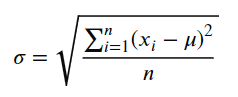
Where:
xi = individual values
μ = population mean
n = total number of observations
Tableau’s Process:
Computes aggregated values in the window
Calculates the mean
Computes squared deviations from the mean
Divides by n
Takes the square root
Return Value
Data Type: Numeric (Float)
Meaning: Returns the population standard deviation of the values within the defined window.
Unlike WINDOW_STDEV(), this function divides by n (total count), not n − 1.
When Should We Use It?
Use WINDOW_STDEVP() when:
Analyzing complete populations (not samples)
Measuring overall company performance variability
Calculating total volatility in time series data
Creating statistical control dashboards
Building population-level KPIs
Performing financial risk analysis
Basic Usage
Population standard deviation across the entire partition:
WINDOW_STDEVP(SUM(Sales))
Column Usage
Calculate monthly population standard deviation of sales within each Region:
WINDOW_STDEVP(SUM(Sales))
Set:
Partition by → Region
Compute Using → Month
Advanced Usage
Rolling 6-Month Population Standard Deviation
WINDOW_STDEVP(SUM(Sales), -5, 0)
Calculates population standard deviation for:
Current month
Previous 5 months
Building Control Limits (Population-Based)
Upper Limit:
WINDOW_AVG(SUM(Sales)) + 3 * WINDOW_STDEVP(SUM(Sales))
Lower Limit:
WINDOW_AVG(SUM(Sales)) - 3 * WINDOW_STDEVP(SUM(Sales))
Tips and Tricks
- Use when analyzing complete datasets
- Combine with
WINDOW_AVG()for statistical banding - Always verify Compute Using configuration
- Sort data properly for time-based analysis
Common Pitfalls:
Confusing it with
WINDOW_STDEV()Incorrect partitioning leads to misleading results
Table calculations run after aggregation
Large partitions can affect dashboard performance
Related Functions
WINDOW_STDEV()(Sample standard deviation)STDEVP()(Aggregate function)WINDOW_VARP()WINDOW_AVG()WINDOW_SUM()RUNNING_AVG()
We’ve got plenty of resources to help you master Tableau functions. For more details, check out the official Tableau documentation. Or, if you’re ready for more practice, let’s dive into related functions and build your Tableau skills further!
If you’re ready to harness the full power of Tableau and elevate your data analytics capabilities, our expert Tableau consulting services are here to guide you. Whether you need support with building advanced calculated fields, creating dynamic visual dashboards, or optimizing your data sources for peak performance, our team of experienced Tableau consultants delivers customized solutions designed for your business needs. Visit our Tableau Consulting page to discover how we can help your organization turn data into impactful, insight-driven decisions.
WINDOW_STDEV() calculates sample standard deviation (divides by n-1), while WINDOW_STDEVP() calculates population standard deviation (divides by n).
Use it when analyzing complete populations rather than samples.
Yes, using the start and end offsets:
WINDOW_STDEVP(SUM(Sales), -5, 0)Yes. The function calculates population standard deviation within each partition defined in the view.
No. It is a table calculation computed within Tableau after the query returns.
Working with Tableau — or thinking about Power BI?
We work both sides. Tableau-certified for production work and complex calcs, and we've shipped 12+ Tableau-to-Power BI migrations with 100% parity testing and 30–60% license savings.
Tableau-certified12+ migrations100% parity