Claude Code on the Web: Anthropic’s Secure AI Sandbox Revolution
TL;DR
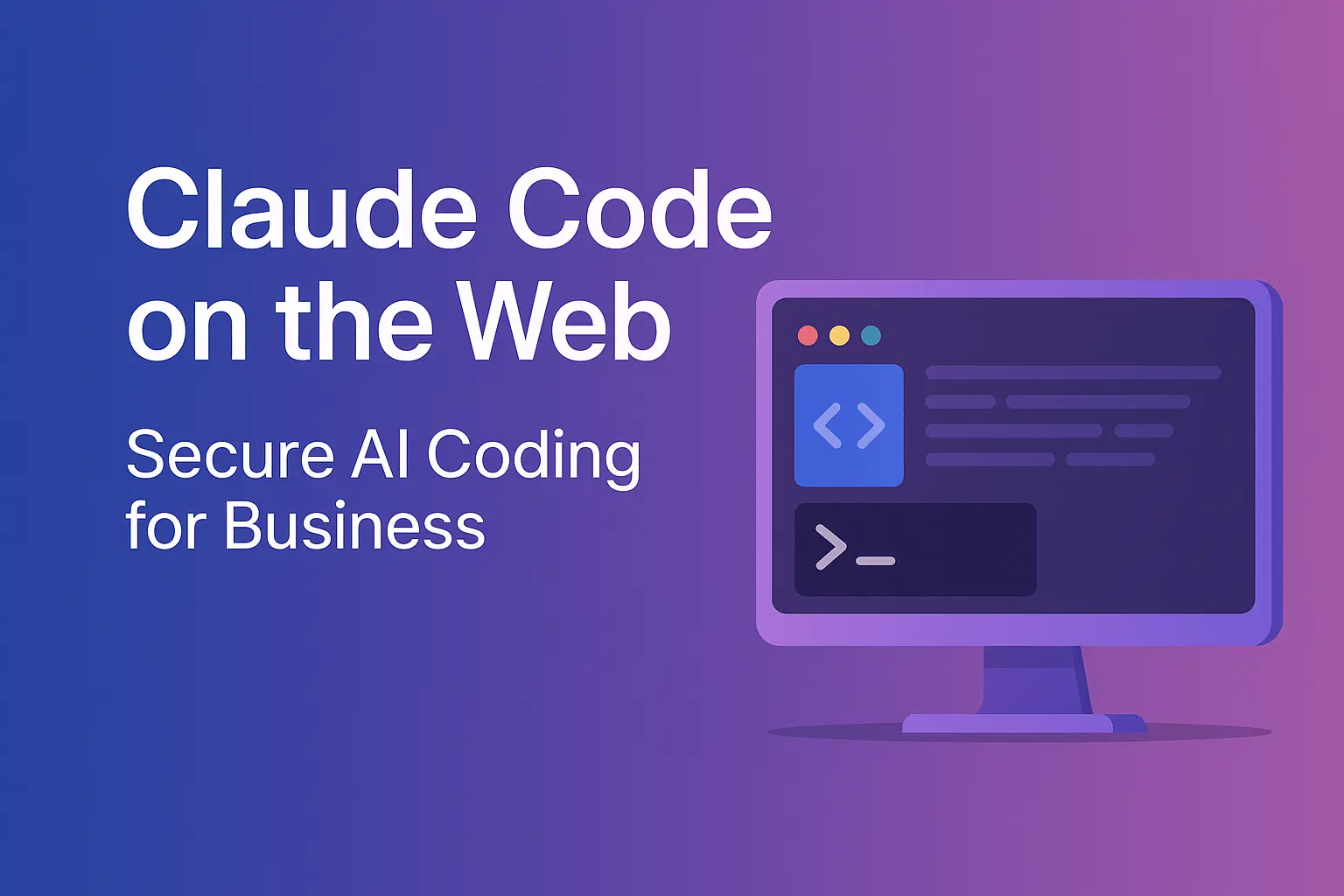
Claude Code on the Web introduces a secure, sandboxed environment for AI coding — letting developers and automation teams run tasks directly in their browser without endless permission prompts. The breakthrough? Anthropic’s sandboxing model reduces approval fatigue by 84% and makes AI coding assistants far safer for business adoption. It’s not just a technical upgrade — it’s a new standard for secure, autonomous AI in enterprise workflows.
What is Claude Code and Why It Matters for Businesses
Anthropic’s Claude Code is a web-based AI coding assistant designed to help developers, automation engineers, and consultants build, edit, and test code directly in the browser. Unlike typical AI coding tools that require constant user approvals for every file change or command execution, Claude Code introduces a sandboxing system — a secure environment where AI can operate autonomously within defined boundaries.
For mid-sized businesses and digital consultancies, this innovation goes beyond developer convenience. It’s a game-changer for scaling AI automation safely, enabling teams to:
- Delegate repetitive coding or data-handling tasks to AI with confidence.
- Reduce security risks associated with prompt injection or file exposure.
- Free up developer time to focus on strategic automation initiatives.
According to TechRadar, Claude Code’s new system makes AI coding tools more viable for enterprise-grade development — addressing one of the most common complaints among developers: approval fatigue.
How Does Anthropic’s Sandboxing Model Work?
At the heart of Claude Code is a fenced sandbox environment — think of it as a playground where AI can run freely but can’t step outside your predefined rules.
Key Components of the Sandbox:
- Filesystem Isolation
Claude Code can only access files within the specific project directory. Sensitive files like.bashrc, SSH keys, or OS-level configurations remain untouchable. - Network Isolation
The AI can connect only to approved domains. If malicious instructions try to redirect it to external servers, the connection is blocked at the OS level. - Real-Time Alerts
Users get notified if the AI tries to access anything beyond the sandbox boundaries. You can then allow it once or update your sandbox settings. - Cloud-Based Execution
Claude Code on the web runs each session in an isolated cloud container, ensuring credentials and sensitive files never leave your control.
This model is similar to enterprise-grade isolation frameworks used in cybersecurity. According to McKinsey’s 2024 report on secure AI adoption, defining trust boundaries upfront is one of the most effective ways to scale automation responsibly.
Why This Matters for Automation & AI Consulting Firms
For AI and automation consultants — including agencies like Lets Viz Technologies — Claude Code’s sandboxing model represents a safer and faster way to integrate autonomous coding into client operations.
Business Impact:
- 84% Reduction in Approval Prompts
Internal tests show that sandboxing reduces permission interruptions by up to 84%. Less clicking = more coding. - Higher Productivity & Focus
Developers can trust Claude to perform bulk edits, refactors, or tests inside safe boundaries — freeing them for higher-value problem-solving. - Improved Security Confidence
By isolating AI interactions, businesses can confidently allow Claude to assist with CI/CD automation, documentation updates, and code cleanup. - Scalable AI Integration
Firms can embed Claude Code in development workflows or connect it with automation tools like n8n and Make.com, safely scaling agentic coding assistants across projects.
🧭 Tip: See how AI automation workflows are evolving in our related guide: n8n vs Zapier vs Make — Which is Best for SME Automation?
How Claude Code Changes the AI Coding Workflow
Traditional coding assistants often force developers into a repetitive loop:
Approve → Run → Approve → Edit → Approve → Test → Approve again.
This constant friction leads to “approval fatigue,” a phenomenon where users blindly approve actions just to move forward — ironically making the system less secure.
Claude’s New Approach:
Instead of per-action approvals, Claude Code asks you to define your sandbox once. After that, it can:
- Write, edit, and test files within the sandbox freely.
- Create pull requests or commits automatically.
- Run build and test commands without constant human intervention.
Result:
More autonomy for AI, more oversight for humans.
Businesses gain productivity without compromising control.
Practical Applications for Mid-Sized Businesses
1. AI-Powered Code Maintenance
Use Claude Code to identify deprecated functions, missing tests, or inefficient queries — all within a controlled environment.
2. Automated Documentation Updates
Claude can safely edit README or API docs after code changes, keeping documentation accurate without risk of editing sensitive areas.
3. Workflow Automation Integrations
Link Claude Code with tools like n8n, Slack, or GitHub Actions to trigger reviews, deploy dashboards, or send change logs automatically. (Explore: Google Sheets to Slack n8n Integration Guide)
4. Client Reporting Dashboards
For consulting firms, Claude Code can generate and maintain BI dashboards faster — for instance, see Marketing Dashboard Examples for inspiration.
Framework: Evaluating Sandbox-Based AI Coding Tools
| Evaluation Area | Claude Code Approach | Business Benefit |
|---|---|---|
| Security | Isolated filesystem & network | Prevents data leaks & injections |
| Automation | AI autonomy inside safe scope | Reduces manual approvals |
| Auditability | Real-time alerts & logs | Traceable AI actions |
| Scalability | Cloud sandbox per session | Easier multi-project use |
| Governance | User-defined policies | Enforces enterprise compliance |
This framework helps decision-makers assess if Claude Code (or any similar AI tool) fits their operational and compliance needs.
Comparison: Claude Code vs Traditional AI Coding Tools
| Feature | Traditional Tools | Claude Code |
|---|---|---|
| File Access | Requires per-action approval | Sandbox-defined boundaries |
| Security | User-managed permissions | OS-level isolation |
| Usability | Interruptive workflow | Seamless, autonomous editing |
| Speed | Slower (manual steps) | Faster (84% fewer prompts) |
| Enterprise Fit | Limited (security risk) | Strong (auditable sandbox) |
The Strategic Advantage: AI that’s Safe and Scalable
Sandboxing transforms how enterprises perceive AI assistants — from experimental helpers to trusted co-developers.
In a 2025 Forbes Tech Council analysis, experts note that secure autonomy will be the defining feature of the next generation of AI tools. Anthropic’s open-sourced sandbox code could soon become a new industry baseline.
For mid-sized firms looking to modernize operations, Claude Code offers a pragmatic step toward AI-driven development governance — where automation doesn’t mean loss of control.
How to Adopt Claude Code in Your Business Safely
- Start with Non-Critical Projects
Begin by sandboxing AI on low-risk tasks like documentation cleanup, script generation, or analytics dashboard updates. - Define Sandbox Rules Clearly
Specify project directories, allowed domains, and test environments. The tighter the scope, the safer the automation. - Integrate Human Review
Use pull requests and version control to ensure AI changes are reviewed before deployment. - Audit Logs Regularly
Monitor Claude’s actions via real-time alerts and logs to spot potential policy violations early. - Upskill Your Teams
Train developers and analysts to write clear, scoped instructions for AI tools — this improves both accuracy and efficiency.
How Lets Viz Technologies Helps You Scale Secure AI Coding
At Lets Viz Technologies, we help organizations adopt AI securely and strategically — from sandboxed automation pilots to full-scale enterprise integrations.
Our consulting teams specialize in:
- AI-powered workflow automation (n8n, Make.com, Zapier)
- BI dashboard engineering for marketing, finance, and operations
- AI security and governance frameworks
We don’t just plug in AI — we make it safe, auditable, and ROI-driven.
Want to explore a sandboxed AI automation roadmap for your business? Contact us here.
Related Reading
Claude Code operates within a secure sandbox and can execute code tasks safely inside that boundary — something traditional assistants can’t do as securely.
No. It runs directly in your web browser with cloud-based sandboxing, meaning no local setup or file exposure.
Yes. It uses proxy authentication to manage Git operations securely, ensuring your credentials never leave your environment.
It isolates file and network access, reducing risks from prompt injection and unauthorized commands.
Absolutely. It’s ideal for building dashboards, automating tests, or performing secure code reviews at scale.
Pro and Max Anthropic users currently have access. Pricing may vary based on usage tiers.
No — it amplifies developer productivity and reduces repetitive work, but human oversight remains essential.