Dax Function: AVERAGE
 Reviewed by Neetu Singla — Founder, Lets Viz Technologies — AI & Data Consultant. Last reviewed June 5, 2026.
Category: Aggregation functions
The AVERAGE function in Power BI is an aggregate DAX function that calculates the arithmetic mean of a set of numeric values.
Purpose:
- To compute the average (mean) of a range or column of numbers.
- It is widely used in summarizing and analyzing numerical datasets.
Type of Calculations:
- The function performs aggregation by summing up all numeric values and dividing the sum by the count of numbers.
Practical Use Cases:
- Performance Analysis: Calculate the average sales, expenses, or revenue for a specific period.
- Customer Metrics: Compute average transaction values, customer ratings, or time taken for customer resolution.
- Trend Analysis: Determine averages to benchmark against targets or forecast future performance.
AVERAGE(<column>)</column>
| Parameter | Type | Description |
|---|---|---|
column | Column | A column of numeric values for which the average is calculated. Non-numeric or blank values are ignored. |
How Does AVERAGE Dax Function Works?
The AVERAGE function calculates the mean using the formula:
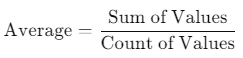
- Non-numeric or blank cells in the column are automatically excluded from the calculation.
- It performs aggregation at the row level if used in conjunction with other DAX functions in calculated measures.
For example:
- For a column with values
[10, 20, 30, 40], AVERAGE(column) returns25.
What Does It Return?
The AVERAGE function returns a numeric scalar value representing the arithmetic mean of the numbers in the specified column. If no rows contain numeric data, it returns a blank.
When Should We Use It?
- KPI Reporting: Use in dashboards to show average metrics like sales, costs, or operational times.
- Performance Benchmarks: Compare average performance against goals or historical data.
- Data Summarization: Provide an overview of datasets to simplify analysis.
- Weighted Averages: Combine with other functions for more complex calculations, such as weighted averages.
Examples
Basic Usage
Calculate the average of a single column:
AverageSales = AVERAGE(Sales[Amount])
Output:Returns the average sales value from the Sales[Amount] column.
Column Usage
Apply the function to calculate averages dynamically in a table or visual:
AvgRating = AVERAGE(CustomerFeedback[Rating])
Displays the average customer rating in the feedback table.
Advanced Usage
Combine with a filter function:
AvgFiltered = CALCULATE(AVERAGE(Sales[Amount]), Sales[Category] = "Electronics")
Result: Computes the average sales amount for the “Electronics” category only.
Tips and Tricks
- Ignore Non-Numeric Data: Ensure the column used contains numeric values; Power BI automatically excludes non-numeric rows, but explicit data validation improves performance.
- Handling Blanks: Use the IF or ISBLANK function to manage blank values if required for specific calculations.
- Avoid Nested Aggregates: Using AVERAGE with another aggregate function (e.g., SUM) inappropriately may lead to errors.
Performance Impact of AVERAGE DAX Function:
- Efficient for small to moderately sized datasets.
- For larger datasets, use AVERAGEX with filters to compute averages dynamically over subsets of data to optimize performance.
Related Functions You Might Need
- AVERAGEX: Performs an average over a table or expression.
- SUM: Calculates the sum of values in a column.
- COUNT: Counts the rows in a column.
- MAX/MIN: Determines the highest/lowest value in a column.
Want to Learn More?
For more information, check out the official Microsoft documentation for AVERAGE. You can also experiment with this function in your Power BI reports to explore its capabilities.
If you’re looking to unlock the full potential of Power BI and take your data insights to the next level, our expert Power BI consulting services are here to help. Whether you need assistance with implementing advanced DAX functions like the ones discussed here, creating interactive dashboards, or optimizing your data models for better performance, our team of seasoned Power BI consultants is ready to provide tailored solutions for your business. Visit our Power BI Consulting page to learn more about how we can empower your organization with data-driven decisions.
The AVERAGE function computes the mean of a single column, while AVERAGEX allows for row-by-row calculations using an expression.
The function ignores blank or non-numeric values in the specified column when calculating the mean.
Yes, it can be combined with DAX functions like CALCULATE to apply filters and compute averages for subsets of data.
If no numeric values are found, the function returns a blank result.
For large datasets, AVERAGEX or optimized calculated measures with filters may be more efficient.
Need Power BI help in a real engagement?
Our team writes DAX like this every day for SaaS finance and ops teams. Refresh monitoring, change requests with a 2-business-day SLA, and a named analyst on retainer — or scoped hourly help if you just need a fix.
Named analyst2-day SLAFrom $5K/mo