Featured Dashboard

Manufacturing Quality Control Dashboard

First Pass Yield, DPMO, and OEE across every production line — defect Pareto analysis, shift-level performance breakdowns, and SPC-style trend monitoring that gives your quality team real-time visibility without waiting for the end-of-shift paper report.

Powered by modern analytics tools including

Power BI, Tableau, Zoho and Looker.
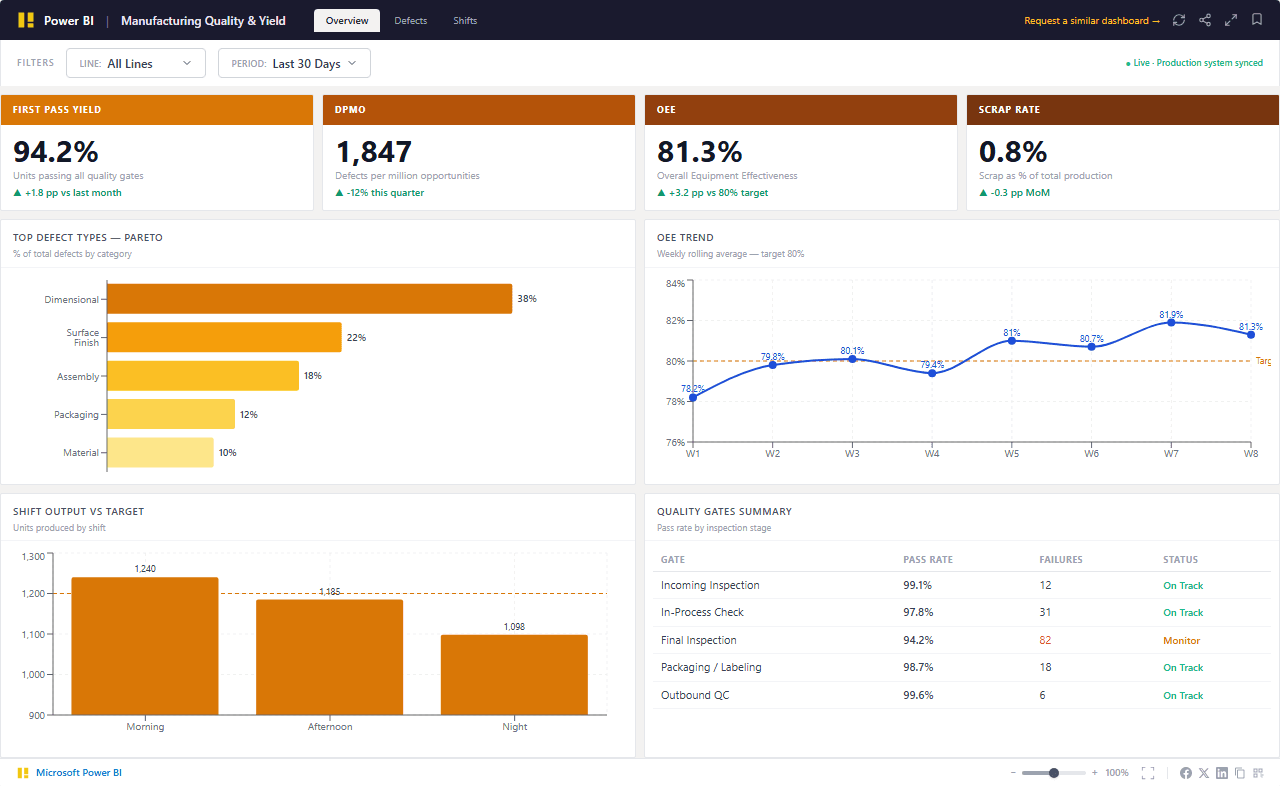
Manufacturing Quality Control Dashboard — interactive Power BI dashboard preview

Trusted by teams across 15+ countries

100+
Clients Served
300+
Dashboards Delivered
50,000+
Hours Saved
5.0★
Rating · 15 Reviews
Trusted by teams at
Audience

Who This Dashboard Is For

Ideal For

  • Charlotte-area discrete and process manufacturers — automotive parts suppliers (Daimler Trucks NA, Continental, Sensata), food processors (Dole, Smithfield), and industrial equipment makers (SPX, Honeywell Charlotte)
  • Plant managers and quality engineers who currently track FPY, DPMO, and OEE in end-of-shift Excel files or MES-native reports
  • Operations leaders at 50-500 employee manufacturing sites that have a MES (Plex, Epicor, SAP PP, Infor) but no unified quality analytics view
  • Quality teams targeting Six Sigma certification or ISO 9001 compliance who need structured DPMO tracking and defect trend documentation
  • Production supervisors who want real-time shift comparison data without waiting for the weekly operations review

Not Ideal For

  • Job shops with fewer than 20 employees and no MES system — manual data entry overhead outweighs the benefit at this scale
  • Pure services businesses — quality analytics in this form applies to physical production processes only
  • Plants where quality data is captured entirely on paper with no digital system of record — a MES or ERP with quality module is required as a data source
By the numbers

Metrics That Drive Decisions

Real impact, clearly measured. These KPIs show the tangible outcomes of data-informed strategy.

First Pass Yield

94.2%

Percentage of units that pass quality inspection on the first attempt without rework

+1.4 pp vs last quarter

DPMO

1,847

Defects Per Million Opportunities — Six Sigma quality level benchmark

Target: < 2,000

OEE

81.3%

Overall Equipment Effectiveness — product of Availability, Performance, and Quality rates

World class = 85%

Scrap Rate

0.8%

Percentage of production units scrapped — direct material cost impact

-0.2 pp vs last month

From challenge to success

From End-of-Shift Paper Reports to Real-Time Quality Visibility

How we turned fragmented data into a single source of truth—and what we achieved.

The challenge

Charlotte-area manufacturers — automotive parts suppliers, food processors, and industrial equipment makers — track quality on clipboards and end-of-shift Excel uploads. By the time the quality manager sees that Line B has a 12% defect spike on the bearing assembly, the line has been running bad parts for four hours. DPMO is calculated monthly in a spreadsheet. OEE is estimated, not measured. Defect root cause analysis takes two days because MES data, inspection records, and shift logs live in three separate systems.

  • MES systems like Plex and Epicor capture production counts and defect codes but data stays siloed — quality, production, and maintenance teams each export their own reports
  • OEE calculation requires combining machine runtime logs, production counts, and quality pass rates from different source systems — rarely done in real time
  • Defect Pareto analysis is done monthly in Excel using data manually pulled from the MES — by the time it's ready, the defect pattern may have already changed
  • Shift-to-shift performance comparison is not tracked systematically — supervisors don't know how their shift compares to others on the same line until the weekly meeting

Our approach

We connect your MES (Plex, Epicor, SAP Production Planning), quality inspection system, and shift scheduling data into a Power BI quality dashboard that refreshes every 15 minutes. Plant managers see First Pass Yield by line in real time. Quality engineers get a defect Pareto that updates as inspection records are entered. Shift supervisors see their team's output vs target compared to other shifts — no spreadsheet, no end-of-day scramble.

  • Connect MES (Plex, Epicor, or SAP PP) via ODBC or REST API for production counts, defect codes, and work order data — refresh every 15 minutes for near-real-time quality visibility
  • Build OEE calculation logic (Availability × Performance × Quality) as calculated measures in the Power BI semantic model using machine runtime and production data
  • Create a defect Pareto view grouped by defect category, production line, and shift — filterable by date range, line, and product family
  • Add shift comparison tables so supervisors see their First Pass Yield vs plant average and vs the prior shift on the same line

What we achieved

Line B defect spike identified within 20 minutes of occurrence instead of at end-of-shift — corrective action taken 3.5 hours earlier than before
Monthly DPMO calculation eliminated — quality team now reads it from the dashboard on demand with full WIP drill-down
Scrap rate reduced 0.2 percentage points in Q3 by identifying that one bearing supplier batch was responsible for 43% of all scrap events
OEE visibility across all four production lines enabled maintenance to shift preventive maintenance windows to lowest-OEE days, recovering 6% equipment uptime
End-of-shift quality report preparation time reduced from 90 minutes to 15 minutes — supervisors read the dashboard instead of building the deck
Results verifiedRead full case study

Frequently Asked Questions

Find answers to common questions about this dashboard and our process.

We support Plex Systems (via REST API or SQL connector), Epicor ERP (via BAQ or SQL), SAP Production Planning (via BW or direct SQL), Infor CloudSuite Industrial (via ION API), and Microsoft Dynamics 365 Supply Chain Management. For plants using legacy MES systems without an API, we can connect via ODBC to the MES reporting database or set up a scheduled CSV drop that feeds the Power BI model. Integration method is confirmed in the scoping call.

From Lets Viz

Ready to Transform Your Data?

Let's build something extraordinary together. Book a free consultation with our experts today.